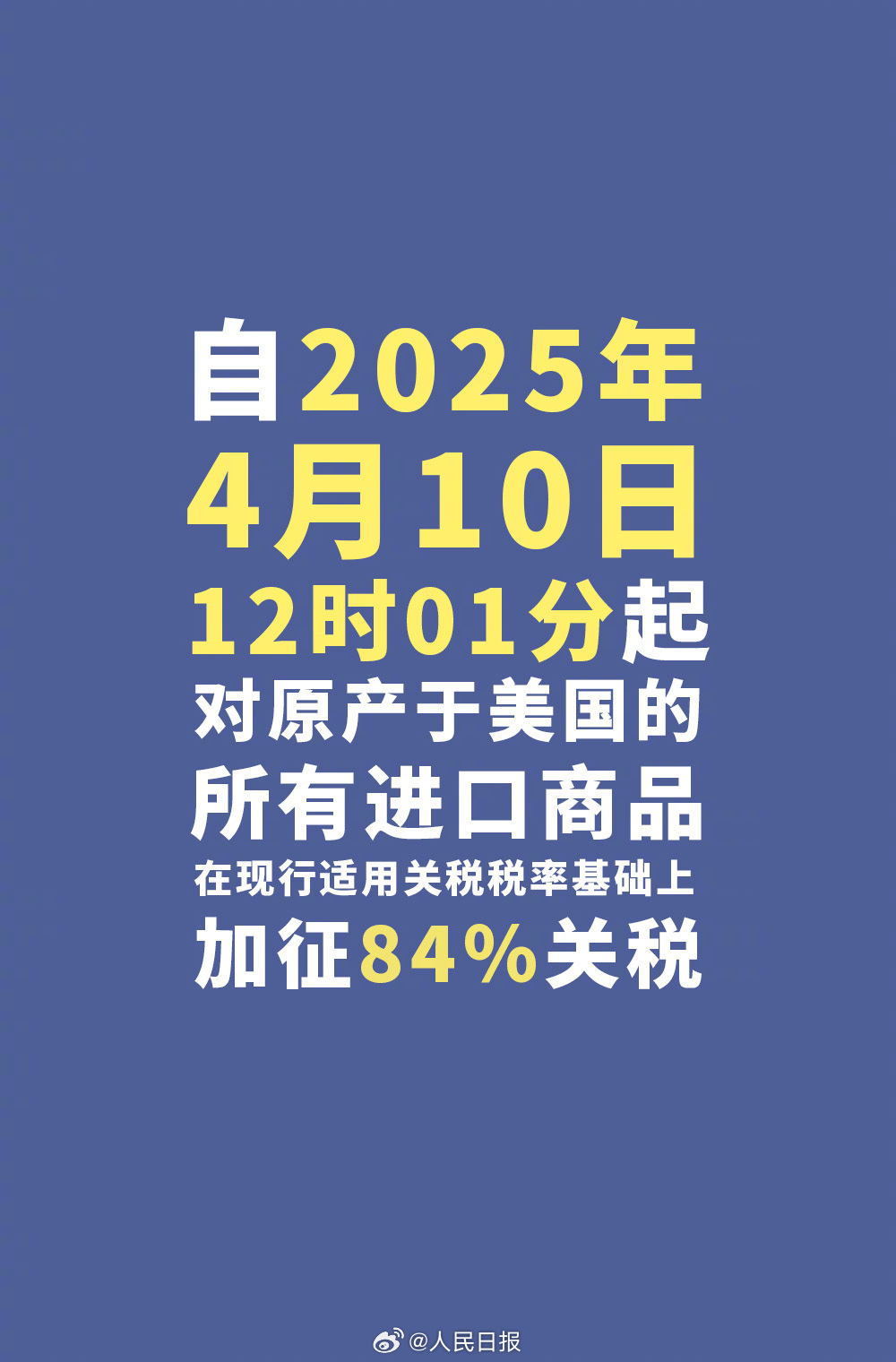
On April 8, Eastern Time, the US side increased the so-called "reciprocal tariff" of 34% previously announced on Chinese products exported to the US by another 50 percentage points to 84%. In addition to the two rounds of 10% tariffs imposed by the Trump administration on China since February 2025, the cumulative tariff rate reaches 104%.The Chinese government quickly took firm countermeasures. On April 9, the Tariff Commission of the State Council issued an announcement stating that, effective from 12:01 on April 10, it would adjust the tariff rates specified in the "Announcement of the Tariff Commission of the State Council on Imposing Additional Tariffs on Imported Goods Originating in the United States" (Tariff Commission Announcement No. 4 of 2025), raising the additional tariff rate for all imported goods originating in the United States from 34% to 84%.
(Image source: People's Daily)Last night, Trump posted again on social media, announcing that tariffs on China will be raised to 125%, while tariffs on most other countries will be suspended for 90 days.(Not officially reported)Previously, China Light Network reported that the new tariff policy is negatively affecting LED lighting manufacturers in the United States, causing many well-known US LED lighting companies to take measures such as price increases. At the same time, this policy will inevitably pose severe challenges to China's lighting Industry, including surging Export costs, risks of order transfers, and supply chain restructuring. So, what is the specific impact of tariff shocks on China's lighting enterprises? From April 7 to today, listed LED lighting companies such as MLS, Sunshine Lighting, Leyard, Inventronics, and Songsheng Shares have publicly responded on investor interaction platforms regarding "the impact of US tariff policies" and "corporate response measures", striving to find breakthroughs in the uncertain international trade environment.MLS stated that to actively respond to the impact of US tariffs, its subsidiary LEDVANCE has adopted a product price increase strategy. It was previously announced that product prices would be raised starting from May 2025; on this basis, all product prices will be increased again in June 2025, thereby reducing the impact of tariffs on the company's products. Under the current scenario where US tariff policies remain unchanged, the company will fully leverage the advantages of its Mexico factory by transferring the production of some products to Mexico.The company's factory located in Mexico officially started production at the end of the third quarter last year. Since the beginning of this year, the factory has continued to expand its Production capacity, with its products mainly supplying the US and Latin American markets. Currently, products exported from Mexico by the company comply with the relevant provisions of the US-Mexico-Canada Agreement and are exempt from reciprocal tariffs. As one of the first companies in the industry to complete this layout, the company will continue to fully leverage this first-mover advantage. Starting this year, the Mexico factory will undergo large-scale expansion to further increase the company's market share in related markets.NationStar Optoelectronics responded that the company's sales are mainly focused on the domestic market. In the first three quarters of 2024, the company's sales Revenue in the United States accounted for approximately 1.76% of total Revenue, indicating a relatively small proportion of direct sales to the US market. The company will closely monitor changes in the international trade policy environment and respond actively to ensure the stability of its business and operations.Inventronics responded that the currently imposed additional tariffs have a limited impact on the company's overall competitiveness and business. On one hand, by continuously advancing its globalization strategy and leveraging its own factories in China, India, and Mexico, as well as overseas contract manufacturing layouts in Brazil (South America), India (Asia-Pacific), and Bulgaria (Europe), it achieves flexible global production and supply chain layout, which can effectively reduce geopolitical risks.On the other hand, the company's trade with the United States accounts for less than 6% of its total Revenue, representing a small proportion. Coupled with its first-mover advantage in globalization, this helps the company maintain its industry competitiveness. Currently, U.S. tariff policies have brought significant uncertainty to the global economy, and the company will closely monitor overseas policy developments and respond actively.Sanan Optoelectronics stated that, according to the company's disclosed 2024 semi-annual report, the proportion of Revenue from countries and regions outside mainland China is 13.81%. The additional tariffs imposed by the United States have a relatively small impact on the company's existing business and supply chain. The company will closely monitor changes in international trade policies and respond actively, maintaining close communication with customers to ensure stable operations.Azure Lithium Core stated that in 2024, battery cells directly sold to the United States accounted for about 2% of the battery segment's Revenue, amounting to approximately RMB 50 million. The total Export value of the company's battery segment was about RMB 600 million, with direct Export revenue to the United States accounting for about 8% of the total Export value of the battery business.In addition, the company's Export sales basically all adopt CIF or FOB terms, with customs clearance being the customer's responsibility, so the direct impact of tariffs on the company's business is very small.The impact of comprehensive tariffs on global international trade etc. cannot be judged at presentThe so-called "reciprocal tariffs" imposed by the United States on the whole world this time have not caused differences in product competitiveness among the company's main competitors. Meanwhile, Malaysia Tianpeng is expected to start production this month, and Malaysia has a cost advantage in Export tariffs compared to domestic products. The company will closely monitor changes in tariff policies and build overseas Production capacity scale according to operational needs.Furi Electronics stated that its foreign trade entity, Fujian Furui Xing International Trade Co., Ltd., completed the equity transfer in July 2024 and is no longer included in the company's consolidated financial statements. Excluding the delisted foreign trade company, the revenue from other subsidiaries' direct exports to the US market in 2024 accounted for less than 2% of the total Revenue, while the portion indirectly exported to the US by customers cannot be statistically tracked.Meanwhile, the company will also closely monitor relevant developments, accelerate its global layout, actively expand market channels, and maintain communication with customers to actively seek various strategies to cope with challenges, striving to minimize the impact.In response to the challenge of US "tariffs",Yangzhou Lighting responded that the company has noted recent stock price fluctuations and market concerns regarding tariff policies. According to changes in the current international trade environment, the US policy of imposing additional tariffs on Chinese goods may have a certain impact on the overall cost structure of the industry. In this regard, the company has actively taken response measures, including but not limited to:1. Price adjustment mechanism:Based on cost changes, the company is gradually optimizing prices for products exported to the US to reasonably pass on part of the cost pressure;2. Supply chain optimization:Reducing policy risks in a single market through overseas bases in Thailand;3. Product Competitiveness: Continuously strengthen technological innovation and the R&D of high value-added products to enhance market bargaining power.Leyardstated that North America accounts for only about 20% of the company's smart display segment Revenue. Apart from the assembly production line of its US subsidiary, Planar, most products are manufactured at the company's factory in Slovakia and then sold to North America.Meanwhile, since the companyintensified its expansion into markets in Asia, Africa, and Latin America in 2022, its reliance on any single market has decreased significantly.Meanwhile, the cultural tourism and night tour segment business is currently 100% domestic; for the AI and spatial computing segment, its subsidiary NP Company is located in North America, owns production factories, and more than 80% of its business is produced and sold locally in North America.Overall, tariffs have a limited impact on the company as a whole, and the company'sforward-looking layout of building factories in Europe and other locationshas also made the company's relative advantages in the industry more prominent.Absenstated that the sales Revenue from products Exported to the United States in 2024 accounted for about 15% of the company's annual sales Revenue, which is expected to remain flat or decrease slightly this year. The company'soverseas markets cover more than 140 countries in Asia, Europe, North America, South America, Africa, and Oceania.Currently, LED display manufacturers are mainly located in China. Therefore, in the long term, the impact of additional U.S. tariffs on the company's overall business is limited. The company will actively monitor policy changes and take targeted measures. To mitigate issues such as compressed profit margins caused by additional U.S. tariffs, the impact can be reduced through methods such as raising product prices, optimizing production processes, and enhancing the company's own competitiveness.Uniluminprovides the following response regarding tariff policies:(1) In addition to the United States, the company has sales layouts in Europe, Asia, Africa, and Latin America. A balanced global layoutcan disperse the risks brought by policy changes in a single region.(2) The company's earlier acquisitionof the US-based LED enterpriseTrans-Lux enables localized production and distribution, helping to avoid the impact of tariffs.(3) As a leading company in China's LED industry, the company enjoys a certain brand premium. It mainly promotes mid-to-high-end products in North America, where customers have lower price sensitivity and the company has stronger cost pass-through capabilities. (4) The company further consolidates its technological advantages through technological innovation and product upgrades, increases the added value of its products, and enhances bargaining power. Yinxi Technology stated that in 2024, the proportion of the company’s direct export revenue to total Revenue was approximately 16.81%. Among this, the proportion of direct Export revenue from the United States to total Revenue was less than 3%. The additional U.S. tariffs currently have a certain impact on the company’s business, but the impact is not significant. Dongshan Precision stated that although the company’s overseas sales account for more than 80%, the proportion of revenue directly exported to the U.S. market does not exceed 5%. The company will adjust and optimize its global Export layout under the complex international trade environment, enhance risk resilience, and strengthen its core competitiveness through product and technological innovation. Minbao Optoelectronics stated that in 2024, the proportion of products directly and indirectly exported to the U.S. market accounted for only 7.3% of total revenue, and the additional U.S. tariffs have very little impact on the company’s operations. Songsheng Shares responded that currently the company’s overseas sales revenue from the U.S. region accounts for approximately 1% of its total Revenue, which is a very small proportion. In 2024, the company’s overseas sales revenue mainly came from Europe, South America, the Middle East, Asia and other regions. Huarong Shares stated that the company's exports do not include North America, and raw materials are not imported from North America.Telink Semiconductor stated that currently, sales to customers outside mainland China account for about one-third of the total, with non-US customers representing a significant proportion. Meanwhile, less than 1% of the company's chip products are directly exported to the US, resulting in minimal direct impact on performance.公司业已初步完成全球化产业布局,形成了以中国大陆供应链为主,中国台湾以及海外供应链为辅的供应链体系,后续将继续予以加强完善、动态优化。目前看美国关税政策对公司的影响有限。公司产品几乎不会有直接的关税成本上升,整体情况可控。OLED Material stated that US tariff policies currently have no direct impact on the company's business. The company's main business involves core materials and equipment upstream of the OLED industry chain. On the customer side, the company's main clients are domestic panel manufacturers; on the cost side, the company's material and equipment suppliers have basically achieved localization. In the current competitive landscape, as a domestic supplier, the company's product prices are unaffected by tariffs, highlighting a cost-performance advantage over imported products. Meanwhile, as a domestic enterprise, it can ensure stable supply.Overall, most companies have a small proportion of export revenue to the US, so they generally indicate that the so-called "reciprocal tariffs" imposed by the US have a relatively limited impact on their business.
In addition, many companies are either expanding into diverse global markets and accelerating the construction of overseas bases through "addition" strategies to reduce reliance on a single market; or flexibly responding to the impact of US "reciprocal tariffs" through price adjustments and cost pass-throughs; or breaking through blockades by achieving technological breakthroughs and developing high value-added products. From adjusting pricing strategies to optimizing global production capacity layout, from technological upgrades to business model innovation, listed companies are alleviating the impact of tariffs with systematic response plans, striving to capture and amplify certainty amidst uncertainties. As for the current situation of LED lighting companies with a high proportion of export revenue to the US in their overall revenue, no public response has been seen yet. Regarding imports, with the implementation of China's strong countermeasures, additional tariffs will sharply reduce the price competitiveness of US goods at the terminal level, and the demand for US imported goods in China will also undergo restructuring. The industry generally expects that the localization of domestic products is expected to accelerate. In short, there are no winners in this trade war, but the resilience of Chinese manufacturing will eventually weather the storm and illuminate the world. Meanwhile, Chinese lighting companies are using global layout as a shield and technological innovation as a spear, accelerating their transformation from "King of OEM" to "Master of Technology" , seeking opportunities in challenges and building long-term competitiveness.
