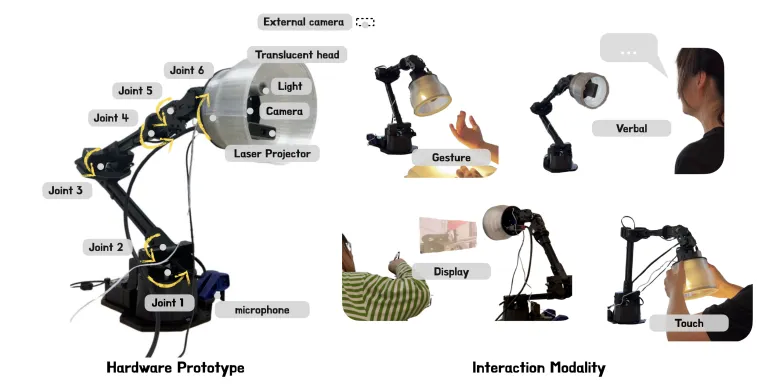
▲Composition and Interaction Forms of the Desk Lamp Robot
For example, when a user plays music, it will dance along with the notes.
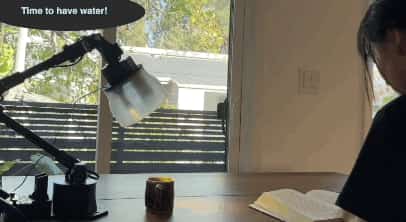
The innovation of this lamp goes beyond entertainment. In research, the team demonstrated its intelligent performance in completing daily tasks. For instance, when a researcher is busy working and needs water, the lamp pushes the glass toward them.
At the same time, when a user asks about the weather, the lamp first "looks" out the window before giving an answer; if told they cannot go hiking together, it also pretends to look sad by lowering its head. This design significantly enhances user engagement and likability, especially doubling the effect in social tasks.
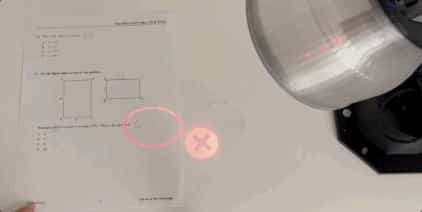
It is worth noting that this lamp can also provide users with learning assistance. When researchers perform complex assembly operations, the lamp not only adjusts the lighting direction but can also display relevant installation videos via projection, and even grade math homework and show problem-solving approaches.
It is reported that the paper proposes a framework named "ELEGNT", specifically designed for non-humanoid robots in daily interactions to create actions that are both practical and expressive. The "ELEGNT" framework combines two design approaches: ● First, function-driven, focusing on enabling robots to complete tasks via optimal paths (e.g., moving to a specific location); ● Second, expression-driven, allowing robots to convey their "inner state" through actions, such as intent, attention, attitude, or emotion, thereby making interactions more natural. The Apple research team points out that traditional robots overemphasize efficiency, while this lamp uses "emotional resonance" and "intent visualization" to allow users to perceive the machine's "inner state". For example, in experiments, when users incorrectly command it to read inaccessible information, it will "shake its head in apology" after multiple attempts, whereas a functional robot would simply coldly declare failure. This expressive AI companion lamp demonstrates Apple's new approach to smart home product design, indicating its hope to attract consumers by enhancing interaction between devices and humans, marking a shift where smart home products not only achieve basic functions but also need to reform in emotional expression and user experience. For consumers, future smart homes will be more than tools; they will be companions and assistants. This transformation provides new ideas for the entire industry, suggesting that future smart devices will move towards a more humanized and emotional direction, adding more convenience and joy to people's lives. With the rapid development of the smart home market, Apple's new product undoubtedly enhances its competitiveness in this field. Market analysts point out that Apple's strong brand influence and product innovation capabilities will effectively drive growth in its market share within the smart home sector. Such developments may also prompt other technology companies to accelerate innovation in smart home products to keep up with consumers' evolving needs and expectations. It has been revealed that this desk lamp is still in the research phase, but the potential it demonstrates is already enough to generate excitement—the future home may have an "emotionally intelligent" butler hiding in every corner.