
Authoritative! Q&A on 52 Mandatory Supporting National Standards in the Lighting Field
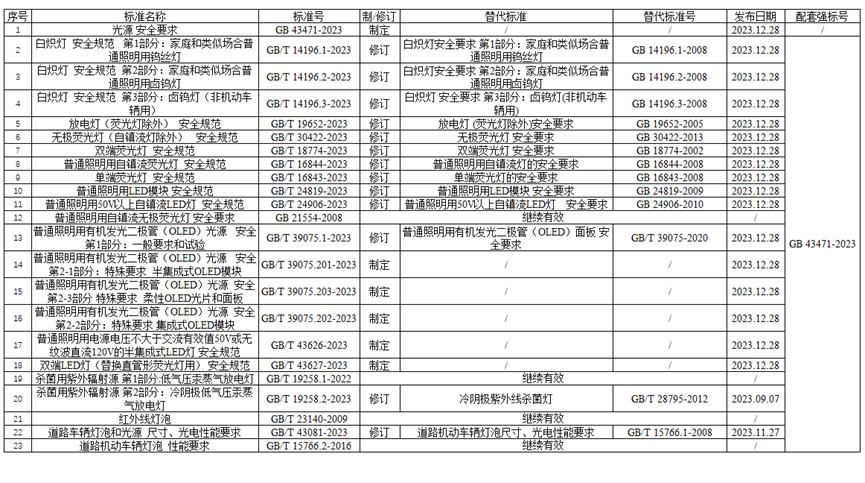
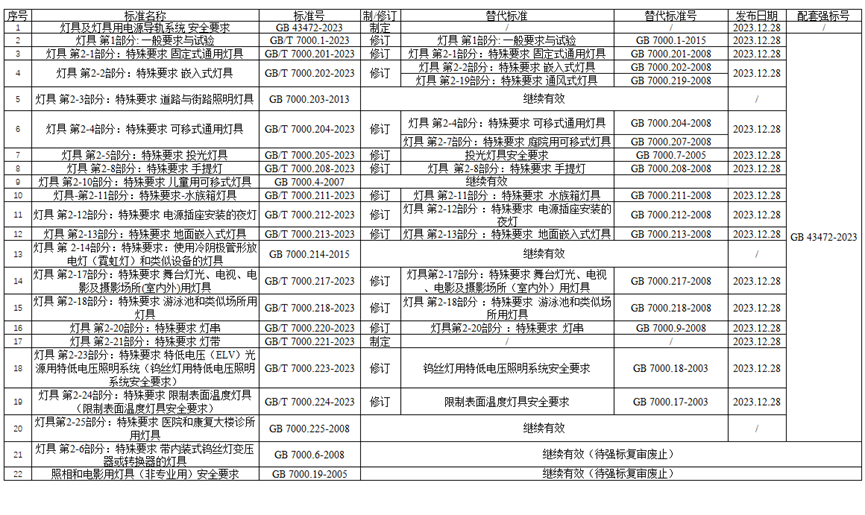
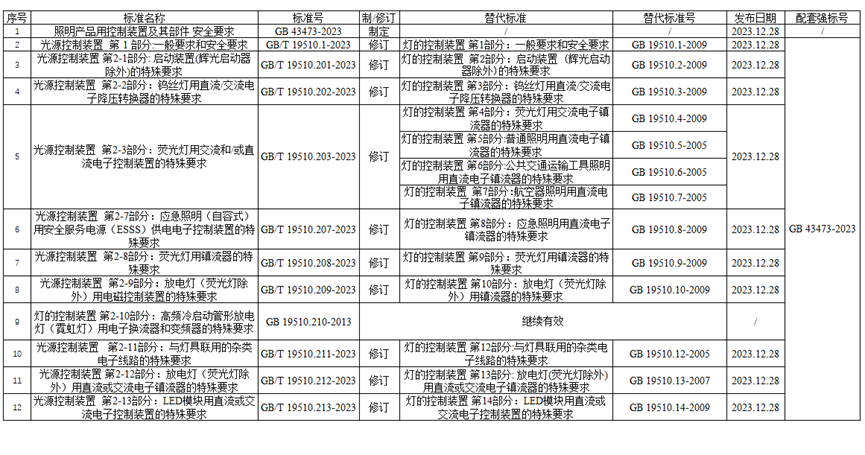
On January 24, 2024, Beijing Electric Light Source Research Institute Co., Ltd., as the secretariat unit of SAC/TC 224, organized an online Q&A session with experts to address questions regarding the transition of the mandatory supporting standard system and standard application for the 52 National standard (mandatory / recommended) under the jurisdiction of SAC/TC 224 (see table below). The meeting invited Wang Zhuo, Secretary-General of China Association of Lighting Industry(中国照明电器协会); Chen Song, Deputy Manager of the New Energy Product Certification Department at China Quality Certification Center; Li Yanjie, Technical Supervisor of the Quality Department at National Electric Light Source Quality Supervision and Inspection Center (Beijing); Zhang Wei, Secretary-General of SAC/TC 224 and Secretary-General of the Subcommittee on Electric Light Sources and Their Accessories; and Yang Yue, Secretary-General of the Luminaire Subcommittee, who provided answers to the following related questions.
Appendix1 Overall Pattern of Mandatory Supporting Standards for Electric light source
Appendix2 Overall Pattern of Mandatory Supporting Standards for Luminaire
Appendix3 Overall Landscape of Mandatory Supporting Standards for Control Devices
Appendix4 List of Non-Mandatory Supporting Standards
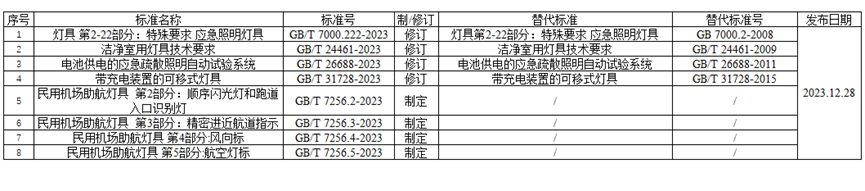
Appendix5 List of Other Lighting-Related Standards Under Relevant Jurisdiction
Transition Period Related
Q
The implementation date for the 15 recommended National standards for Luminaires is July 1, 2024. Why is this different from the implementation date of January 1, 2026, for the 3 mandatory standards and other recommended National standards released at the same time? During the period from July 1, 2024, to January 1, 2026, are there no mandatory standards for Luminaires?
Answer
Among the 15 recommended National standards for Luminaires, 14 are revised recommended National standards that replace the GB 7000 series standards; their implementation date has been adjusted to January 1, 2026, aligning with the 3 mandatory standards and other recommended National standards released simultaneously. The remaining standard, GB/T 7000.221-2023 "Luminaires - Part 2-21: Particular requirements - Light strips", is a newly formulated recommended National standard, and its implementation date remains July 1, 2024.
Question
Why is the implementation date of GB/T 7000.221-2023 still July 1, 2027? Before January 1, 2026, is it not considered a mandatory standard?
Answer
This standard is a newly formulated recommended standard. Before January 1, 2026 (prior to the implementation date of GB 43472-2023 "Safety requirements for luminaires and power track systems for luminaires"), it is used as a recommended national standard and does not belong to mandatory standards; from January 1, 2026 onwards (starting from the implementation date of GB 43472-2023 "Safety requirements for luminaires and power track systems for luminaires"), it will be implemented as a mandatory requirement in conjunction with GB 43472-2023.
Standard coordination and compatibility
Question
Does changing a mandatory standard to a recommended standard mean that corporate control is weakened?
Answer
In this revision of standards in the lighting field, while mandatory standards are being converted to recommended standards, three new mandatory National standard (mandatory / recommended) are simultaneously released: GB 43471-2023 "Lamps - Safety requirements", GB 43472-2023 "Luminaires and power track systems for luminaires - Safety requirements", and GB 43473-2023 "Controlgear for lighting products and their components - Safety requirements". The standards converted to recommended status serve as supporting standards for these three newly published mandatory national standards. Therefore, the relevant requirements of the recommended standards have indirectly become mandatory requirements. It should not be simply understood that "converting mandatory standards to recommended standards means weakened enterprise control".
Correspondence between domestic and international standards
Question
GB/T 13961-2008 is identical to IEC 60570-2003, but International Electrotechnical Commission has been updated to IEC 60570:2003+AMD1:2017+AMD2:2019. Does the Standards Committee have any plans for further revision?
Answer
GB/T 13961-2008 is the current recommended National standard (mandatory / recommended), under the jurisdiction of SAC/TC 224, with specific implementation by the Luminaire Subcommittee. This recommended National standard (mandatory / recommended) was not revised concurrently with this batch of lighting standards updates. Currently, this standard has been included in the standard revision plan of the Luminaire Subcommittee of SAC/TC 224.
Question
Given that newly released product-specific safety standards and general safety standards, such as GB/T 7000.202-2023 and GB/T 7000.1-2023, reference each other and are no longer related to the corresponding IEC standards, if IEC 60598.1 is updated in the future but the corresponding GB/T 7000.1 is not updated, it will cause discrepancies between products within the scope of GB/T 7000.202 and IEC. Does the Standards Committee have any Solution?
Answer
The time lag between adopted standards and their corresponding international standards is inevitable. It is a common, realistic, and necessary status quo for national standards involving adoption across various fields. The National Technical Committee on Standardization of Lighting Appliances, in coordination with its subordinate subcommittees, closely monitors developments in international standards. In alignment with the development and revision processes of relevant international standards, it promptly coordinates domestic standardization activities. By comprehensively considering methods such as standard revisions and amendments, it aims to minimize technical discrepancies caused by time differences between adopted standards and international standards.
Standard Implementation and Application
Question
After the implementation of the major mandatory standard on January 1, 2026, how should existing inventory products designed and manufactured according to the old standard be handled? Must all inventory comply with the new standard?
Answer
In September 2023, an entity raised a similar question on the same topic through the public message board of the State Administration for Market Regulation. The Standard Technology Management Bureau of the State Administration for Market Regulation also responded to this public message. The specific details are as follows.
Question from the State Administration for Market Regulation public message board: Dear leaders of the Administration, I would like to consult on an issue. After the mandatory national standard (GB) for a product is updated, for example, if it officially comes into effect on July 1st, can products manufactured before July 1st continue to be sold in the market until their expiration date? Please provide an answer.
Response from the Standard Technology Management Bureau of the State Administration for Market Regulation: According to Article 25 of the Standardization Law of the People's Republic of China, products and services that do not comply with mandatory standards shall not be produced, sold, imported, or provided. It should be pointed out that the mandatory standards mentioned here refer to currently effective standards. The Measures for the Administration of Mandatory National Standards stipulate that after a new mandatory standard is implemented, the original mandatory national standard (GB) is simultaneously abolished. A certain implementation transition period is given for newly released mandatory standards. The reason for setting a transition period is not only to provide time for enterprises to carry out technical transformation and smoothly transition production or provide products or services that meet the new standards, but also to leave time for digesting products already on the market (IPO / Go public). Therefore, after the implementation of mandatory standards, except for products that do not meet the requirements of the new standards as specially provided in the standard content, they can no longer be sold.
Question
With this large-scale update of national standards (GB), if enterprise standards reference them, do the enterprise standards need to be updated immediately? Or abolished?
Answer
According to Article 27 of the Standardization Law of the People's Republic of China, enterprises shall disclose the numbers and names of the mandatory standards, recommended standards, group standards, or enterprise standards they implement. Meanwhile, Article 7 of the Measures for the Administration of Enterprise Standardization stipulates that enterprise standards shall strictly implement mandatory national standards, industry standards, and local standards. Therefore, during the transition period, enterprises may choose whether to update their enterprise standards based on actual conditions; after the mandatory national standard is officially implemented, enterprise standards shall strictly implement the new version of the mandatory national standard. In addition, in accordance with Article 6 of the Measures for the Administration of Enterprise Standardization, enterprise standards may propose stricter requirements on the basis of strict implementation of mandatory national standards; alternatively, enterprises may choose not to formulate separate enterprise standards while implementing the corresponding national standards.
Product Labeling
Question
After the release of the major mandatory standard, how should the applicable standard for products be labeled? Should it indicate the major mandatory standard? The supporting recommended standard? Or both the major mandatory standard and the supporting recommended standard?
Answer
According to Article 18 of the "Measures for the Standardization Management of Enterprises", enterprises that implement National standard (mandatory / recommended), industry standards, local standards, or enterprise product standards in production shall mark the code, number, and name of the implemented standard on the product, its instruction manual, or packaging. During the transition period for the revision of lighting standards before January 1, 2026, enterprise products may choose to implement and label either the original National standard (mandatory / recommended) or the new National standard (mandatory / recommended). Starting from January 1, 2026, the major mandatory standards (GB 43471-2023, GB 43472-2023, and GB 43473-2023) will be officially implemented. The implementation standards for products shall be the corresponding major mandatory standards and their supporting recommended National standard (mandatory / recommended) for the respective products. Therefore, the product implementation standards should be labeled with the major mandatory standards and the supporting recommended standards.
Question
Starting from January 1, 2026, for products still circulating in the market that are not within the CCC scope, which inherently meet the requirements of the new version of safety standards, but whose packaging still labels "Implementation Standard: GB 7000.202-2008", is this allowed?
Answer
The product scope of GB 7000.202-2008 covers recessed luminaires, which fall within the CCC certification scope. Even for products outside the CCC scope, starting from January 1, 2026, the new mandatory standard (GB 43472-2023) and its supporting recommended standards will be officially implemented. In accordance with Article 25 of the Standardization Law of the People's Republic of China, Article 39 of the Measures for the Administration of Mandatory National Standards, and Article 18 of the Measures for the Administration of Enterprise Standardization, it is not permitted to label products with abolished mandatory national standards.
Question
If the product itself already meets the requirements of the new version of the standard, but the product labeling still indicates the old version of the standard, and the product is already circulating in the market, can such products continue to be used after the implementation of the new version of the standard?
Answer
In accordance with Article 39 of the Measures for the Administration of Mandatory National Standards, after the new mandatory national standard is implemented, the original mandatory national standard is simultaneously abolished. Meanwhile, in accordance with Article 18 of the Measures for the Administration of Enterprise Standardization, enterprises producing and implementing national standards, industry standards, local standards, or enterprise product standards shall mark the code, number, and name of the implemented standard on the product, its manual, or packaging. Therefore, after the implementation of the new version of the standard, not only must the product itself meet the requirements of the new standard, but the product labeling must also correspondingly indicate the new implemented standard.
Q
The current products already meet the new version of the standard. Is it permissible to label them with the new version of the standard during the transition period?
A
During the transition period for the implementation of the standard, enterprises may choose to implement and label either the original standard or the new version of the standard. If the product falls within the scope of CCC certification and involves issues regarding the version of the standards associated with the CCC certificate, it is recommended that enterprises maintain consistency between the renewal of the CCC certificate and the labeling of the product execution standard.
Scope of Standards and Technical Issues
Question
Some lighting products currently lack corresponding GB/T standards, such as retrofit TLEDs, PLL fluorescent lamps, self-ballasted LED lamps over 60W, projector lamps, HID stage/entertainment lamps, and high-power mercury vapor germicidal lamps. Do the major mandatory standards apply to these products? How is compliance with relevant technical requirements determined? How should the implemented standards be marked?
Answer
The three major mandatory lighting standards, including GB 43471-2023 "Light sources - Safety requirements", are intended to be used together with their supporting recommended standards and should not be used alone. For products not yet covered by the supporting recommended standards, the major mandatory standards are temporarily not applied. If there are products that should be covered but are not yet included in the scope of supporting recommended standards, please contact the Secretariat of SAC/TC 224 to submit a standard project proposal. If the Committee assesses it suitable for inclusion in the national standard development or revision scope, it will initiate the corresponding standard development or revision procedure. Before any applicable national standard is available, enterprises may formulate their own enterprise product standards in accordance with Articles 6 and 18 of the "Measures for the Administration of Enterprise Standardization", and mark the code, number and name of the implemented standard on the product, its instruction manual or packaging.
Question
What are the specific differences between the old and new standards for control devices? Is it necessary to resubmit samples for difference testing?
Answer
Regarding control devices and luminaires within the scope of CCC, the Secretariats of the Electric Light Source and Its Accessories Subcommittee and the Luminaire Subcommittee under SAC/TC 224 are cooperating with the requirements of the Mandatory Product Certification TC05 Technical Expert Group to prepare information on standard differences and analyze the need for difference testing. Regarding the full series of standard differences for light sources, control devices, and luminaires, in conjunction with this revision of lighting standards, the Secretariat units of SAC/TC 224 and its subordinate Electric Light Source and Its Accessories Subcommittee and Luminaire Subcommittee are planning systematic standard promotion. It is recommended that relevant entities continue to monitor the subsequent work of the Mandatory Product Certification TC05 Technical Expert Group and SAC/TC 224.
Laboratory Accreditation
Question
The three mandatory standards GB 43471, GB 43472, and GB 43473 have been added to the laboratory's CNAS accreditation. Is it sufficient to provide verification records for Appendix A of these three mandatory standards, without needing to submit new method re-verification records? This is because these three mandatory standards do not involve their own test methods.
Answer
This issue falls under the scope of CNAS laboratory accreditation. It is recommended to consult the official opinion of CNAS. To provide experience and reference suggestions for enterprises, laboratories, and other relevant parties, the Secretariat of SAC/TC 224, in conjunction with the National Electric Light Source Quality Supervision and Inspection Center (Beijing), solicited opinions from some CNAS assessment reviewers and project supervisors in the lighting field. The suggestion is to include the three mandatory standards and the corresponding recommended National standard (mandatory / recommended) for related products as method standards within the scope of laboratory capability accreditation, and to provide corresponding evidence of testing capability verification and related explanations.
China Compulsory Certification
Question
Will the "CQC-C1001-2014 Implementation Rules for Compulsory Product Certification - Lighting Appliances" be revised? After revision, will the standards for safety certification be the GB/T 7000 series and GB/T 19510 series, or GB 43472 and GB 43473, or both?
Answer
CQC will revise the CQC-C1001-2014 "Implementation Rules for Compulsory Product Certification - Lighting Appliances" in a timely manner based on the differences between the old and new standards. Relevant notices will be published on the website (www.cqc.com.cn). Currently, the safety item testing for compulsory product certification of lighting appliances is based on the corresponding National standard (mandatory / recommended) requirements in the GB 7000 series and GB 19510 series. The new version of the standards has been updated to the GB/T 7000 series and GB/T 19510 series. Regarding whether the compulsory product certification for lighting appliances will add references to GB 43472 and GB 43473, the TC05 Technical Expert Group for Compulsory Product Certification has submitted this to the Certification and Accreditation Administration of the People's Republic of China (CNCA). The relevant departments will fully consider the applicability of laws, regulations, and the above two major mandatory standards, and carry out Certification work in a reasonable, compliant manner that minimizes the burden on enterprises.
Question
With the current update of standards in the lighting field, will the corresponding CCC Certification catalog also change?
Answer
From the current perspective, the new version of the standard will not affect lighting electrical products (luminaires and ballasts) in the compulsory product certification catalog. After the new version of the standard is officially published, the TC05 technical expert group for compulsory product certification will make a final judgment based on the differences between the old and new standards.
Question
When is it expected that control devices and luminaire products can be certified using the new standard? If control devices are not certified according to the latest standard, will it affect the certification of luminaire products according to the latest standard?
Answer
The Technical Expert Group TC05 for Compulsory Product Certification has organized the secretariats of SAC/TC224/SC1 and SAC/TC224/SC2 to compile the "Supplementary Test Requirements for Major Differences in the New National Standards for Luminaires and Light Source Control Devices". It is planned to complete all technical preparations before the certification of the new standards in the first half of 2024. To provide certification and testing services for the new standards to enterprises as early as possible, laboratories should complete their capability building and qualification acquisition in accordance with the new standards as soon as possible, and report to the certification bodies in a timely manner. For enterprises planning to obtain certification certificates under the new standards, it is recommended to communicate with testing agencies in advance to understand the testing capabilities of the laboratories.
The implementation date of the new version of the GB/T 7000 series National standard (mandatory / recommended) for Luminaires, which serves as the basis for Compulsory Product Certification, has been adjusted to January 1, 2026, consistent with the implementation date of the new standard for light source control devices. It is recommended that enterprises consider this holistically before applying for Certification to avoid increasing the cost of certificate replacement due to their own reasons.
Q
Since CCC is a compulsory Certification, does the adoption of the recommended standard GB/T 7000.1-2023 mean that this standard is also mandatory?
A
If a recommended National standard is adopted for China Compulsory Certification, the relevant content of the recommended National standard adopted in CCC certification is treated as a mandatory requirement.
Question
Due to differences between the old and new versions of the standards, if a product meets the requirements of the new version during the transition period and has obtained CCC certification according to the new version, will it be deemed non-compliant if tested against the old version during spot checks?
Answer
According to Article 39 of the Measures for the Administration of Mandatory National Standards, enterprises may choose to implement either the original or the new mandatory National standard after its publication but before its implementation. Therefore, during the transition period, product quality supervision shall, in principle, be conducted in accordance with the standard chosen by the enterprise.
Others
Question
When will the standard text be available? The download availability date for the standard should be clearly announced to facilitate industry research.
Answer
The publisher is currently processing and publishing the standards in stages. Inventory checks are being conducted this week, and further confirmation will be possible only after the publisher completes the inventory. It is recommended to closely monitor information releases from the secretariat unit of SAC/TC 224 to obtain printed publication information as soon as it becomes available.