
Research Notes | The Path to Developing Luminescent Plants
The following article is sourced from Mol Plant Plant Science , authors Ge Jieyu and Du Hao
In the Pandora planet and stunning seascape showcased in the sci-fi movie Avatar, we can admire the dazzling beauty of bioluminescent plants such as War Feather Fern, Jellyfish Grass, and Hairy-leaf Bulrush, revealing nocturnal wonders and underwater secrets. Scientists are striving to turn science fiction into reality, achieving a perfect fusion of natural science and art, creating a more harmonious and beautiful living environment for humanity.
In nature, there are luminous jellyfish, bacteria, mushrooms, and fireflies. Unfortunately, plants that provide humans with food, clothing, shelter, transportation, and spiritual comfort cannot light up the darkness of night for us. When night falls, people usually dress plants in LED "light coats" or illuminate them with high beams to create an aesthetic effect, but this consumes a large amount of electricity. According to statistics, lighting accounts for approximately 25% of all electricity consumption. In the current situation of extreme energy scarcity and increasingly serious environmental pollution, reducing electricity use for lighting is an important way to promote energy saving and emission reduction. With the rapid development of biotechnology, creating glowing plants is gradually becoming possible, which can not only bring aesthetic enjoyment to humans but also save energy and promote green, low-carbon development.
To this end, scientists embarked on a forty-year exploration. In 1986, researchers at the University of California, San Diego published in science, demonstrating that by expressing the firefly luciferase coding gene in tobacco plants and adding an exogenous substrate, the tobacco plants could emit extremely faint light (Figure 1). Due to the very weak light output and the need for expensive substrates to produce luminescence, this lighting system is currently mainly used in basic research.
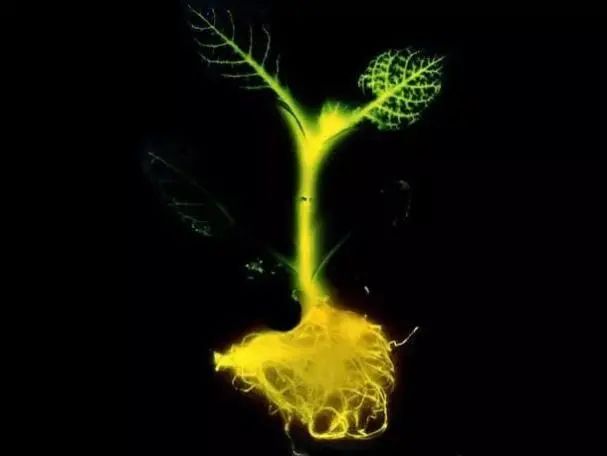
Figure 1
In 2017, scientists from the Massachusetts Institute of Technology (MIT) in the United States published a research paper in Nano Letters, introducing nano-loading technology to deliver components of the firefly luciferase system into plants. The plants injected with luciferase could emit a faint glow for up to 4 hours, even illuminating text on a book page (Figure 2) . However, this luminescent system also requires exogenous substrates and nanoparticles, and the light emission is not sustainable, limiting the application of this method.
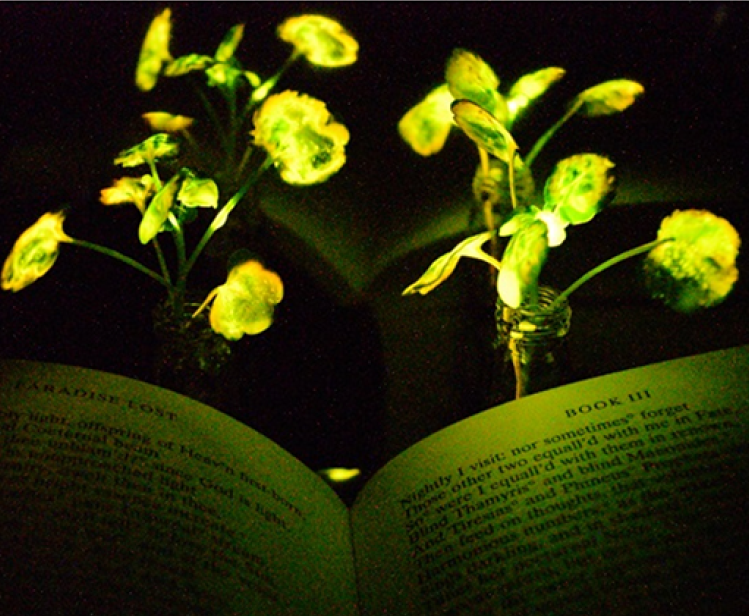
Figure 2
There are also some bioluminescent mushrooms in the forest, mainly distributed in tropical and subtropical areas with relatively dim light. The most well-known is Mycena chlorophosMycena chlorophos (Figure 3), also known as fluorescent mushroom or night-light mushroom. Legend has it that ancient Greeks used fluorescent mushrooms as night lights, but their lifespan is usually only three days. If moved to a dark place during the day, they do not glow; they emit a faint green light only at dusk, indicating that their luminescence is periodic.
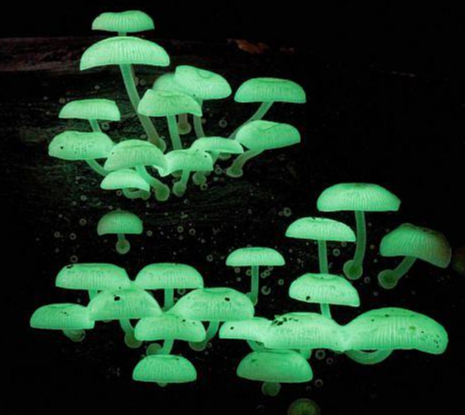
Figure 3
In 2018, scientists from Russia, together with researchers from the United Kingdom, Spain, Brazil, Japan, and Austria, comprehensively described the mechanism of fungal bioluminescence in the Proceedings of the National Academy of Sciences. They discovered that fungi utilize only four key enzymes to convert caffeic acid into luciferin, thereby achieving luminescence, and that transferring these enzymes into other organisms also enables them to emit light. In 2020, the team published a paper in Nature Biotechnology, where they introduced the coding genes corresponding to these four enzymes into the tobacco genome, successfully creating glowing tobacco. Since the luminescent substrate for this system is caffeic acid, an endogenous plant metabolite, it can continuously emit light visible to the naked eye (Figure 4) , with the brightest flowers producing 6.47×10¹⁰ photons/min/cm2. In March of the same year, the University of Minnesota in the United States published an article titled "Building customizable auto-luminescent luciferase-based reporters in plants" in eLife. This study demonstrated transient expression of the fungal luminescence system in different species, validating the hypothesis of spontaneous luminescence within a certain range and indicating broad application prospects for this system in plants. However, the luminous intensity of these studies remains relatively low, severely limiting the application of this luminescence system.
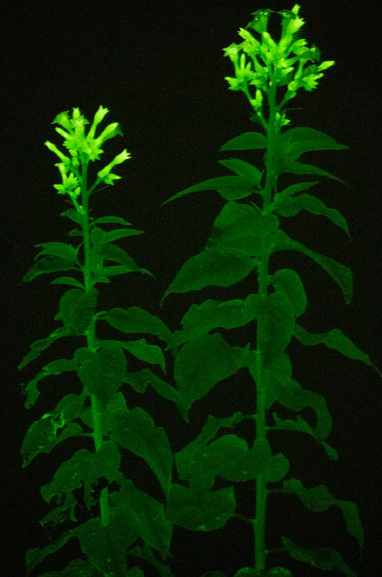
Figure 4
On May 8, 2023, the research team led by Researcher Du Hao from the College of Agriculture and Biotechnology at Zhejiang University published a research paper titled "Metabolic engineering and mechanical investigation of enhanced plant autoluminescence" online in the internationally renowned journal Plant Biotechnology Journal. The study showcased the latest achievements in the field of luminescent plants, successfully creating self-luminescent plants with significantly enhanced glow (Figure 5). The luminous intensity reached 3×10¹² photons/min/cm2, and the paper provided a detailed explanation of the biological characteristics and luminescence mechanisms of these plants.
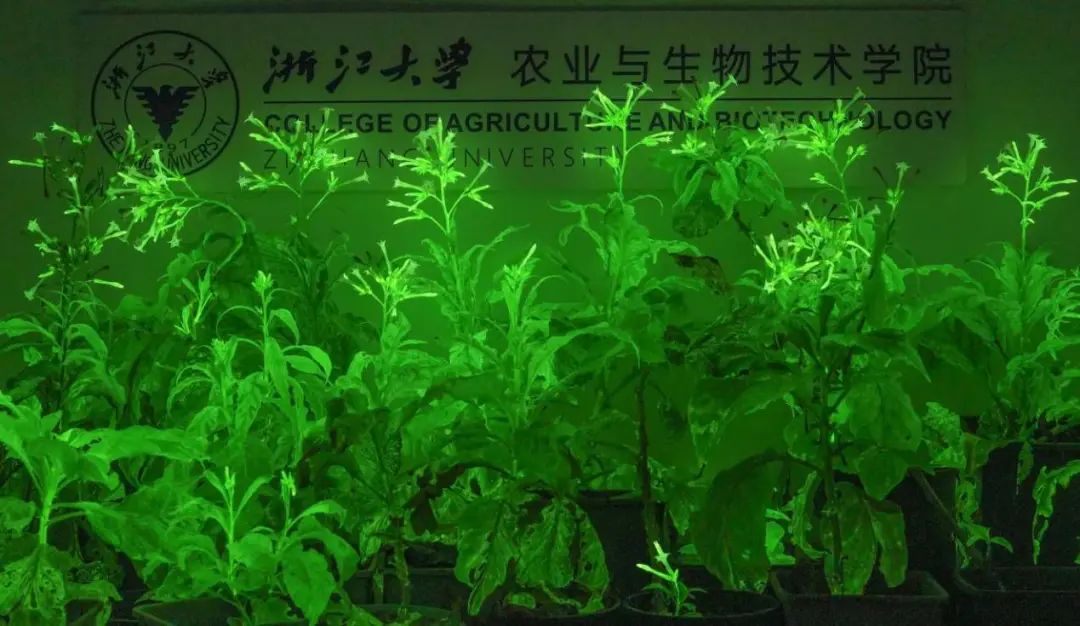
Figure 5
Researchers found that the content of luminescent substrates such as caffeic acid (Caffeic acid) and hispidin (Hispidin) is a limiting factor for enhanced plant bioluminescence. The research team screened and identified genes that promote the synthesis of endogenous luminescent substrates in plants. They introduced the BnC3’H1 gene from Brassica napus and the AnNPGA gene from Aspergillus nidulans into the fungal luminescence system, successfully creating plants with significantly enhanced luminescence. LC-MS/MS data indicated that the introduction of these two genes was key to increasing luminescent substrates and thereby enhancing luminescence.
Considering that luminescent plants have a wide range of potential applications, from basic biological research to landscape decoration, the team studied the impact of plant growth environments on luminescent systems. Luminous intensity responds differently to various abiotic stresses, and its response pattern reflects changes in the expression levels of key genes in the biosynthetic pathway of endogenous luminescent substrates within plants. Through a series of treatment experiments, the research team discovered that the initial energy for plant luminescence comes from sugars (Figure 6) . Furthermore, as photoautotrophic organisms, plants have unique advantages over animals and microorganisms; they can produce all substrates and cofactors required for the operation of the luminescent system, including coenzyme A, malonyl-CoA, NADPH, ATP, protons, and oxygen (Figure 6) , through photosynthesis and respiration.
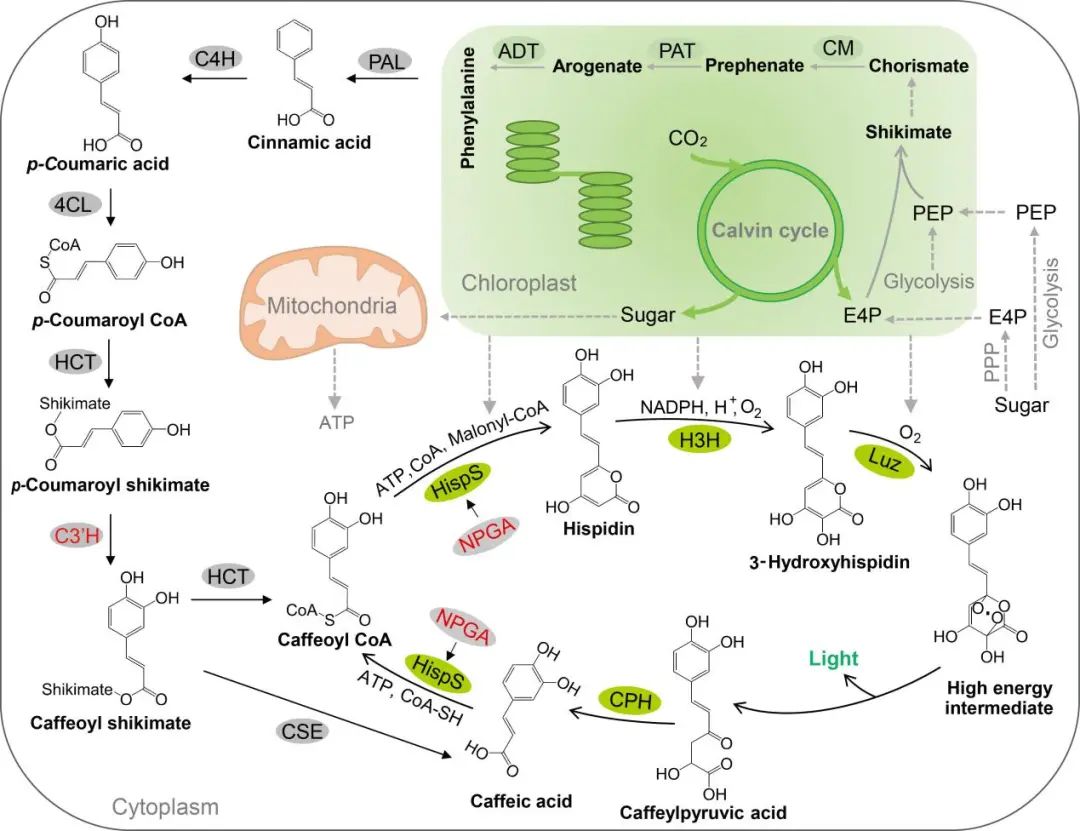
Figure 6
The authors also tested this luminescent system in other ornamental plants, further confirming the broad applicability of the fungal bioluminescence system in herbaceous and perennial woody plants. They selected poplar, a common street tree in China, for genetic transformation, and successfully created luminescent poplar trees through phenotypic and molecular analyses. Researchers from Dr. Du Hao's team introduced that this luminescent system has wide applications and can be developed into a tool for detecting basic biological macromolecules in animals and plants in the future. It will enable detection without relying on expensive large-scale instruments, allowing visual observation or the use of consumer-grade cameras to achieve detection goals. Moreover, the luminescence process of this system does not require the addition of exogenous substrates, making it suitable for high-throughput in vivo detection with low cost and high convenience. In addition, this system can be used as a biosensor for crop detection, offering extensive applications in the fields of healthy agriculture and smart agriculture. It is reported that the research team is continuing to develop methods to increase the luminance of luminescent plants and to create tools for biological research. More surprises will be brought to everyone soon.
In the near future, new models of bioenergy utilization will emerge in our lives, namely a novel bioenergy conversion and utilization model composed of luminescent plants—during the day, they can convert solar energy into organic matter through photosynthesis and fix CO2 from the air; at night, they release light energy through catabolism for low-luminance lighting. This helps save electricity, reduce carbon emissions, provides new strategies for achieving the "dual carbon" goals, and allows us to experience the wonderful diversity and awe-inspiring beauty of life in the real-world "Avatar".
Zheng Peng, a postdoctoral fellow at the College of Agriculture and Biotechnology, Zhejiang University, and the Hangzhou International Innovation Center, Zhejiang University, and Ge Jieyu, a master's student at the College of Agriculture and Biotechnology, Zhejiang University, are co-first authors of this article. Researcher Du Hao from the College of Agriculture and Biotechnology, Zhejiang University, and the Hangzhou International Innovation Center, Zhejiang University, is the corresponding author. Researcher Wu Jianping from Westlake University, Professor Lu Mengzhu from Zhejiang A&F University, Dr. Ma Siqi from the Qingdao Tobacco Research Institute of the Chinese Academy of Agricultural Sciences, and Researchers Fan Pengxiang and Pan Ronghui from the College of Agriculture and Biotechnology, Zhejiang University, provided significant assistance to this study. Professor Jen Sheen from Harvard University offered valuable suggestions for the manuscript preparation. The backbone vectors used in this study were sourced from the team of Academician Liu Yaoguang and Researcher Zhu Qinlong at South China Agricultural University. This research was supported by the Key R&D Program of Zhejiang Province (2020C02002), the Natural Science Foundation of Zhejiang Province (Y21C020015 and LQ22C020002), the International Cooperation Program of Zhejiang University, and the Fundamental Research Funds for the Central Universities (K20200168).
The original link is as follows:
https://onlinelibrary.wiley.com/doi/10.1111/pbi.14068
References
Ow, D.W. et al. Transient and stable expression of the firefly luciferase gene in plant cells and transgenic plants. Science, 1986. 234, 856–859
Kwak, S.Y., Giraldo, J.P., Wong, M.H., et al. A nanobionic light-emitting plant. Nano Lett. 2017,17, 7951–7961.
Kotlobay AA, Sarkisyan KS, Mokrushina YA, et al. Genetically encodable bioluminescent system from fungi. Proc Natl Acad Sci USA. 2018 Dec 11;115(50):12728-12732.
Mitiouchkina T, Mishin AS, Somermeyer LG, et al. Plants with genetically encoded autoluminescence. Nat Biotechnol. 2020 Aug;38(8):944-946.
Khakhar A, Starker CG, Chamness JC, et al. Building customizable auto-luminescent luciferase-based reporters in plants. Elife. 2020 Mar 25;9:e52786.
Zheng P, Ge J, Ji J, et al. Metabolic engineering and mechanical investigation of enhanced plant autoluminescence. Plant Biotechnol J. 2023 May 8.
Authors | Ge Jieyu, Du Hao
Source: Mol Plant Plant Science