
Discussion on Staircase Lighting Issues
Author / Li Jing
We have previously discussed stair lighting from an aesthetic perspective, but stair lighting is primarily a functional issue. The functionality of stair lighting is to enable pedestrians on the stairs to see the steps clearly and proceed steadily.
In JGJ/T 163 "Code for Design of Urban Nightscape Lighting", in the design of park and square lighting, stair lighting is mentioned multiple times, such as stipulating that "lighting facilities shall be provided at slopes, stairs, and height differences on square ground" and "lighting facilities shall be provided at slopes, stairs, and height differences on park pathways", etc.
How exactly should we set this? In CJJ45 "Standard for Road Lighting Design", the requirements for stair lighting on pedestrian overpasses are specified as follows: "The average horizontal illuminance of the bridge deck with dedicated lighting shall not be less than 5 lx; stair illuminance should be appropriately increased, and the ratio of horizontal illuminance on stair treads to vertical illuminance on risers shall not be less than 2:1". In the explanatory notes for this clause, the standard drafters explain: "Referencing CIE documents, a requirement was proposed that the horizontal illuminance of the bridge deck shall not be less than 5lx. Stair illuminance should be higher than bridge deck illuminance because seeing the stairs clearly is more important than seeing the bridge deck, requiring higher visual performance. "
CIE文件还提出‘应使踢板和踏板的照度值之间有明显差别,以确保有适当对比,使行人看得清楚’。据此,本标准作出了‘阶梯踏板的水平照度与踢板的垂直照度之比不应小于2:1’的规定。”
Visible, stair lighting has two key indicators: first, the average horizontal illuminance; second, the illuminance contrast between the two parts that make up the stairs (i.e., the riser and the tread). Although CJJ45 only specifies requirements for stair lighting on pedestrian overpasses, the lighting principles underlying these requirements have a certain universality. Among them, the necessity of the requirement for average horizontal illuminance is obvious: only when a certain level of illuminance is met can the stairs be seen. We will focus on discussing the requirements for the illuminance contrast between the riser and the tread.
组成台阶的两部分结构中,踢脚起到抬升或降低高度的作用,踏步是支撑和过渡作用,踢脚的抬升或降低高度作用通过反复的踏步支撑来实现。在台阶照明中,首先,我们依赖照度(亮度)差异产生立体感,一定的对比度保证立体感的被感知,立体感可以告诉路人,这是台阶而非平地,相比平地行走,路人在台阶上行走要更加小心谨慎。
其次,踢脚和踏步的照度,必须是踏步高于踢脚。除非是在特别熟悉的情况下,我们上下台阶都是要关注脚下的。踏步是人脚实际接触的部分,明亮的踏步可以给人“脚踏实地”的感觉。如果踢脚亮于踏步,会给人以视错觉,下意识将踢脚误判为踏步,需要不断进行“感知-行为”调整,轻则打乱行走节奏,重则容易引起摔跤。当踢脚亮度远高于踏步时,上行时踢脚部分眩目的光芒会让人看不清踏步,路人生怕脚步踩空,行走不免犹豫,最终影响行走效率和行走安全。
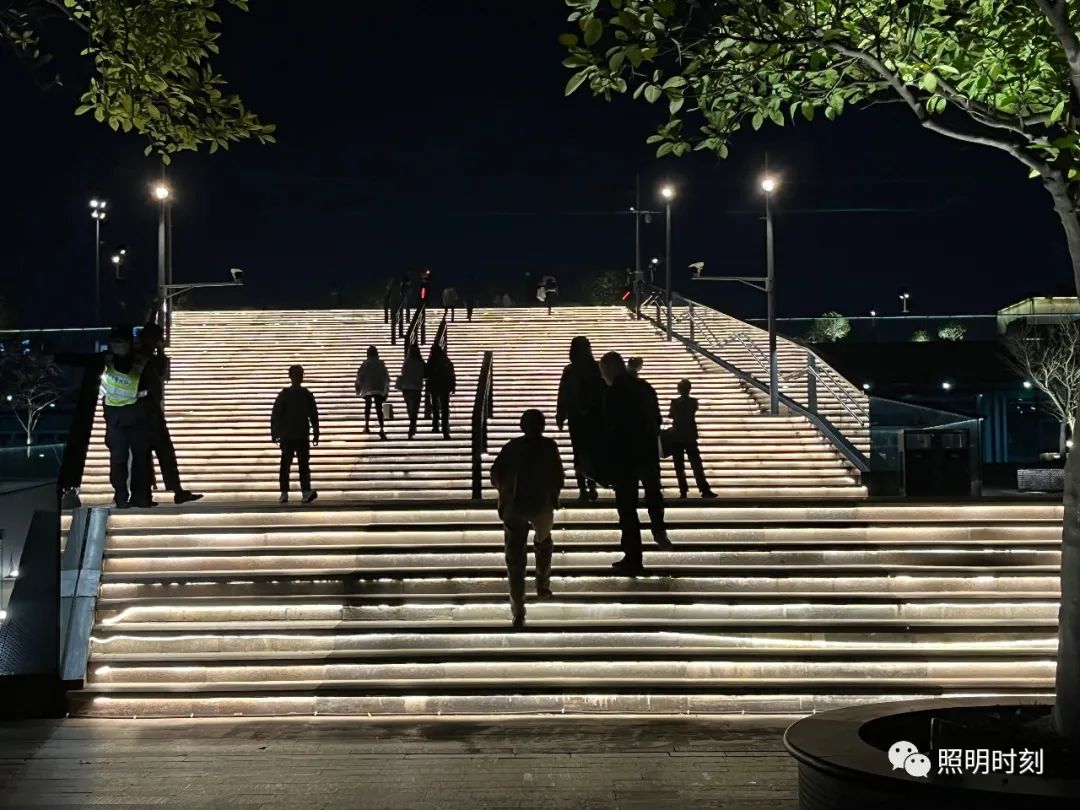
Figure 1
以图1的台阶照明为例。该处采用柔性灯带嵌入式安装与踢脚上方向下照射作为台阶照明。柔性灯带将踢脚洗亮,由于踢脚面积较大(灯具安装高度较高),被洗亮的踢脚面形成了眩目的光幕,以至于在台阶上行走的人成为一个个剪影。整个踏步的照度远远低于踢脚的垂直照度,再加上踏步较宽,踏步边缘照度更加微弱。
Based on my personal experience, when the illuminance of the skirting is greater than that of the steps and the contrast is extremely high, one must be extremely cautious while ascending to avoid missteps. This is undoubtedly a failed step lighting design. However, when descending along these steps, since the human eye can only see the treads, the high-illuminance (luminance) skirting is hidden, and the descent speed is not affected (Fig. 2). Thus, the contrast requirements for step lighting mainly apply to the ascending phase.
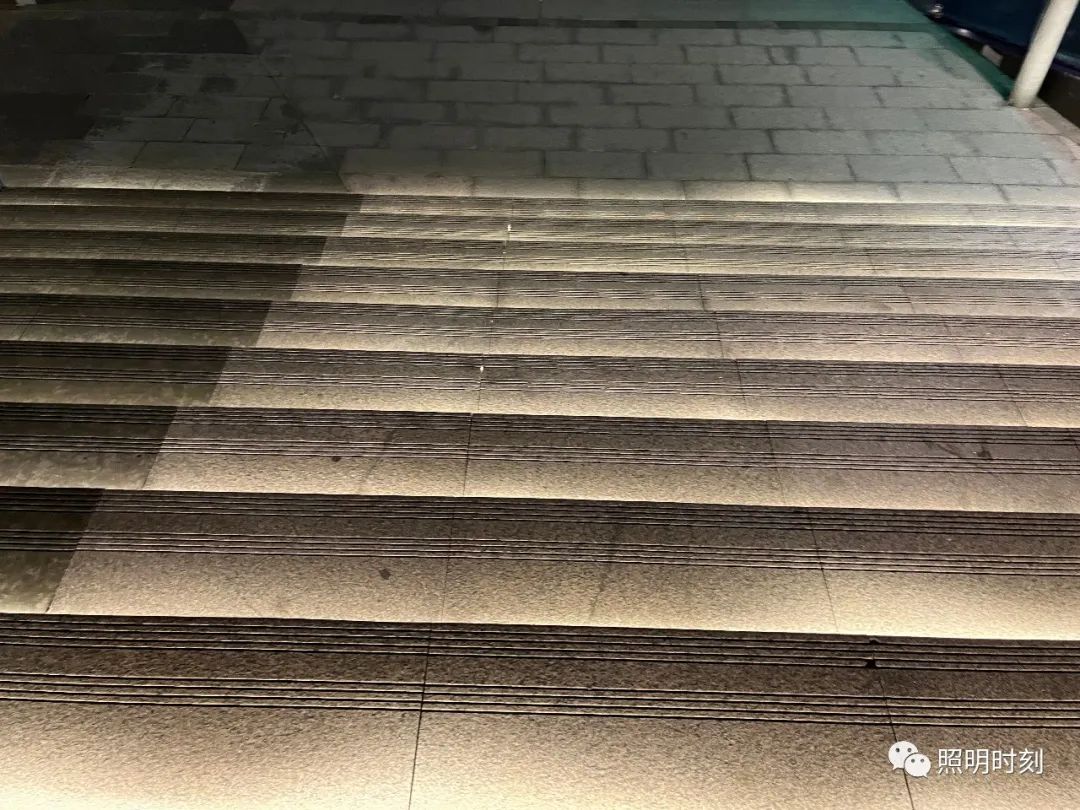
Figure 2
台阶照明的景观性通过功能性来实现。景观照明的明暗关系有一定的艺术性和戏剧性,没有一定之规,但功能照明的明暗却不能错配,否则可能引起错觉,容易引发安全事故。景观不能凌驾于功能之上。台阶照明重在踢脚和踏步的对比度设计,照明设计时应处理好踢脚和踏步照度的关系,踢脚的亮度至少不应高于踏步(图3)。JGJ/T 163可适当对台阶照明要求进行细化。目前市面上的台阶照明产品也还有完善的空间。
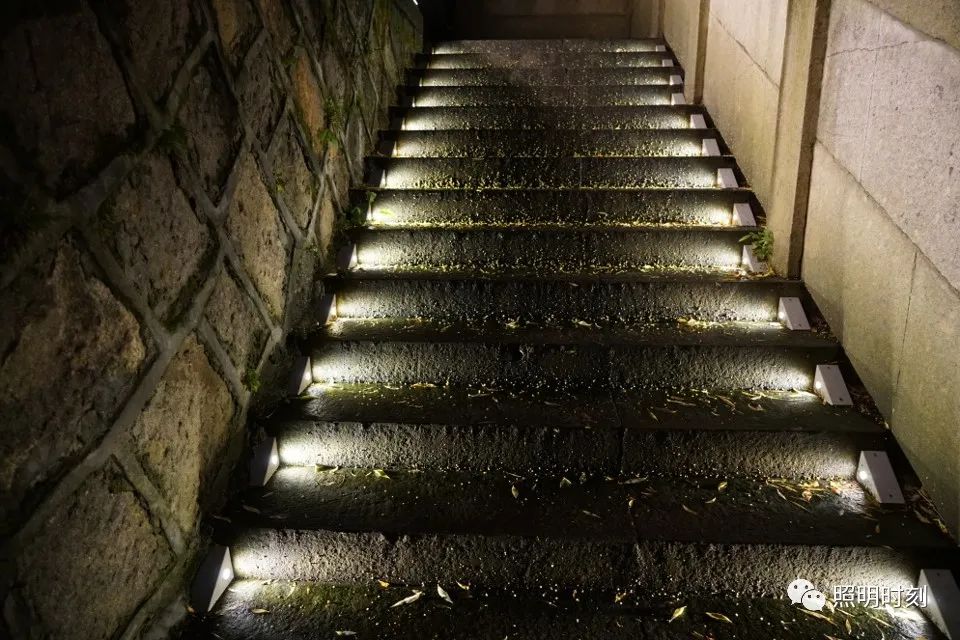
Figure 3
Laozi said, 'The multitude is bustling, as if enjoying a grand feast, as if ascending a terrace in spring.' Ascending a terrace in spring is a life enjoyment; it is so during the day, and even more so at night. Providing effective stair lighting to improve efficiency, prevent congestion, and ensure safety amidst the bustling crowd is the basic responsibility of every Lighting design[[/1]].
Author / Li Jing
Engineer, Hangzhou Urban Appearance and Landscape Development Center
Engaged in urban lighting management work
Li Jing, with a background in optics, has been engaged in the urban lighting industry for over 15 years.
is skilled in urban lighting design management, maintenance management, and safety management, with familiarity in theories related to urban lighting including light sources, luminaire, optical design, lighting design, photometry, chromaticity, electrical engineering, and urban lighting planning.
participated in drafting policy documents such as "Hangzhou City Lighting Management Measures", "Hangzhou City Lighting Facility Maintenance Service Specifications", and "Hangzhou City Lighting Quality Evaluation Specifications".
Current research focuses on nightscape aesthetics.
Related recommendations:
On the Cyclical Nature of the Lighting Industry
Source: Lighting Moments