
398 billion yuan! The market size of the smart lighting industry was disclosed last year! The compound annual growth rate reached 22%
LED lighting has become the industry mainstream
In recent years, with the popularization of environmental protection concepts and advances in LED technology, LED lighting products are rapidly replacing traditional lighting products; incandescent lamps and fluorescent lamps are gradually entering the phase-out stage. As a new type of high-efficiency energy-saving lighting product, LED lighting is a key promoted product for energy-saving lighting worldwide. Many countries have successively established phase-out schedules for incandescent lamps. Among them, the European Union, Australia, Japan, the United States, and other countries/regions launched their phase-out plans relatively early. The National Development and Reform Commission also released an incandescent lamp phase-out roadmap in 2011. The scale of the LED lighting industry has steadily expanded, gradually replacing traditional lighting and occupying a mainstream position in the lighting industry.
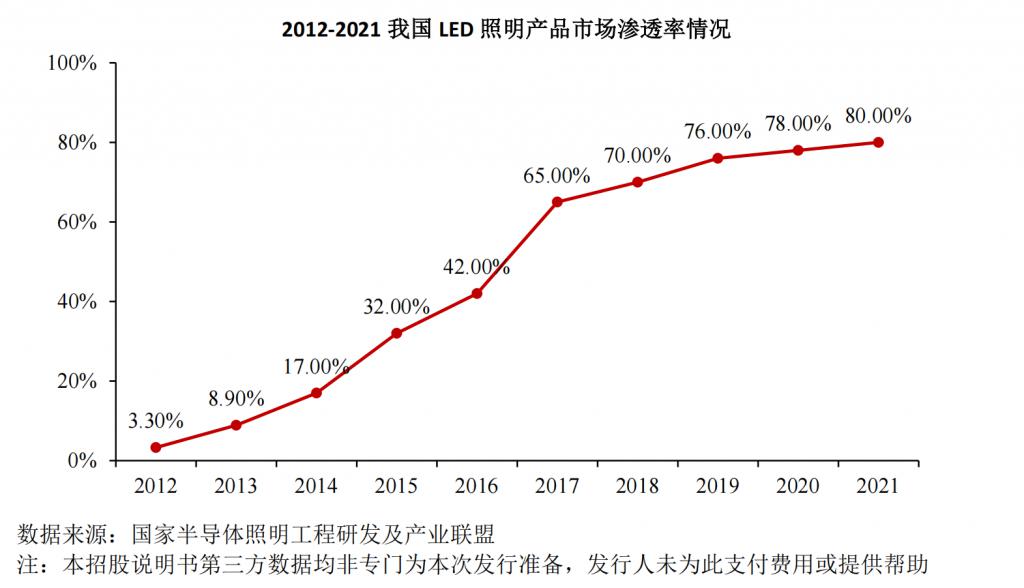
Under the strong guidance of national policies and the rapid iteration of LED lighting products, the substitution effect of LED on traditional light sources continues to be released, and LED penetration rates continue to rise. According to data from the China Solid State Lighting Alliance (National Semiconductor Lighting Engineering Research and Industry Alliance), China's LED lighting product penetration rate was only 3.3% in 2012, reaching 80% by 2021.
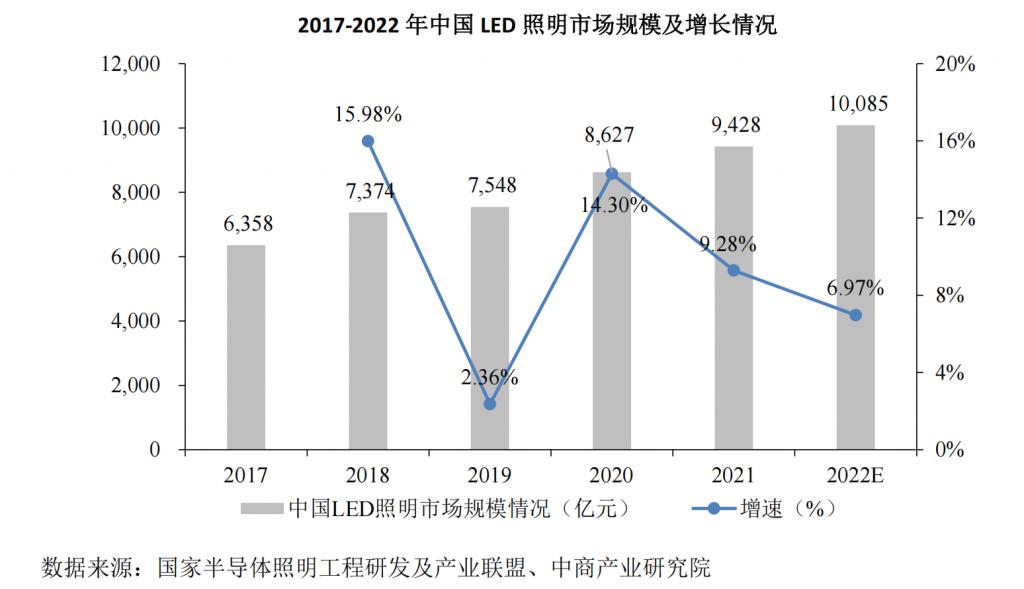
According to statistics from the China Solid State Lighting Alliance (国家半导体照明工程研发及产业联盟), China's LED lighting market size grew from 635.8 billion yuan in 2017 to 942.8 billion yuan in 2021, and is expected to exceed one trillion yuan in 2022, reaching 1,008.5 billion yuan.
The overall scale of smart lighting is showing an upward trend
Smart lighting, based on LED lighting, utilizes partial IoT technologies, wired/wireless communication technologies, power line carrier communication technologies, embedded computer intelligent information processing, and energy-saving control technologies to form a distributed lighting control system that achieves intelligent control of lighting equipment. In terms of application areas, smart lighting covers residential lighting, commercial lighting, industrial lighting, and urban lighting, with significant prospects in green energy saving, network interconnectivity, and urban management.
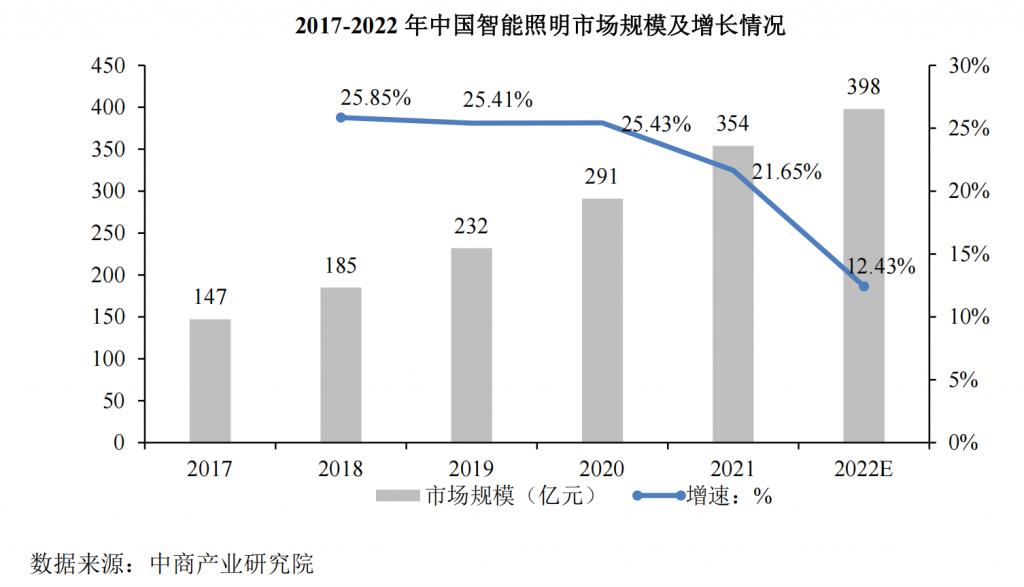
As a key component of scenario interconnection, smart lighting has seen growing demand in recent years with the continuous extension of intelligent living concepts, and is poised for further rapid development. According to statistics from the China Merchants Industry Research Institute, the smart lighting industry has experienced rapid growth since 2017, with market size expanding from 14.7 billion yuan in 2017 to 39.8 billion yuan in 2022, representing a compound annual growth rate (CAGR) of 22.04% and demonstrating a high-speed growth trend. Driven by the intelligence of pre-installation scenarios, the market size of China's smart lighting industry will accelerate its expansion, holding immense market potential.
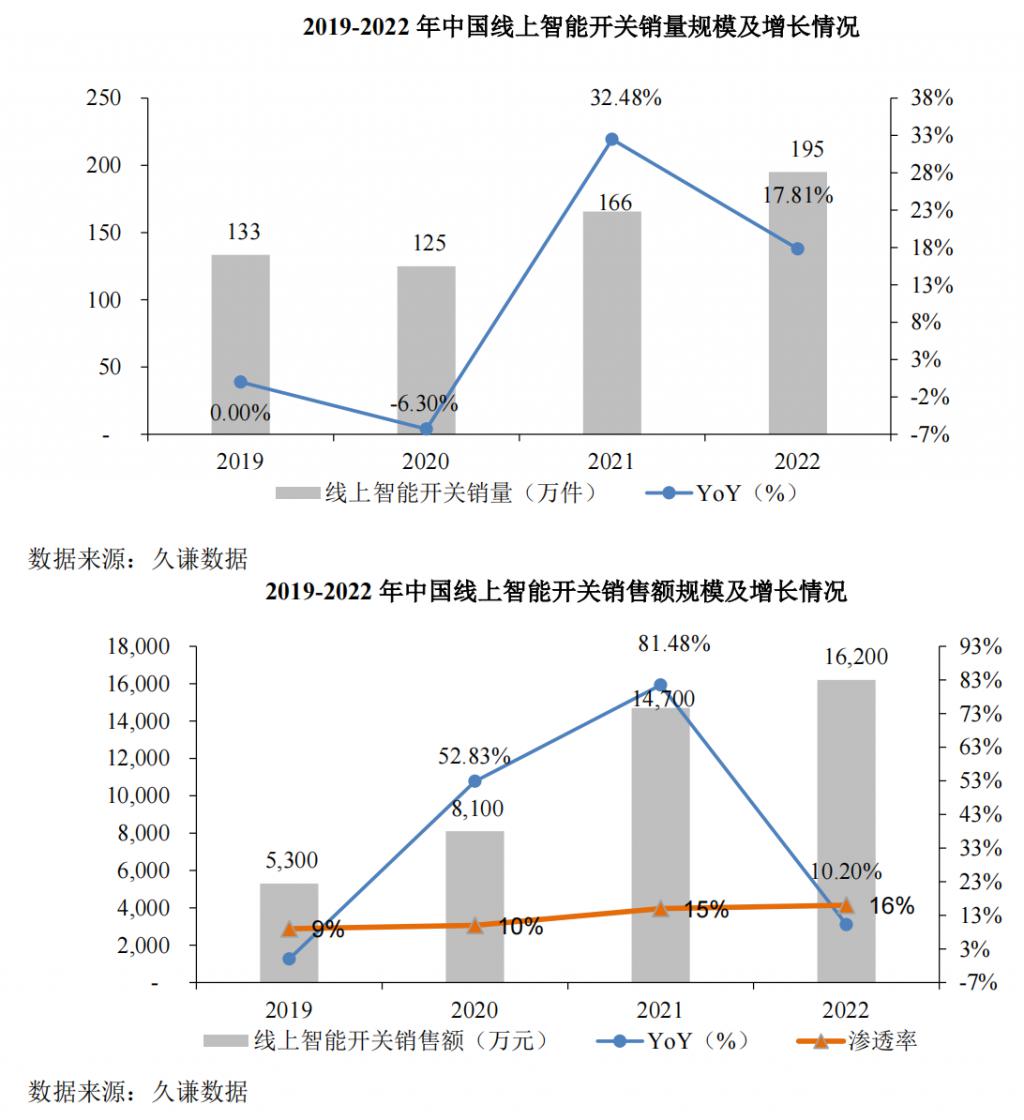
According to Jiuqian data statistics, in terms of sales volume, online smart switches sold 1.25 million units in 2020, 1.656 million units in 2021, and 1.951 million units in 2022, with sales volume continuously rising; the year-on-year (YoY) growth rate of sales volume in 2021 was 32.48%. In terms of sales revenue, sales amounted to 81 million yuan, 147 million yuan, and 162 million yuan respectively from 2020 to 2022; the year-on-year (YoY) growth rate of sales revenue in 2021 was 81%, the penetration rate of online smart switch sales revenue reached 16% in 2022, and the compound annual growth rate of sales revenue from 2019 to 2022 was 45%. The market size of online smart switches is developing rapidly with significant growth potential.
精装修市场上,智能面板的精装修配套率稳定提升,根据奥维云网统计,2021 年国内精装修市场智能开关配套规模达 42.7 万套,同比增长 15.5%;智能开关配置率为 14.9%,较 2020 年增长 3.5 个百分点,增长趋势较为明显。
Trends in the Lighting Industry
(1) Continuous improvement in the quality and intelligence of lighting products
Smart lighting products, compared to traditional lighting and LED lighting products, integrate multiple smart control functions such as color temperature adjustment, timing control, light sensing control, and smart scene switching. Relying on various control function modules and bus control systems, smart lighting products are easy to operate, flexible in control, and offer extremely high safety, creating a safe, energy-saving, comfortable, and efficient home environment for residents.
In the future, with the advancement of frontier technologies such as IoT technology, wireless communication technology, and energy-saving control technology, as well as the reduction in product costs brought about by industrial scaling, LED will quickly enter an era of quality and intelligence. The application of smart lighting products will accelerate their popularization, becoming the mainstream product of the next stage of the lighting industry, bringing new development opportunities to enterprises that master core smart lighting technologies, and further raising the threshold for industry competition.
(2) The smart pre-installation market is gradually rising
部分智能前装厂商已经开始与房地产、家装公司合作,将其产品打包进整体的智能前装解决方案,一方面借助线下渠道的力量更快地触达消费者,一方面将目标用户拓展至消费能力更强、年龄层次更广的群体中。
The post-installation and pre-installation home markets serve different scenarios. Post-installation products can be freely installed by users, primarily providing an incremental smart lifestyle, such as smart appliances. The smart pre-installation market has largely overcome the limitations of existing functional structures, wiring designs, and furniture placement in original homes, offering comprehensive, integrated, and personalized design from the bare shell stage. Therefore, the smart pre-installation market can provide more systematic and comprehensive solutions. Pre-installation intelligent products feature greater uniformity in decoration style, better synergy in functionality, and a more complete user experience. In contrast, post-installation intelligent products offer greater flexibility in selection, easier replacement, and lower costs. The two complement each other's advantages and jointly promote the development of the smart home industry.
Source: Leju Finance