
How to extend the usage time of solar landscape lighting luminaires under rainy weather conditions
Landscape lighting refers to outdoor lighting projects that serve both functional illumination and artistic decoration and environmental beautification purposes. Landscape lighting typically covers a wide range and includes many categories, requiring holistic planning while also addressing key nodes such as small scenic spots, buildings, etc., with accent lighting for individual elements. Therefore, lighting techniques are diverse, and the selection of luminaires is complex, demanding high overall capabilities from lighting designers. Previously, landscape lighting was solely intended for city illumination and beautification.
Nowadays, with the prevalence of low-carbon and environmental protection concepts, landscape lighting is not only for beautification but also considers issues such as carbon emissions and carbon neutrality. However, regarding the use of solar products, many people still have confusion: can solar products operate normally in rainy weather and extend their usage time?
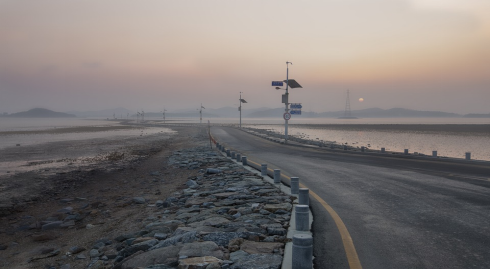
Advantages of Solar Luminaire Lighting
1、Safe and reliable
Generally, mains-powered landscape lighting operates at 220V. If cables are accidentally cut during other construction work or if cables have aged, electric shock accidents can easily occur. In contrast, solar tools typically operate at a low voltage of approximately 12V~24V, effectively ensuring personal safety.
2, easy to maintain
If traditional landscape lights encounter a fault, they must be checked one by one from the cable to the street light. During this inspection process, the use of other street lights is inevitably affected to some extent. In contrast, solar street lights are independent units; if a specific light has an issue, only that particular unit needs to be inspected to determine the cause of the failure, significantly reducing maintenance pressure.
3, green and low-carbon
Based on the current rate of nuclear energy production by the sun, hydrogen reserves are sufficient to last for over ten billion years. In today's world facing increasingly severe ecological pollution, solar energy resources represent a truly renewable and clean energy source that significantly reduces pollutant emissions.
4、Cost Advantage
Carbon-neutral smart centralized power supply lighting system. Because it integrates Sunway Lighting and a mains-powered intelligent energy storage system, the cost of the entire system is reduced by half compared to conventional solar luminaires. There is no need to consider whether one day of charging can support 5-7 days of operation; only the solar charging for one day, the power required to illuminate for one day, and the battery capacity need to be considered, resulting in significantly lower costs.
Extended usage guidelines for solar lighting
Generally, solar street lights stay on for about 8 hours a day. They emit sufficient light during the first 4 hours, but brightness gradually decreases during the last 4 hours. Due to the inherent energy storage capability of solar power, solar street lights can still operate for 3-7 days under rainy weather conditions. However, in cases of prolonged rainy weather, it is necessary to increase the capacity of the solar panels and batteries to ensure continuous operation during such periods.
Due to differences in product design and positioning of various solar lighting luminaires, general solar street lights are typically designed with different margins to withstand continuous rainy days. Since charging is also possible on rainy days, the lights can remain on, though they will not be very bright. Extending the illumination duration of luminaires during rainy weather is also a top priority.
First, improve the conversion efficiency of solar panels. You can select solar panels with higher conversion efficiency per unit area, or increase the irradiation area of the solar panels, thereby increasing their power output.
Second, increase the battery capacity. Due to uncontrollable weather conditions, solar power supply is not particularly stable; therefore, it is necessary to increase the storage battery capacity to avoid insufficient power supply during rainy or cloudy days. By increasing the battery capacity, continuous power output can be ensured.
Third, achieve intelligent power regulation through technical means. Starting from our own products, develop solar lighting luminaires with higher cost-performance and stronger sustainability, or use smart systems to assess weather conditions and reasonably plan discharge power.