
Seven lighting industry national standard projects have been assigned project initiation plans
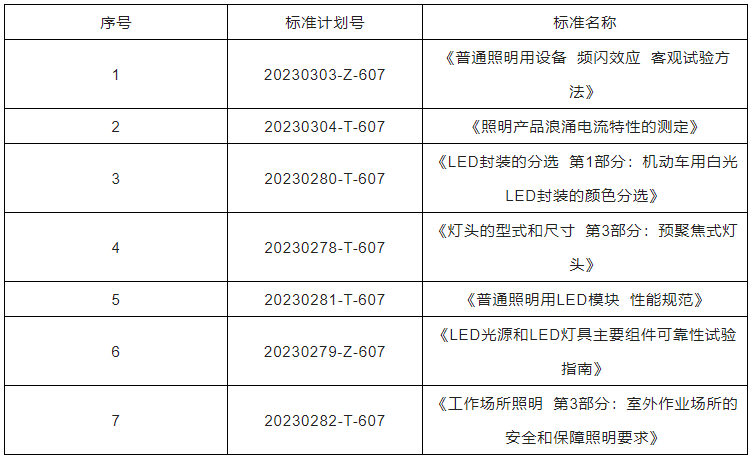
On March 21, 2023, the Standardization Administration of China issued the first batch of recommended national standard plans and related foreign language versions for 2023 (Standardization Administration Document [2023] No. 10), which includes seven national standard projects in the lighting field under the jurisdiction of SAC/TC 224.
"Stroboscopic Effect - Objective Test Methods for Equipment Used in General Lighting"
The stroboscopic effect of lighting products has increasingly attracted attention from the market and consumers. The stroboscopic effect can significantly impact the assessment of light quality; visible light modulation may lead to degraded light performance, increased fatigue, and acute health issues such as seizures and migraines. Standards regarding flicker and the stroboscopic effect were promulgated and implemented abroad in 2018. However, China lacks relevant national standards (mandatory / recommended) and guidelines for testing the stroboscopic effect. For many years, domestic enterprises or testing institutions have mostly relied on "IEEE Std 1789-2015: IEEE Recommended Practices for High Brightness LED Flicker Current to Mitigate Observer Health Risks" for evaluation. The assessment indicators and parameters in this method, such as flicker percentage and flicker index, cannot objectively evaluate the stroboscopic effect. China has now published GB/T 42064-2022 "General Lighting Equipment - Flicker Characteristics - Photoflicker Test Method". The formulation of this standard will improve the standards for testing the stroboscopic effect of lighting equipment, facilitate better detection and R&D of higher-quality lighting products, and protect people's vision.
Determination of Surge Current Characteristics of Lighting Products
Currently, there is a gap in the methods for measuring the surge current characteristics of lighting products in China, but the demand for such measurements is urgent. Surge currents during the startup process of lighting products can cause harm to circuits, including triggering false protection of circuit breakers/air switches, interfering with other devices on the same circuit, and disrupting the power grid, leading to degraded power quality. As a major manufacturer, exporter, and user of lighting products, accurately measuring their surge current characteristics is essential. The development of the standard "Measurement of Surge Current Characteristics of Lighting Products" will effectively guide the R&D and manufacturing of lighting products, as well as the design, installation, inspection, and acceptance of lighting engineering projects, promote the improvement of lighting product quality in China, and ensure the safety of lighting products and the circuits and equipment they are connected to.
Sorting of LED Packaging - Part 1: Color Sorting for White LED Packaging Used in Motor Vehicles
Currently, white LED packaging is primarily surface-mount type (SMT), used in general lighting products. Considering the needs for applications in fields with higher precision requirements such as automotive, the requirements and consistency of key indicators are continuously increasing. Additionally, as the application scope of LED packaging becomes broader, the perfection of standards and ensuring the accuracy of product performance indicators become particularly important. With the expansion of LED applications in automotive and other fields, original standards can no longer fully meet the higher requirements of these niche areas. Therefore, revisions and improvements to the original standards are needed based on market circulation demands domestically and internationally, thereby improving the quality level of LED packaging color binning and standardizing and enhancing LED packaging testing methods to provide quality assurance. By reorganizing, perfecting, and optimizing the standards, supplementing main contents such as binning test procedures and test accuracy, the testing methods can be effectively improved to meet binning requirements, which holds significant importance for manufacturers and downstream lighting applications.
Lamp cap types and dimensions - Part 3: Pre-focus lamp caps
This standard is Part 3 of the series of 5 standards for GB/T 1406 "Lamp cap types and dimensions". This part specifies the types and dimensions of pre-focusing lamp caps, which are basic requirements to ensure interchangeability and safety of lamp caps. This standard adopts IEC 60061-1:2020 with modifications. Compared with the current version, technical content has been added for lamp cap models PG15, PGZ12, PGZ18&PGZX18, PGJY19, PG18.5d, PGJ18.5d/t, PGJX19, PU20d, PGJ21t, PGJ23t, PX23t, P(X)(Y)26.4t&PJ26.4t, PGJX28, PGJX36, PU43t, PGJ(X)50, and PGJY50; technical content for model PGJ19 has been updated. This revision is conducive to further improving product quality, regulating the market, raising the technical level of national standards, aligning with international standards, and maintaining consistency with the new IEC international standard.
"Performance Specification for LED Modules for General Lighting"
With the continuous development and widespread application of LED lighting, new technologies are constantly being researched and developed. The emergence of LED modules enables manufacturing enterprises to produce LED luminaires more conveniently and effectively at a lower cost. As a major country in the manufacturing, export, and use of LED lighting products, China has been leading globally in the design, manufacturing, and sales of LED modules. It is therefore necessary to align with current market conditions and standardize with IEC international standards by revising GB/T 24823-2017 "General Lighting LED Modules - Performance Requirements". This revision will effectively guide the R&D, manufacturing, and testing of LED module products, promote quality improvement of China's LED modules, reduce certification and testing costs for domestic enterprises, and lower raw material and product inventory levels. The revision of this standard plays a positive role in the healthy development of China's LED modules and luminaire products.
Guidelines for Reliability Testing of Main Components of LED Light Sources and LED Luminaire
近年来,照明领域越来越广泛地采用LED光源和LED灯具。LED作为一种集成的电子产品,技术含量不断扩大、尺寸重量日益缩小、智能化程度成倍提高,全球产业发展极为迅速。但LED光源、灯具始终存在质量参差不齐的问题。国内外大量研究认为,决定LED产品综合质量的关键是可靠性,具体来讲是其各主要组件本身的可靠性及相互间的平衡程度,这些组件包括LED元件、电子器件、光学材料、机械和相关散热装置等部分。对此,亟需制定一套规范且系统的测试指南,对LED光源和LED灯具组件可靠性展开测试评价。
Workplace Lighting - Part 3: Safety and Security Lighting Requirements for Outdoor Work Areas
Human activity areas typically include indoor and outdoor spaces. In certain specific outdoor work environments, people must perform tasks under defined lighting conditions, such as storage areas in industrial sites, coal fields in power plants, ports, docks, switchyards in power plants, etc. When the lighting quality in these areas fails to meet requirements, safety risks may arise. To enable people to efficiently and accurately complete visual tasks in these locations, especially at night, adequate and appropriate lighting must be provided. This document adopts ISO/CIE 8995-3:2018 identically, specifying visibility and comfort requirements for various outdoor work environments based on the type and duration of activities.
Source: Standard Center for Light Sources