
Digital Review 2022: Overview of China's Lighting Industry
The following article is sourced from Yu Guang Tong Chen, authored by Wen Qidong
Author / Wen Qidong
-5.4%/643.5 billion
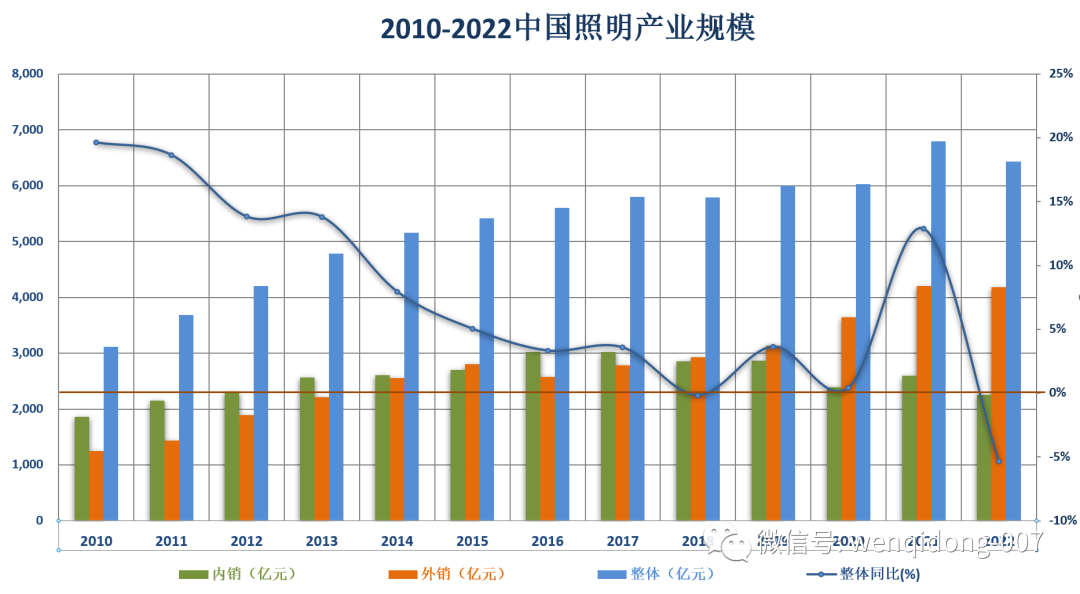
In 2022, the scale of China's lighting Industry was approximately 643.5 billion, a Year-on-year (YoY) decrease of 5.4%, yet it remained at a historically high level. Among them, facing multiple pressures such as declining external demand, deteriorating trade conditions, pandemic impacts on supply, and intensified external competition, China's lighting foreign trade recorded a total Export value of 62.7 billion US dollars in 2022, a Year-on-year (YoY) decrease of 4.3%; equivalent to approximately 418.5 billion RMB, a Year-on-year (YoY) decrease of 0.9%. The Federal Reserve's multiple interest rate hikes drove a strong appreciation of the US dollar, resulting in a modest decline in the annual Export value when calculated in RMB. In 2022, domestic sales of lighting products were constrained by many factors, including recurring pandemic outbreaks, a slump in the real estate sector, pressure on employment and income, insufficient consumer confidence, and widening income disparity. The entire industry achieved domestic sales of approximately 225 billion RMB, a Year-on-year (YoY) decrease of 13.5%, which was more dismal than the export situation.
-20%/14 billion
In 2022, the number of lighting equipment manufactured and sold in China was approximately 14 billion units, a year-on-year (YoY) decrease of 20%. Among them, various light source products totaled about 10.13 billion units, a year-on-year (YoY) decrease of 19.9%; various luminaire products totaled about 3.89 billion units, a year-on-year (YoY) decrease of 20.4%.
4.3%/600 million
2022年,含装置有可互联模组的照明设备(光源和灯具)约为6亿台,数量占比仅4.3%,不足5%,仍低于很多人预期。首先需要指出,智能照明是系统化的概念,即经过精准的照明设计,来构建一个能够自适应提供健康且舒适光环境的智慧化低碳照明系统。但是行业目前产品思路更多是单个或多个的产品或终端,智能照明业态现在也还处在初级的终端铺设阶段。LED叠加智慧系统,使得产品/方案类型多样化,实现路径多样化,应用场景也多样化。未来要实现我们所说的真正的系统化智能照明,实现我们所期望的全域感知、多源融合、万物互联,需要经历从单品到多品再到系统的发展阶段,还有相当长的一段路要走。
12%/16%
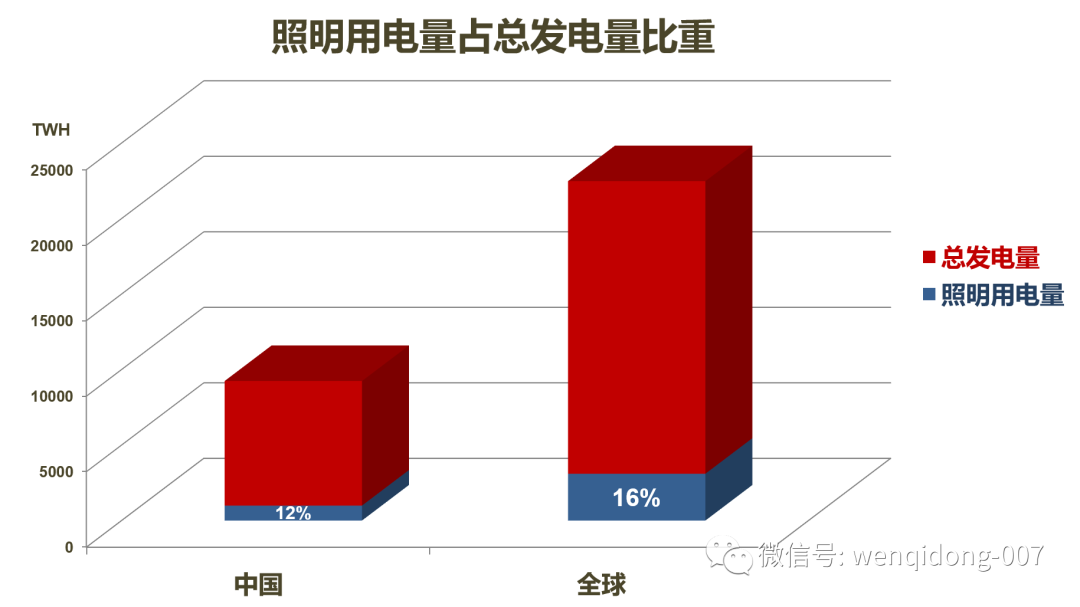
In 2022, China's electricity consumption for lighting accounted for approximately 12% of the country's total power generation, equivalent to about 990 TWh (terawatt-hours, where 1 TWh = 1 billion kWh); globally, lighting electricity consumption represented around 16% of total global power generation, amounting to roughly 3,100 TWh. As the "world's factory" supplying the globe, China's power generation constitutes approximately 30% of the world's total.
31%
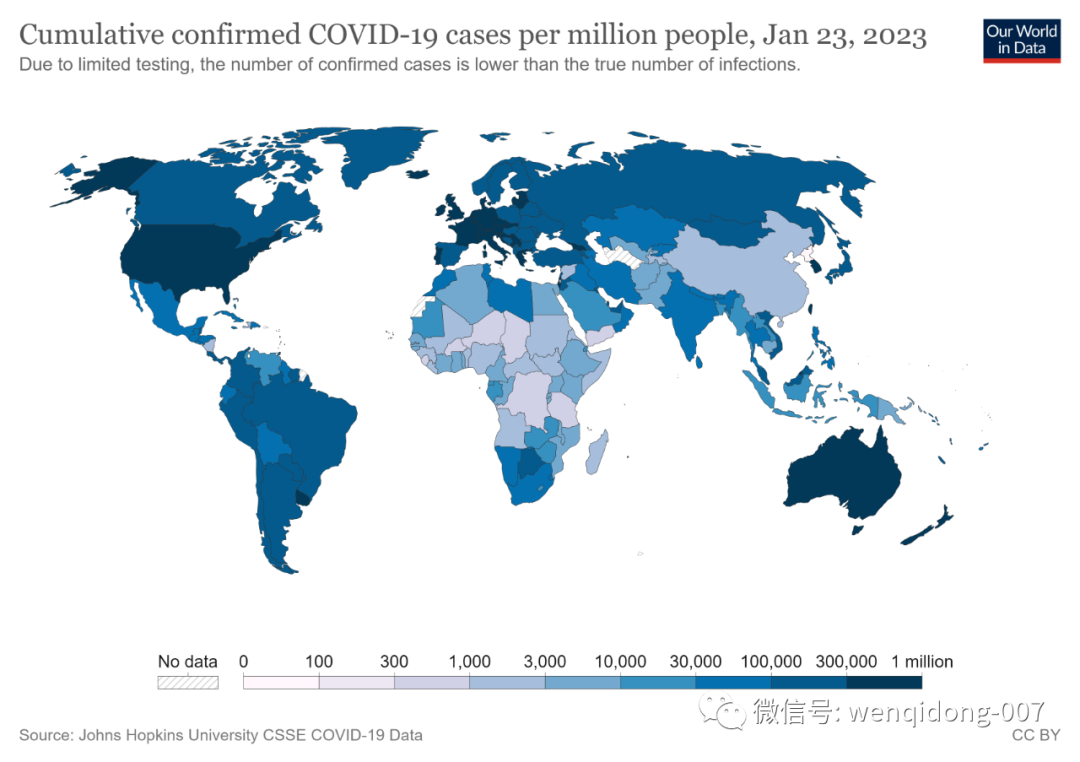
上面讲中国独占全球发电总量的30%雄居第一,而作为全球第二大经济体和名副其实的“世界工厂”,中国也同时是碳排放大户,全球碳排放总量约为340亿吨,中国独揽其中105亿吨,占比达31%;全球煤炭年消耗量约82亿吨,中国则烧掉42亿吨,占比超过50%;欧美早已酝酿对进口产品收“碳关税”,矛头直指“中国制造”。因此低碳不仅是未来诸多产业的准入门槛,也将是产业升级的关键方向。因此,我们的“双碳”目标依然任重而道远,照明界同仁们仍需上下而求索。未来,依托精准的设计构建自适应提供健康舒适光环境的智慧化低碳照明系统将是赋予我们照明行业更多附加值和想象空间的终极追求。
2023 Starting from "0"
Looking ahead, lighting exports first face demand contraction caused by monetary tightening policies, high inflation, and economic recession in major economies, compounded by the continued suppression of growth from the European energy crisis and supply chain bottlenecks, as well as the weakening "transfer substitution" effect of Chinese manufacturing abroad. Meanwhile, black swan events such as China-US trade friction, the outbreak of the COVID-19 pandemic, and the Russia-Ukraine geopolitical conflict have triggered global concern over supply chain security. Under the new global theme of "development and security," Europe and the United States are aggressively promoting the restructuring of the global industry / supply chain based on supplier diversification, localization, nearshoring, and friend-shoring. This presents an increasingly realistic and severe challenge to China's lighting industry, which is deeply embedded in the global industry / supply chain. Based on this judgment, the long-standing trend of continuous growth in lighting exports has reversed. Achieving growth in lighting exports in 2023 faces numerous difficulties, and the possibility of a continued downward trend cannot be ruled out.
In terms of domestic lighting sales, the long-tail "scarring" effects of the COVID-19 pandemic on prices, debt, and consumer psychology persist. On the consumer side, although there are benefits from the organic combination of national policies to expand domestic demand and supply-side structural reform, household income and employment have suffered a structural decline due to the pandemic. It will take time to return to normalcy, especially since restoring confidence requires a prolonged period. Therefore, challenges remain significant: not only must the issue of insufficient disposable income be addressed, but also the reluctance to spend despite having funds. While policies have improved, they are accompanied by financial, land, and demographic issues. The real estate sector is likely to recover but will probably remain a drag, offering limited stimulus to the domestic lighting market. On the project side, the country is leaning more towards coordinated regional development, restricting the growth of mega-city clusters, super-tall buildings, and urban rail transit. However, it will continue to advance high-speed rail and airport construction in central and western regions and deepen the rural revitalization strategy, where opportunities lie. In summary, 2023 will be a year of bottoming out and rebounding for the domestic market, showing a significant recovery compared to 2022, with project-driven business likely becoming a highlight.
In 2023, with the full lifting of pandemic control policies, lighting companies will continue to expand globally. Overseas demand and investment will thus differ from the previous "All in China" strategy. "China+1" is a new strategy to diversify risk control costs amid increasingly tense geopolitical situations in the future. Consequently, it is inevitable that some lighting orders and parts of the supply chain will shift to other manufacturing countries. In the future era of stock competition, limited demand will concentrate on high-quality production capacity with supply chain control capabilities and core competitiveness in technology, market, brand, and sales channels, leading to further increased industry concentration.
Future lighting enterprises should focus on supply chain restructuring and optimization, overseas investment to build production capacity, mergers and acquisitions using capital, balanced development of domestic and international business cycles, and continuous deepening in niche markets . I will also empower enterprises with ideas and needs in these areas, walking hand in hand with them.
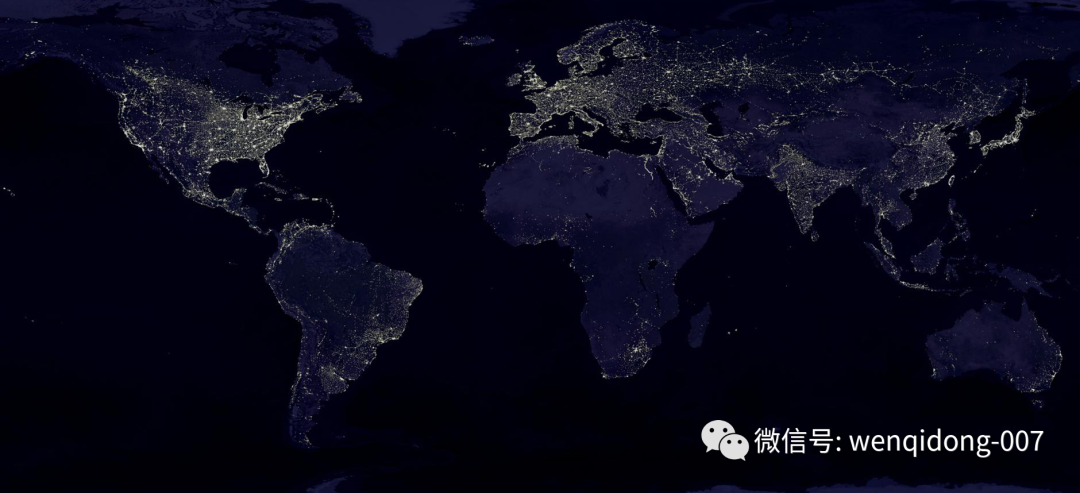
The curtain has fallen on 2022, never to return. Winter is here, but the lights remain bright;
2023 has arrived with a roar, the road ahead is unpredictable. Through this arduous journey, we reach the other shore;
The future: Life is like a journey against the current; sail with a single reed. Follow your heart’s direction, walking simply towards it.