
Researchers have developed a single-component warm white LED
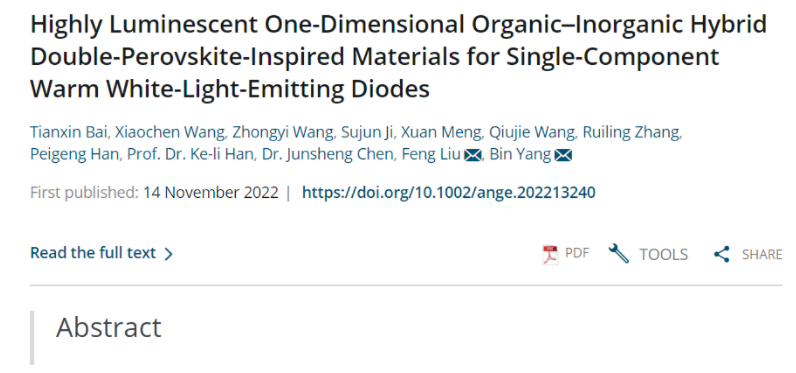
According to China Science Daily, Associate Researcher Yang Bin from the Dalian Institute of Chemical Physics, Chinese Academy of Sciences, and Researcher Liu Feng from Shandong University, among others, collaborated to develop a novel double perovskite material with efficient white light emission, and fabricated single-component warm white light-emitting diodes (LEDs) based on this material. The related research findings were recently published in Angewandte Chemie.
Electrical lighting accounts for 15% of global electricity consumption and is responsible for 5% of global greenhouse gas emissions. Adopting more efficient, low-cost lighting technologies can alleviate energy and environmental crises and help achieve the "dual carbon" goals. Currently, the vast majority of white LED technologies rely on blue LEDs to excite multi-component phosphors to produce white light, which often leads to issues such as poor color rendering, low luminous efficacy, high levels of harmful blue light, and discontinuous white light spectrum. Developing efficient single-component white light materials is considered key to solving these problems.
In this study, researchers found that lead-free metal halide double perovskite materials can be prepared using a low-temperature solution method, with lower production costs.
In addition, due to the confinement of its own structure and strong electron-phonon coupling effects, double perovskite materials possess unique self-trapped exciton (STE) characteristics. Their recombination luminescence exhibits a large Stokes shift and broadband light emission, thereby demonstrating white-light emission properties.
Due to the high optoelectronic performance and excellent solution processability of the low-dimensional double perovskite materials prepared by the institute, single-component warm white LEDs based on these materials can be fabricated via a simple solution method. Therefore, this work provides new insights for the design of next-generation lighting devices.
Related paper information: https://doi.org/10.1002/ange.202213240
(Originally published in China Science Daily, December 15, 2022, Page 1, Headline News)