
Automotive Lighting Industry Research Report: Intelligent Upgrades in Vehicle Lighting, with Through-Type Lights and Ambient Lights Leading the Breakthrough
1. Headlight
1.1. Matrix type: Mass-market and independent brands are promoting adoption, gradually extending to the 100,000–150,000 yuan price range
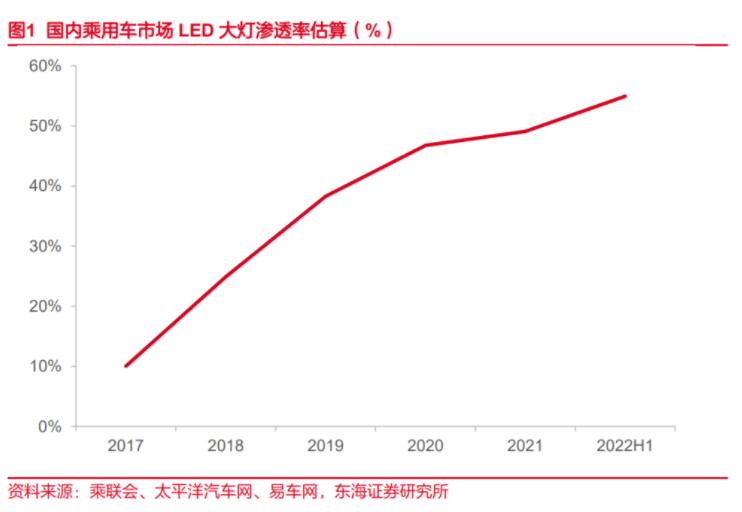
The penetration rate of LED headlights in the passenger car segment exceeds 50%, with matrix-style systems becoming the new direction for upgrades. Automotive headlights have evolved through stages including kerosene, acetylene, halogen, xenon, and LED. Since 2017, driven by declining LED costs and stricter energy consumption requirements, LED headlights—offering advantages such as higher light intensity, lower energy consumption, and longer service life—have rapidly replaced halogen headlights. Based on sales data from the China Passenger Car Association and vehicle configuration data from PCAuto and Yiche, the penetration rate of LED headlights in the passenger car market reached approximately 55% in the first half of this year.
Among the top 15 best-selling car models: (1) Sedans: New Lavida, Camry, New Bora, Sagitar, BYD Han, Levin, BMW 5 Series, BMW 3 Series, etc., are all equipped with standard LED headlights; (2) SUVs: BYD Song, Tesla Model Y, Haval H6, Honda CR-V, Changan CS75, Mercedes-Benz GLC, Audi Q5, BMW X3, Toyota RAV4, Wildlander, Tiguan, etc., are equipped with standard LED headlights; (3) MPVs: Buick GL8, Sienna, Trumpchi M8, Odyssey, Elysion, Kaijie, Custo, etc., are equipped with standard LED headlights. Overall, best-selling sedan and SUV models are basically equipped with LED headlights or have them in certain versions, but the penetration rate of LED headlights in MPV models is slightly lower than that in sedans and SUVs. As automotive configurations improve, some models are further upgrading to matrix headlights.
Matrix headlights enable ADB functionality and offer significant advantages over mechanical ADB in terms of response speed and lighting effects. Inside the matrix headlights are multiple LEDs; the LED light sources are grouped, with each group forming a high-beam lighting component. Each LED unit can independently adjust its luminance or turn off, enabling various features to enhance nighttime driving safety through different light distribution patterns, such as adaptive cornering, precise illumination, control of the illumination range, dynamic turn signals, and pedestrian warnings. Traditional mechanical ADB adjusts the headlight up/down or left/right via motors, or changes the headlight's light pattern by rotating cut-off shields, resulting in slower adjustment and lower precision. Matrix headlights can replicate the functions of mechanical ADB while outperforming it in response speed and lighting effects.
It is estimated that the penetration rate of matrix headlights in the first half of this year was around 6%. Based on sales data from the China Passenger Car Association (CPCA) and vehicle configuration data from Pacific Auto and Yiche, the penetration rate of matrix headlights in the first half of this year is estimated to be around 6%. Among the top 15 best-selling models: (1) Sedans: Some versions of the BYD Qin Pro NEV are equipped with matrix headlights; (2) SUVs: Models such as the BYD Song Pro NEV, Haval H6, Audi Q5, and Tiguan, or certain versions thereof, are equipped with matrix headlights. (3) MPVs: Models such as the Buick GL8, GAC Trumpchi M8, Dongfeng Forthing, GAC Trumpchi M6, and Wuling Kaijie, or certain versions thereof, are equipped with matrix headlights. By vehicle type, the penetration rate of matrix headlights is higher in the MPV and SUV segments than in the sedan segment.
By brand, FAW-Volkswagen and SAIC Volkswagen have a high configuration ratio of matrix headlights, followed by domestic brands such as BYD, Geely, and GAC Trumpchi. The equipped models are gradually extending to the 100,000–150,000 RMB price range. According to vehicle configuration data from PCAuto, brands with a high configuration ratio of matrix headlights currently include FAW-Volkswagen, SAIC Volkswagen, as well as domestic brands like GAC Trumpchi, BYD, and Geely. Other joint venture brands such as SAIC-GM, Changan Lincoln, GAC Toyota, Polestar, and Sehol, along with domestic brands like Great Wall, Chery, Changan, Arcfox, Hongqi, and Wuling, also equip matrix headlights in certain models.
In terms of price: (1) FAW-Volkswagen and SAIC Volkswagen: Models equipped with matrix headlights are generally priced above RMB 200,000. A few models in the RMB 150,000–200,000 range, such as the ID.3 and Lamando, also offer matrix headlights as standard or optional equipment in high-trim versions. (2) Domestic brands: Matrix headlights are mostly paired with models priced above RMB 150,000, and are gradually extending to the RMB 100,000–150,000 segment. For example, the Chery Tiggo 7 PLUS, SAIC-GM-Wuling Victory, and GAC Trumpchi GS4 PLUS are all priced below RMB 150,000. Currently, the lowest-priced models equipped with matrix headlights can be found below RMB 100,000.
(1) Volkswagen: Matrix headlights are an important component of the IQ.Light system, extending into the 150,000-200,000 yuan price range. Volkswagen's IQ.Light matrix headlights provide clear and effective visibility in different environments and weather conditions; the low beam mode can automatically adjust according to vehicle speed and scenarios. It also features automatically activated matrix LED dynamic high beam functionality and automatic height adjustment, including AFS cornering lights and all-weather adaptive headlights. The all-weather adaptive headlights can automatically output various low beam modes such as town mode, classic mode, and highway mode based on vehicle speed and scenarios. When the matrix dynamic high beam assist function is enabled, it provides a farther and wider light range than low beams without dazzling vehicles ahead. Currently, among Volkswagen's domestically produced models, FAW-Volkswagen's ID.6 CROZZ, ID.4 CROZZ, Magotan, Golf, and SAIC Volkswagen's Tiguan, Teramont, Passat, Lamando, and other models have all adopted matrix headlights.
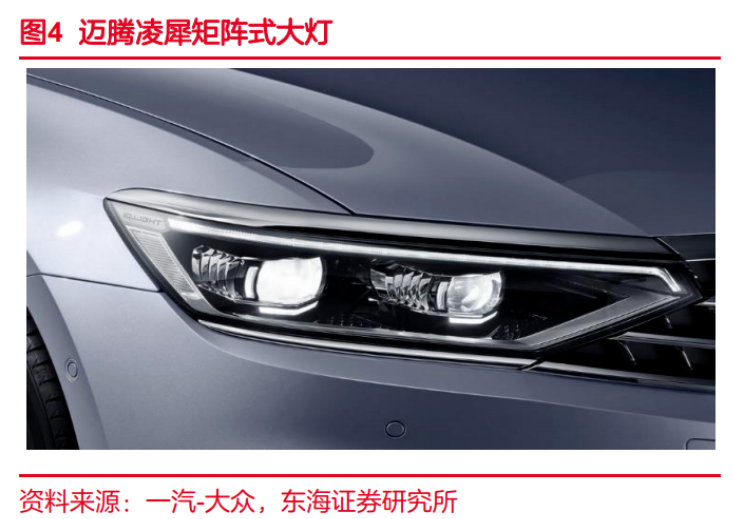
(2) BYD: Showcasing its family design language, expanding into the 150,000–200,000 RMB price range. BYD models equipped with matrix headlights include those priced above 200,000 RMB, such as the Seal ("Haiyue Yaomu Double U Floating Headlights"), Han ("Floating Dragon Crystal LED Headlights"), and Tang New Energy ("Floating Dragon Crystal LED Headlights"), as well as models in the 150,000–200,000 RMB range like the Song MAX New Energy ("Diamond Dragon Eye LED Headlights") and Qin Pro New Energy. The new model Frigate 07, currently in pre-sale, is also equipped with matrix headlights ("Deep Sea Light and Shadow Crystal Cobalt Headlights"). Since its launch in 2018, BYD's Dragon Beam "Dragon Crystal" has become a unique family design language for the Dynasty Network models.
1.2. Pixel-type: High-definition lighting technologies such as DLP and Micro-LED are entering the automotive lighting field
In the field of pixelated headlights, there are different technical routes such as DLP, Micro-LED, and LCD. Pixelated headlights can be regarded as matrix headlights with higher pixel counts. There are various technical routes including DLP, Micro-LED, and LCD. DLP and LCD achieve pixelation through light modulation devices; among them, DLP has a higher cost and is generally used in luxury vehicles, while LCD has not yet been used in mass-produced vehicles. Micro-LED achieves pixelation at the light source level and is expected to be gradually applied on a large scale in mid-to-high-end vehicles. According to vehicle configuration data from sources such as Pacific Auto Network, models like HiPhi Z and HiPhi X, IM Motors L7, Mercedes-Benz C-Class, Volvo C40 and XC40 New Energy, Buick Envision and Regal are all equipped with pixelated headlights. Among them, HiPhi Z/X, IM Motors L7, and Mercedes-Benz C-Class adopt DLP technology, with a combined total of up to 2.6 million pixels for both headlights, supplied by Huayu Vision and Marelli AL. Several Volvo and Buick models feature 84 pixels, supplied by ZKW.
1.2.1 DLP Headlights: Million-level pixels, already applied in multiple mass-produced vehicle models
DLP headlights can achieve million-level pixel resolution. They were first used in high-end Mercedes-Benz and Audi models, and in recent years have been adopted by new EV brands such as IM Motors and HiPhi. In 2018, the Maybach S-Class was the first to adopt DLP headlights, followed by the Audi A8, Audi e-tron Sportback, and Mercedes-Benz C-Class. Currently, mass-produced models equipped with DLP headlights also include the Land Rover Range Rover, IM L7, HiPhi X, Cadillac Lyriq, and WEY Mocha. The high resolution of DLP headlights not only enables matrix headlight functions but also allows for various personalized lighting modes through supplier-provided programming capabilities. For example, the DLP headlights on the IM L7 can implement features such as spotlights, light carpets, and projected crosswalks, while DLP headlights on HiPhi models can provide low-speed turn assistance, blind-spot lane-change warnings, trajectory prediction, lane departure alerts, pedestrian tracking alerts, pedestrian guidance and yielding, and vehicle tracking masking.
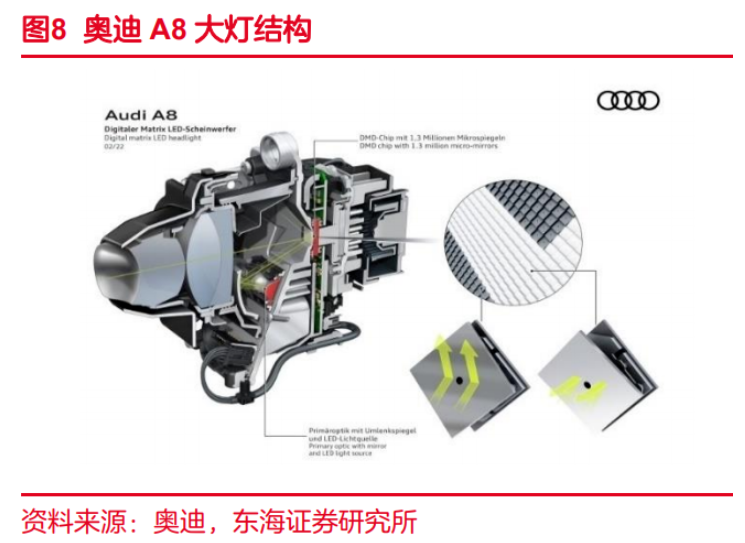
Tier 1 suppliers such as Marelli AL, ZKW, Huayu Vision, and Mand Optoelectronics all offer DLP headlight products. The core of DLP (Digital Light Processing) technology is Texas Instruments' DMD (Digital Micromirror Device). The DMD comprises up to 1.3 million aluminum micromirrors, each measuring 8*8μm, achieving a resolution of 1.3 megapixels. Under the influence of an electrostatic field, these micromirror elements can change their angle up to 5,000 times per second. At the assembly level, many domestic and international Tier 1 suppliers, including Marelli AL, ZKW, Huayu Vision, and Mand Optoelectronics, have deployed DLP headlights and achieved integration into mass-produced vehicle models. (1) Marelli AL: Supplies models such as the Maybach S. (2) ZKW: Supplies the Land Rover Range Rover. (3) Huayu Vision: Supplies the IM Motors L7, HiPhi X, HiPhi Z, Cadillac Lyriq, etc. (4) Mand Optoelectronics: Supplies the Wey Mocha.
1.2.2. Micro-LED: Tens of thousands of pixels, expected to accelerate penetration with cost advantages
Micro-LED headlights offer the advantages of low cost and lightweight design, and are expected to achieve large-scale application in mid-to-high-end vehicle models. Tier 1 suppliers with Micro-LED headlight technology include Hella and Marelli AL, among others. (1) Hella: In 2019, Hella launched its SSL|HD technology, which supports up to 30,000 pixels and enables functions such as adaptive lighting, glare-free high beam, lane light markings, and welcome scenarios, while providing programmable lighting features for OEMs. Hella has secured an order for an electric SUV model from an international automaker and a nomination for a premium vehicle from a German automaker, with production scheduled to start in Europe and China in 2024. (2) Marelli AL: Marelli AL's Micro-LED headlights consist of LEDs with side lengths of 40-50μm arranged in an 80*250 matrix, achieving 20,000 pixels. According to Marelli AL data, compared to DLP headlights, Micro-LED headlights reduce power consumption by 30W, occupy 30% less space, and weigh 1kg less.
2. Tail Light
2.1. Through-type: A high-aesthetic solution for tail lights, widely adopted by Volkswagen, BYD, and new energy vehicle manufacturers
Mass adoption across Volkswagen models sees through-type taillights extending to vehicles in the 150,000 yuan price segment. Through-type taillights were first used on the Lincoln Continental in the 1960s, and later adopted by Japanese models such as the Acura NSX and Toyota Crown. Since 2014, Audi has applied through-type taillights to the Prologue concept car, Audi A7, Audi A8, and gradually expanded them to all Audi models. In recent years, other brands under the Volkswagen Group, such as Volkswagen and Porsche, have also widely adopted through-type taillights. Among Volkswagen's domestically produced models in China, the latest versions of FAW-Volkswagen's Talagon, Tavendor, Tayron, T-Roc, ID.4 CROZZ, ID.6 CROZZ, and SAIC Volkswagen's Passat, Lamando, Teramont, ID.4 X, and ID.6 X are all equipped with through-type taillights, bringing this feature down to the 150,000 yuan vehicle segment.
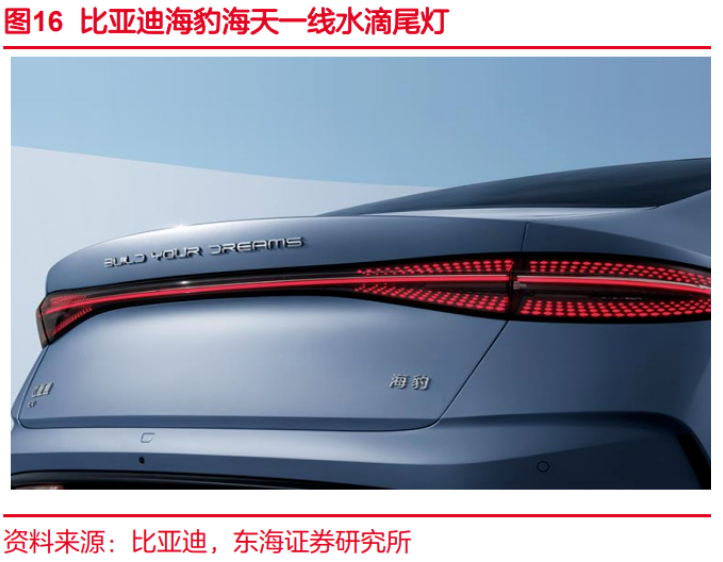
New energy vehicle manufacturers prioritize styling design, and full-width taillights have become a common choice. In recent years, new energy vehicle companies such as BYD and emerging brands have widely adopted full-width taillights in their new models. (1) BYD: Models in the Ocean Network series, such as the Seal with its "Horizon Line," the Dolphin with its "Geometric Folded Lines," and the Frigate 05 with its "Geometric Dot Matrix"; models in the Dynasty Network series, such as the Qin with its "Dragon Claw Mark," the Han with its "Chinese Knot," and the Yuan with its "Flying Feather Shadow," all feature full-width taillights, showcasing the Ocean Aesthetics of the Ocean Network and the Dragon Beam family design philosophy of the Dynasty Network. (2) Emerging Brands: Applications of full-width taillights include the "Star Ring Light" on Li Auto models, the "Eagle Wing Taillight" on the AITO M5, the "Star Flame Taillight" on the Deepal SL03, and the "Star Ring Flowing Light Taillight" on the Avatr 11. On some models like the AITO M7 and XPeng G9, the full-width taillights can coordinate with the headlights to implement light language modes. For example, the AITO M7 offers intelligent light language functions such as "door opening triggers lighting response for smart welcome; voice activation causes flicker with zoned response; after door opening, if a vehicle approaches from behind, the lights turn red for intelligent warning."
Some vehicle models also use through-type headlights on the front of the car. Brands such as Volkswagen and Li Auto have adopted the design of through-type headlights as a form of exterior ambient lighting. (1) Volkswagen: In 2020, Volkswagen first used through-type headlights on the TAOS. Currently, domestic models such as the Golf and Tavendor have adopted through-type headlights. According to SAIC Volkswagen's "A Design Scheme for Through-Type Front Lighting in Automobiles," Volkswagen's through-type front lighting system consists of the car logo, logo trim ring, grille body, through-type light strip, grille decorative strips, and light strips. Among these, the through-type light strip uses the principle of light guide illumination to convert LED point light sources on the PCB circuit board into soft line light sources. (2) Li Auto: Li Auto models all feature the "Star Ring Light." The Star Ring headlight on the new Li Auto L9 model is over 2 meters long with no breaks in the middle. (3) Other brands: Many models such as the BYD Destroyer 05, Chevrolet Trailblazer, Changan CS75 PLUS, Enovate ME5, and Roewe RX5 are also equipped with through-type headlights.
2.2. Digitalization: Pixel enhancement drives tail lights toward information interaction
2.2.1. OLED: Surface light source technology, with luxury brands such as BBA, Bugatti, and Hongqi successively entering the market
Luxury brands such as BBA, Bugatti, and Hongqi have successively advanced the application of OLED tail lights. (1) Audi: In 2016, the Audi TT RS became the first mass-produced model to adopt OLED tail lights, followed by models like the Audi A8 and Audi RS7 Sportback. In 2019, Audi introduced digital OLED technology, significantly increasing the number of segments from the initial 4 to over 50, enabling more customized designs for OLED tail lights. With the application of digital OLED technology, the Audi Q5 tail lights achieved modes such as welcome sequential lighting, goodbye sequential lighting, and approach indication, while the Audi A8 and Audi S8 added dynamic turning functions. (2) Mercedes-Benz: In 2017, OLED tail lights were used in the Mercedes-Benz S-Class, featuring 33 segments. The EQA concept car unveiled this year adopts the latest technology, with light strips in a three-dimensional spiral shape. (3) BMW: Since 2015, OLED tail lights have been used in the M4 Concept Iconic Lights, M4 GTS, M4 CS, BMW 8 Series, and the recently previewed M4 CSL. (4) Bugatti: Used in the Divo model launched in 2018. (5) Hongqi: In 2020, the Hongqi H9 adopted OLED tail lights, with 4 panels on each side, each panel having 5 segments.
OLED taillights are now available in the 300,000 RMB price segment. In the domestic market, the Audi Q5L Sportback, priced around 400,000 RMB, features OLED taillights on its top-trim version, offering dynamic driving modes and three constant-light modes. For other models, they can be optionally equipped for 9,800 RMB, significantly lower than the 25,000 RMB option price for the Audi A8L. The Hongqi H9 is priced between 309,800 and 539,800 RMB, with three versions above 369,800 RMB featuring the "Beidou Wing" rear combination lamp with dynamic welcome effects, bringing OLED taillight applications down to the 300,000 RMB level.
The supply chain for OLED taillights mainly includes Tier 1 lighting assembly suppliers and Tier 2 suppliers of OLED panels, chips, etc. (1) Lighting assemblies: Includes Hella, Valeo, Xingyu, etc. Huayu Vision, Yanfeng Plastic Omnium, and Mand Optoelectronics also have relevant layouts. Hella and Xingyu's OLED taillight products are already equipped on related Audi and Hongqi models, while Huayu Vision, Yanfeng Plastic Omnium, and Mand Optoelectronics cooperate with Yiguang, with OLED taillight products in small-scale mass production or used for display.
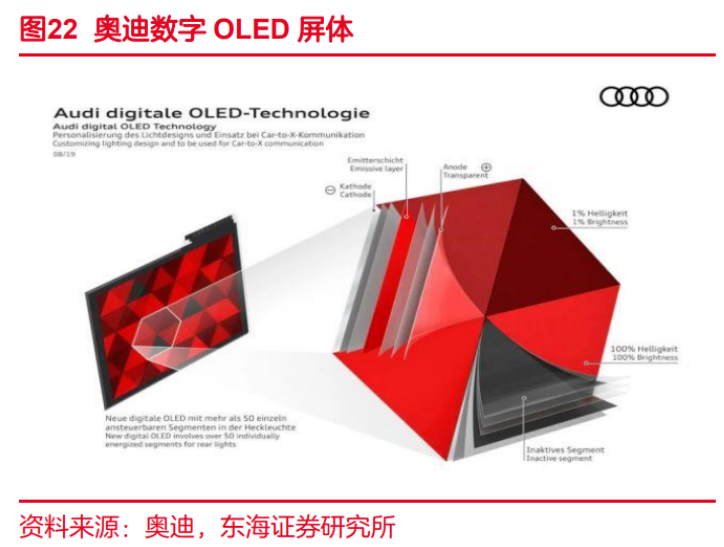
(2) OLED panels: including OLEDWorks, YiGuang, etc. Taking Audi as an example, the flexible OLED technology adopted by Audi was jointly developed by OSRAM, Hella, Audi, and others in the R2D2 project of the German Federal Ministry of Education and Research (BMBF). Later, due to OSRAM reducing its investment in OLED, Audi turned to cooperate with OLEDWorks. OLEDWorks is a global leading OLED panel manufacturer; it acquired Philips' OLED business, including the Aachen factory in Germany, in 2015, and is the panel supplier for the digital OLED taillights of the Audi A8. Domestic company YiGuang was spun off from Visionox in 2015, with its technology originating from Tsinghua University's OLED project team, and its production bases located in Gu'an, Hebei and Huaishan, Anhui. The OLED taillights of the Hongqi H9, which went public in 2020, were supplied through a collaboration between YiGuang and Xingyu. Other suppliers such as Yiguang Technology, Fangsheng Electronics, Jinghe Optoelectronics, BOE, as well as Haosheng, Dibao, Lai Bao, and Industrial Technology Research Institute in Taiwan, China, also have relevant layouts.
OLED taillights require no optics or heat sinks, offering advantages such as ultra-lightweight, ultra-thin profile, and flexibility. The OLED light source module consists of an OLED panel, FPC, and panel bracket. The OLED panel is mainly composed of a substrate, transparent electrodes, and organic emissive layers. Its principle involves exciting the organic emissive layer to emit light via electric current. Since organic materials can emit light efficiently without forming single crystals and do not need to be placed on expensive crystal substrates, the light-emitting area can cover most of the substrate, providing wide-angle, low-glare, hotspot-free light sources, making them ideal for large-area lighting applications.
According to data from OLEDWorks and YiGuang Technology, the advantages of OLED taillights include: (1) Thin and lightweight: The OLED panel thickness is 1 mm, requiring no more than 25 mm of installation space, whereas inorganic LED components typically exceed 100 mm in size. Meanwhile, the operating temperature of OLED is only 36°C, lower than the 60°C of LED, eliminating the need for heat sinks. As a surface light source technology, it also does not require complex optical devices, effectively reducing weight and decreasing the workload for assembly manufacturers in calibration and assembly. (2) Flexible: OLED can be easily stacked to produce different luminance and colors, and due to its special materials, it is easier to process into various shapes and sizes.
Digital OLED technology enables light language. According to OLEDWorks, OLED panels can be designed with multiple individually addressable segments, providing high contrast between segments without crosstalk, which makes light language possible. This allows OLED taillights to serve an interactive display function beyond signaling, conveying hazards and sudden changes in speed or road conditions to surrounding vehicles or pedestrians, thereby improving road safety. With the development of digital OLED technology, the number of zones in OLED taillights continues to increase. For example, OLEDWorks' latest automotive OLED panel features over 600 zones, and the digital OLED taillight developed by Yiguang in collaboration with STMicroelectronics has 1,434 pixels, enabling functions such as interaction, decoration, welcome, farewell, and position lighting, while demonstrating the potential for future implementation of braking, turning, and reversing functions.
2.2.2. Surface LED: A low-cost alternative to OLED taillights, already used in many Volkswagen models
Surface LED technology is used in many Volkswagen models, and Land Rover has introduced it in new models. Since 2020, Volkswagen has applied Surface LED technology to models such as the ID.4, ID.6, Arteon, Taos, and Tiguan. The Range Rover Sport released this year also marks the first time Surface LED technology has been introduced into mass-produced vehicles.
Tier 1 suppliers such as Magna, Huayu Vision, Hella, and Marelli all possess Surface LED lighting technology, generally using light guide plates and optical films to achieve uniform illumination. The Surface LED taillights for Volkswagen models are supplied by Magna, Huayu Vision, and others. Other Tier 1 suppliers' Surface LED technologies include Hella's FlatLight and Marelli's Folia LED. (1) Magna: The taillights for the Volkswagen ID.4 are supplied by Magna, utilizing Surface Element Lighting technology. The minimum thickness of a single panel is only 4 mm, and it allows for pre-programmed custom lighting animation effects. (2) Huayu Vision: The IQ.Light LED continuous parallel flowing-light taillights for the domestic ID.6 X are provided by Huayu Vision, featuring side light entry and composed of reflectors, optical panels, diffusion films, etc.
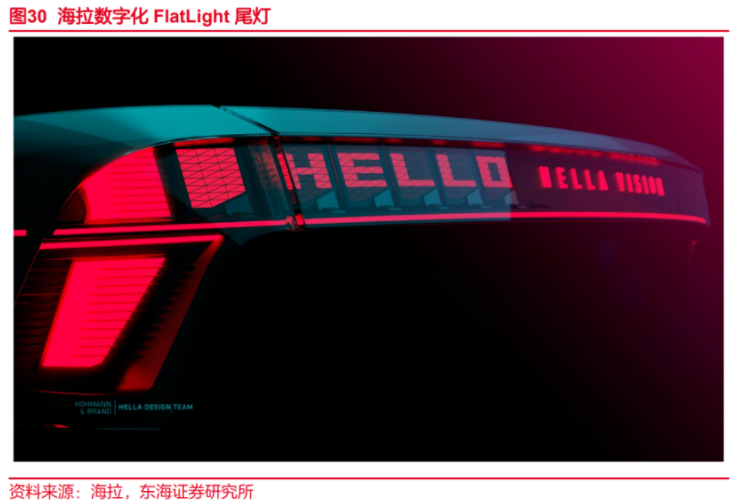
(3) Hella FlatLight: Composed of a rear cover, light guide plate, optical film, and front Lens. It is realized based on various technologies such as Hella's μMX (micro-optics technology using innovative light guides), μDP (metal coating technology that eliminates the need for covers and lenses), and SmartGlass (display technology). With a thickness of only 5 mm, it achieves all rear combination lamp functions, including turn signals, brake lights, and tail lights, with just 1W of power. Compared to traditional tail lights, FlatLight offers 80% Energy saving. According to Hella's annual report, FlatLight will be mass-produced for an international automobile manufacturer in 2024. (4) Marelli Folia LED: Adopts a design with two LED screens and an interlayer, combining shape and texture. The thin-layer Folia LED technology can achieve the thickness of OLED but at a significantly reduced cost.
Surface LED pixels continue to improve, enabling dynamic display functions. Hella's digital FlatLight has achieved a significant increase in pixel count. In the digital FlatLight prototype released in 2021, the front SmartGlass was divided into 44 triangular sections, making it easier to program new headlight designs. It also enables new business models such as installation and graphic adjustments via apps or software updates. The lighting can be adjusted according to driving modes, displaying text or symbols to warn road users of traffic jams or icy roads, or showing graphics for electric vehicle battery levels. Hella states that integrating Active Matrix Displays technology will further enhance the resolution and functional range of rear combination lamps.
3. Ambient Light
3.1. Interior Lighting: Integrated into the smart cockpit to create an immersive experience
Interior ambient lighting is used in multiple areas inside the vehicle cabin. It is commonly applied to the instrument panel, doors, center console, dome lights, sunroof, headliner, front and rear footwells, rear seats, and other areas, using light strips or point-source forms. In terms of light emission, it includes direct-emission point-source ambient lighting (composed of a diffuser cover, LED circuit board, and housing), linear point-source ambient lighting (composed of a light-emitting module, light guide, and mounting bracket), and surface-emitting point-source ambient lighting (composed of a luminous cover, surface light guide, LED circuit board, and housing), serving different areas of the vehicle cabin.
The penetration rate of ambient lighting in the domestic passenger car market is estimated to be around 30%. Based on the latest configurations and sales volumes of major models, the current penetration rate of ambient lighting in the domestic passenger car market is approximately 30%. According to sales data from the China Passenger Car Association (CPCA) and configuration data from Pacific Auto Network and Yiche, among the top 15 best-selling models in the first half of this year: (1) Sedans: Sagitar and BMW 5 Series come with standard ambient lighting; Sylphy, New Lavida, BYD Qin, New Bora, BYD Han, BMW 3 Series, Emgrand, and other models have ambient lighting in certain versions. (2) SUVs: Tesla Model Y, Audi Q5, and BMW X3 come with standard ambient lighting; BYD Song, Haval H6, Honda CR-V, Changan CS75, Changan CS55, Mercedes-Benz GLC, Toyota RAV4, Wildlander, Tiguan, and other models have ambient lighting in certain versions. (3) MPVs: Elysion, Refine, and Custo come with standard ambient lighting; Buick GL8, Sienna, GAC Trumpchi M8, Forthing, GAC Trumpchi M6, Mercedes-Benz V-Class, and other models have ambient lighting in certain versions. Overall, German brands have a higher proportion of ambient lighting configurations, followed by domestic brands, while Japanese brands have a relatively lower proportion.
Taking Volkswagen and new energy vehicle startups, which feature advanced ambient lighting configurations, as examples: (1) Volkswagen: Ambient lighting upgrade; the IQ.Light Spirit offers scenario-based expression. Volkswagen has continuously upgraded its ambient lighting, increasing from single-color/multi-color/10-color to 30-color ambient lighting in certain models starting with the 2021 lineup, such as the ID.4 launched in 2021, as well as the 2021 CC and Teramont. The IQ.Light Spirit at the front of the cockpit is also a key component of Volkswagen's IQ.Tech suite. According to Volkswagen, the IQ.Light Spirit is a light strip that runs horizontally across the cockpit, featuring scenario-based expression. Drivers can intuitively perceive the vehicle's status through color and dynamic lighting effects, reducing the complexity of information reading. Lighting changes occur during actions such as unlocking (welcome), locking (farewell), vehicle start-up, gear shifting, and navigation turns.
(2) New Forces: Ambient lighting linked with the vehicle infotainment system, audio, seats, etc., to achieve personalized lighting changes. New force brands generally prioritize ambient lighting configurations; for example, Leapmotor C11/S01 and Neta S are equipped with stepless color-changing ambient lighting, Li Auto L9, NIO ET5/ET7/ES6, and IM Motors L7 are equipped with 256-color ambient lighting, while AITO M5 and HiPhi X are equipped with 128-color ambient lighting. In smart cockpits, ambient lighting can interact with the vehicle infotainment system, audio, seats, steering wheel, air conditioning, fragrance systems, etc., automatically changing color and luminance based on driving scenarios, driving modes, driver emotions, movies, music, etc. Models like XPeng G9 and AITO M7 can achieve these functions, providing immersive movie and gaming experiences; Avatr 11 adjusts lighting based on the owner's emotions via in-car cameras.
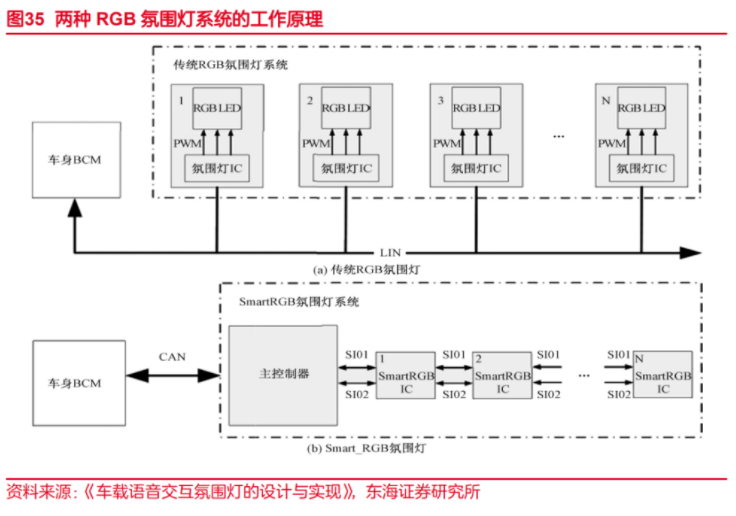
Under the Smart RGB technology roadmap, the cost of multi-color ambient lighting is reduced and transmission speed is increased. Single-color ambient lights can adjust luminance according to different lighting needs, while multi-color ambient lights, based on RGB LED controllers, enable richer scenarios and can adjust color and luminance according to temperature, rhythm, etc. The technical roadmaps for multi-color ambient lighting mainly include the traditional approach and Smart RGB. (1) Traditional RGB ambient lighting: A single ambient light chip controls and drives a single RGB light source, communicating with the vehicle body BCM via LIN. The traditional solution requires a large number of electronic components and connection wires, resulting in slower transmission speeds and electromagnetic interference issues, and it is difficult to ensure consistency in light color and luminance for each RGB LED. (2) Smart RGB: Integrates RGB LED, LED driver, and communication link into one IC packaging. Each IC acts as an independent node, with all nodes connected in series to the main controller via a bus, which communicates with the vehicle body BCM. Smart RGB offers advantages such as low cost, fast transmission speed, high reliability, and high consistency.
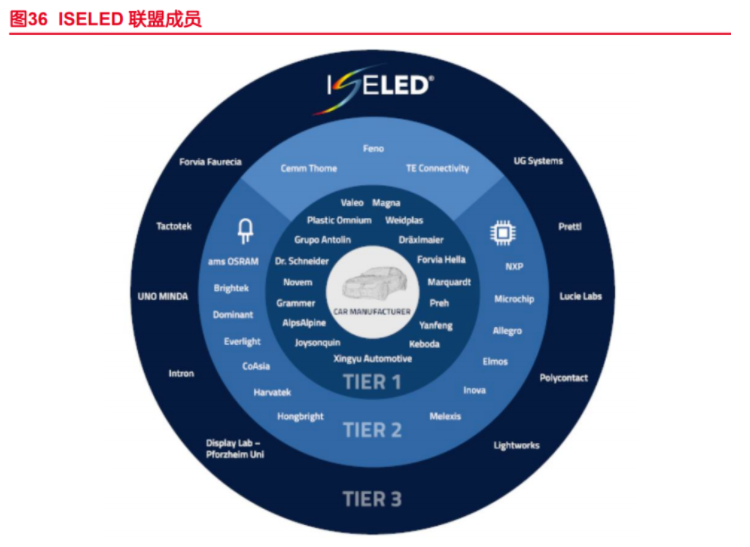
Upstream and downstream players across the supply chain are jointly promoting the adoption of Smart RGB solutions. The ISELED Alliance was founded in 2016 and is dedicated to the application of intelligent LED modules in automotive lighting. It currently has more than thirty corporate members, covering suppliers and research institutions across various segments including light sources, EDS, semiconductors, MCUs, wiring harnesses/connectors, Tier 1, software, design, and testing. Tier 1 members include automotive lighting and interior suppliers such as Alps Alpine, Schneider, Dräxlmaier, Hella, Grammer, Antolin, Joyson Qunying, Keboda, Magna, Marquardt, Plastic Omnium, Preh, Valeo, Xingyu, and Yanfeng; Tier 2 consists of suppliers of light sources, chips, connectors, and other components.
3.2. Exterior Lighting: Volkswagen widely applies exterior lights such as light carpet lamps, puddle lamps, LOGO lamps, and grille lamps.
Volkswagen models extensively use exterior lighting, which has become an important component of the IQ.Light matrix. The Volkswagen IQ.Light matrix consists of the VW emblem, welcome puddle lights, headlights, taillights, continuous front and rear light bars, and matrix headlights. With the introduction of IQ.Light, the importance of exterior lights such as the VW emblem and welcome puddle lights has significantly increased. Based on current model configurations, Volkswagen's exterior lights are distributed across various locations including above the front grille, side mirrors, side badges, door handles, and roof racks. Models like the CC, Magotan, and Golf feature 7-8 exterior light positions. The new Tavendor model adopts full-body exterior ambient lighting, including a continuous front ambient light strip, fender light strips, illuminated front and rear logos, roof rack ambient lights, door handle ambient lights, puddle lights, and a continuous taillight bar. These can work in conjunction with the headlights to realize welcome and goodbye modes.
Grille lights: Evolving from a single lighting function to dynamic interactive light language modes. Beyond mass-market models, vehicles such as the Changan UNI-T, Roewe RX5, Zeekr 009, and Cadillac Lyriq are also equipped with grille lights. Some grille lights can achieve light language modes; for example, the Roewe RX5 "Phoenix Feather Emotional Interaction Grille Light" consists of 18 DRL modules on each side forming a "3×6" matrix to create various light language patterns. The Lyriq's "Black Crystal Radiant Grille" comprises 58 light strips with independent light sources, which can illuminate step-by-step and then light up the entire emblem, creating a wing-spreading effect.
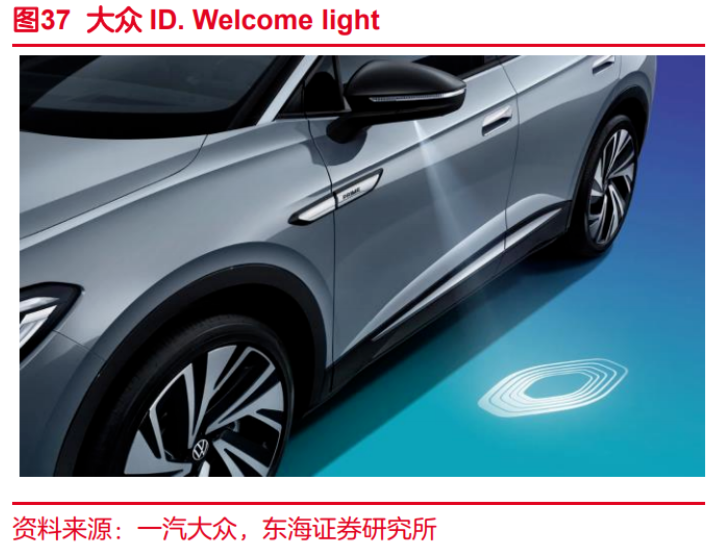
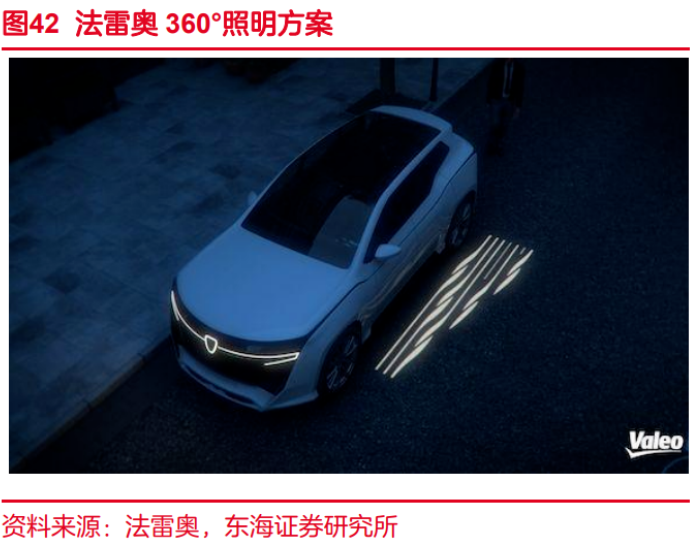
Light Carpet Lamps: Expected to become a carrier for information interaction under 360-degree lighting Solution. Light carpet lamps are also known as carpet-style welcome lamps, light-and-shadow carpet lamps, or light-curtain vehicle lamps. Companies such as Hella, Valeo, and Huawei have made strategic layouts in this area. (1) Hella: The light carpet lamp was first introduced by Hella as the "Angel Wings" feature for the BMW 7 Series. Owners can illuminate the roads on both sides of the vehicle by simply pressing a button on the car key. This technology is based on MLA (Micro Lens Array) technology, installed on the door sills behind the front wheels, and achieved local production at Hella's Changchun factory in 2020. (2) Valeo: In 2021, Valeo announced the development of the first 360-degree lighting Solution entirely centered around the vehicle. It projects operational information onto the ground while driving, such as direction changes or engaging reverse gear, and can also project short-range welcome messages or door-opening signals around the vehicle to facilitate other road users.
4. Key Company Analysis
4.1. Xingyu Shares: Leader in complete headlamp assemblies, expanding into halo ring lights and grille lights
A leading automotive lighting assembly manufacturer with a domestic market share at the forefront in China. The company is one of the leading suppliers of automotive lighting assemblies in China, with products comprehensively covering headlamps, rear combination lamps, fog lamps, door lamps, reading lamps, turn signal lamps, parking lamps, and other types. It supplies to leading domestic joint-venture and independent brands such as FAW-Volkswagen, FAW-Toyota, SAIC Volkswagen, Chery Automobile, and FAW Car. In 2021, the company's automotive lighting business revenue reached RMB 7.048 billion, accounting for 89% of its sales revenue. According to data from Huajing Industry Research Institute and Yole, the company's domestic market share reached 14%, second only to Huayu Vision; its global market share reached 3%.
The product upgrade path is clear, with ASP continuously increasing. From 2012 to 2021, the company's automotive lighting product ASP rose from around 39 yuan to around 112 yuan, corresponding to a CAGR of 13%, continuously benefiting from the dividends brought by product upgrades. Reviewing the company's development history: (1) Improvement in product structure: In the early stages, the company focused on promoting headlight配套, increasing the proportion of high-priced headlights and decreasing the proportion of low-priced small lights; (2) LED headlight penetration: In recent years, the company has seized the trend of LED headlights replacing halogen lamps, achieving an increase in the per-vehicle配套 amount for headlights; (3) Intelligent automotive lighting: Electric vehicle brands have aggressive lighting configurations, and various new technologies are gradually being commercialized. The company has deep technical accumulation in areas such as ADB headlights, pixel headlights, laser-assisted headlights, and OLED taillights, and is expected to continue benefiting from the popularization of intelligent automotive lighting.
Newly built through-type headlight factory; star ring lights and grille lights show promising growth. In July this year, the company announced that it would change the original fundraising investment project "Smart Manufacturing Industrial Park Electronic Factory" to the "Smart Manufacturing Industrial Park Phase V" project, planning to build a through-type front headlight factory with an annual production capacity of 500,000 units each for star ring lights and grille lights. Against the industry backdrop of increasing adoption of through-type headlights, the new project is expected to further help the company expand into this high-growth niche market.
4.2. Keboda: Leader in Lighting Control, Smart Light Source Business Poised for Growth
A leader in the lighting control niche with global competitiveness. The company has deeply cultivated the automotive electronics field, with product types covering lighting control systems (lighting control), motor control systems, energy management systems, smart actuators, and more. Among these, lighting control products have been the company's advantageous products since its establishment, with profound technical accumulation and global competitiveness. Currently, the company's lighting control products comprehensively cover main light source controllers, auxiliary light source controllers, tail light controllers, ambient light controllers, and other types. In 2021, sales revenue reached 1.38 billion yuan, accounting for 49% of the company's total sales revenue.
Deepened cooperation with Volkswagen, actively expanding Japanese and luxury customers. The company is one of the core enterprises in the Volkswagen supply chain. Its main light source controller products have upgraded from early HID electronic ballasts to LED headlight controllers. In the field of LED headlights, it obtained product development rights for Porsche LHC and LLP in 2014 and 2016, with product competitiveness recognized by high-end brands. Meanwhile, the company actively promotes the optimization of its customer structure, with lighting control products gradually supplied to global OEMs such as BMW, Ford, Renault, Nissan, Honda, and Suzuki. It is focusing on intelligent light sources, leveraging the trend of Volkswagen's ambient lighting upgrades. In 2020, the company established an Intelligent Light Source Center based on its original ambient lighting business, with products including ambient lights, reading lights, Smartlight, etc. It has cumulatively secured multiple nominated projects from FAW-Volkswagen, SAIC Volkswagen, and Volkswagen Germany, and is gradually supplying models such as ID.4, CC, Audi A3, and Teramont for FAW-Volkswagen and SAIC Volkswagen. Since the 2021 model year, Volkswagen has upgraded single-color/multi-color/10-color ambient lights in some models to 30 colors, benefiting the company from this upgrade trend. In the first half of 2022, the company's intelligent light source sales revenue increased by 50% year-on-year (YoY).
(Report Provider/Author: Donghai Securities, Huang Hanxu)
Source: Future Think Tank