
[[0]] Museum Cabinet Lighting Design | Dilemmas and Breakthroughs
For the audience, the greatest value of display cases lies in meeting their exhibition needs to appreciate the overall appearance of exhibits and examine details at an extremely close distance.
Lighting within display cases offers the greatest value to viewers by restoring the physical characteristics of exhibits within a minimal spatial scale, enhancing their artistic features, and meeting aesthetic needs for visual experience.
PART-01
Three Major Criteria for Cabinet Lighting
照明还原的准则有三,首先要客观、完整、准确地展现展品的形体、轮廓、结构(第一准则);然后是质感、色彩、图案(第二准则);最后是画工、笔法、技艺(第三准则)。三个准则遵循认知事物先从整体再到局部再到细节的规律,第一准则没有达成,第二、三准则就无法达成。
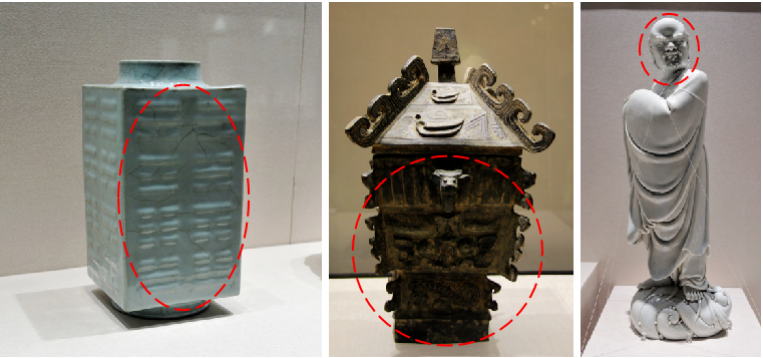
Figure 1
图中红圈所示是当下博物馆展柜内常见的“第一准则”未达成的普遍现象,其不仅破坏了展品的形状、轮廓、结构的属性,使其失去了观赏的价值,而且传递了错误视觉印象,降低了展览体验兴致。同时也充分反映了主体表现的缺失,就无法提供有效的界面来表现局部与细节。
To achieve the goal of the 'First Criterion', one must select the main light direction based on the form characteristics of the exhibit; this is the first important decision in lighting design within the display case.
To fully represent a three-dimensional exhibit, lighting positions for top, side, and bottom illumination must be set up inside the display case, especially when the exhibit is uncertain or subject to regular replacement; no direction should be missing.
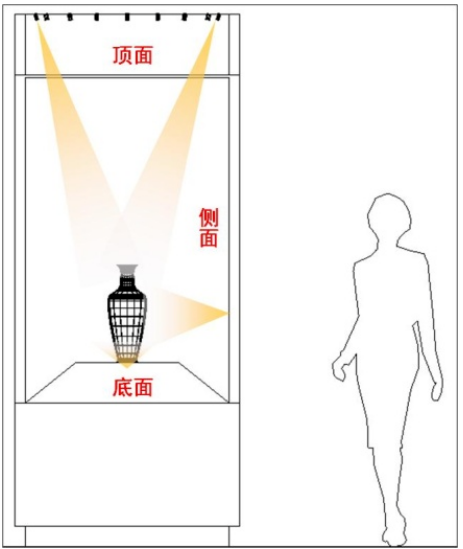
Figure 2
In actual venues, when lighting teams cannot provide an effective Solution due to requirements for the simple and aesthetic appearance of display cases and their internal space, side lighting is typically not used. (See Fig. 3)
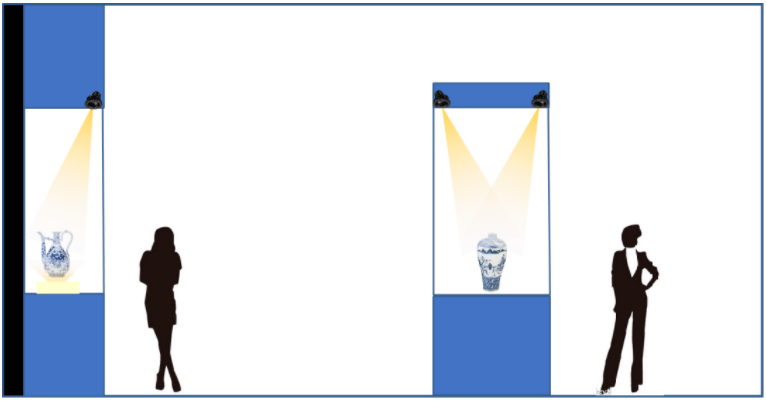
Figure 3
The core essence of a museum is the exhibits . Most institutions prioritize ensuring optimal exhibit presentation over display case aesthetics. Currently, the industry often focuses solely on technical parameters such as "color temperature, illuminance, and color rendering," while rarely addressing visual design and management aspects like "light-and-shadow sculpting, field of view composition, and light-color psychology." Consequently, the first principle remains largely unfulfilled. During site visits, construction personnel observed that many venues do not employ side lighting, mistakenly considering this a standard practice; thus, they adopted it as a benchmark for new museum constructions. This "directional error" and "standard error" are the root causes of the current lighting dilemmas within display cases , resulting in visitors generally perceiving exhibits with the following visual impressions (see Figure 4) .
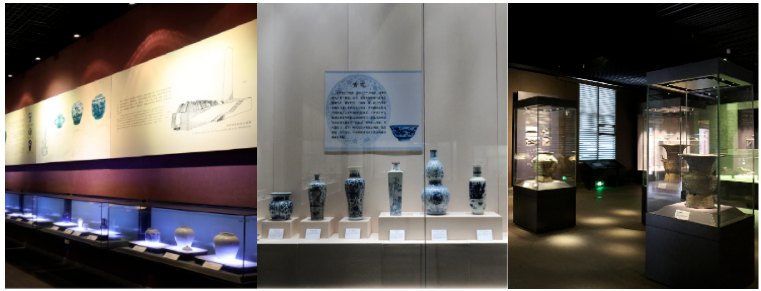
Figure 4
If the display effect of a museum exhibit is not achieved, what is the point of making the exhibition environment and equipment excellent? Visitors come to museums to see exhibits, not decorations.
Choosing the direction of the main light is a critical success factor in accurately expressing the formal and intrinsic beauty of an exhibit and presenting it unified to the audience.
PART-02
Two Major Application Principles and Analysis of Light
Before selecting the main light direction, we must understand and accept the two most fundamental principles of lighting application. These are scientific and objectively existing; they do not change according to human will. This ensures that our selection is free from shortcuts or imagination.
First Application Principle: Light propagates in a straight line through air; when an object blocks the propagation path, the surface below cannot be illuminated and a shadow of the upper structure appears (see Fig. 5).
Second Application Principle: Light follows the principle that the angle of incidence equals the angle of reflection; surfaces parallel to the light rays cannot be illuminated without reflection (see Figure 5).
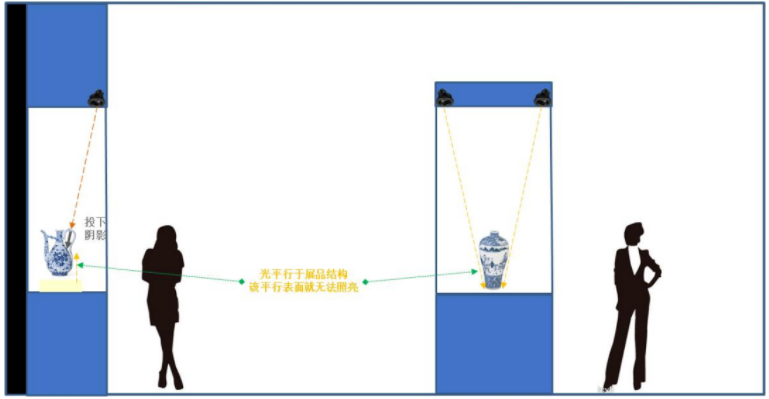
Figure 5
Following the two principles above, this reduces shadows on the exhibit surface while fully rendering the main body of the exhibit. Corresponding to the vessel forms of the two exhibits shown in the figure, the correct key light direction should be frontal or side lighting. (See Fig. 6)
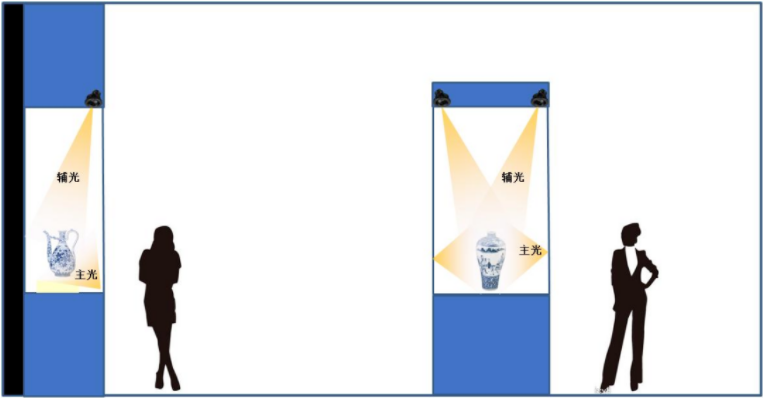
Figure 6
The following compares the visual effects and lighting data simulated via software: results using only top-down single-direction lighting (Fig. 7) versus results using both top-down and side lighting in two directions (Fig. 8).

(The above are illuminance false-color values; except for Figure 12 which uses luminance false-color values, all other figures in the text follow the above reference values)
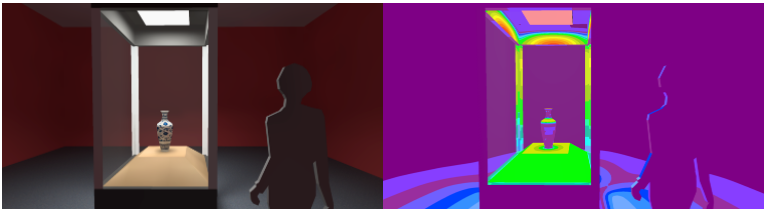
Figure 7
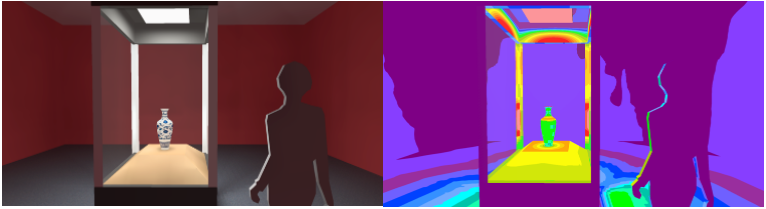
Figure 8
Figure 7 shows that the bottle surface is dull and non-reflective; the illuminance on this surface is <10 lx, while only the shoulder reaches the national standard of 300 lx. The contrast ratio between them is 1:30, far exceeding the comfortable range of 1:3 or 1:5.
In Figure 8, the bottle surface is relatively bright; the illuminance on this surface exceeds 100 lx because side lighting control is effective. The shoulder remains unaffected by叠加 and stays at 300 lx, resulting in a comfortable contrast ratio of 1:3 between the two areas.
In addition to independent cabinets, where side lighting can enhance display effects and data for exhibits, longer wall-mounted cabinets can achieve the same improvement by adding face-direction lighting. See the comparison in (Fig. 9) and (Fig. 10).
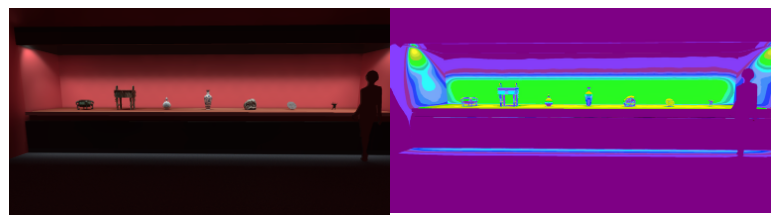
Figure 9
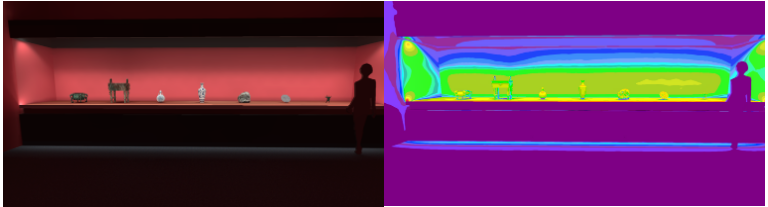
Figure 10
clearly shows (Fig. 10) a significant improvement over (Fig. 9) in terms of display lighting effect expressiveness, visual aesthetic appeal, illumination data values, and contrast ratios.
After selecting the correct main light direction to achieve the 'First Principle' goal, choosing the lighting form along that direction is the second important decision in . Even with the correct direction, an incorrect form will still produce erroneous lighting results.
Common museum display case lighting forms; typically, top and bottom lighting use area illumination, while top and side lighting use multi-point illumination. (See Fig. 11)
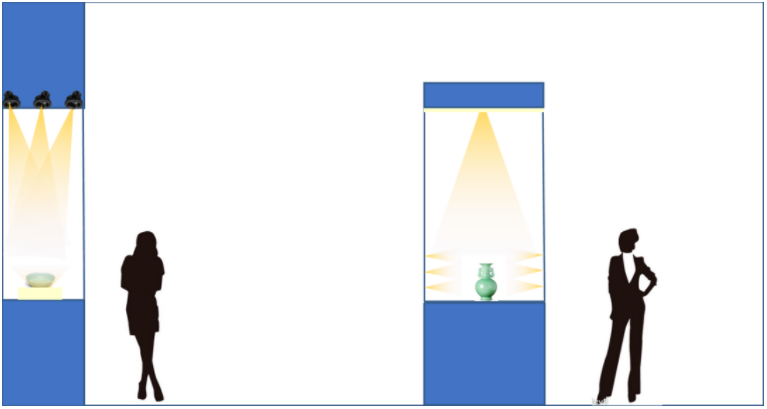
Figure 11
First, objectively analyze the pros and cons of the surface-emitting form. (See Fig. 12)
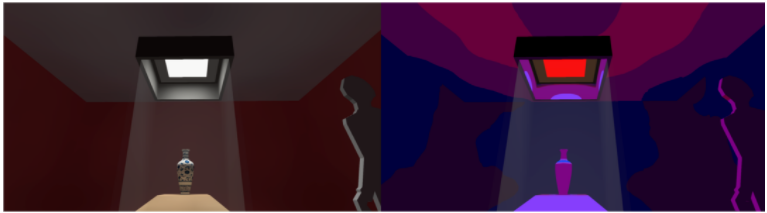
Figure 12

(Luminance pseudocolor values above)
The luminance of the luminaire's emitting surface is >500 cd/m², while the luminance at the bottle shoulder is <40 and at the bottle body is <5. The contrast ratio between the highest and lowest values reaches 100:1, creating an overly strong stimulating effect within the field of view. According to the principle of human eye phototropism, the bright luminaire surface attracts the audience's gaze, interfering with the attention of visitors; clearly, the disadvantages outweigh the benefits. (See Fig. 13)
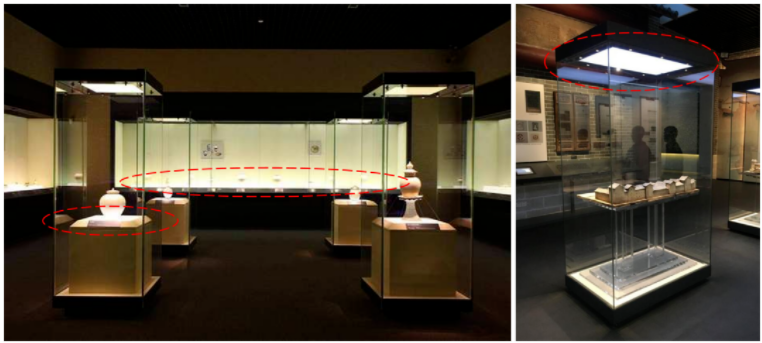
Figure 13
Secondly, objectively analyze the pros and cons of multi-point lighting forms. (See Fig. 14)
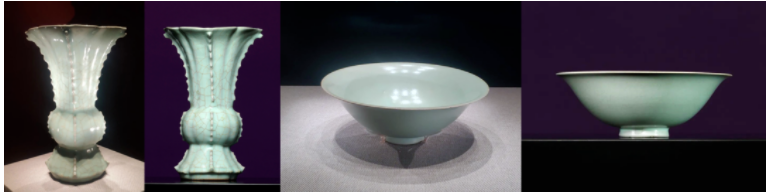
图14
Multi-point side lighting overlap severely degrades the texture of exhibits, completely eliminating the jade-like warmth of porcelain glazes: the specular highlights from multiple light positions reflect and disrupt the elegant form of the exhibits; each Luminaire produces a shadow, and the chaotic overlapping of multiple shadows creates a disorienting, out-of-focus visual effect.
To overcome the drawbacks of the aforementioned lighting forms, the countermeasure is to adopt secondary diffuse reflection instead of surface-emitting luminaires and multi-point lighting fixtures . By applying dark-lighting techniques on the diffuse surfaces, phenomena such as overly bright emitting surfaces, multiple specular highlights, and multiple shadows are avoided. This achieves excellent illumination for exhibits while providing a comfortable viewing environment for the audience. (See Figures 15, 16)
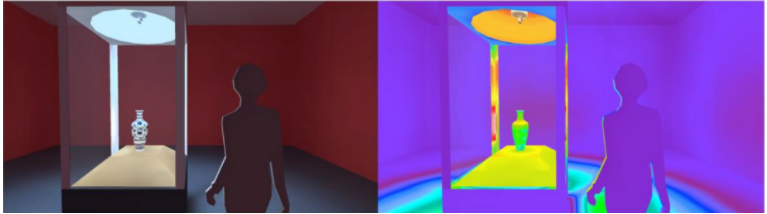
Figure 15
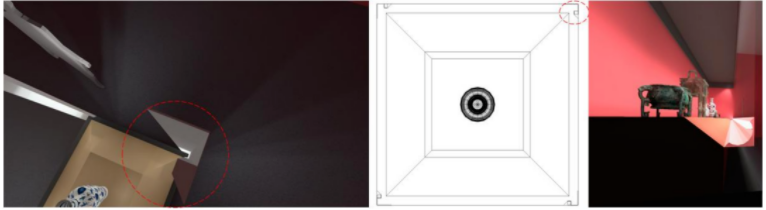
Figure 16
Achieving lighting restoration in an exhibition only fulfills the most basic functional goal; creating lighting effects that enhance the artistic characteristics of exhibits and meet aesthetic needs for visual experience represents a higher value and purpose.
Strengthening the guidelines is achieved by shaping through subjective, directional, and guiding light and shadow, allowing the audience to feel why this exhibit is important, how it relates to them, and to perceive it more directly through visual effects, thereby understanding and comprehending the exhibit. This requires lighting professionals not only to master lighting expertise but also to possess substantial knowledge in exhibits, history, humanities, visual psychology, art appreciation, and aesthetic cultivation, along with high artistic expressiveness. Therefore, selecting a truly professional collaborative partner can yield twice the result with half the effort.
Professional lighting is a design art that uses light composition, figure-ground relationships of light and shadow, etc., to visually manage and guide the audience's perception and emotions (see Fig. 17/18/19). It provides the audience with a richer and more diverse immersive light-and-shadow experience, truly bringing exhibits to life instead of keeping them rigid, generating more traffic for exhibitions, attracting audiences to linger longer in front of the exhibits, and ultimately making the museum a professional place worthy of trust, a cultural place worthy of appreciation, an educational place worthy of learning, and a leisure place worthy of lingering. This is the breakthrough strategy for achieving "people-oriented" lighting both inside and outside museum display cases.
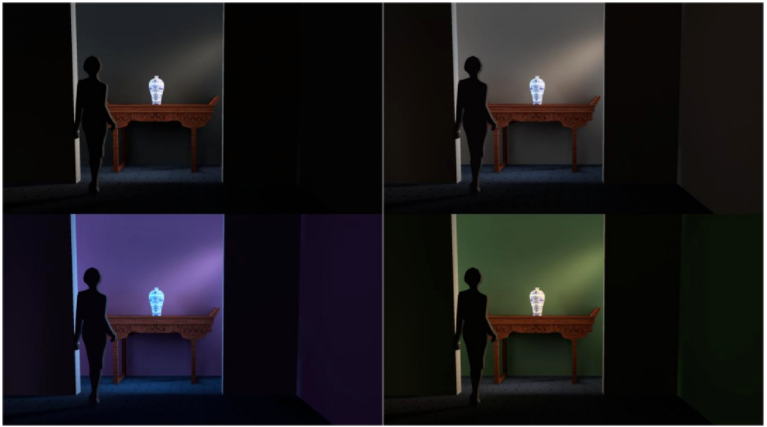
Figure 17
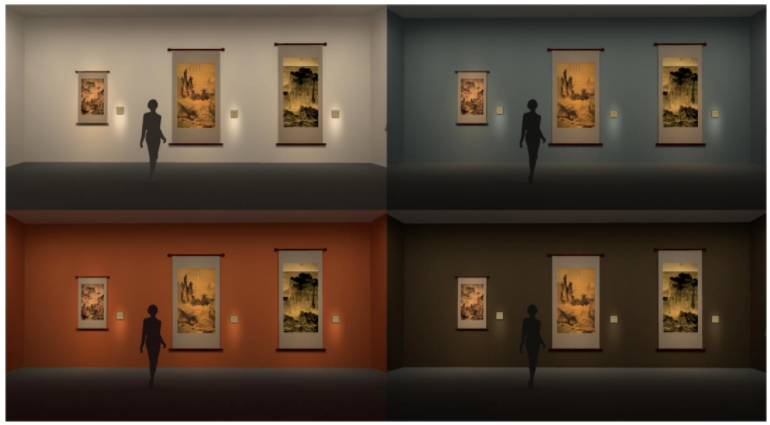
Figure 18
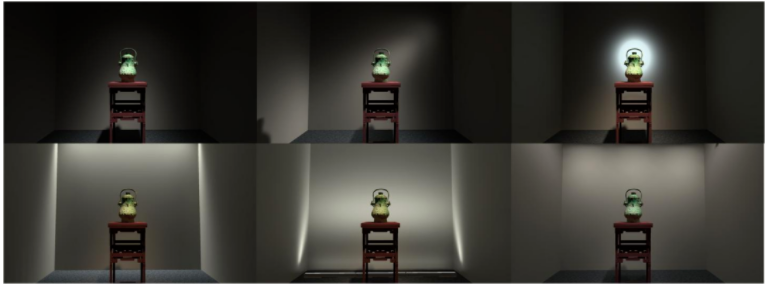
Figure 19
Author: Shi Cong Source: Mayalit