
Shenzhen University and the University of Science and Technology of China make new progress in perovskite LED field
Shenzhen University makes new progress in perovskite blue LED field
Recently, an interdisciplinary team led by Assistant Professor Huang Pu, Professor He Tingchao, and Assistant Professor Li Guijun from the School of Physics and Optoelectronic Engineering at Shenzhen University has achieved a major breakthrough in perovskite blue LED research. The findings were published under the title "Lattice strain modulation toward efficient blue perovskite light-emitting diodes" in Science Advances, a top-tier international journal under the Science umbrella. Shenzhen University is listed as the primary institution, with Huang Pu, He Tingchao, and Li Guijun serving as corresponding authors, and Postdoctoral Researcher Liu Baoxing as the first author. This research further advances the industrial application of perovskite blue LEDs.
据悉,该研究首次提出组合钙钛矿中的双极化跃迁通道增强蓝光跃迁的新思想,并通过应变工程实现破纪录的钙钛矿蓝光发射。研究不仅为钙钛矿蓝光LED的产业化应用迈出了重要一步,更为以实际应用为目标导向的材料设计和器件研究提供了一条标准范式。
Blue light is an indispensable component of the three primary colors (red/green/blue) in nature. Blue light materials and their light-emitting diodes (LEDs) play a crucial role in solid-state lighting and flat-panel display fields. In recent years, halide perovskite materials with high fluorescence quantum yield and high saturation have shown broad application prospects in solid-state lighting and display fields due to their unique advantages such as low cost and good conductivity, making them an ideal choice for next-generation energy-saving lighting. Currently, the external quantum efficiency (EQE) of green, red, and near-infrared perovskite LEDs is very high, having already exceeded 20% and approaching the device performance of commercial quantum dots and organic LEDs. However, as the last important cornerstone for white-light lighting and full-color displays, perovskite blue LEDs lag significantly in efficiency.
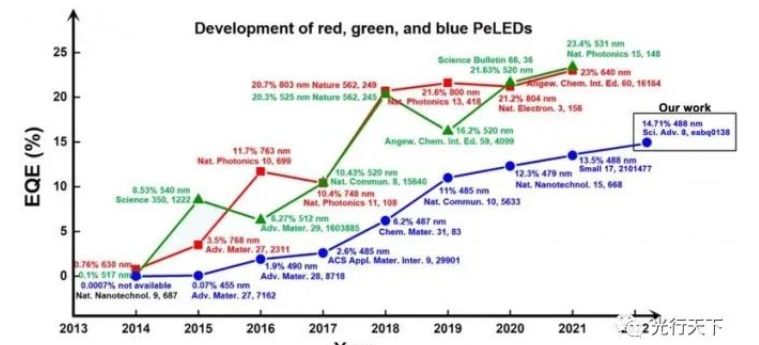
Development trends of red/green/blue perovskite LEDs since 2014
To address this issue, the research team proposed for the first time the physical concept of enhancing blue-light transitions via dual-polarization transition channels in combined perovskites. Typically, achieving efficient blue-light emission from semiconductors requires materials with a direct bandgap, a bandgap width within the blue-light spectrum, and non-forbidden parity of wavefunctions at the band edges. Furthermore, due to symmetry differences, the wavefunctions of energy states near the conduction and valence bands exhibit selectivity toward the polarization modes of absorbed/emitted photons, as seen in anisotropic semiconductors. Therefore, reasonably leveraging the polarization selectivity of electron/hole transitions at the band edges based on material symmetry characteristics is of significant importance for achieving polarization manipulation and performance enhancement in optoelectronic devices.
该研究从半导体发光的电子结构角度出发,到设计增强蓝光跃迁的物理模型,再到基于构效关系的理论+实验双重验证,最后实现器件研发和性能调控,为以实际应用为目标导向的材料设计和器件研究提供了一条标准范式。研究所提出的操控极化跃迁通道的物理模型和应变工程策略,不仅可以成功应用于钙钛矿蓝光器件的性能提升,更可以推广到光电、光伏、电子、能源催化等领域的多种材料体系,通过合理调控载流子的跃迁极化特征来实现相关器件的性能调制,或基于此构筑极化依赖的新原理器件原型。
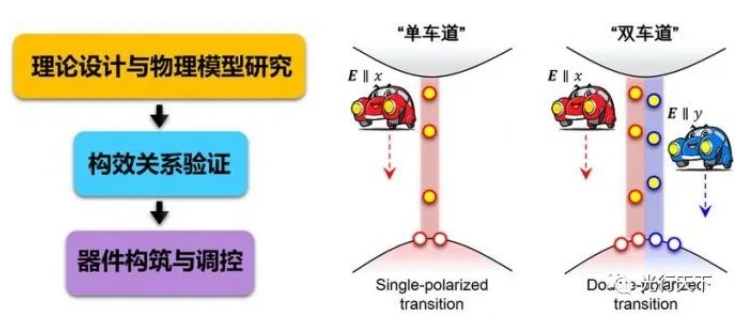
Standard research paradigm of theory + experiment, cartoon image of the transition channel from single-polarization to dual-polarization
This research work has received high praise from "Science Advances" and was supported by the Guangdong Provincial Natural Science Foundation, the National Key R&D Program, the Shenzhen Peacock Team, Basic Discipline Layout, and the Guangdong-Hong Kong-Macao Joint Fund projects.
Significant progress made by USTC in the field of perovskite LED and light-emitting devices
Recently, the research group led by Professor Xiao Zhengguo from the School of Physics at the University of Science and Technology of China, in collaboration with the groups of Professors Wang Jianpu and Wang Nana from Nanjing Tech University, has achieved significant progress in the preparation of perovskite films and the study of light-emitting devices.
Perovskite materials have important application prospects in solar cells, LEDs, and photodetectors due to their excellent optoelectronic properties. The film quality and microstructure of perovskite films play a crucial role in the performance of optoelectronic devices.
By creating nanostructures on the surface of perovskite, this research team increased photon scattering at the thin film surface, achieving a breakthrough in the efficiency limit of perovskite LED devices. The related findings were published in Advanced Materials under the title "Overcoming the Outcoupling Limit of Perovskite Light-emitting Diodes with Artificially Formed Nanostructures".
Perovskite LEDs offer advantages such as tunable emission wavelength, narrow full width at half maximum (FWHM), and ease of fabrication. However, the device efficiency of perovskite LEDs is currently mainly limited by light extraction efficiency. Therefore, increasing the light extraction efficiency of devices is a very important research direction.
In organic LEDs and quantum dot LEDs, an additional light extraction layer is generally required to increase photon outcoupling, such as using microlens arrays, biomimetic moth-eye nanostructures, and low-refractive-index coupling layers. However, these methods make the device fabrication process more complex and increase manufacturing costs.
The research group of Xiao Zhengguo reported a method that can spontaneously form textured structures on the surface of perovskite films, thereby increasing the light extraction efficiency of perovskite LEDs by enhancing photon scattering at the film surface.
During the thin-film preparation process, controlling the residence time of the anti-solvent on the film surface allows regulation of the perovskite crystallization process, thereby achieving a textured surface. For films with an average thickness of 1.5 μm, the surface roughness can be continuously controlled from 15.3 nm to 241 nm, and the haze correspondingly increases from 6% to over 90%.
Thanks to the increased photon scattering on the thin film surface, the light extraction efficiency of textured perovskite LEDs has increased from 11.7% for planar perovskite LEDs to 26.5%, and the corresponding device efficiency of perovskite LEDs has also significantly improved from 10% to 20.5%.
The above work provides a new method for fabricating light-extraction nanostructures in perovskite optoelectronic devices. Perovskite films with micro-nano structures resemble the textured morphology in crystalline silicon solar cells, promising to enhance the light absorption efficiency and performance of perovskite solar cells.
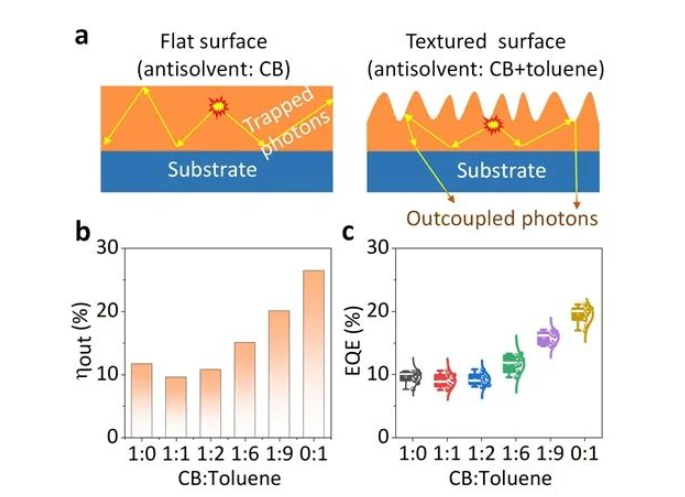
Figure: Schematic diagrams of photon extraction from different perovskite thin film surfaces (a). Light extraction efficiency (b) and device efficiency (c) of perovskite LEDs prepared with different anti-solvents.
Prof. Xiao Zhengguo from the School of Physics at the University of Science and Technology of China, along with Prof. Wang Jianpu and Prof. Wang Nana from Nanjing Tech University, are the corresponding authors of this paper. Postdoctoral researcher Chen Wenjing, master's students Chen Jia and Huang Zongming from the School of Physics, and PhD student Gu Lianghui from Nanjing Tech University are the first authors of this paper.
This research was supported by the National Natural Science Foundation of China, the Fundamental Research Funds for the Central Universities, and the Energy Research Institute of Hefei Comprehensive National Science Center.
Source: University of Science and Technology of China, Guangxing Tianxia, Shenzhen University