
Compare luminaires with different beam angles in cove lighting
In some spaces, cove lighting is often used as functional lighting; therefore, select luminaires with different power and light distribution according to the space to meet functional lighting needs.
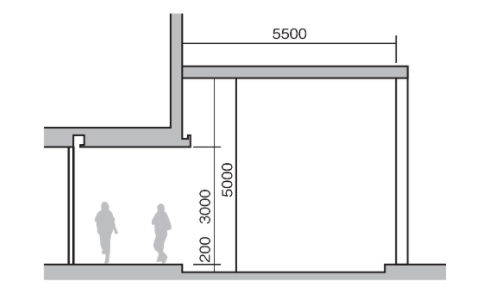
The figure below shows a garage cross-section: the right side is the garage space, illuminated by uplighting walls and ceiling; the left side is the corridor space, illuminated by downlighting the floor.
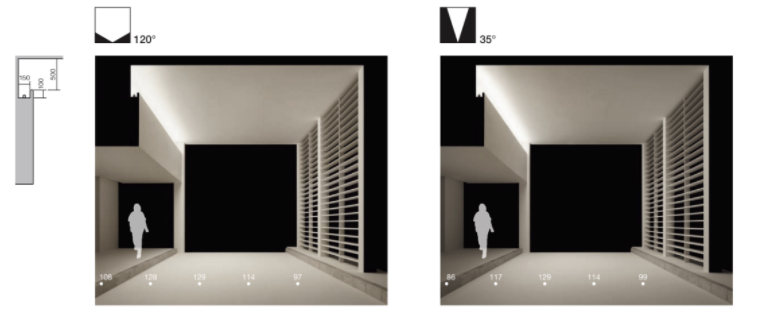
Below is a comparison of simulated effects when the cove light output is 500mm, with beam angles of 120° and 35° respectively; it is obvious that the 120° beam angle performs better than 35°;
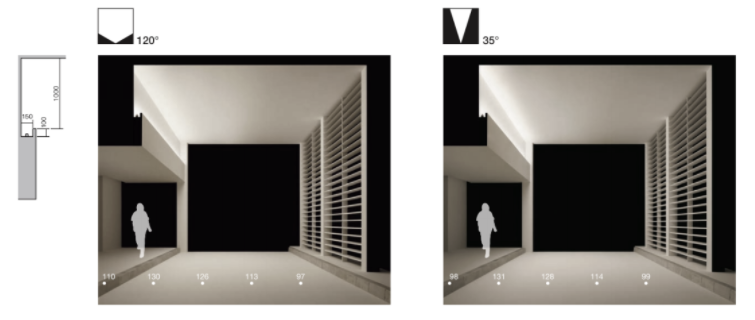
When the light slot emission width is 1000mm, both beam angles of 120° and 35° provide significant overall improvement, with ground illuminance increased in both cases; however, the transition between light and dark areas is more natural with the 120° angle.
When the light slot opening is 1500mm, the ground illuminance with a 120° beam angle decreases slightly, the ceiling luminance becomes softer, but the luminance contrast on the wall increases slightly; compared to 35°, the wall luminance is more uniform, with minimal impact on ground illuminance.
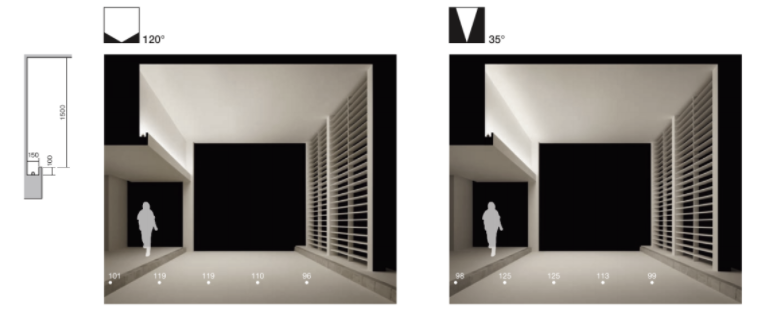
The above upward lighting of the ceiling via reflection has little difference in its effect on ground illuminance, but downward lighting is significantly affected by the size of the light slot opening and the beam angle, having a greater impact on walls and floors.
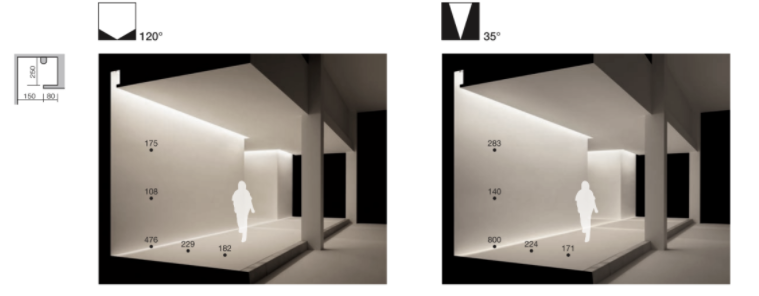
Below is the downward lighting method for corridors. First, let's look at the difference between a 120° and 35° beam angle when the light slot opening is 150mm: the wall illuminance with 120° is significantly lower than with 35°, while the ground illuminance shows little difference.
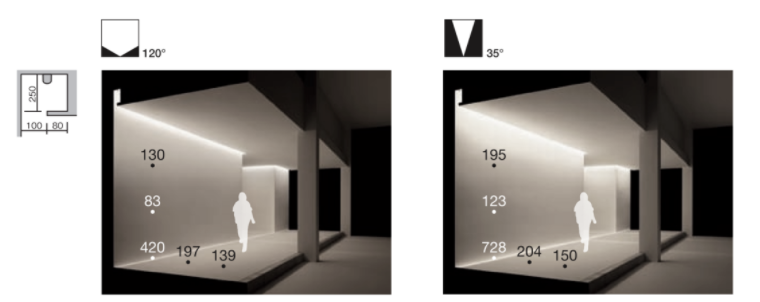
When the light slot opening is 100mm, the overall illuminance is significantly lower than with a 150mm opening, but the impact of the 35° beam angle is relatively smaller.
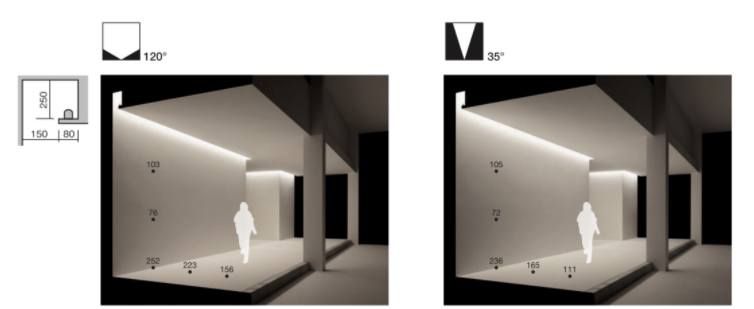
When the luminaire is installed on the bottom surface of the light trough, the difference in wall illuminance between the two beam angles is very small, but the ground illuminance with a 120° beam angle is slightly better than that with a 30° beam angle, resulting in a softer overall lighting effect;
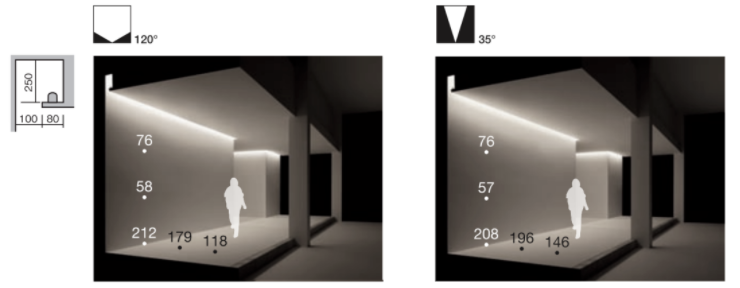
When the light outlet is 100mm, the illuminance for beam angles of 120° and 35° is reduced by approximately 20% and 15%, respectively, compared to a 150mm light outlet;
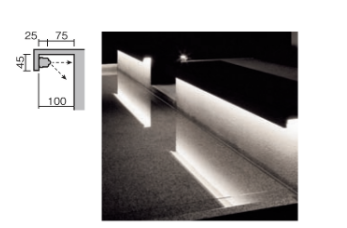
There is another situation to note: when the distance between the luminaire and the illuminated surface is too close, if the position and angle of the luminaire are inappropriate, cut-off lines may be generated or reflections may appear on the illuminated surface due to its reflectivity. Common areas include: the bottom of display stands, under-counter surfaces in restrooms, the bottom of shoe cabinets in foyers, the bottom of beds, the edges of landscape pools, and the bottoms of benches.
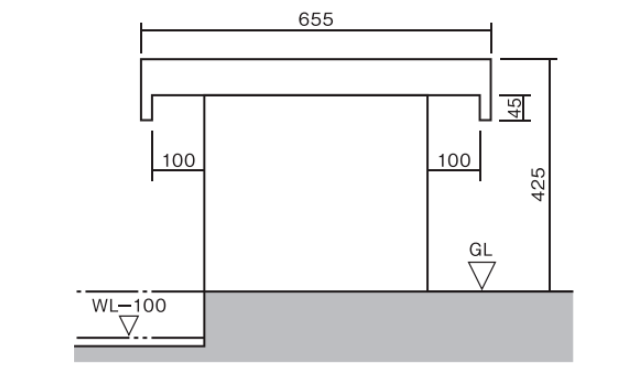
Taking the cross-sectional dimension drawing of the bench below as an example, simulations and comparisons are conducted for different beam angles, installation positions, and angles.
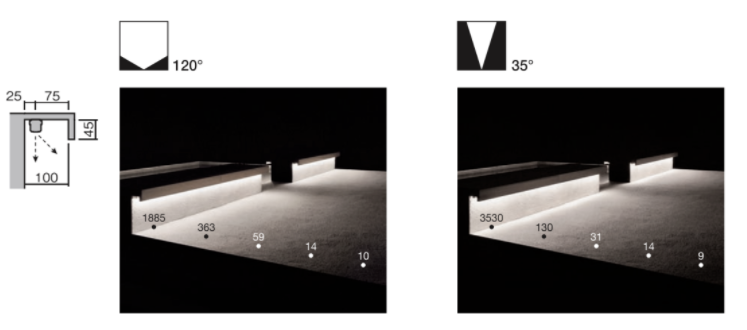
The figure below shows the simulation results when the luminaire is installed inside the light trough; using a 120° beam angle produces a softer lighting effect, while a 35° beam angle creates a peak light on the ground.
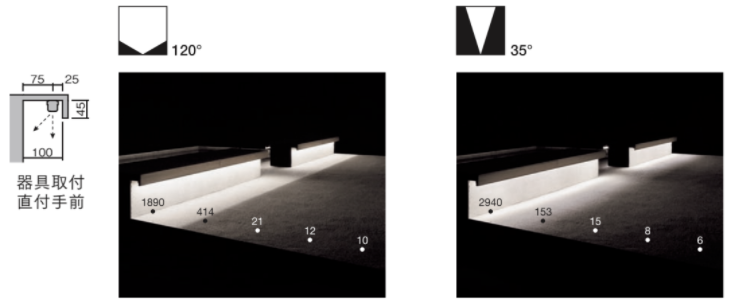
The figure below shows the simulation result when the luminaire is installed outside the light trough. Using a 120° beam angle, the lighting effect shows obvious cut-off lines; using a 35° beam angle uniformly illuminates the bench facade, but there is still peak light on the ground.
If the illuminated surface is smooth, reflections will be produced on its surface. The figure below shows the lighting effects with different beam angles and positions; it can be seen that regardless of which is used, reflections will be generated.
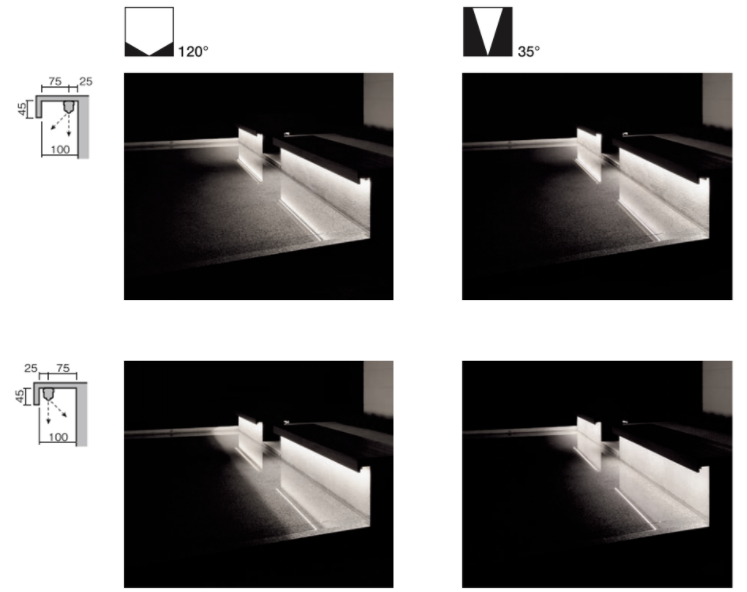
We can also change the direction in which the luminaire shines; this will also greatly reduce the reflections caused by the luminaire, as shown in the figure below.
Conclusion: Details determine success or failure. When designing, you must fully consider space structure, materials, luminaire power and photometry, especially LED luminaires. Luminaires from different manufacturers and batches may have significant differences in lighting effects; if necessary, simulations must be performed or actual tests conducted.
The content of this article comes from the DAIKO website. If there is any infringement, please contact us.

Han Junchang
National Senior Lighting Designer
PS Lighting Design Rendering Expert
Special Appointed Teacher at the School of Urban Design, Central Academy of Fine Arts
More than 20 years of experience in the lighting industry
Proficient in full-process design management and expert in design-related software
Completed over 500 lighting design projects, producing more than 3,000 renderings
China Light
The official website of the China Association of Lighting Industry and a full-media platform for the lighting sector. We provide authoritative and timely lighting information while striving to be a growth partner for businesses. From brand promotion and channel expansion to consulting, talent training and participation in standards development, we provide comprehensive professional services to help businesses improve quality and efficiency and jointly advance the high-quality development of the lighting industry.
Business Contacts
仇纯 (Ms.): 158 6155 3579
顾君 (Mr.): 137 7157 5253