
Classroom Lighting: Differences Among Six Local Standards
The following article is from Light Research Market, authored by Yi Jian
Local standards are unified standards approved and issued by local standardization competent authorities or professional competent authorities (provinces, autonomous regions, municipalities directly under the Central Government) within a specific region.
The local standard number consists of four parts: 'DB (local standard code)' + 'first two digits of the provincial, autonomous region, or municipal administrative code' + ' / ' + 'serial number' + 'year'.
Formulating local standards generally helps leverage regional advantages, improves the quality and competitiveness of local products, and ensures that standards better align with local realities, thereby facilitating their implementation.
There are currently 6 local standards for classroom lighting, of which 5 were published and implemented in the last three years.
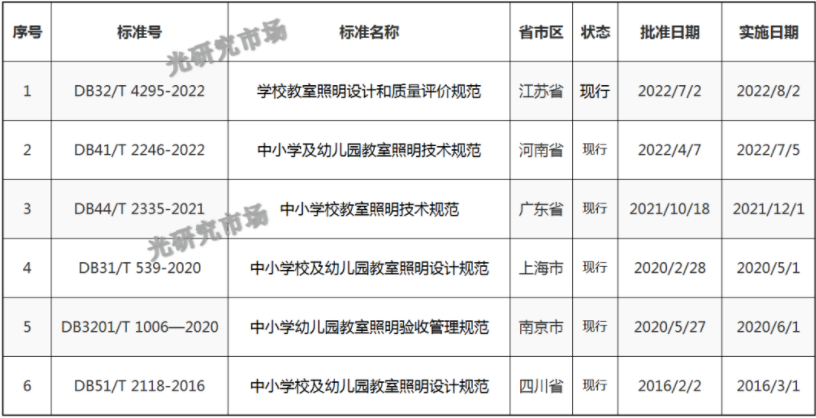
To understand the main parameters of local standards and effectively implement them, we have specifically compiled relevant parameters, using LED as an example to collect and compare differences.
01. Maintained average illuminance
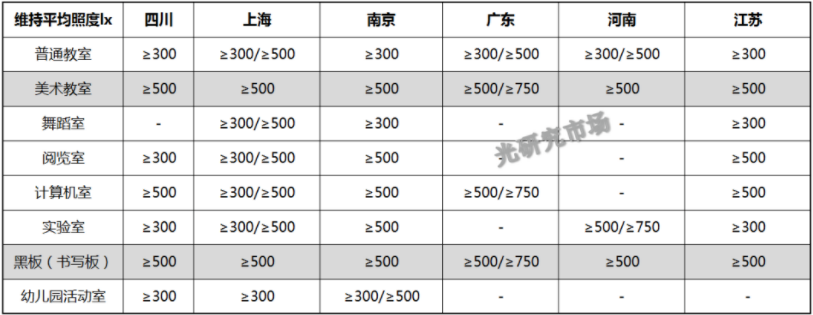
Overall, local standards are basically consistent in maintained average illuminance, with no significant differences; they generally add expected 'recommended' targets on top of national standard requirements, without any so-called controversial upper limit requirements.
02. Unified glare rating (UGR)
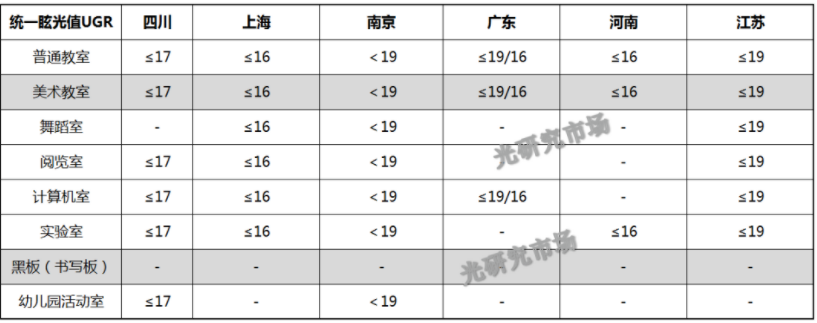
Regarding the Unified Glare Rating (UGR), Shanghai and Henan require it to be within 16, which is slightly higher. Nanjing, Guangdong, and Jiangsu require it to be 19, equivalent to the national standard. Guangdong "expects" to achieve 16.
03. Color rendering index (CRI)
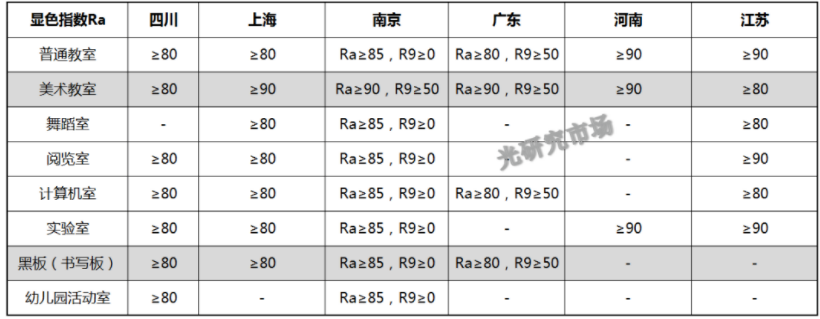
Nanjing and Guangdong clearly propose unique requirements in terms of R9; overall, Guangdong has stricter requirements for the CRI.
04. Uniformity
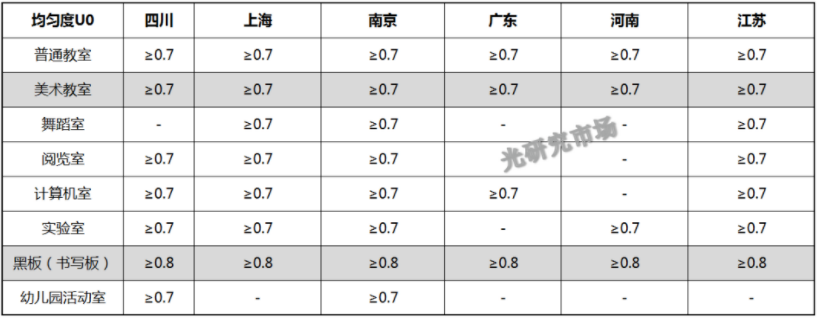
The overall uniformity requirements in various regions are consistent with the National standard (mandatory / recommended).
05. Power Density Value
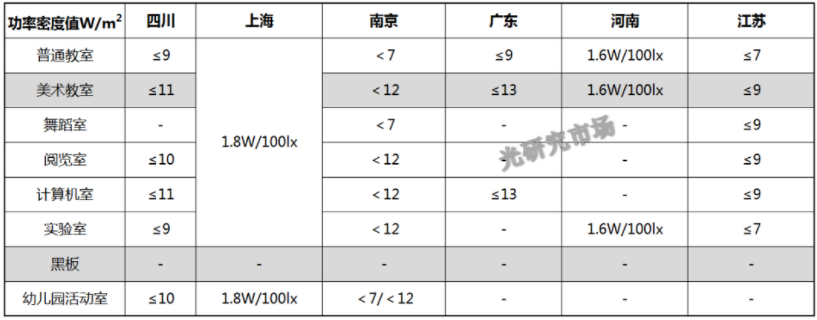
For power density values, there are two different methods in six locations; Shanghai and Henan both calculate using lux.
06. Installation Dimensions
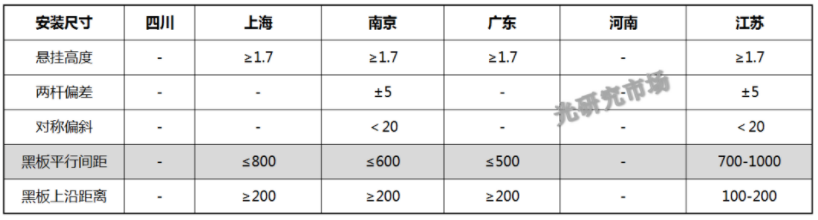
In terms of installation dimensions, only Guangdong has more stringent requirements for the parallel spacing of blackboards, mainly to reduce the interference caused by glare from blackboard lights on teachers' eyes.
07. Measurement method for blackboards (writing boards)

In addition to the six local standards mentioned above, Xinjiang, Hubei, and other regions will also issue relevant local standards based on their respective regional conditions.