
"More Light, Less Heat": A Day in the Life of Academician Jiang Fengyi from the Chinese Academy of Sciences
At 8 a.m., we went to the office of the National Silicon-based LED Engineering Technology Research Center to interview Jiang Fengyi, but he was not there. His students told us, "You've come to the wrong place; Professor Jiang rarely stays in his office."
This research center is located in the Nanchang High-Tech Zone. Its three-story building houses six laboratories, including those for equipment manufacturing, material growth, and chip fabrication. "Wherever there is an unsolvable problem, the teacher will appear. You can only reach him on his mobile phone."
The call connected, and a Mandarin voice with a Jiangxi accent came through: "I'm here in the MOCVD equipment room on the first floor; it's been a busy day!"
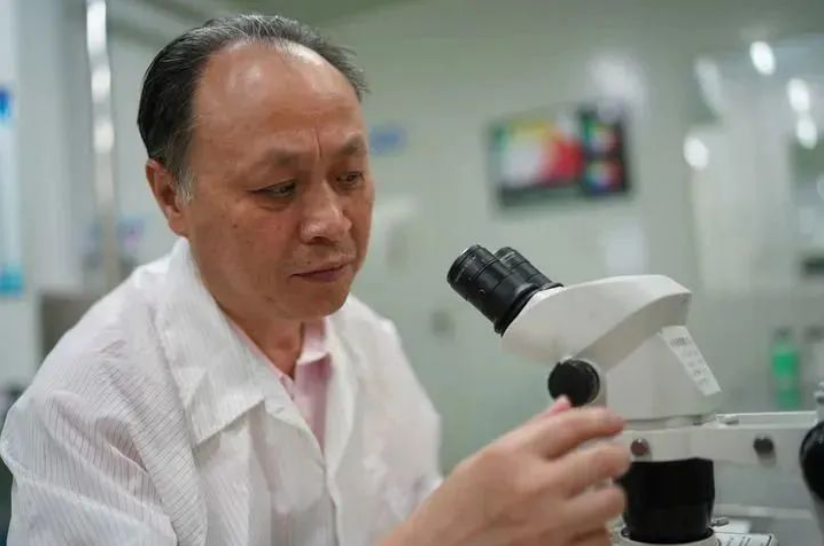
▲ Jiang Fengyi works in his laboratory at the Nanchang High-Tech Industrial Development Zone (photo taken on August 5, 2022). Photo by Zhou Mi, Xinhua News Agency
Step into the laboratory, where seven MOCVD systems are neatly arranged. They are key equipment for manufacturing semiconductor lighting chips. In front of the largest system, a person of medium height wearing a white cleanroom suit is providing guidance to everyone.
The device indicator light was flashing, and the data on the console screen kept changing. "Conducting experiments requires continuous trial and error." The presenter raised his voice. He was Jiang Fengyi.
Jiang Fengyi, 59, is an academician of the Chinese Academy of Sciences and Vice President of Nanchang University, but he prefers to be called "Teacher Jiang"—he likes this title.
We called out, "Teacher Jiang." He waved for us to sit nearby: "Wait a moment. We're currently facing a difficult problem with our yellow LED experiment."
Light-emitting diode (LED), abbreviated as LED in English, is a commonly used light-emitting device. Yellow-light LED is the key core technology that Jiang Fengyi has focused on in recent years. It requires no rare-earth phosphor and poses no blue light hazard, and is considered a potential replacement for the current "blue LED + rare-earth phosphor" artificial lighting source.
Unexpectedly, the wait lasted several hours. After touring the laboratory, we followed Teacher Jiang into the office on the third floor.
After taking off his dust-proof suit, Professor Jiang’s white shirt was soaked with sweat. “Research conditions are so much better now!” He pointed out the window, “We moved from the Nanchang University campus to the High-Tech Zone. This laboratory building covers nearly 9,000 square meters. In the early days, the lab was only 60 square meters. We borrowed 600,000 yuan to buy equipment and began researching blue LED.”
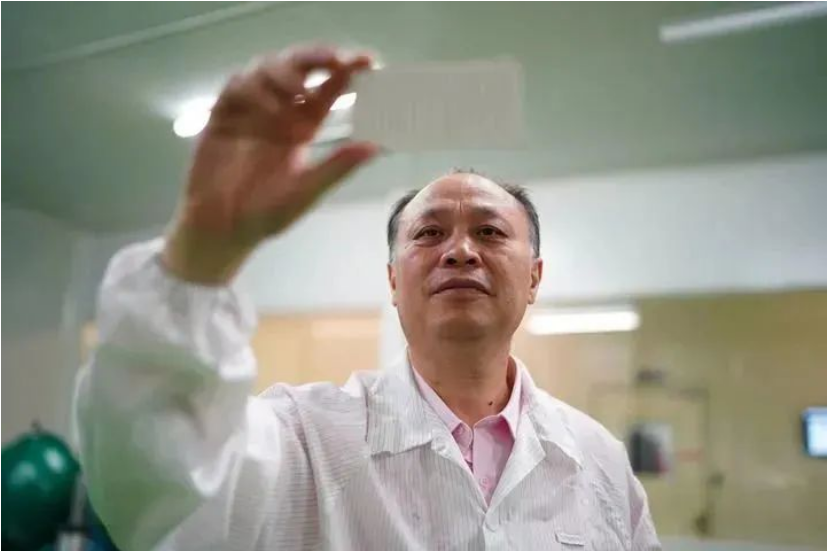
▲ Jiang Fengyi working in his laboratory at the Nanchang High-Tech Industrial Development Zone (photo taken on August 5, 2022). Photo by Zhou Mi, Xinhua News Agency
Draw the curtains, turn on the lights in the room, and let the conversation begin with this room full of "light".
“这个天花板吊灯就是我这里研制的,以人眼比较舒适的红、黄光为主。”江老师“开课”了:从煤油灯、白炽灯、荧光灯到蓝光LED,以前一次次照明技术都是由国外定义。
"For example, kerosene lamps were called 'foreign oil lamps' because the lamp oil was imported at the time. LED lighting technology also saw breakthroughs abroad, but we cannot keep relying on foreign LED lights!"
At the beginning of this century, the core patents for blue LED, which is widely used today, were still monopolized by foreign companies. This deeply hurt Jiang Fengyi.
He was determined to blaze a new trail by choosing to grow materials on silicon substrates for chip fabrication. This process involves numerous steps, with the material structure alone comprising over 70 layers, more than 100 growth procedures, and involving over 2,000 parameters.
"Each parameter is a variable, and each adjustment is a trial-and-error process. Finding the optimal solution requires thousands upon thousands of iterations," he said.
Jiang Fengyi has walked this path of "chasing light" for 19 years. He successfully developed silicon substrate blue LED materials and chip technology, making China the third country in the world to possess independent intellectual property rights for blue LED technology.
Turn on a cylindrical desk lamp on the table, and soft yellow light spreads across the desktop. Teacher Jiang happily pats it: "This is golden-yellow LED, a better yet more challenging LED lighting technology!"
In 2011, while focusing on blue LED, Jiang Fengyi had already set his sights on yellow LED. However, researchers at home and abroad faced a "yellow light gap"—the luminous efficacy of yellow light was significantly lower than that of blue light, with efficiency struggling to break through 10%.
Jiang Fengyi pulled out the drawer and took out a thick stack of diaries, which recorded his daily research progress. He has maintained this habit for nearly 30 years.
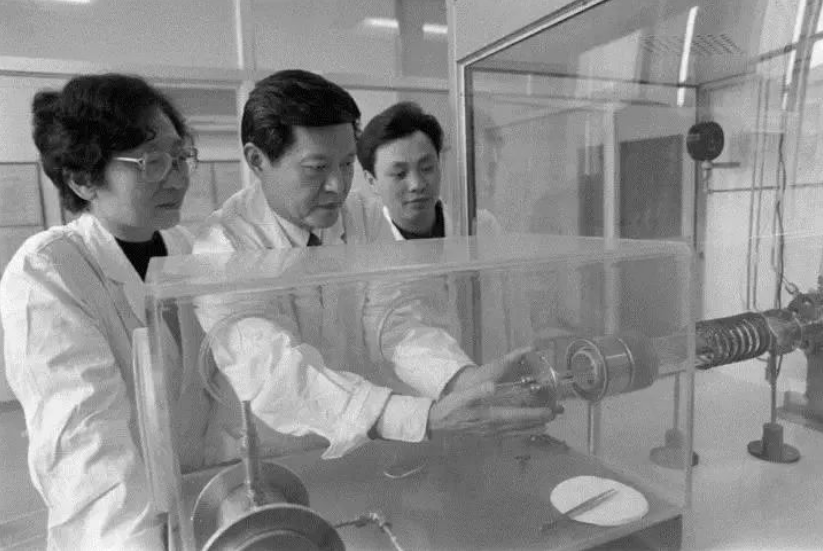
▲In the 1990s, significant achievements were made in the research on strained superlattice structures, completed through the collaboration of three professors from Nanchang University: Pan Chuankang (center), Jiang Fengyi (right), and Zheng Daichou. Their pioneering ion beam channeling layer-by-layer scanning technology improved measurement accuracy by an order of magnitude, reaching an internationally leading level at the time (archival photo). Photo by Song Zhenping, Xinhua News Agency.
Opening the top diary, Jiang Fengyi drew several heavy lines under the figure "9.4%" on one page: "This is a hurdle."
At that time, the laboratory had four MOCVD systems. Jiang Fengyi allocated three for blue light and one for yellow light. "The investment was substantial and the future uncertain, so I dared not move too quickly."
However, the luminous efficacy of the yellow light produced by this machine stopped at 9.4%.
"I hesitated at the time, wondering if this path would lead to success?" Jiang Fengyi flipped back through his diary.
The lab notebook usually contains one page of research data per day. But on February 3, 2016, Jiang Fengyi filled five densely written pages. He recorded the scenes and instructions from General Secretary Xi Jinping’s inspection visit.
"We decided to allocate three units for yellow light—let's get to work!" Jiang Fengyi stood up and rummaged through the files in the cabinet. "Look, national support is increasing, and provincial and municipal incentive policies are now in place. With such favorable timing, what excuse do we have not to strive?"
Jiang Fengyi and his team were "nailed" to the laboratory. When hungry, they ate boxed meals in the lab; when tired, they found a place to take a nap. "Once, we didn't leave the building for a whole week," he said, pointing to the bed in the room.
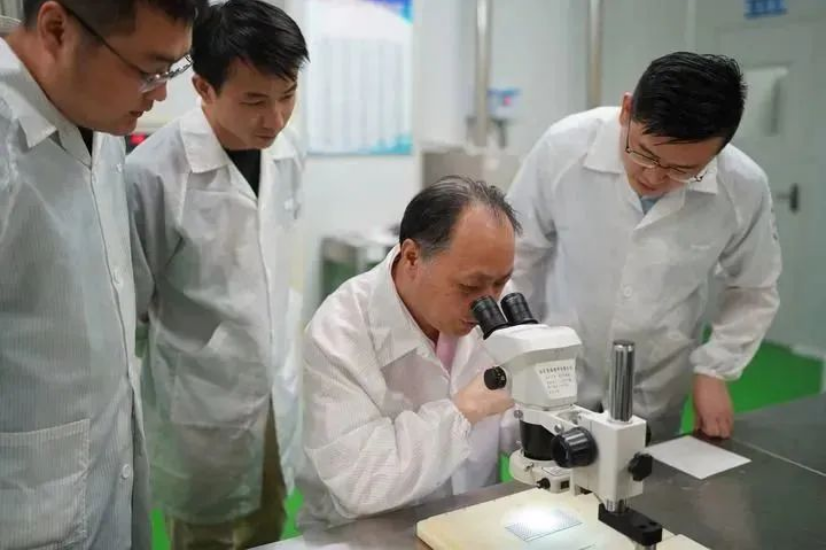
▲ Jiang Fengyi works with his team members in the laboratory located in Nanchang High-Tech Zone (photo taken on August 5, 2022). Photo by Zhou Mi, Xinhua News Agency
After 40 days, the luminous efficacy crossed the "yellow light gap", reaching 12.2%. However, this value later stagnated.
"I knew it, this gap is not so easy to cross!" Teacher Jiang paused here. "After careful consideration, I proposed modifying the equipment! We decided to 'operate on' the imported MOCVD equipment. When everyone heard about it, they said I was too bold."
Over the course of more than a month, he led two equipment experts and a team of engineers in working overtime, implementing six major revisions and over ten minor adjustments, significantly boosting the performance of the MOCVD.
On May 5, 2016, after nearly 100 days of intensive research, Jiang Fengyi arrived at the laboratory early in the morning. Everyone was watching the screen as the test results for the chips and devices manufactured by the new equipment came out—17.2%!
A student shouted out. Jiang Fengyi, usually reserved, also clapped happily.
"At 12%, I was still uncertain, but reaching 17% proved that this path is viable."
How was the diary entry written that day?
"2016-05-05, Result: Luminous efficacy reached 17%... With further optimization, it is hoped to exceed 25%..."
Guessing what we were thinking, Teacher Jiang said, "I feel we are still far from meeting the General Secretary's expectations for us; we must not be complacent."
October 26, 2016: 21.4%, July 16, 2018: 24.3%, November 25, 2020: 27.9%... Yellow light luminous efficacy has repeatedly broken through, continuously setting new world records.
Jiang Fengyi's "light-chasing" journey continues. Over the past two years, they have continuously improved the luminous efficacy of yellow light and accelerated the commercialization of their achievements. Standing up to look out the window, Old Jiang pointed to the golden landscape lights in the nearby Aixi Lake Park and said, "Those are our golden-yellow LED lights, which have already achieved mass production."
As night fell, we rose to say goodbye. "I'm sorry we can't keep you for dinner today," Jiang Fengyi said apologetically as he shook our hands. He also shared some good news: "We have made another major breakthrough in yellow light, with a peak luminous efficacy exceeding 50% at specific operating points!"
Jiang Fengyi escorted us downstairs, where we saw six large red characters on the wall of the research center lobby: "Emit more light, generate less heat."
He deliberately stopped and said, "This statement has three layers of meaning: first, in the LED field, to emit more light, one must generate less heat; second, in conduct and dealings, one should focus on work with dedication and avoid impulsiveness; third, in scientific research, one must endure solitude and avoid chasing trends."
Waving goodbye, Jiang Fengyi turned and walked back into the laboratory.
During the CLITI exhibition on September 14-15, China Association of Lighting Industry(中国照明电器协会) will hold the "2022 (12th) China Lighting Industry Conference" in Shenzhen. Academician Jiang Fengyi of the Chinese Academy of Sciences will attend the event and deliver a speech as a special guest on "Semiconductor / Solid-state lighting (SSL) Technology and Application Prospects".
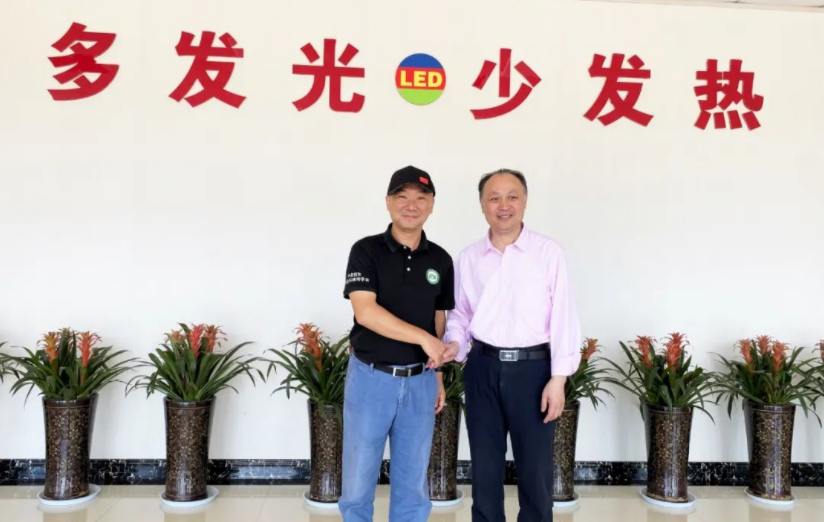
▲Hong Bing (left), General Manager of China Light Network; Jiang Fengyi (right), Academician of the Chinese Academy of Sciences and Vice President of Nanchang University
Jiang Fengyi
Born in 1963, Academician of the Chinese Academy of Sciences, First-Class Professor, Doctoral Supervisor. Currently serves as a member of the Party Committee and Vice President of Nanchang University, Director of the National Silicon-based LED Engineering Technology Research Center, and leader of the Semiconductor Lighting Technology Innovation Team under the Ministry of Science and Technology and the Ministry of Education.
Received a bachelor's degree from the Department of Physics at Jilin University in 1984. After graduation, worked in the Physics Teaching and Research Section of the Basic Courses Department at Jiangxi University of Technology; received a master's degree from the Changchun Institute of Physics, Chinese Academy of Sciences in 1989; worked at the Institute of Materials Science, Nanchang University in 1992, successively serving as associate professor and professor; appointed Director of the Ministry of Education Engineering Research Center for Semiconductor Light-Emitting in 2001.
Recipient of the National Advanced Worker (2000), National Outstanding Science and Technology Worker (2010), "National Outstanding Communist Party Member" (2016), and First Prize of the National Technological Invention Award (2016). The International Solid-State Lighting Alliance awarded Comrade Jiang Fengyi the "Global Outstanding Contribution Award for Solid-State Lighting." Inventor of silicon substrate LED technology and founder of JNCE Optoelectronics. He has presided over more than 30 national projects, including the National 863 Program, the Electronic Development Fund, and Jiangxi Provincial science and technology topics/projects; obtained more than 90 authorized domestic and international invention patents; and published more than 90 SCI papers.
▲This article is reposted from the WeChat official account: Xinhua News Agency (ID: newsxinhua). Original text reporters: Guo Qiang, Yu Xianhong. Original new media editor: Wu Jinfu
Related Links:
The CLITI Exhibition is about to grandly open! Visitors are welcome to register in advance!
The 12th China Lighting Industry Conference 2022 looks forward to your participation