Sharing of the Industry Standard "Design Specification for Lighting Systems in Archives"
The DA/T 91-2022 "Code for Lighting System Design of Archives", issued by the National Archives Administration, has been officially implemented since July 1, 2022. This industry standard specifies general provisions, lighting indicators, energy saving, lighting power distribution and control, and safety protection and grounding for archive lighting systems. It applies to lighting design for newly built, renovated, or expanded archives.
The specific content is as follows:
1 Scope
This document specifies the general provisions, lighting indicators, energy saving, lighting power distribution and control, and safety protection and grounding for archive lighting systems.
This document applies to lighting design for newly built, renovated, or expanded archives; other archive storage institutions may refer to it for implementation.
2 Normative references
The contents of the following documents are indispensable to this document through normative references cited herein. For dated references, only the version corresponding to that date applies to this document; for undated references, the latest edition (including all amendments) applies.
GB50033 National Standard for Architectural Daylighting Design
GB50034 Architectural Lighting Design Standard
GB50054 Low-voltage Power Distribution Design Code
Technical Standard for Fire Emergency Lighting and Evacuation Signage System GB51309
3 Terms and Definitions
The terms and definitions defined in GB50033, GB50034 and the following apply to this document.
3.1 Optical radiation
Electromagnetic radiation with wavelengths in the X-ray transition region (approximately 1nm) and radio waves (approximately 106nm).
Note: Abbreviated as "Optical radiation". [Source: GB/T20145—2006, 3.28, with modifications]
3.2 Infrared radiation
Optical radiation with wavelengths longer than visible radiation. Infrared radiation in the wavelength range of 780 nm to 106 nm is typically subdivided into: IR-A 780 nm~1400 nm, IR-B 1400 nm~3000 nm, IR-C 3000 nm~106 nm. Note: Visible radiation is optical radiation that can directly cause visual sensation. The wavelength range is usually limited to 400 nm~780 nm. [Source: GB/T20145—2006, 3.14, modified]
3.3 Ultraviolet radiation
波长小于可见辐射波长的光学辐射。通常将波长范围在100nm~400nm的紫外辐射细分为:UV-A315nm~400nmUV-B280nm~315nmUV-C100nm~280nm[来源:GB/T20145—2006,3.43,有修改]
3.4 Luminous efficacy
The quotient obtained by dividing the luminous flux emitted by a light source by the power consumed by the light source.
Note 1: Luminous efficacy is expressed in lm/W.
Note 2: For LED applications, the light source can be an LED package, module, lamp, luminaire, etc. [Source: GB/T 24826—2016, 3.26, with modifications]
3.5-year annual photosynthetic photon flux density
The cumulative number of photons in the visible light wavelength range received by an object over a year, expressed as the product of photon flux and annual accumulated seconds, with units of μmol/(s·m²)·s/year.
4 General Provisions
4.1 Basic Design Requirements
4.1.1 The lighting method for the archive room shall be determined according to the following requirements:
a) General lighting shall be provided in the workplace;
b) When different areas have different illuminance requirements, zoned general lighting shall be adopted;
c) When using intelligent dense shelving, local lighting can be set.
4.1.2 The lighting method for the special collection display room and exhibition hall shall be determined according to the following requirements:
a) General lighting shall be provided in work areas;
b) When different areas have different illuminance requirements, zoned general lighting shall be adopted;
c) General lighting and accent lighting should be combined;
d) Local lighting should not be used exclusively.
4.1.3 The lighting method for reading rooms shall be determined according to the following requirements:
a) General lighting shall be provided in work areas;
b) When different areas have different illuminance requirements, zoned general lighting shall be adopted.
4.1.4 At the entrances and exits of low-illuminance special collection display rooms, visual adaptation guidance zones shall be provided. The guidance zones shall use reflective luminaires, and the ratio of illuminance in the guidance zone to that in the low-illuminance special collection display room shall not exceed 10:1.
4.1.5 Lighting fixtures within display cases shall be isolated from the exhibits with protective measures and shall be easy to maintain and manage.
4.1.6 Archives shall be equipped with emergency, duty, and guard lighting.
4.2 Selection of Lighting Sources
4.2.1 The lighting sources selected shall comply with the relevant provisions of current national standards.
4.2.2 When selecting a light source, the final choice shall be made after conducting a comprehensive technical and economic analysis comparing the efficiency, lifespan, and cost of the light sources, under the condition that the requirements of Chapter 5 are met.
4.2.3 Select the light source for lighting design according to the following conditions:
a) Premises for archive storage, display, organization, restoration, and digital processing shall use LED light sources or other light sources without ultraviolet or infrared radiation;
b) The facilities for the storage, display, organization, restoration, and digital processing of magnetic carrier archives shall use light sources that do not generate electromagnetic interference;
c) For archives particularly sensitive to light, fiber optic lighting sources should be used during display;
d) Emergency lighting shall use light sources that can be quickly illuminated.
4.2.4 The response time for the light source of emergency lighting luminaires to turn on and off shall comply with the following provisions:
a) The response time for emergency illumination of the luminaire light source in archives and special collections display rooms shall not exceed 0.25s;
b) The response time for emergency lighting of luminaire light sources in other locations shall not exceed 5s;
c) In premises with two or more evacuation indication schemes, the response time for the marking light source to turn on and off shall not exceed 5s.
4.2.5 The power factor (PF) of the LED light source shall comply with the provisions of Table 1.
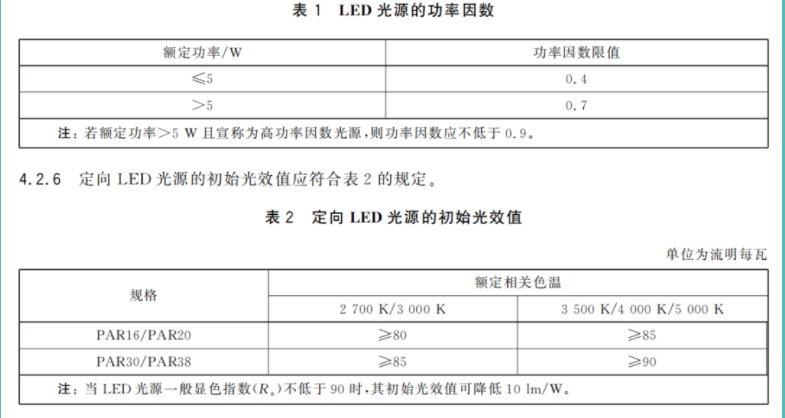
4.3 Selection of Luminaire and Its Accessories
4.3.1选用的照明灯具、镇流器、LED控制装置等应通过国家强制性产品认证。
4.3.2选用的应急照明灯具应通过国家消防认证。
4.3.3 Select luminaires for lighting design based on the following conditions:
a) Archives storage, display, organization, restoration, and digital processing areas shall use high luminous efficacy LED luminaires or other luminaires without UV or IR radiation;
b) Archives storage, display, organization, restoration, and digital processing areas shall adopt clean luminaires that are dust-resistant and easy to wipe, and shall meet the relevant requirements for clean areas;
c) Luminaire for illuminating three-dimensional exhibits in the exhibition hall; the Color rendering index (CRI) shall not be lower than 90, and shadows shall not be produced;
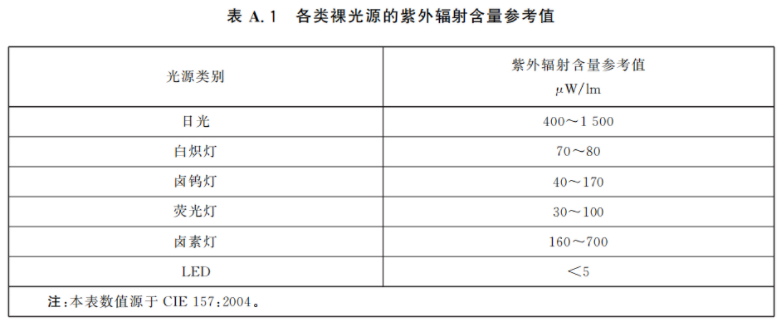
d) General lighting for archives and exhibitions sensitive to light shall use luminaires with low ultraviolet (UV) and infrared (IR) radiation; the UV radiation content of the luminaire shall be less than 10 μW/lm. For the UV radiation content of bare light sources of various luminaires, see Appendix A.
e) General lighting for technical rooms and other premises used for color inspection, precision finishing, or finished product inspection should preferably use LED luminaires with wide beam distribution, flicker level of no significant impact, and a Color rendering index (CRI) (Ra) not lower than 90;
f) For rooms or places where long-term work is performed, general lighting shall use luminaires with a blue light hazard assessment rating of Risk Group 0 (RG0);
g) General lighting in places such as negotiation rooms, conference rooms, and press release halls should preferably use wide-beam luminaires;
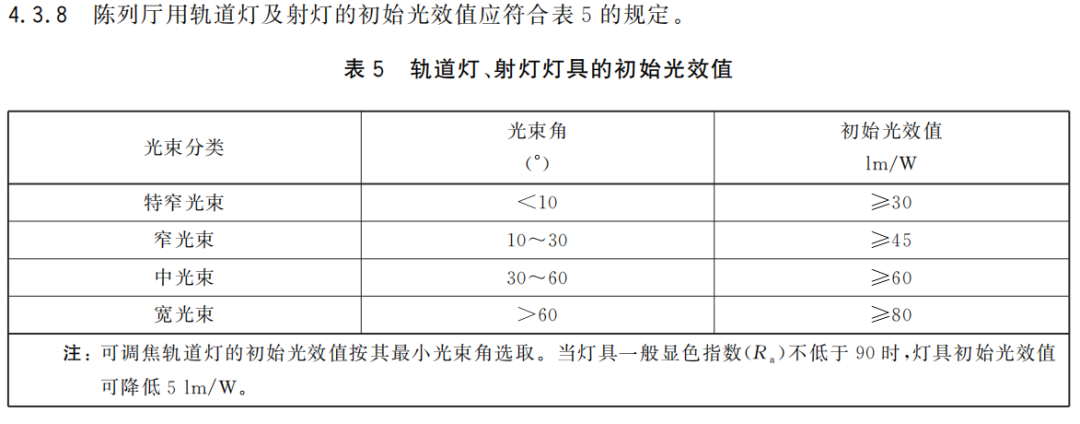
h) For general lighting in exhibition halls where luminaires are installed at heights exceeding 8m, narrow-beam luminaires are recommended.
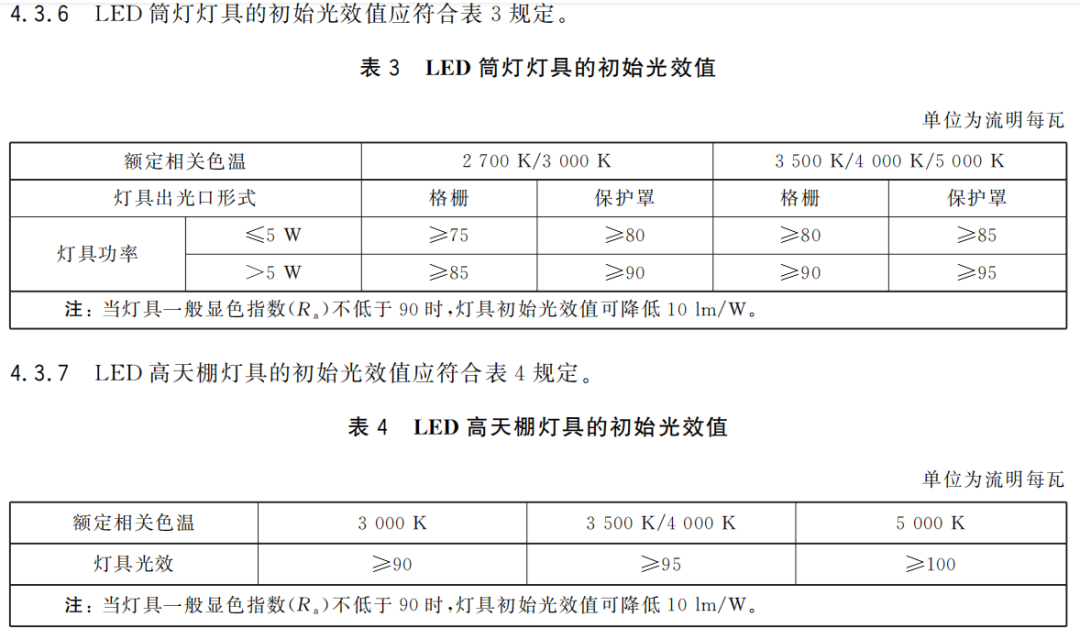
4.3.4 The power factor (PF) of LED luminaires with a rated power greater than 5W and less than or equal to 25W shall not be lower than 0.7; for LED luminaires with a rated power greater than 25W, the power factor (PF) shall not be lower than 0.9.
4.3.5 The initial luminous flux of LED luminaires shall not be lower than 90% of the rated luminous flux, nor higher than 120% of the rated luminous flux; its lumen maintenance after 3000h of operation shall not be less than 96%, and its lumen maintenance after 6000h shall not be less than 92%.
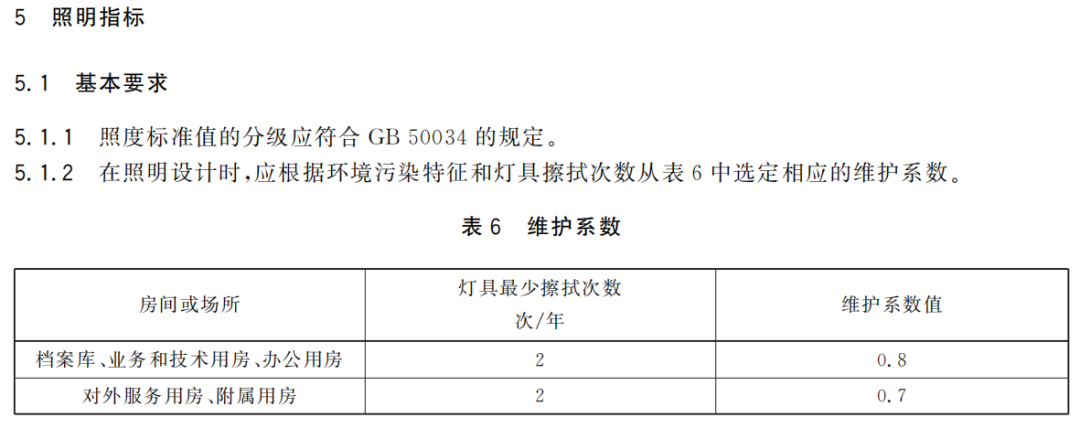
5.1.3 Under general conditions, the designed illuminance value may deviate by ±10% from the standard illuminance value.
5.2 Illuminance
5.2.1 The illuminance values specified in this document are the maintained average illuminance values on the work plane or reference plane.
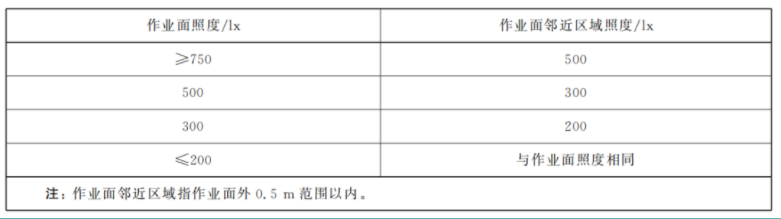
5.2.2 The illuminance in the area adjacent to the work surface may be lower than the illuminance on the work surface, but shall not be less than the values in Table 7.
Table 7 Illuminance of the area adjacent to the work surface
5.2.3 The illuminance values for general lighting in corridors and other non-work areas within commonly used rooms or spaces of archives shall not be lower than 1/3 of the illuminance values for general lighting in work areas.
5.3 Uniformity of illuminance
5.3.1 The uniformity of illuminance for general lighting in commonly used rooms or spaces within archives shall not be lower than the provisions specified in Chapter 5.
5.3.2 For planar exhibits in displays and exhibitions, the Uniformity of illuminance shall not be less than 0.8; for planar exhibits with a height greater than 1.4 m, the Uniformity of illuminance shall not be less than 0.4.
5.4 Glare Limitation
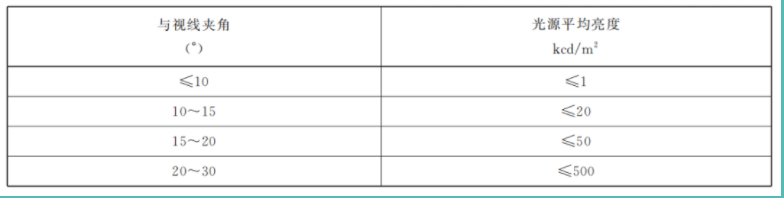
5.4.1 The shielding angle of direct-type luminaire shall not be less than the provisions in Table 8.
Table 8 Shielding angle of direct-type luminaire
5.4.2 Discomfort glare in commonly used rooms or spaces of archives shall be evaluated using the Unified Glare Rating (UGR) and calculated in accordance with GB50034; its maximum allowable value should not exceed the provisions specified in Chapter 5.
5.4.3 In the field of view where the audience views archive exhibits, direct glare from light sources or windows and reflected glare from various indoor surfaces shall be limited.
5.4.4 For archival exhibits with a glossy surface, veiling reflections should not appear in the viewing direction of the audience.
5.4.5 Glare and reflected glare can be prevented or reduced by the following methods:
a) Avoid installing the Luminaire in areas of visual interference;
b) Use surface decoration materials with a matte or low-gloss finish;
c) Limit luminaire luminance;
d) Restrict the use of flash-type devices.
5.5 Light Source Color
5.5.1 The color appearance of indoor lighting sources shall be classified into 3 groups based on their Correlated color temperature (CCT); the classification of source color appearance shall be determined according to Table 9.
Table 9: Grouping of Light Source Color Rendering

5.5.2 The general color rendering index (Ra) for commonly used rooms or spaces in archives shall not be lower than the provisions of Chapter 5.
5.5.3 The color tolerance between similar light sources shall be lower than 5 SDCM.
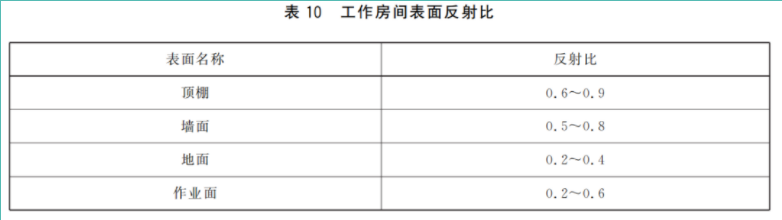
5.6 Reflectance
For rooms or places where long-term work is performed, the surface reflectance shall be selected according to Table 10.
5.7 Flicker
In rooms or places where people work for long periods, the light emitted by luminaires shall not cause uncomfortable flicker and shall comply with the Flicker level of no significant effect specified in IEEE Std 1789-2015. The limits for modulation depth corresponding to the Flicker level of no significant effect are as follows:
f≤10Hz, modulation depth ≤0.1%;
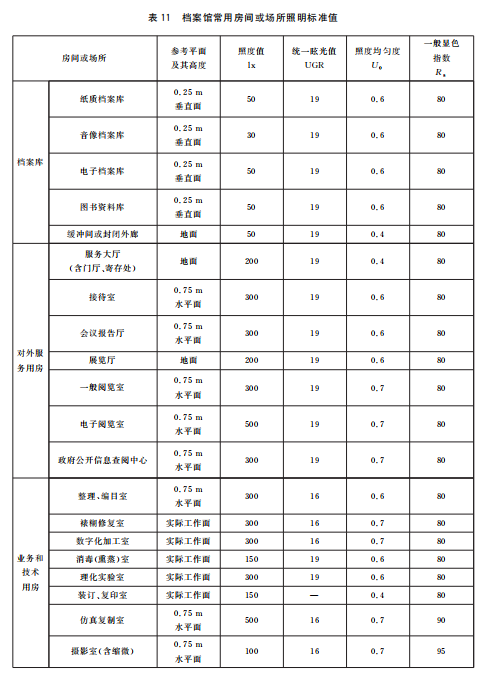
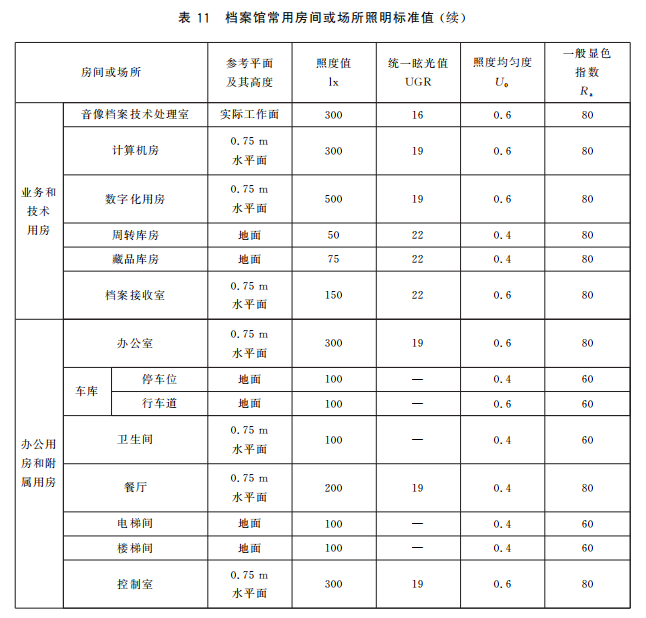
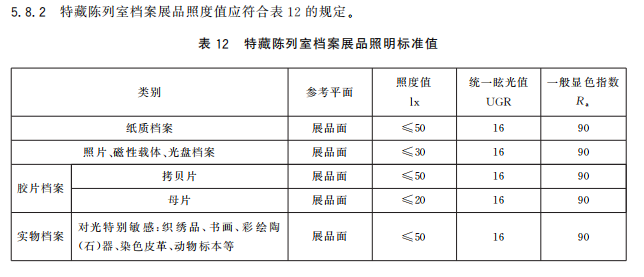
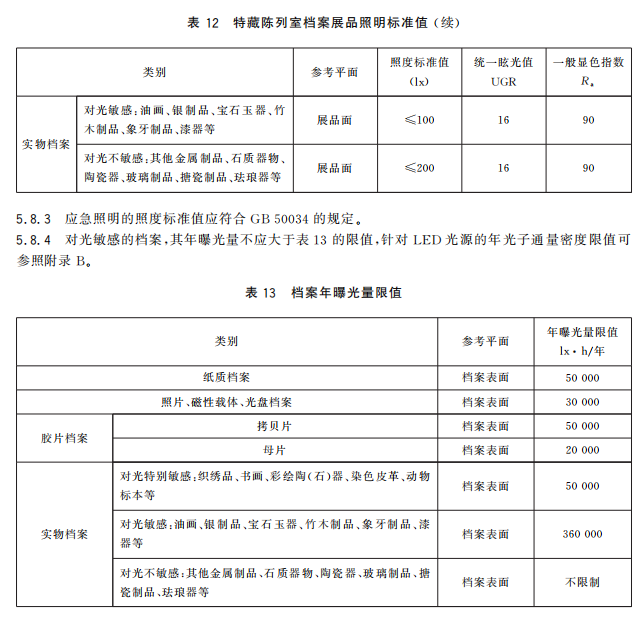
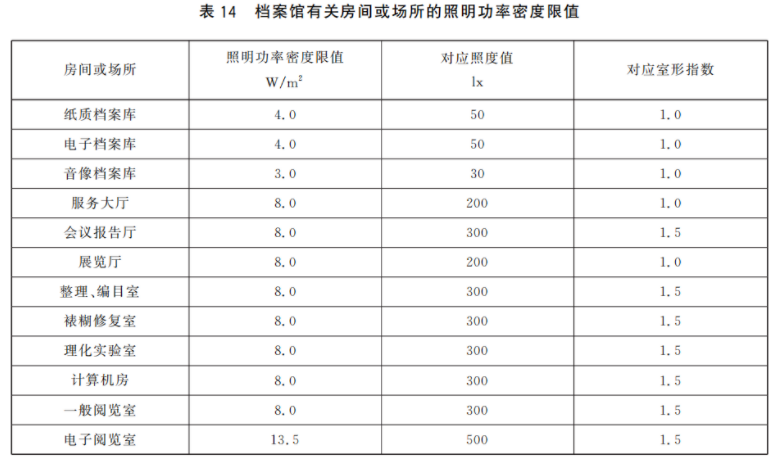
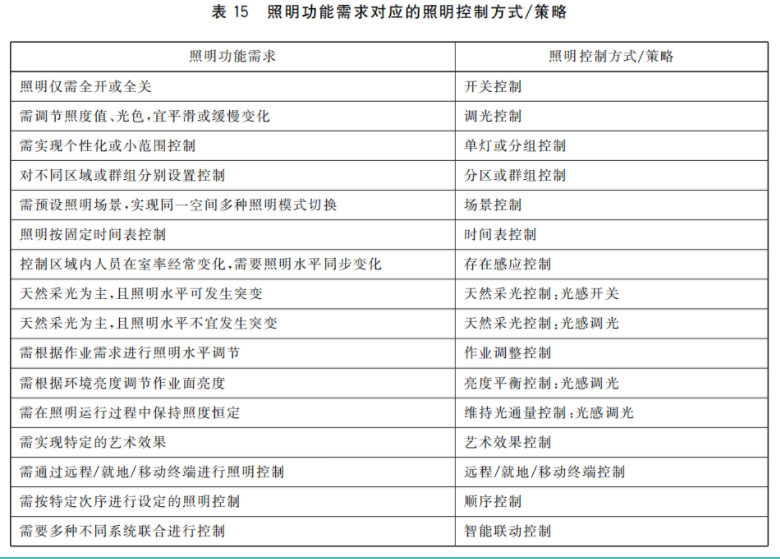
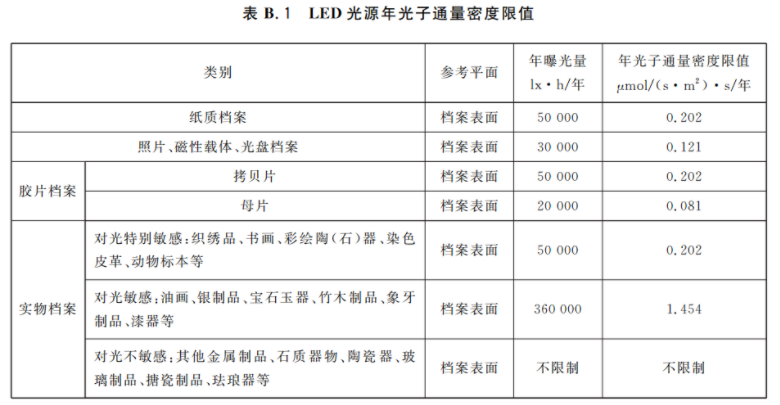
10Hz 90Hz f > 3125Hz, exempt from assessment. Note: f is the light output waveform frequency. 5.8 Lighting Standard Values 5.8.1 The illumination standard values for commonly used rooms or spaces in archives shall comply with the provisions of Table 11. 6 Lighting Energy Saving 6.1 Daylighting 6.1.1无特殊要求的档案馆用房应充分利用自然光,房间的采光系数或采光窗地面积比应符合GB50033的有关规定。 6.1.2 Where feasible, artificial lighting illuminance should be automatically adjusted in response to changes in outdoor natural light. 6.1.3 Where feasible, various light guides and reflective devices should be utilized to introduce natural light indoors for illumination. 6.1.4 Where feasible, solar energy should be utilized as a lighting power source. 6.2 Lighting power density limits 6.2.1 Energy saving in lighting shall use the Lighting power density (LPD) limits for General lighting as the evaluation indicator. 6.2.2 The lighting power density (LPD) limits for rooms or places in archives shall not exceed the provisions of Table 14. When the illuminance values for relevant rooms or places are higher or lower than the corresponding illuminance values specified in Table 14, their LPD limits shall be increased or reduced proportionally. 7 Lighting Power Distribution and Control 7.1 Lighting Voltage and Distribution System 7.1.1 The power supply voltage for general lighting luminaires shall be 220V. The voltage deviation at the luminaire terminals should be controlled within ±5%. For situations with significant power supply voltage fluctuations, the use of voltage stabilizer equipment may be considered. 7.1.2 The load level shall be determined and the distribution scheme selected based on the impact and losses that may result from interruption of lighting power supply. 7.1.3 The lighting distribution circuits in the archive storage area shall be copper-core insulated wires installed in metal conduits, meeting the design requirements for electrical load usage. 7.1.4 The fire emergency lighting and evacuation indication system shall comply with the design requirements of GB51309. 7.1.5 Emergency lighting distribution shall comply with the following provisions: a) The emergency power supply for escape lighting should preferably use a battery/dry cell device, or a combination of a battery/dry cell device with a dedicated feeder circuit that is effectively independent from the normal lighting power supply in the power system, or adopt a method combining a battery/dry cell device with an on-site generator set; b) The emergency power supply for safety lighting shall be connected to different transformers or different feeder mains from the power supply lines of the premises; where necessary, a battery bank may be used for power supply; c) The emergency power supply for standby lighting shall adopt dedicated feeder lines that are effectively independent of the normal lighting power supply in the power system, or self-contained generator sets. 7.2 Lighting Control 7.2.1 Lighting control for archive storage and exhibition areas shall include single-circuit control, zoning control, grouping control, automatic control, and centralized control. 7.2.2 Automatic control may adopt programmed, timed, light-controlled, infrared, etc., methods, and implement energy-saving measures such as automatic dimming, reduced illuminance, and delayed automatic extinguishing as needed. 7.2.3 The lighting control switch for the archive storage room shall be installed at a location outside the entrance/exit of the storage room. 7.2.4 The lighting control method/strategy should be determined according to Table 15 based on the lighting functional requirements. 7.2.5 Archives shall reserve interfaces and pipelines for networked monitoring, and adopt a suitable smart lighting control system according to the determined lighting functions. The lighting control system shall possess the following functions: a) Good Chinese human-machine interface; b) Remote control function; c) Automatically generate various relevant information analysis and statistical reports for the controlled lighting system, including recording lighting information for important exhibits that are sensitive or particularly sensitive to light. 8 Safety Protection and Grounding 8.1 Archives and business technical rooms shall use UV-resistant glass and adopt shading measures to prevent direct sunlight from entering. 8.2灯具与档案、图书资料等易燃物的垂直距离不应小于0.5m,且应依照爆炸性环境选用对应类型的防爆灯具,防爆灯具的分类参见GB/T3836.1。 8.3 The lighting distribution system installed within a building shall match the grounding configuration of that building's power distribution system. 8.4 Protection of distribution circuits shall comply with the requirements of National standard (mandatory / recommended) GB50054. The installation of the lighting device inside the display cabinet at 8.5 shall comply with the requirements of electrical construction fire safety codes. Appendix A (Informative) UV radiation content of various bare light sources Table A.1 provides reference values for the UV radiation content of various bare light sources. Appendix B (Normative Appendix) Annual photon flux density limit for LED light sources LED光源可通过改变光谱达到减弱对档案有害波长光的光子通量,降低对档案保存寿命的影响,依照对光敏感档案的年曝光量限值,对应的LED光源年光子通量密度限值详见表B.1。