
Research findings: Low correlated color temperature (CCT) artificial lighting sources can slow the development of the axial length in juvenile macaques
Myopia is a pathological condition where, in a state of relaxed accommodation, reflected light from distant objects is focused in front of the retina after passing through the eye's refractive system, resulting in blurred vision. Myopia not only significantly impacts work and daily life, but also markedly increases the incidence of cataracts, glaucoma, retinal detachment, and retinal degeneration in moderate to high myopia patients after middle age. According to WHO statistics, visual health issues have been ranked alongside tumors and cardiovascular diseases as one of the three major global conditions severely affecting human quality of life.
Nearly 500 million people in China suffer from myopia, ranking first globally in prevalence, making it a true "national disease." According to the National Health Commission, the overall myopia rate among children and adolescents nationwide was 53.6% in 2018. Specifically, the myopia rate for 6-year-olds was 14.5%, primary school students 36.0%, junior high school students 71.6%, and senior high school students 81.0%. Particularly concerning is the continuous rise in poor vision rates among students, with a more pronounced upward trend in lower grades. Therefore, student myopia has become a critical issue affecting the future of the nation and its people.
In recent decades, with the tremendous changes in lighting conditions in living and learning environments, the incidence of myopia has increased rapidly, suggesting that the light environment may be an important cause of the onset and development of myopia. Correlated color temperature (CCT) can reflect the spectral composition of a light source to some extent.
The Hu Xintian research group used 32 young monkeys as subjects, employing four typical light sources with different CCTs to investigate the relationship between CCT and axial length growth. After 365 days of observation, the axial length growth of macaques under low-CCT lighting was significantly less than that of macaques under high-CCT lighting, and throughout the entire observation period, this effect remained consistent and stable.
This report is the first systematic documentation worldwide on the relationship between color temperature of conventional lighting sources and axial eye development in children. Since excessive axial elongation is the primary cause of myopia in adolescents, these findings may offer new strategies and methods for preventing myopia in young people.
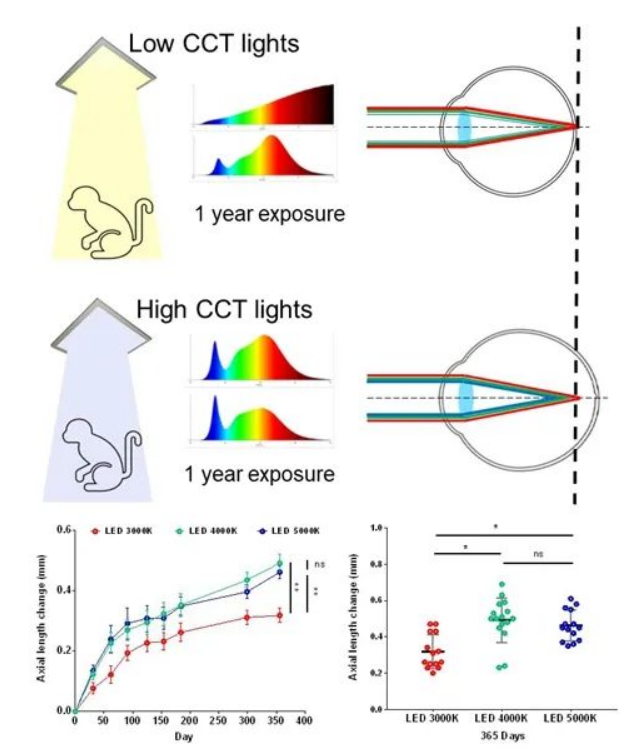
Figure: Low color temperature lighting can significantly slow the growth of axial length in juvenile macaques, thereby reducing the incidence of myopia
This study was published in Zoological Research under the title 'Low color temperature artificial lighting can slow down myopia development: long-term study using juvenile monkeys'.
Assistant Researcher Hu Yingzhou from the Kunming Institute of Zoology, Chinese Academy of Sciences; Associate Researcher Yang Hua from the Institute of Semiconductors, Chinese Academy of Sciences; and Associate Researcher Li Hao from the Kunming Institute of Zoology are co-first authors of the paper.
This work was carried out依托 the National Major Scientific Infrastructure Facility for Model Animal Phenotype and Genetic Research (Primate Facility) of the Kunming Institute of Zoology, Chinese Academy of Sciences, and the Primate Research Center. It was jointly completed by the Kunming Institute of Zoology, Chinese Academy of Sciences; the Institute of Psychology, Chinese Academy of Sciences; the Semiconductor Research Institute, Chinese Academy of Sciences; and the China Academy of Building Research. The study received funding support from key projects of the Science and Technology Service Program (STS) of the Chinese Academy of Sciences and other funds.
Source: Kunming Institute of Zoology, Chinese Academy of Sciences
Recommended reading: