
Research by the Singapore National Eye Centre shows that this LED lighting is beneficial for preventing myopia
Seoul Semiconductor announced the results of a study independently conducted by the Singapore Eye Research Institute (SERI), which demonstrated the impact of Sunlike lighting on eye emmetropization and myopia.
The results of this study were published in the journal "Investigative Ophthalmology & Visual Science" (IOVS), a professional journal dedicated to clinical and laboratory research in ophthalmology and vision.
Seoul Semiconductor (KOSDAQ 046890) announced the latest findings of an independent experimental study conducted by Assistant Professor Raymond Najjar's team at the Singapore Eye Research Institute (SERI), published in the peer-reviewed scientific journal "Investigative Ophthalmology & Visual Science" (IOVS). (*Full text link (Muralidharan et al. 2022): https://doi.org/10.1167/iovs.63.2.16)
To demonstrate the correlation between Seoul Semiconductor's years of R&D on natural light illumination technology SunLike and health, experiments were conducted starting in 2017 with institutions such as Seoul National University, the University of Basel, Harvard University, and others. This time, Seoul Semiconductor collaborated with SERI to test the effects of SunLike on ocular emmetropization (i.e., controlling eye growth processes and axial length to prevent myopia and maximize visual acuity) and myopia progression. Simply put, the results of this study indicate that, compared with traditional Fluorescent lamps, SunLike can promote emmetropization in chicken myopia models and accelerate recovery.
This experiment used three medium-level lighting conditions to raise chicks: Fluorescent lamp - 4000K (Group 1), SunLike - 4000K (Group 2), and SunLike 6500K (Group 3). One eye of each chick was covered with a diffuser for 14 days to induce myopia, then the diffuser was removed, and monitoring continued for another 14 days (up to day 28). The other eye of each chick served as a control. Throughout the study, in addition to other measured indicators, the axial length of the chicken eyeball was primarily monitored.
从第22天和第28天的监测结果显示,与暴露在荧光灯下的眼睛(图1A, D)相比,暴露在SunLike 4000K(图1B, D)和6500K(图1C, D)下的眼睛从诱导性近视中恢复得更快,眼轴长度已恢复到与对照眼(图1中的黑色线条)相似的水平。 而在荧光灯下没有观察到这样的恢复。
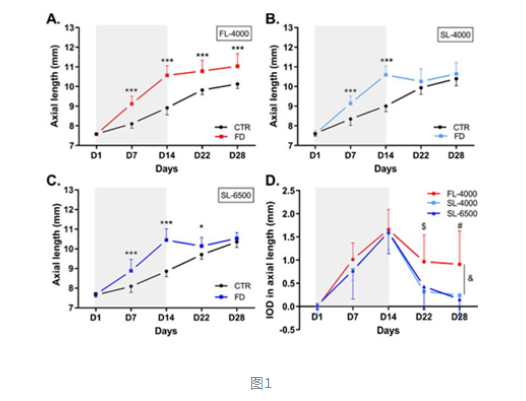
This study indirectly indicates that, compared with fluorescent lamps, SunLike lighting can promote emmetropization and accelerate recovery in experimental myopia of chickens.
Associate Professor Raymond Najjar commented: "Although these findings still need to be replicated in mammalian models and/or humans, they support the view that the spectral composition of indoor light affects eye growth and emmetropization, and open new research pathways for passive myopia control centered on light."
Professor Kim Seung-hyun (Kim seung - hyun, transliterated) of the Department of Ophthalmology at Korea University said: "I believe that if children in their growth phase are illuminated with light similar to sunlight, myopia will certainly improve. " "Today, we spend more time indoors; theoretically, providing such (sunlight-like) light to children may alleviate vision loss caused by myopia to some extent, but more research is still needed."
William Lee, Vice President of Seoul Semiconductor, stated: "We found that using SunLike lighting technology accelerated the recovery of myopia in the experimental group." "We confirmed the importance of lighting with a spectrum similar to sunlight for eye growth and emmetropization."
Source: Seoul Semiconductor