
Overview of China's Lighting Industry Exports in the First Half of 2022: Demand Contraction Led to a Decline in Volume, While Price Inflation Supported Stable Value
I. Overall Situation
In the first half of 2022, China's total export value of lighting products was USD 29.008 billion, a slight year-on-year (YoY) decrease of 0.25%, generally underperforming the overall export market. Among them, the export value of LED lighting products was USD 21.430 billion, with a slight year-on-year (YoY) increase of 2.10%. Specifically, traditional light source products generally experienced significant declines, while LED products, luminaires, and accessories remained relatively stable; Christmas string lights were one of the few growth highlights. Price factors driven by high inflation were the main support for the resilient export value in the first half of the year.
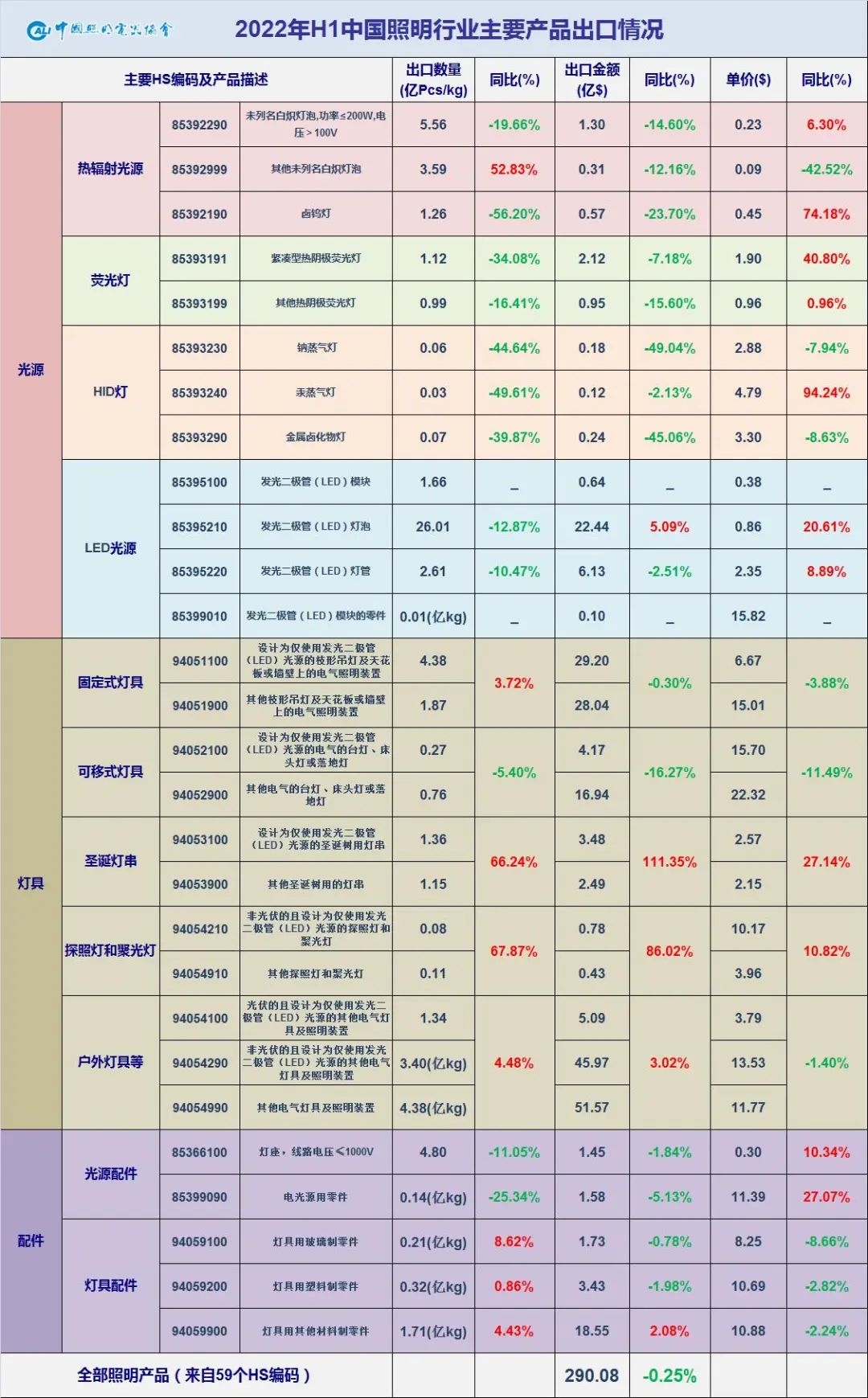
In the first half of the year, lighting product exports generally showed a decrease in volume but an increase in price. Export volume declined by approximately 20% in the first half of the year, with a nearly 30% drop in the second quarter. It is evident that export volumes for many products, including traditional light source products and LED light source products, decreased significantly. Setting aside the price increases caused by substantial rises in upstream costs such as raw materials, energy, and logistics, the actual decline in export volume exceeds the decline reflected in export value.
II. Monthly and Quarterly Breakdown
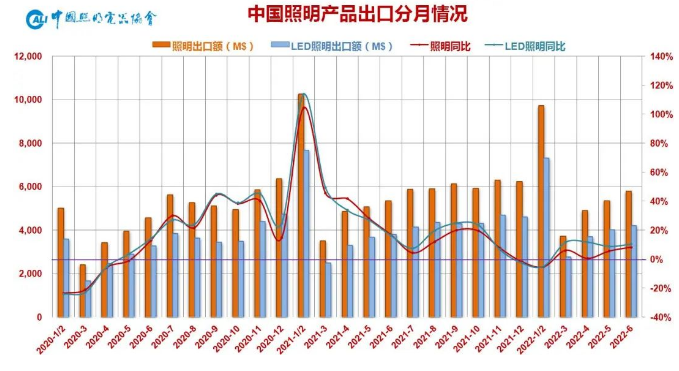
Looking at the monthly data, it is evident that overall export growth has hit a bottleneck since the fourth quarter of 2021. In 2022, export value slightly declined by 5.3% in January and February; while export volume dropped from March to June, price factors driven by inflation supported the total export value. As these price factors gradually weaken, downward pressure on overall exports will further intensify.
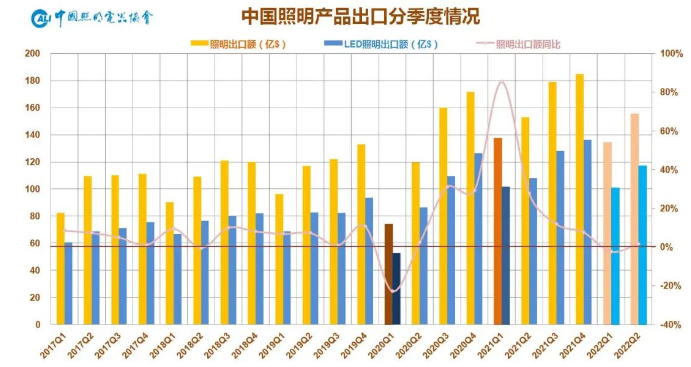
Looking at the data by quarter, Q1 2022 marked the first quarterly negative growth in China's lighting product exports since the outbreak of the COVID-19 pandemic in Q1 2020. However, the decline was within expectations, and the export value of both total lighting products and LED lighting products remained at historical highs. In other words, it was not that Q1 2022 performed poorly, but rather that the same period in 2021 was abnormally strong. Lighting exports in 2021 experienced a disrupted cycle with no distinct peak or off-seasons. In Q1 2021, driven by monetary easing and fiscal stimulus, consumer demand surged. Coupled with the ongoing substitution effect and customers placing "ahead-of-schedule and oversized" orders due to predictions of chip and material shortages, overseas demand remained high. Meanwhile, under the national initiative of "staying local for the Chinese New Year," sufficient production capacity was ensured for relevant export enterprises. As a result, export figures for Q1 2021 were not only far better than those of the same period in previous years but also significantly higher than the data for Q3 and Q4, which are traditionally peak seasons in normal years. This situation was abnormal and difficult to replicate. Therefore, it is acceptable that the data at the beginning of 2022, as part of a cyclical recovery period, was slightly lower than the same period last year. By Q2 2022, exports returned to positive growth even when compared against the high base of the same period last year.
3. Market Situation
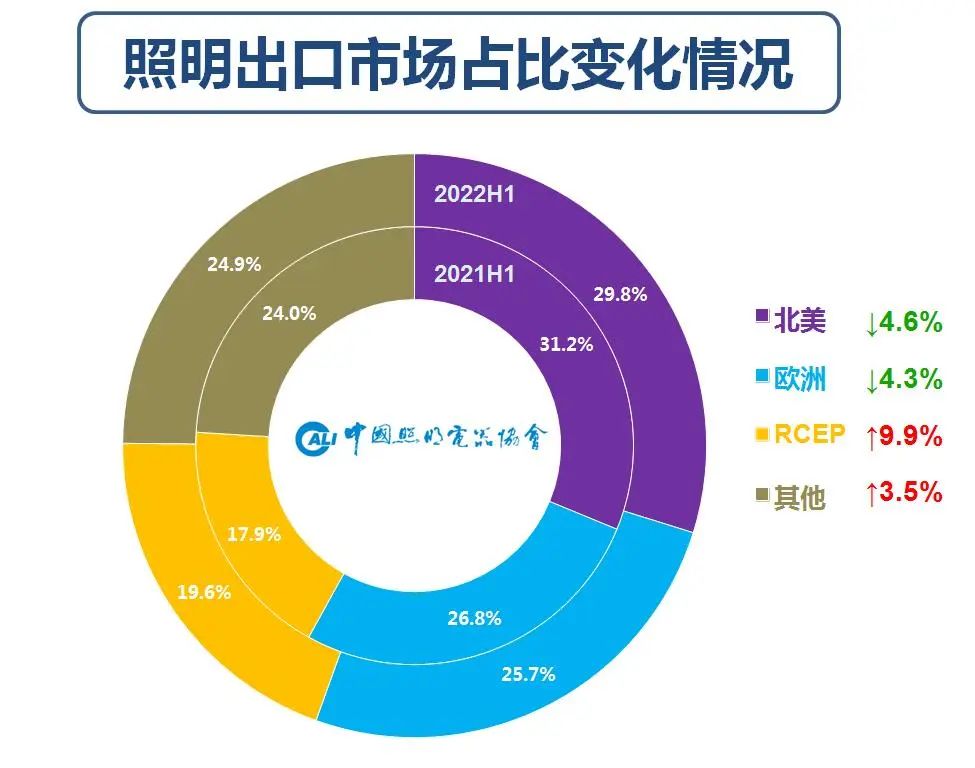
Currently, export enterprises generally report that the European and American markets are relatively sluggish, a trend confirmed by data. In the first half of 2022, the value of China's lighting product exports to North America decreased by 4.6%, with volume dropping by over 20%; exports to Europe saw a 4.3% decline in value and a 17% drop in volume. Notably, since the Regional Comprehensive Economic Partnership (RCEP)—which includes China, the 10 ASEAN countries, Japan, South Korea, Australia, and New Zealand, totaling 15 countries—came into effect in early 2022, it has yielded immediate results. Exports to RCEP countries grew by 9.9% against the trend in the first half of the year, partially offsetting the decline in the European and American markets. From another perspective, this also reflects the trend of parts of the lighting industry supply chain gradually spilling over into Southeast Asia.
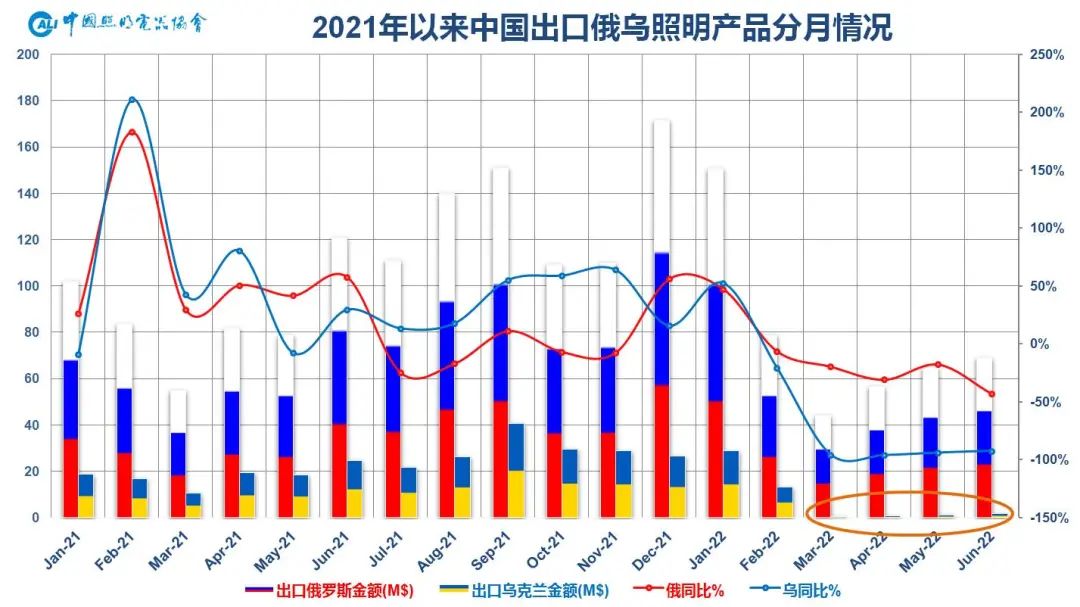
In addition, let's look at the hot Russia-Ukraine market. Due to logistics disruptions, trade interruptions, and a sharp decline in demand caused by the ongoing geopolitical conflict between Russia and Ukraine, Ukraine's lighting export market, which was at the tens of millions of USD level, plummeted by over 90% to the hundreds of thousands of USD level from March to June 2022. Currently, the outlook for the war remains uncertain, and the recovery of the export market to Ukraine is still a long and arduous journey.
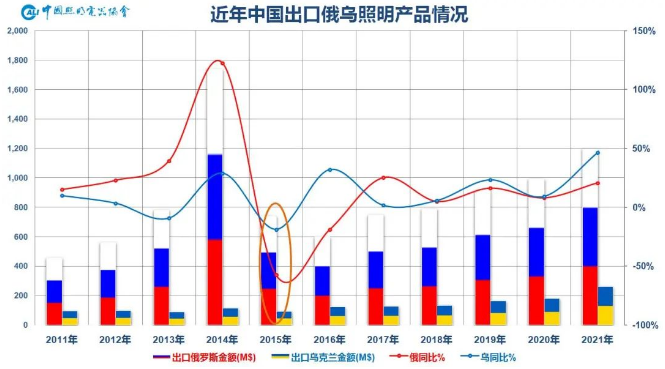
In comparison, related enterprises are currently facing many disadvantages in their Export to Russia, such as shrinking demand, difficult transactions, inflationary pressure, and supply constraints. Drawing on the experience of the cliff-like decline in Export to Russia after the 2014 Crimea incident, and considering the unprecedented comprehensive economic sanctions imposed by the West on Russia, there is a very high probability that the Russian economy will shrink significantly in 2022, making the prospects for lighting Export to Russia far from optimistic. Although the markets of Russia and Ukraine account for a small proportion of the entire lighting Export market, with relatively limited direct impact, the butterfly effect caused by the escalating situation has already had an immeasurable negative impact on the recovery of the global economy during the pandemic.
4. Place of Origin
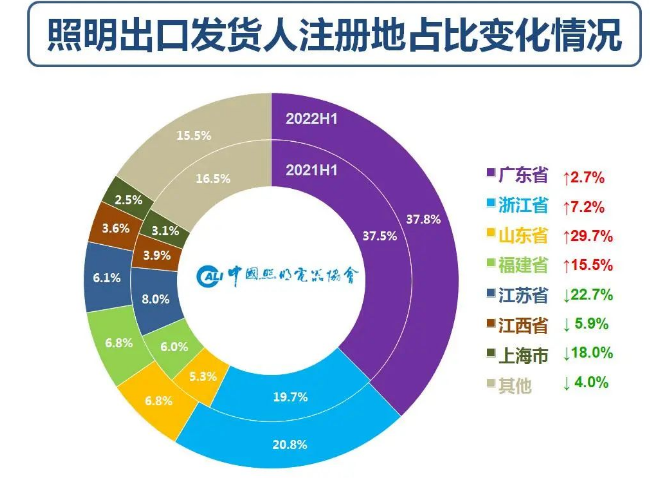
Looking at the changes in the proportion of registered places for export shipments, Guangdong and Zhejiang have long maintained their top-two positions, accounting for 60% of the country's total exports. However, the Shanghai outbreak that began in March not only significantly impacted local lighting export deliveries in Shanghai but also adversely affected exports across the entire Yangtze River Delta region.
V. Cause Analysis and Prediction
Demand-side contraction
1. The continuous emergence of new virus variants and regional geopolitical conflicts have hindered the recovery of global market demand.
2. Developed economies such as Europe and the United States have entered a monetary tightening cycle this year, with demand on a downward trajectory, while persistently high inflation will further suppress demand.
3. More countries choose to coexist with the virus, driving a shift in market consumption demand from products to services, leading to a natural decline in demand for durable consumer goods like lighting products.
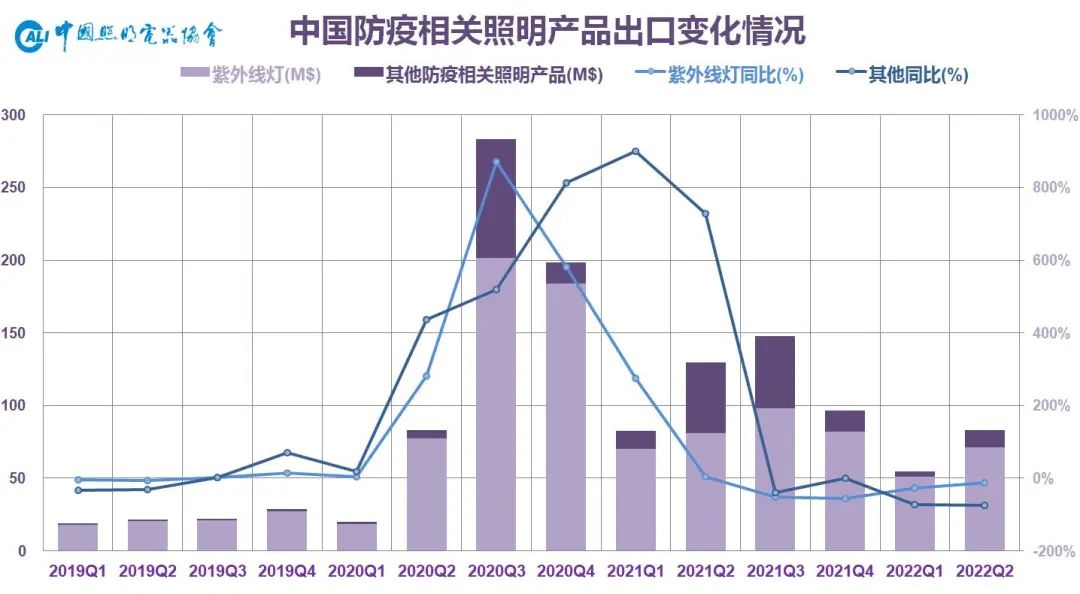
4. Demand for products related to the "epidemic prevention" and "stay-at-home economy" concepts, which saw a surge driven by the pandemic, has peaked and declined (with scientific research and medical lighting dropping by over 90%; UV lamps decreasing by nearly 30%; LED filament lamp quantities halving; and LED plant growth lights declining by approximately 15%), weakening their boosting effect on overall Export.
5. Overseas customers placed "ahead-of-schedule and excessive" orders last year based on their anticipation of the "chip shortage and material scarcity" trend. Additionally, the pandemic disrupted supply chains and logistics, leading to low inventory turnover efficiency. The resulting large backlog of inventory has constrained new order procurement.
6. In particular, as other manufacturing countries further advance the resumption of work and production, the "transfer substitution" effect of Chinese manufacturing abroad is weakened, reducing the spillover pressure on the lighting industry supply chain.
Supply-side pressure
While bearing the rigid rise in costs for materials, logistics, labor, land, and energy, the recurring domestic outbreaks since March have significantly adversely affected the production capacity and supply chain coordination of relevant enterprises. Additionally, overheated upstream cost inflation and weak downstream market deflation have squeezed midstream manufacturing, with continuous divergence in profit margins between upstream and downstream sectors further compressing corporate survival space. The essence of the overall decrease in export volume but increase in prices in the first half of the year is that the already slim profits of the lighting manufacturing industry were almost entirely used to hedge against the rise in various upstream costs. The industry has evolved from previously "earning hard-earned money" to the current widespread situation of "working hard without making profits," which is fundamentally detrimental to the sustainable development of the entire industry.
Second Half Forecast
Under the current situation, supply and demand have shifted from rising to falling, inflationary pressures continue to climb, and end-users are under pressure. Meanwhile, recurring pandemic outbreaks and geopolitical conflicts have led to further downward revisions in expectations for both the production and consumption sectors, making it quite challenging to achieve growth targets. Given the high base effect from the same period last year and the entry of commodity prices into a declining cycle, it is unlikely that exports will replicate the strong growth seen over the past two years once price factors weaken; negative growth cannot be ruled out.
At present, the industry benefits brought about by technological innovations in LED light source technology have almost reached their ceiling. The incremental growth in effective demand is gradually decreasing, and the lighting industry has entered an era of stock competition. In the future, relatively limited demand will increasingly concentrate on high-quality production capacity that possesses core competitiveness in technology or market, as well as supply chain control capabilities. The fully competitive landscape will also force a large number of mediocre companies to exit the market competition. Therefore, major high-quality lighting enterprises should maintain strategic focus, leverage their comparative advantages, concentrate on their core business, and patiently wait for better times.