
Studies confirm that far-UVC can effectively kill airborne pathogens in rooms.
The following article is sourced from Guangmingyuan Light Technology , authored by Guangmingyuan Light Technology
Scientists from the University of St Andrews, the University of Dundee, the University of Leeds, and Columbia University tested the germicidal efficacy of far-UVC in a real room with ventilation rates equivalent to typical home or office environments (approximately three air changes per hour).
During the experiment, a nebulizer continuously sprayed an aerosol mist of Staphylococcus aureus into the room. (This microorganism was chosen because it is slightly less sensitive to far-UVC than coronaviruses, providing researchers with an appropriately conservative model.) Once the microbial concentration in the room stabilized, the researchers turned on the far-UVC lamps in the room. These lamps eliminated more than 98% of the airborne microbes within just five minutes.
Dr. Kenneth Wood of the University of St Andrews said: "The results of our trials were astonishing, far exceeding what could be achieved by ventilation alone." "In terms of preventing airborne diseases, far-UVC lamps can make indoor spaces as safe as the golf courses in St Andrews."
In real rooms, far-UVC effectively inactivates airborne pathogens
包括COVID-19在内的许多传染病,都是通过空气中的病原体得以传播,因而有必要采取不依赖于人类行为的环境控制措施。一种潜在的解决方案是氯化氪准分子灯(通常称为远紫外线),它可以有效地灭活空气中的病原体,如冠状病毒和流感病毒。研究表明,当氯化氪灯过滤掉长波紫外线辐射后,它不会引起皮肤或者眼睛的急性反应,也不会引起皮肤癌等延迟症状。虽然有实验室的数据表明远紫外有效,但在实际的房间空间中,其有效性还得不到确认。
We demonstrate for the first time that deploying far-UVC light indoors can effectively inactivate aerosolized Staphylococcus aureus. With an air change rate of 3 ACH and five filtered UV sources, steady-state pathogen levels were reduced by 98.4%, equivalent to providing an additional 184 equivalent air changes. The far-UVC radiation dose used aligns with the current American Conference of Governmental Industrial Hygienists (ACGIH) threshold limit value for continuous 8-hour skin exposure. Our data suggest that far-UVC may be even more effective against common airborne viruses, including SARS-CoV-2, serving as an effective "non-intervention" technology to reduce airborne diseases. These findings provide spatial-scale data support for the design and development of far-UVC systems.
Severe Acute Respiratory Syndrome Coronavirus 2 (SARS-CoV-2), which caused the COVID-19 pandemic, can be transmitted through the air from one person to one or more individuals. In indoor environments with large crowds, especially where ventilation is poor, the risk of airborne transmission of SARS-CoV-2 increases.
As is well known, the high transmissibility of SARS-CoV-2 overwhelmed national healthcare systems, resulting in millions of deaths and long-term health issues. While causing sustained, devastating impacts on the global economy, it has in turn led to more profound welfare and public health problems.
It is evident that reducing or preventing the spread of SARS-CoV-2 is a critical and unprecedented global challenge. Transmission control measures include national lockdowns, restrictions on social and commercial gatherings, improved indoor ventilation, public health campaigns, wearing protective masks, and vaccination. The effectiveness of these measures varies. Vaccination has remained one of the most effective measures for reducing deaths and severe illness, but its effectiveness in reducing viral transmission remains unclear. Face covering is an effective control measure for reducing airborne transmission risk, but it relies on individual behavioral choices and requires high compliance to impact transmission suppression. As the COVID-19 pandemic has progressed, acceptance and adoption of control measures affecting daily life have declined, increasing the need for effective measures that do not depend on human behavioral choices. This is not limited to SARS-CoV-2; airborne transmission is recognized as a significant mechanism for a range of other viral infections, including influenza, measles, and other human coronaviruses (SARS-CoV, MERS), as well as respiratory syncytial virus (RSV), bacterial infections such as tuberculosis, and some sexually transmitted pathogens.
Germicidal Ultraviolet (GUV) is a control measure that meets the above requirements and has a scientific track record of success. In 1942, Wells et al. demonstrated that, compared to rooms without GUV, rooms with upper-room GUV irradiation had less transmission of measles and mumps among children. Similarly, Escombe et al. demonstrated that when upper-room germicidal ultraviolet was used, tuberculosis transmission from patients to guinea pigs was reduced by more than 70%: the infection rate in the control group was 35%, while in the GUV group it was 9.5%. However, a major hazard of traditional 254 nm germicidal ultraviolet stems from potential accidental human exposure, which can cause skin and corneal sunburn. This limits the use of traditional germicidal ultraviolet to carefully designed upper-room systems, enclosed fixtures, or irradiation of unoccupied rooms. Even with these measures, accidental exposure can still occur, affecting the adoption of this technology.
A potential Solution is "UVC ultraviolet", a germicidal UV in the C-band with wavelengths typically between 200 and 230 nm. A common far-UVC light source is the krypton chloride excimer lamp, which has a primary emission wavelength of 222 nm and low residual emissions across the UV region of the electromagnetic spectrum. In laboratory experiments, the germicidal properties of KrCl excimer lamps have been proven to inactivate Gram-positive and Gram-negative bacteria, drug-resistant bacteria, influenza viruses, and human coronaviruses including the SARS-CoV-2 virus. Importantly, when filtering minimizes UV above 230 nm, krypton chloride far-UVC excimer lamps are much less likely to induce acute adverse reactions in skin and eyes compared to traditional 254 nm germicidal UV. To date, studies in animal and human models have not demonstrated any long-term adverse health effects.
Experimental results showing pathogen inactivation in controlled standard laboratory environments are encouraging, but deploying this technology under "real-world" constraints does not necessarily mean it will reduce disease transmission. Historical precedents for upper-room germicidal UV provide some confidence in the potential of Far-UVC to reduce disease transmission, but practical assessments are still required. Such studies are complex and must be conducted over long periods (typically at least 12 months), and a translational step toward real-world research involves experiments in large, room-sized aerosol chambers. These room-sized chambers feature controlled airflow, temperature, and humidity, designed to replicate real room environments. Such spaces have already been used to demonstrate the effectiveness of upper-room germicidal UV systems and to study microbial survival and dispersion. They can also help understand the application of a technology in rooms where infected individuals may be present for extended periods (similar to schools, workplaces, hospitals, and reception areas). By continuously controlling the release of airborne pathogens to achieve a steady-state environment, sampling indoor air with or without ambient air disinfection technology can provide data closer to real-world conditions. Here, we present the first study on the effectiveness of Far-UVC in inactivating airborne pathogens in a full-scale bioaerosol chamber under steady-state conditions.
Results
Five krypton chloride excimer lamps were installed on the ceiling of a room-sized bioaerosol chamber at the University of Leeds, filtered to reduce UV emissions above 230 nm, and fitted with diffusers at their emission windows to broaden their irradiation pattern. The lamps were arranged in a quincunx pattern (Figure 1), with their emission directed toward the floor. The study was conducted with all five lamps on or only the central lamp on. This was done to investigate the effects of localized (one lamp) and full (five lamps) irradiation of the room volume. The 32 m³ room was mechanically ventilated at a rate of 3 air changes per hour (ACH), and aerosolized Staphylococcus aureus was continuously released into the room at a height of 168 cm. After a 60-minute stabilization period, 10 air samples were collected over 50 minutes. Then one (the central far-UVC lamp) or five far-UVC light sources were turned on, and sampling continued for another 50 minutes.
We repeated these tests using three different irradiance levels (Table 1). The selected irradiance levels are based on the optical radiation recommendations from the International Commission on Non-Ionizing Radiation Protection (ICNIRP) for the "moderate" scenario and the exposure limits from the American Conference of Governmental Industrial Hygienists (ACGIH) for the "high" scenario. Additionally, an extra scenario with lower irradiance intensity ("low" scenario) was included. Detailed statistical analysis is provided in Table S1.
As described in the "Methods" section, 4-minute continuous sampling was performed every 5 minutes before and after turning on the light. The concentration of viable Staphylococcus aureus pathogens in the air at the collection site is shown in Figure 1. Figures 2 and Table 1 show the colony-forming units per cubic meter (cfu m-3) results for 45 minutes before "light on" and 50 minutes after "light on", respectively. The values after "light on" are expressed as a percentage of the average value before the light was turned on. It is emphasized again that pathogens were continuously released into the room throughout the experiment.
As expected, the greatest reduction in viable Staphylococcus aureus counts in steady-state air occurred under the "high" irradiation scenario. Compared to ventilation alone (3 air changes per hour), using all 5 lamps reduced steady-state viable bacteria by 98.4% (standard deviation 0.7%). The estimated equivalent air change rate ranged from 128-322 eACH (one standard deviation confidence interval). In this "high" scenario, the maximum 8-hour exposure dose referenced the American Conference of Governmental Industrial Hygienists (ACGIH) skin threshold limit value (the 222 nm dose limit is 478 mJcm-2 over more than 8 hours). Under the "high" irradiation scenario, the average 8-hour exposure dose from a single lamp did not exceed the ICNIRP exposure limits, pathogen levels were reduced by 93.7%, and the estimated equivalent air change rate ranged from 33-66 eACH. Although a single lamp did not irradiate the entire room, good air mixing indoors likely contributed to this very significant effect.
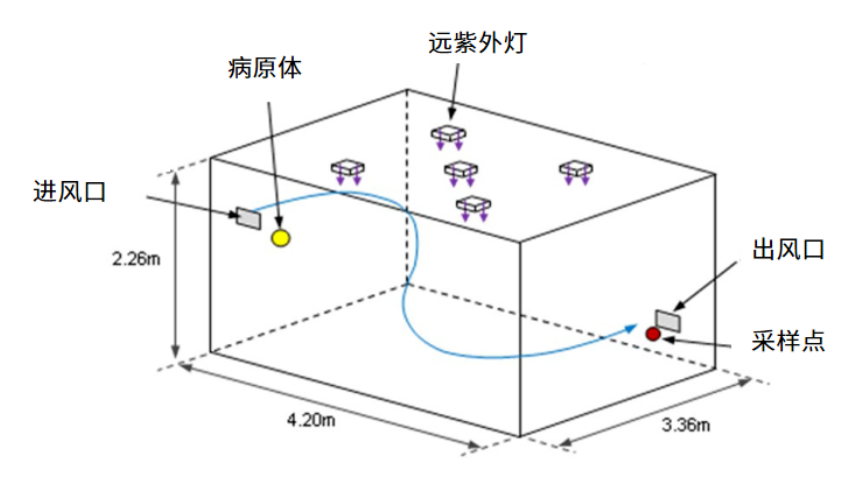
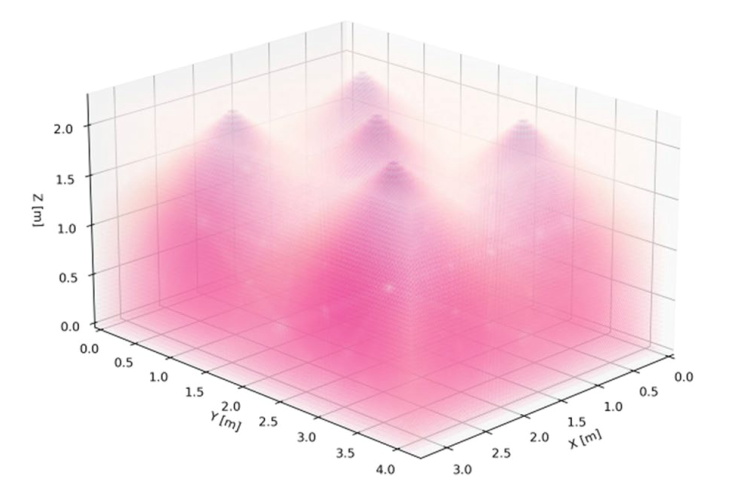
Figure 1 is a three-dimensional schematic of the bioaerosol chamber, showing room dimensions, luminaire locations, pathogen sources and collection points (top), and an example of far-UVC irradiation (bottom).
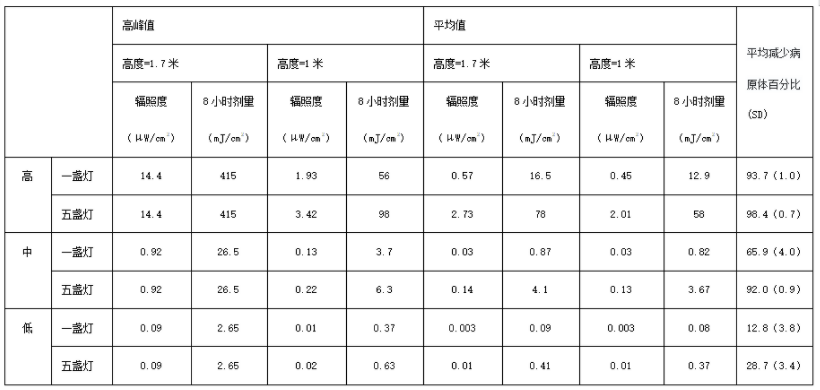
Table 1 shows the average percentages of pathogen reduction rate, irradiance, and 8-hour exposure dose under three different illumination conditions at two heights above the ground. The bold italicized 8-hour exposure values exceed the ICNIRP 222 nm exposure limit of 23 mJ cm⁻². None of the exposures exceeded the 2022 ACGIH skin exposure threshold of 478 mJ cm⁻². Statistical significance is indicated as: ns = p > 0.05, * = p ≤ 0.05, ** = p ≤ 0.01, *** = p ≤ 0.001, **** = p ≤ 0.0001.
In the "moderate" irradiation scenario, the 8-hour peak irradiation dose references the current ICNIRP guideline exposure limit of 23 mJcm-2. With all five lamps in use, the viable bioburden under steady-state conditions was reduced by 92.0%. This is approximately equivalent to 35 eACH (range 27-46 eACH), which is more than 11 times that of standard ventilation within 15 minutes. Notably, although the 8-hour peak exposure dose is slightly higher than the ICNIRP guideline exposure limit, the average 8-hour exposure dose is more than 5 times lower than the ICNIRP guideline exposure limit (Table 1).
"Low" irradiation scenario, i.e., very low intensity far-UVC irradiance (10 times lower than the "medium" exposure rate scenario), reduces the viable pathogen load by 13% (one lamp) and 29% (five lamps).
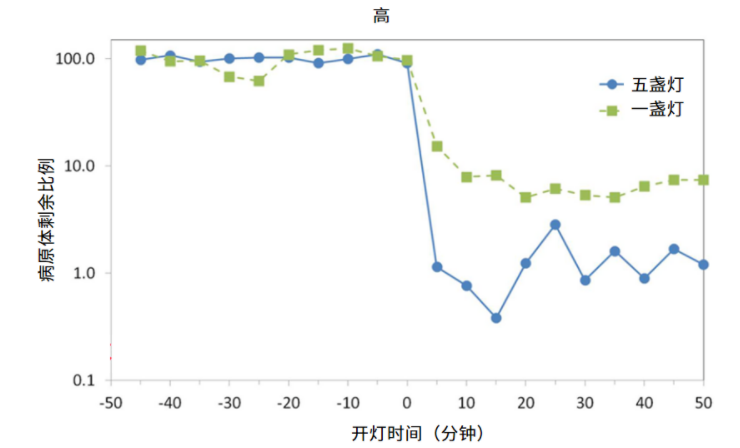
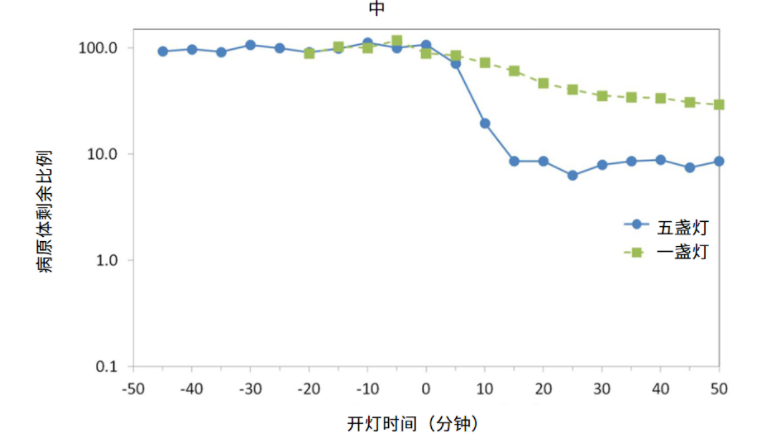
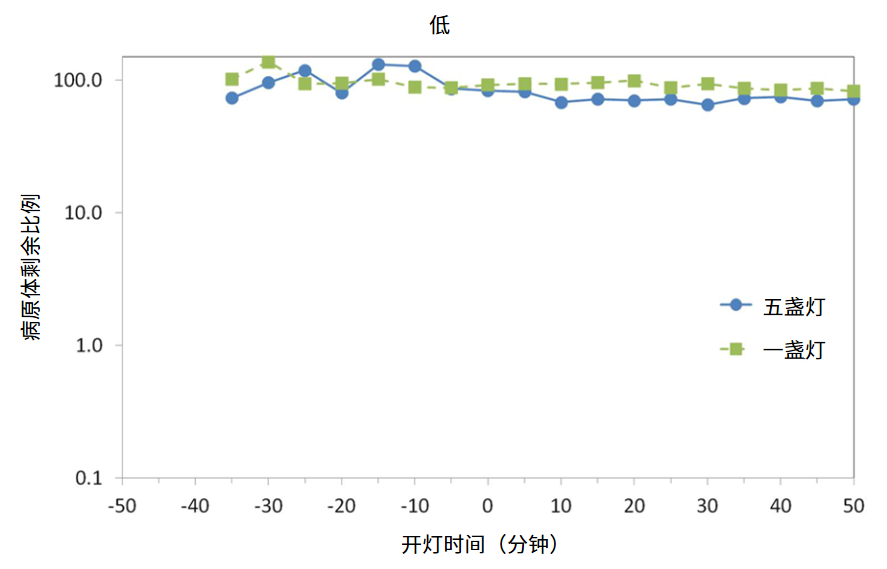
Figure 2: After turning on the far-UVC light source, the percentage of viable Staphylococcus aureus remaining in the air over time under high, medium, and low irradiation scenarios shows a logarithmic relationship on the y-axis. Note that pathogens were continuously released into the room throughout the experiment: the study was conducted using either a single central lamp (green, square data points, dashed line) or all five far-UVC lamps (blue, circular data points, solid line).
Discussion
For the first time, we demonstrated in a full-scale room under typical ventilation conditions and with pathogens persisting in the air that far-UVC has the potential to rapidly and significantly reduce airborne pathogens. At irradiance levels not exceeding the exposure limits set by the ICNIRP guidelines, a new environmental level with approximately 92% reduction in viable bacterial count can be achieved within 15 minutes. At the ACGIH threshold limit value, an approximately 98% reduction can be achieved in less than 5 minutes. Figure 3 shows a comparison of the two scenarios.
Although SARS-CoV-2 was not used in our study for safety reasons, aerosolized Staphylococcus aureus served as a surrogate for airborne viruses such as human coronaviruses and influenza viruses. Figure 4 illustrates the underlying principle of this theory, comparing the far-UVC inactivation rates of airborne human coronaviruses (OC43 and 229E), airborne influenza virus (H1N1), and airborne Staphylococcus aureus. All inactivation rates were measured using the same laboratory setup. Although far-UVC inactivation results for SARS-CoV-2 have not yet been reported, results on far-UVC carrier inactivation of SARS-CoV-2 indicate that its sensitivity is similar to that of human coronaviruses OC43 and 229E. Our results show that airborne Staphylococcus aureus is less sensitive to far-UVC inactivation than airborne influenza viruses and human coronaviruses, making it a conservative surrogate.
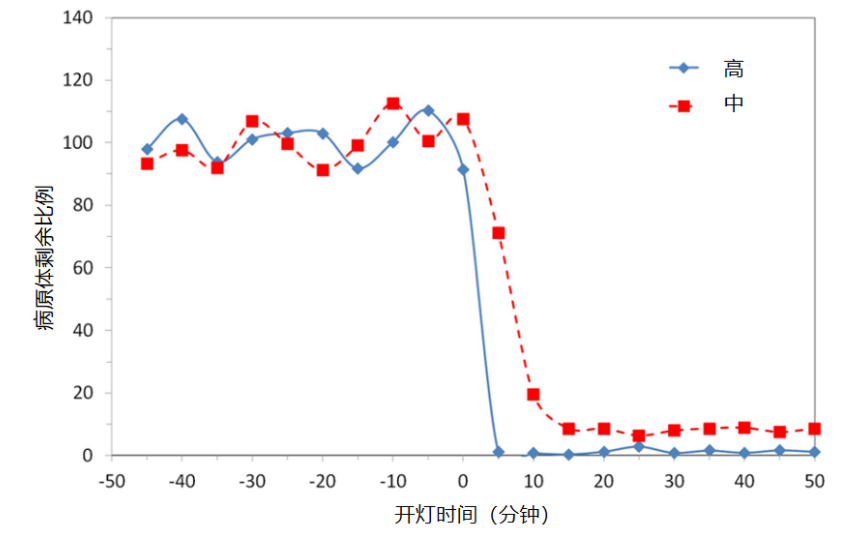
Figure 3: Percentage of viable airborne Staphylococcus aureus remaining on the y-axis under two exposure scenarios based on ICNIRP guideline exposure limits (5 "medium" lamps) and ACGIH threshold limit values (5 "high" lamps). Note that throughout the experiment, pathogens were continuously released into the room at a mechanical ventilation rate of 3 air changes per hour.
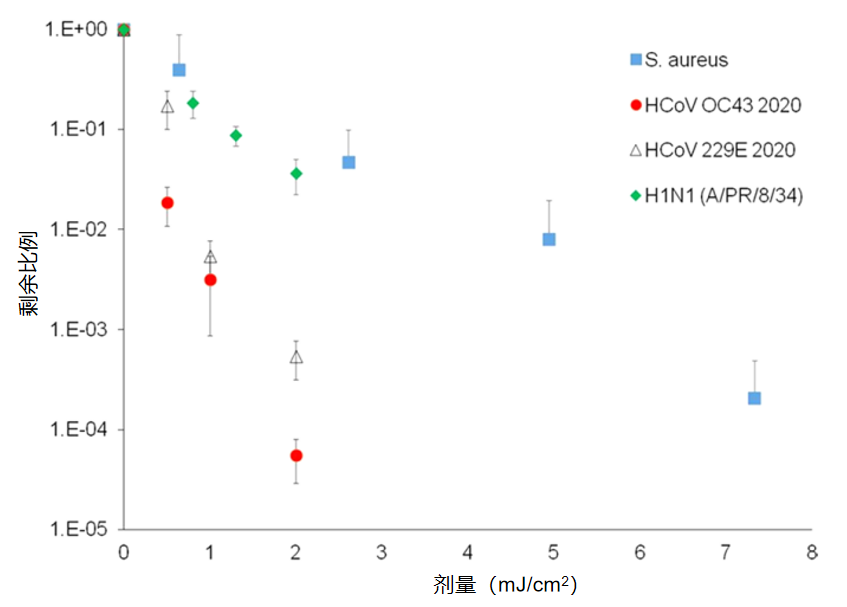
Figure 4: Inactivation of human coronaviruses HCoV-OC43 and HCoV-229E, and influenza A (H1N1) virus compared with aerosolized Staphylococcus aureus under low far-UVC irradiation doses. Measurements were performed using the aerosol pathogen irradiation system at Columbia University laboratories. Previously published data on HCoV-OC43, HCoV-229E, and influenza A (H1N1) are included for comparison.
It is hypothesized that the percentage of airborne coronaviruses and influenza viruses inactivated may be higher, with shorter inactivation times.
For those installing far-UVC lamps, interpreting and applying optical radiation exposure limits can be challenging. Many adopt a conservative approach, assuming an 8-hour exposure dose based on peak illuminance. However, exposure limits are based on the time-weighted average (TWA) of irradiance (ETWA), which accounts for the actual exposure received by an individual within a space. If the ETWA remains within the limits, higher peak irradiance is permitted. In this study, the peak lamp intensity may be 5 times higher than in a "moderate" scenario, thereby improving inactivation efficacy, while the average 8-hour dose will still remain within the ICNIRP guideline exposure limits.
This highlights the importance of correctly installing far-UVC lamps to ensure that the designated space receives appropriate and safe irradiation. For example, although a single lamp achieves an overall pathogen reduction rate of approximately 94% in the "high" scenario, some areas within the room are not fully irradiated. Compared to the room used in the experiment, actual room spaces may be larger, air mixing effects may be weaker, and the actual pathogen reduction may be significantly lower. Based on previous modeling studies, we have improved the far-UVC lamps by placing a diffusing material on the emitting surface of the far-UVC light source indoors to expand its irradiation pattern and increase far-UVC coverage.
Our findings also provide some initial data that can be compared with other technologies such as portable air purifiers. Depending on the size of the device, its Clean Air Delivery Rate (CADR) is typically between 200 and 500 cubic meters per hour, while in the laboratory it would reach 6.2 to 15.5 eACH. Therefore, a "medium" Far-UVC scenario with 5 lamps performs better than higher-flow HEPA air purifiers. Although Far-UVC systems are more complex to design and install than "plug-and-play" portable air purifiers, this approach may provide greater eACH and is also very quiet. Another potential advantage of Far-UVC over air purifiers and upper-room UVGI is that it may not require "good" air mixing within the room. We will investigate this in future studies.
All methods aimed at reducing the airborne transmission of diseases such as COVID-19 should ideally be used in layers, including vaccination where appropriate, social distancing, wearing masks, and ventilation. Further research is needed on the impact of parameters such as temperature, humidity, ventilation rates, and proximity to infection sources, but the results reported here should provide confidence that far-UVC, when properly deployed and compliant with current (or future) safety regulatory limits, can be an effective, human-behavior-independent control measure. It inactivates key airborne pathogens, such as human coronaviruses and influenza, thereby reducing their airborne and fomite transmission.
Method
Bioaerosol chamber.The experiments were conducted in a controlled bioaerosol chamber measuring 4.26 m in length, 3.35 m in width, and 2.26 m in height. The chamber operates under negative pressure with mechanical ventilation and is equipped with a 100% fresh air system featuring HEPA filtration on both supply and exhaust to ensure experimental control and operational safety. Ventilation air is supplied through a wall-mounted inlet grille located in one corner of the room. A wall-mounted outlet is positioned low on the diagonally opposite side. The test chamber operates at an airflow rate of 0.027 m³/s, equivalent to three air changes per hour (ACH). Previous studies have demonstrated good air mixing within this chamber. The release point for Staphylococcus aureus was located at a height of 168 cm from the floor, 50 cm from the air inlet, and 64 cm from the adjacent wall (Figure 1). The sampling point was situated at a height of 50 cm, 20 cm from the air outlet, and 64 cm from the adjacent wall. Prior research indicates that this location represents the average concentration within the laboratory. Care was taken to ensure that neither the bacterial release point nor the sampling point was directly beneath the far-UVC source (Figure 1). The laboratory temperature was maintained at 28°C ± 1°C, with a relative humidity of 50% ± 2%. Although mechanical ventilation provided well-mixed airflow, no mixing fans were used inside the chamber. The experiments required biosafety containment; they were performed with the chamber sealed and during aerosolization, with remote operation of aerosol sampling and far-UVC radiation devices.
Selection of aerosolized pathogens. As described by Welch et al.: In practice, bioaerosol chambers cannot be used for aerosolized Risk Group 3 pathogens, such as SARS-CoV-2. To select a viable aerosolized pathogen—i.e., a reasonable yet prudent and conservative model for airborne human coronaviruses—we conducted preliminary studies using the aerosolized pathogen UV irradiation system at the Columbia University laboratory. This system consists of an aerosolized pathogen source, with its flow passing through a UV irradiation chamber composed of a far-UVC source and far-UVC transparent windows; different far-UVC doses can be obtained by varying the intensity of far-UVC exposure and the velocity of the pathogens. Airborne Staphylococcus aureus was collected on gelatin filters (Sartorius, Germany) after irradiation, dissolved in 5 ml of PBS, and analyzed for inactivation using the colony-forming unit (CFU) method on Tryptic Soy Agar (TSA) plates.
Figure 4 shows indoor results for aerosolized Staphylococcus aureus, compared with previously published results for aerosolized human coronaviruses 229E and OC43, as well as the H1N1 influenza virus. We conclude from these preliminary studies that, despite differences between bacteria and viruses, aerosolized Staphylococcus aureus can be used as a conservative and reasonable model for far-UVC inactivation of human coronaviruses in current indoor studies. Staphylococcus aureus has been applied in many indoor experiments and has proven to be a reliable test organism that can be aerosolized into rooms and continuously sampled from the space, enabling good comparability between experiments. Staphylococcus aureus itself is also a pathogenic bacterium, as it represents methicillin-resistant Staphylococcus aureus (MRSA), which is important in hospital-acquired infections and is often used as a reference for cleaning. In the wake of the current pandemic, evaluating pathogen inactivation technologies is critical.
Far-UVC lamps. Five commercial krypton chloride (KrCl) excimer far-UVC lamps, filtered to reduce UV radiation above 230 nm, were placed in a room at a height of 2.12 meters in a quincunx pattern (the pattern of five dots on a six-sided die), with the irradiation directed towards the floor. These lamps operate continuously and have been modified with a diffuser material to expand the distribution range of far-UVC radiation, maximizing the irradiance. To adjust the irradiation intensity of the lamps, the Medical Physics and Clinical Engineering department at Ninewells Hospital in Dundee customized metal mesh attenuation filters. These filters provided irradiation intensities of 10% and 1% of the original far-UVC output. The attenuation filters were placed between the lamps and the diffuser material.
The irradiance (E) field inside the cabin was measured on a horizontal plane using a calibrated UVC radiometer (UV-3727-5 detector with X1-5 optical head, Gigahertz-Optik, Germany, April 29, 2021). Measurements were performed at two heights (z) of 1.7 meters and 1 meter above the ground, with a spacing of 0.5 meters. In Equation (1), exposure is defined as the radiant exposure H at height z, such that

Here, Eiz is the irradiance at height z and position i multiplied by the time spent at position iz, integrated over all positions. The peak exposure dose is assumed at t = 8 hours (28,800 seconds) at the position i where the irradiance measurement is highest for a given z (i.e., directly under the lamp). The average exposure dose is defined as the 8-hour radiant exposure based on the average measured irradiance at a given height. After careful consideration, we decided not to name the far-short-wavelength devices used in this study, as these experiments are an investigation of far-UV principles rather than an endorsement of any specific device.
Experimental procedure. Preparation of the suspension and generation of bioaerosols. Aerosol generation was conducted in a controlled environment where temperature (28°C ± 1°C) and relative humidity (50% ± 2%) were taken into account. A Collison 6-jet nebulizer (BGI, USA) operating at 12 L/min was used to generate aerosols; it was located outside the chamber, and the aerosols entered the test chamber through a tube. The aerosols generated by the nebulizer had a diameter of 0.3 µm to 5 µm, with a mass median aerodynamic diameter of 2.5 µm (geometric standard deviation of 1.8). The suspension in the nebulizer container (100 ml) consisted of Staphylococcus aureus (ATCC 6538) prepared in sterile distilled water at a concentration of approximately 1.35 × 10⁶ CFU/ml. Preliminary investigations of pathogen suspensions in other media (i.e., 1% fetal bovine serum) showed no significant effect on the results.
Sampler sampling. The sampling process uses a six-stage Anderson impactor (Anderson INC.) with a flow rate of 28 L/min. Samples are delivered from the exterior to the chamber, and collected via test tubes. Tryptic Soy Agar (TSA) plates in stages 5 and 6 of the Anderson impactor were prepared using 40 g of TSA (Oxoid, UK) per 1 L of distilled water. Approximately 90% of the Staphylococcus aureus aerosol was collected at stage 6 (aerosol diameter 0.65 µm - 1.1 µm), with the remaining 10% collected at stage 5 (aerosol diameter 1.1 µm - 2.1 µm). In previous experiments, under identical environmental conditions and S. aureus concentrations, aerosols collected at stages 1–4 (2.1, 3.3, 4.7, and 7 µm) accounted for less than 1% of the total collected volume. After sampling, agar plates were incubated at 37°C for 24 hours, and colonies on each plate were counted using a Gallenkamp colony counter. Finally, results were corrected using the positive hole correction table, and the sampler flow rate was used to determine the concentration of colony-forming units per cubic meter (CFU/m³) in the air.
This experiment. Staphylococcus aureus transmitted through the air established a steady state lasting 60 minutes indoors, similar to an infected person emitting aerosolized pathogens from a corner of the room. Then, at each sampling point, 10 air samples with a duration of 4 minutes were collected every 5 minutes (Figure 2), with the remaining time used to prepare the next sample. The far-UVC lamp was then turned on, and sampling was repeated in the same manner. Before turning on the far-UVC lamp, the indoor concentration of Staphylococcus aureus (cfu m-3) was determined using the average of the first 10 air samples. Subsequently, the concentration (cfu m-3) of each air sample was plotted as a percentage of the initial steady-state average concentration.
分析。在开启远uvc设备之前,通过与所有样品的平均浓度进行比较,将金黄色葡萄球菌的浓度归一化,以便在实验内部和实验之间进行比较。当灯打开后的衰减期结束后,在20到50分钟之间进行6次测量,以确定灯打开时的稳定浓度。由(2)式(C)和(Cuv)(灯被打开前(C)和之后(Cuv)的稳态浓度)计算出了由远超紫外线引起的等效换气率。

where N is the room ventilation rate (ACH), and Nuv is the equivalent air change rate.
Statistical analysis. An unpaired t-test was used to compare viable bacteria before and 20 min after turning on the Far-UVC lamp. Statistical analysis was performed using GraphPad Prism (Prism 9, GraphPad Software, USA). Statistical significance for all cases: ns = p > 0.05, * = p ≤ 0.05, ** = p ≤ 0.01, *** = p ≤ 0.001, **** = p ≤ 0.0001.
Original reference: Far-UVC efficiently inactivates an airborne pathogen in a room-sized chamber