
Scientists are searching for the best UV lamps to eliminate coronaviruses
Research collaboration between NIST and DHS reveals which UV wavelengths are most effective for disinfecting the COVID-19 virus. To disinfect a surface, you can expose it to ultraviolet (UV) light, which has a shorter wavelength than visible blue light. But to specifically inactivate SARS-CoV-2 (the virus that causes COVID-19), which wavelength is best? And how much radiation is sufficient?
To answer these questions, scientists must overcome two major obstacles. First, they need to completely separate the virus from irrelevant substances in the environment. Second, they must irradiate the virus with ultraviolet light of a single wavelength at a time, minimizing changes to the experimental setup between tests.
A recent study overcame both obstacles, completing what may be the most thorough test to date on how several different ultraviolet and visible light wavelengths affect SARS-CoV-2. This study was a collaboration between the National Institute of Standards and Technology (NIST) and the National Biodefense Analysis and Countermeasures Center (NBACC), a laboratory of the Science and Technology Directorate of the U.S. Department of Homeland Security (DHS).
In a new paper recently published in the journal Applied Optics, collaborators describe a novel system that projects single-wavelength light onto COVID-19 virus samples in a secure laboratory. The laboratory is classified as Biosafety Level 3 (BSL-3) and is designed to study microorganisms that can be fatal if inhaled. Their experiments tested more wavelengths of ultraviolet and visible light than any other study on the virus causing COVID-19 to date.
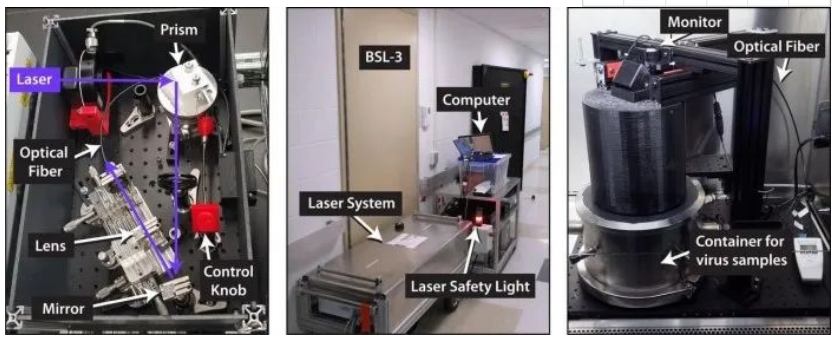
Photos of the setup. Left: Close-up inside the box containing the laser-to-fiber coupling system. Center: Laser system in the corridor outside the BSL-3 door. Right: Close-up of the experimental setup inside BSL-3, including the room where SARS-CoV-2 samples are placed. Source: NIST
So, does SARS-CoV-2 have any special weaknesses? It turns out, not really. The SARS-CoV-2 virus is susceptible to UV light at the same wavelengths as other viruses, such as those that cause influenza. The most effective wavelengths are in the "UVC" range, between 222 and 280 nanometers (nm). UVC light (full range from 200 to 280 nm) has shorter wavelengths than UVB light (280 to 315 nm), which causes sunburn.
Scientists have also shown that the surrounding environment can protect viruses. In experiments, the UV dose required when viruses were placed in pure water was lower than when they were placed in simulated saliva, which contains salts, proteins, and other substances found in real human saliva. Suspending viruses in simulated saliva creates a scenario similar to real-world situations involving sneezing and coughing . This detail may make the findings more directly informative than previous studies.
Michael Schuit of NBACC said: "I think a major contribution of this study is that we were able to show that the idealized results we see in most studies do not always predict what happens under more realistic conditions. When you have substances like simulated saliva around viruses, this may reduce the efficacy of UV purification methods."
Manufacturers and regulators of UV disinfection equipment can use these results to help determine how long surfaces in healthcare facilities, transportation vehicles, and even liquids should be irradiated to achieve inactivation of the SARS-CoV-2 virus.
"There is now significant momentum to bring UV disinfection into commercial settings," says NIST researcher Cameron Miller. "In the long term, it is hoped that this research will lead to standards and other methods for measuring the UV dose required to inactivate SARS-CoV-2 and other harmful viruses."
This project builds on earlier work by the NIST team and another collaborator on inactivating microorganisms in water.
Depending on the wavelength, UV light damages pathogens in different ways. Some wavelengths can destroy the RNA or DNA of microorganisms, rendering them unable to replicate. Other wavelengths can break down proteins, destroying the virus itself.
Although the disinfection capability of ultraviolet light has been known for over a century, research into UV disinfection has seen explosive growth in the past decade. One reason is that traditional UV light sources sometimes contain toxic substances such as mercury. Recently, the use of non-toxic LED lamps as UV light sources has alleviated some of these concerns.
In this study, NIST collaborators worked with biologists at NBACC, whose research informs biodefense programs against biological threats such as anthrax and the Ebola virus.
"What NBACC can do is culture the virus, concentrate it, and remove everything else," Miller said. "We are trying to get a clear message on how much light we need to inactivate the SARS-CoV-2 virus."
In this study, the team tested the virus in different suspensions. In addition to using a saliva simulant, the scientists also placed the virus in water to see what would happen in a "pure" environment. They tested the viral suspensions as liquids and as dried droplets on steel surfaces, representing other substances that an infected person might produce when sneezing or coughing.
NIST's work involves exposing samples to ultraviolet light from lasers. They are looking for the dose required to kill 90% of viruses.
With this device, the collaborative project can measure viral responses to 16 different wavelengths, ranging from the extreme low end of ultraviolet light at 222 nm to the middle of the visible spectrum at 488 nm. Researchers included longer wavelengths because some blue light has been proven to have disinfecting properties.
Shining a laser onto a sample in a secure laboratory is no easy task. Researchers in BSL-3 laboratories wear frosted suits and hooded respirators. Leaving the laboratory requires taking a long shower before changing into casual clothes.
Expensive equipment such as lasers will also have to undergo a fairly strict disinfection procedure.
"It's a bit like a one-way door," Miller said. "Anything coming out of the lab must be incinerated, autoclaved [heat sterilized], or chemically disinfected with hydrogen peroxide vapor. So bringing in our $120,000 laser wasn't an option we wanted to use."
In contrast, NIST researchers designed a system that places the laser and some optical components in the hallway outside the laboratory. They transmit light through a 4-meter-long fiber optic cable to a sealed point under the laboratory door. Negative pressure causes air to flow from the hallway into the laboratory, preventing any materials from leaking back into the laboratory.
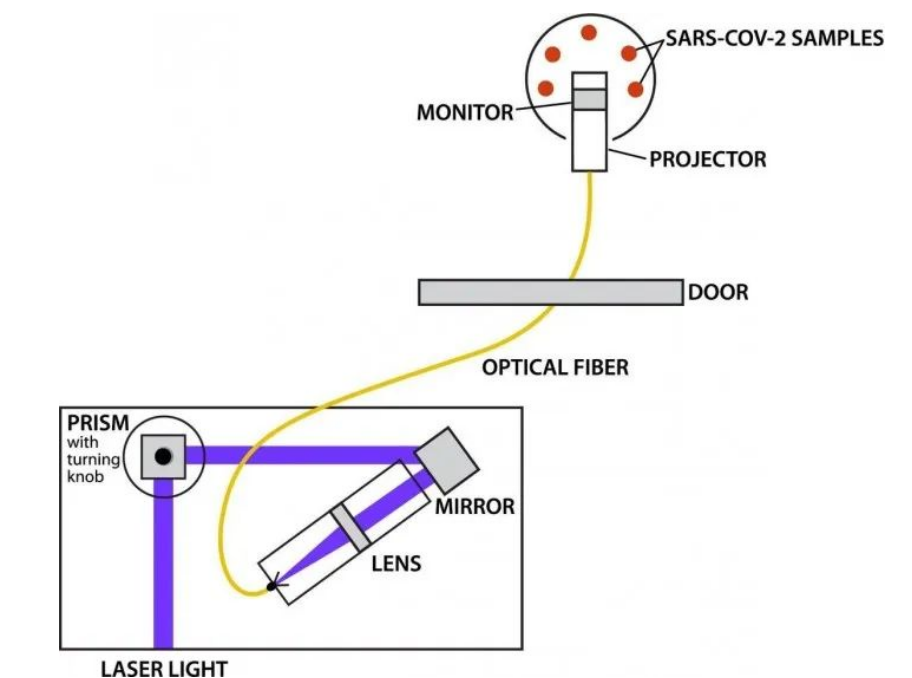
Overview of the researchers' setup. The laser is placed in a hallway outside the laboratory. A fiber optic cable directs the laser through an opening under the door into the room where the SARS-CoV-2 samples are located.
This laser generates only one wavelength at a time and is fully tunable, allowing researchers to produce any wavelength they desire. However, since the angle of light bending depends on its wavelength, they must create a prism system to adjust the angle at which light enters the optical fiber for proper alignment. Changing the export angle requires manually turning a knob they created to adjust the prism's position. They aimed to make this process as simple as possible, with minimal moving parts.
Schuit said: "The device devised by the NIST team enables us to rapidly test a very wide range of different wavelengths, all within highly controlled and precise bands. If we attempted to test the same number of wavelengths without that system, we would have to debug a host of different types of equipment, each producing bands of varying widths. They would require different configurations, introducing many additional variables."
Manipulating light requires mirrors and lenses, but researchers use them as sparingly as possible in the design, because each one causes a loss of UV intensity.
For materials that require directing light from optical fibers onto virus samples in the laboratory, the team attempted to use inexpensive components. "We 3D printed a lot of things," said Steve Grantham, a physicist at NIST, who, along with Thomas Larason of NIST, was a key member of the team. "So, nothing is truly expensive, and if we no longer use it, it's not a big problem."
Even communication between the laser area and inside the laboratory was difficult, as people could not enter or exit at will, so they adopted a wired intercom system.
Miller said that despite these challenges, the system performed surprisingly well, especially considering they had only a few months to assemble it. "There are a few areas we could potentially improve," Miller said, "but I think our gains would be minimal."
The NIST team plans to use this system for future studies of other viruses and microorganisms that biologists in high-security laboratories may wish to investigate.
Miller said: "When the next virus appears, or any pathogen of interest to them, all we need to do is roll the laser system over there, push a fiber optic cable in place, and they will connect it to their projector system. So now we are ready for the next time."
This work was partially funded by the Science and Technology Directorate of the Department of Homeland Security.
Source: cnBeta