
NiCS Lighting System Application Case: Zero-Energy Smart Lighting Project for Underground Parking Lots
The "Action Plan for Carbon Peaking Before 2030" issued by the State Council explicitly states in the section on "Carbon Peaking Actions in Urban and Rural Construction": Enhance the level of electrification at building endpoints, and construct "PV-Storage-Direct Current-Flexibility" buildings that integrate photovoltaic power generation, energy storage, DC distribution, and flexible electricity consumption. By 2025, the renewable energy substitution rate for urban buildings shall reach 8%, and the rooftop PV coverage rate for newly built public institution buildings and newly built factory buildings shall strive to reach 50%.
互联智控科技(天津)有限公司自2014年开始,以自有知识产权为主导,自主研发NiCS网络智能照明系统(以太网供电网络智能照明系统)。NiCS网络智能照明系统通过将成熟的以太网低压直流供电技术,结合“光储直柔”技术的应用,在光伏发电后无需逆变的情况下,能够轻松实现零能耗照明,从根本上实现了照明零碳排放。公司以NiCS照明系统为基础研发了NiCS零能耗照明系统。
The company introduced the concept of "Software Defined Lighting (SDL)". Through software definition, the NiCS networked lighting system allows luminaires to be grouped arbitrarily and regrouped at any time, making scheduled control, zone control, scene control, sensor control, and human-centric lighting very simple.
System Architecture:
NiCS Lighting System Standard Structure
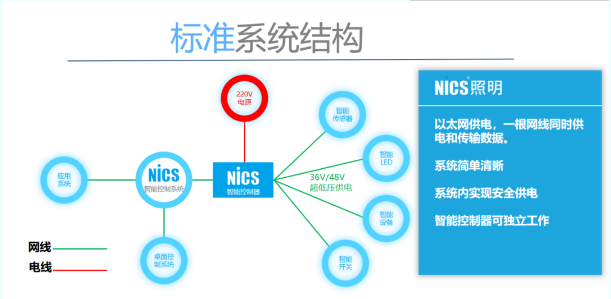
The NiCS lighting system consists of five parts: controllers, integrated cabling systems, panel switches and sensors, luminaires, and an integrated management cloud platform.
Zero Energy Lighting System Architecture
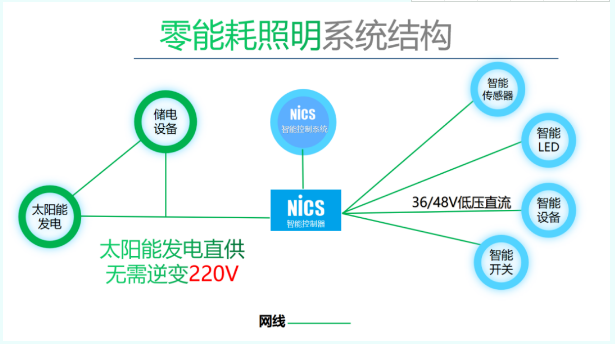
The zero-energy lighting system consists of a photovoltaic power generation system + NiCS lighting system.
"Optical Storage Direct Flexibility" Network Smart Lighting System Architecture
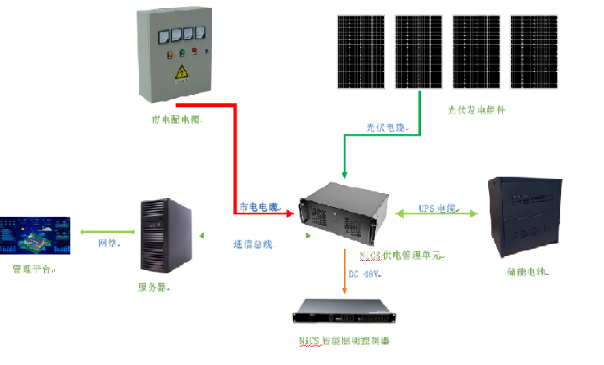
System composition: photovoltaic power generation system (PV), energy storage system, Ethernet smart lighting system, mains supplementary conversion system, power supply management system, cloud platform management system, and integrated cabling system.
It is reported that NiCS Lighting is a domestic first, adopting Power over Ethernet technology and network structured cabling, LED luminaires, and integrating sensor technology widely used in intelligent control and the Internet of Things. It has developed the NiCS Lighting Intelligent Control Cloud Platform to intelligently manage LED luminaires and other connected devices, providing buildings with a safe, energy-saving, intelligent, healthy, and easy-to-maintain lighting system that meets the control needs of various application scenarios.
Currently, Interconnected Smart Control Technology (Tianjin) Co., Ltd. is collaborating with Tianjin Jianneng Energy Saving Technology Co., Ltd. (formerly Tianjin Building Energy Efficiency Promotion Center) to jointly design and implement a zero-energy smart lighting project for the underground parking lot of a government office building in Tianjin. The project has entered the specific implementation phase.
XXXX Building Underground Parking Garage Situation
1. Current Lighting Status
★ Number of luminaires: 728
★ Lamp Type: T8 LED Bracket Tube, Power 22W
★Control and Usage Method: Zone Manual Control
2. Existing Problems
★ Garage lighting needs to operate continuously 24 hours a day, resulting in considerable annual electricity costs.
★ Traditional control methods, with no significant energy saving and no statistical capability.
★ There are many garage lights, resulting in a heavy workload for replacement and maintenance, and high maintenance costs.
★ Unable to obtain accurate energy consumption data for the luminaire.
★ Existing photovoltaic systems are not fully utilized, resulting in waste.
3. Requirements Analysis
3.1 Energy Saving Requirements
★Adopts intelligent control: lights turn on when vehicles or people approach and dim when they leave, thereby achieving energy savings.
★Make full use of the energy from existing photovoltaic panels to achieve energy saving.
3.2 Control Method Requirements
Remote control via a software platform to switch luminaires on and off based on time and traffic flow.
3.3 Maintenance Cost Requirements
Use luminaires with a long service life to reduce maintenance costs caused by luminaire replacement, and at the same time reduce labor costs associated with replacing luminaires.
Solution
Using the NiCS smart lighting system, connect the controller to 220V mains power. The controller converts it to 48V low-voltage DC, supplying power and transmitting data to the luminaire via Cat5e Ethernet cable.
There are currently 568 photovoltaic panels, with dimensions of 800*1200 and a power rating of 130W.
Utilizing the 568 photovoltaic panels installed on-site, electricity is stored in batteries to power the lighting in eight fire protection zones (excluding the bicycle area). When battery storage is depleted, grid power is used as a supplement, thereby achieving energy saving requirements.
Annual power generation of existing PV panels = Number of PV panels × Power × 4 hours of actual daily operation × Days × PV panel utilization rate × Number of sunny days in a year = 568 × Power × 4 × 365 × 0.8 × 0.5 = 43,099 kWh
Through the NiCS intelligent energy saving method, annual electricity consumption is approximately 21,045 kW. After using photovoltaic panels, the annual electricity cost becomes negligible.
1. System Structure
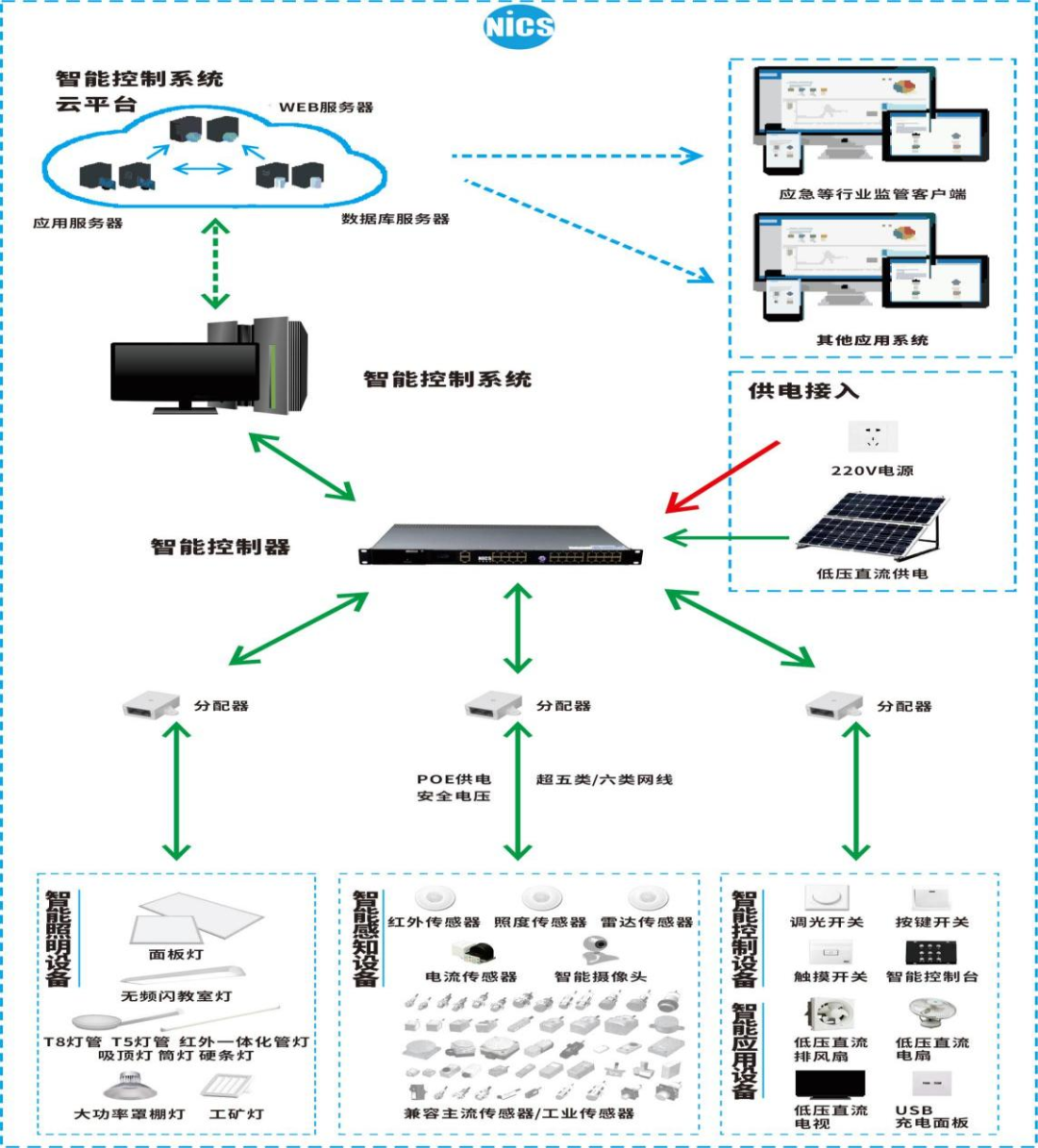
Schematic diagram of smart lighting system structure
2. Design Proposal
(1) Luminaire
NiCS LED luminaires feature flicker-free operation, extremely low glare, moderate color temperature, and moderate CRI, making them suitable for garage lighting.
(2) Control Method
★Deploy integrated infrared luminaires to achieve the effect of "lights on when people arrive, lights off when people leave." Control interior lighting based on vehicle flow in the underground garage.
★ Remotely control luminaires by grouping them via the software platform.
(3) Energy saving
Uses LED luminaires, saving 50%–70% in electricity consumption; adopts Ethernet power supply to reduce energy loss in wiring; implements intelligent control for lighting to further save energy.
Utilizes existing photovoltaic panels to connect to storage batteries for energy storage, which is then supplied to lighting systems to achieve energy savings.
(4) Information Management
Manage and monitor lighting conditions by deploying NiCS system software, and deploy a sensor network to collect and provide feedback for the garage.
(5) Low maintenance cost
By adopting Power over Ethernet (PoE) to directly supply low-voltage DC power to the luminaire, issues with limited service life caused by constant-current driver quality are minimized. This brings the actual lifespan much closer to the theoretical lifespan of LED luminaires, significantly reducing the frequency of luminaire replacements and thereby lowering both replacement and labor maintenance costs.
III. System Advantages
1. Smart
Infrared integrated luminaire and data platform center enable intelligent control and management of luminaires.
2. Energy saving
Using LED luminaires saves 50%–70% of electricity; using Ethernet power supply reduces energy loss in the wiring; using intelligent control enables smart lighting control, thereby saving electricity.
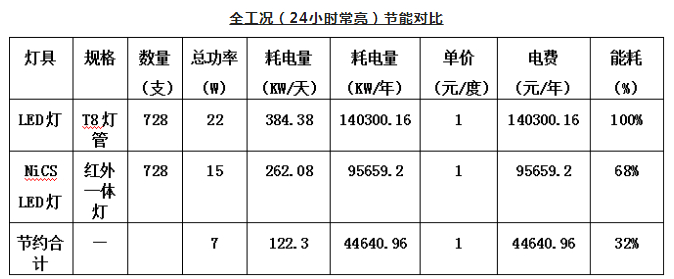
Note: Calculations are based on 24 hours per day and 365 days per year.
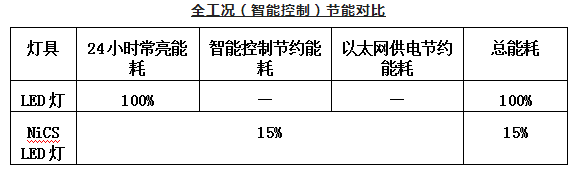
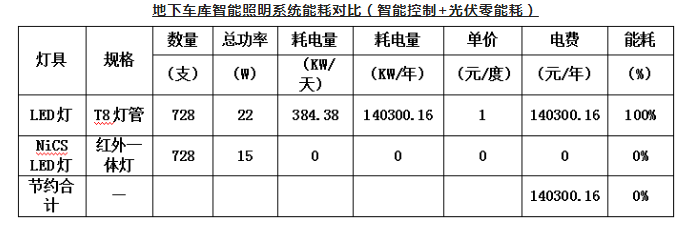
3. Extremely low maintenance costs
Power over Ethernet enables LED luminaires to approach their theoretical lifespan, breaking through application bottlenecks and reducing both luminaire replacement costs and labor costs.
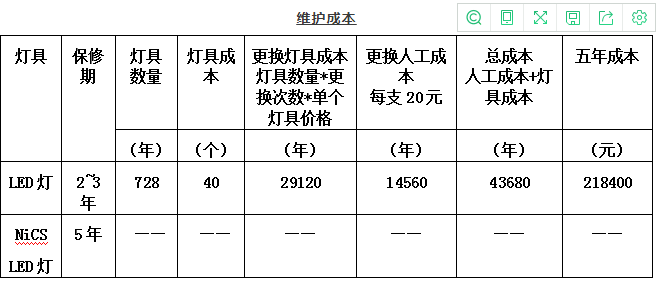
Note: The warranty period for ordinary LED tubes is generally 2–3 years, calculated based on 24 hours of daily operation. Therefore, the service life of LED luminaires is approximately 12 months, requiring replacement once a year. The unit price is calculated at 40 yuan per luminaire, and the labor cost for replacing luminaires is calculated at 20 yuan per replacement.
4. Information Management
Deploy the NiCS lighting system software to achieve information-based management of logarithmic underground garage lighting, including monitoring and managing lighting conditions.