
Standards related to LED energy efficiency have been released; enterprises can receive subsidies of up to 200,000 by passing Shenzhen Standard Certification.
In accordance with the provisions of the "Shenzhen Lighting and Display Engineering Industry Association Group Standard Management Measures", the group standard "Specification for Minimum Energy Efficiency Values and Energy Efficiency Classes of LED Strips" has completed public consultation and technical review by an expert panel. It is hereby approved for official release, with standard number T/SLDA 004—2022, and will be officially implemented from May 1, 2022.
This standard was led by the Shenzhen Lighting and Display Engineering Industry Association, with Lanjing Optoelectronics, Mingxue Optoelectronics, Sianpu, and Huace as chief editors. Participating units in the compilation include Jindingsheng, Yufu, Guangshengde, Xinshengkai, Chengguang, Weiguan Technology, Ruifeng, Youyixiang, Ledemei, Shirui Technology, Kaiming, Aijia Lighting, Hengzhiyuan, Lingbenyang, Yuantian Engineering, Rishang, NVC / NVC Lighting, Sidun, Sanxiong, Chint, Tianjin University, Qingmei Daohe Planning and Design Institute, Chongqing Hanrun Lighting design, China Fifteenth Metallurgical Corporation, Shenxin Institute, Shenzhen General Institute of Architectural Design and Research, National Museum of China, and other organizations.
Jing Fajun, the Chief Engineer of the Association, revealed that the Association is promoting this standard through the Shenzhen Standard Certification system. After obtaining certification, enterprises can receive a subsidy of up to 200,000 from the Shenzhen municipal and district governments, and are authorized to use the "Shenzhen Standard Certification" LOGO on their products.
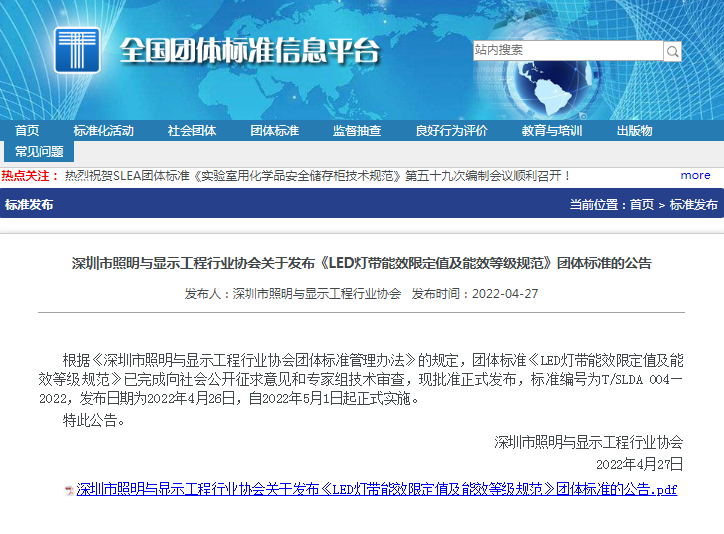
This standard specifies the technical requirements, test methods, etc., for the energy efficiency of LED strips powered by DC or AC at 50 Hz or 60 Hz with a rated supply voltage of 250 V or less; it applies to indoor or outdoor illuminating and decorative flexible LED strips; it does not apply to light tubes or luminaires supported by rigid circuit boards, or strips connected in series or parallel using flexible cords or solid wires.
This standard specifies the classification of LED flexible light strips. Based on compliance with the requirements of IEC 60598-2-21:2014, Clause 21.6, it clarifies the marking of LED light strips and sets technical requirements regarding dimming, monochromatic light, white light, color tolerance (SDCM), input power, sudden failure, modulation depth, initial luminous flux, color-tunable light sources, color rendering index (CRI), lumen maintenance, and luminous efficacy. Based on these requirements, the document provides the minimum energy efficiency values, energy efficiency class, and energy-saving evaluation values for LED light strips.
This standard specifies the general test requirements and environmental conditions for LED strips, and proposes test methods item by item in accordance with the aforementioned technical requirements.
The formulation of this standard helps guide the standardized design and production of LED strips, assists enterprises in assessing product quality levels, enables market customers (consumers) to evaluate product value, plays a positive role in the economic development of the LED strip industry, and promotes standardized, healthy, and orderly market development.
This standard establishes market benchmarks for the energy efficiency levels of LED strips, reflecting the technical expertise accumulated by numerous enterprises in developing LED strip products and filling a domestic gap in such standards. It serves as a basis for industry regulators, testing and certification bodies, and manufacturers to conduct energy efficiency class assessments of LED strip products. Furthermore, as energy-consuming devices, establishing energy efficiency class specifications for LED strips can play a positive role in societal efforts toward "dual carbon" control.
Source: Daily LED