
Analysis Report on China's Specialized Lighting Industry
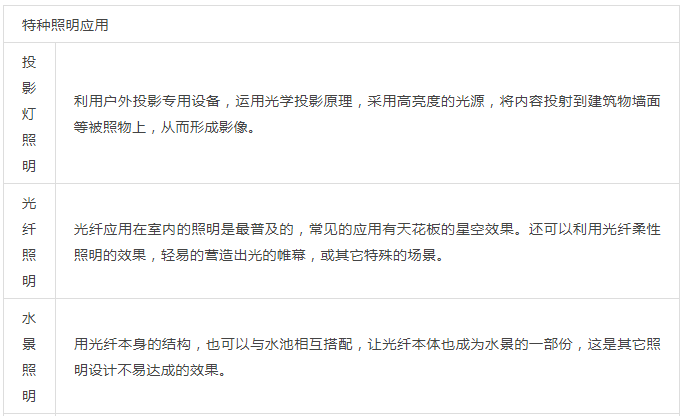
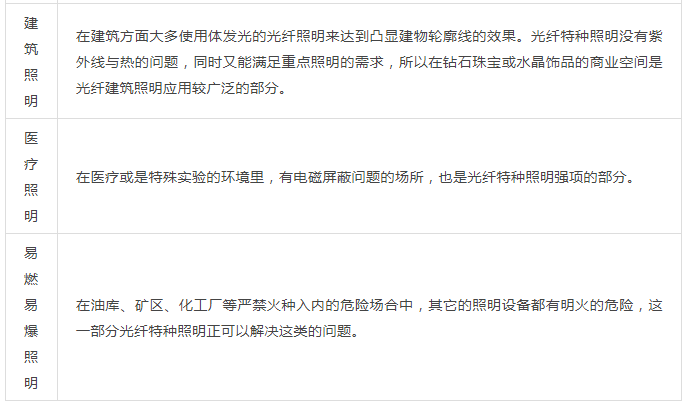
Specialty lighting mainly refers to lighting under special conditions, including projection lighting, fiber optic lighting, waterscape lighting, Architectural lighting, medical lighting, flammable and explosive environment lighting, light guide lighting, etc. It is mainly applied in medical or special experimental environments, searchlighting and inspection for transportation, as well as explosion-proof lighting in heavy industrial fields such as electric power, petroleum, and chemical industry.

Source: Compiled from public information
Specialty luminaires include explosion-proof LED energy-saving lamps, maintenance-free explosion-proof LED energy-saving lamps, LED specialty lighting explosion-proof lamps, LED explosion-proof flood lamps, LED specialty industrial and mining lamps, specialty lighting LED industrial and mining lamps, LED indoor lighting specialty lamps, specialty lighting LED industrial and mining lamps, specialty lighting LED explosion-proof roadway lamps, specialty lighting LED fluorescent lamps, explosion-proof LED downlights, and other types.
The downstream industries of special lighting mainly include basic industries related to national economy and people's livelihood, such as electric power, metallurgy, coal, railways, oil fields, petrochemicals, machinery manufacturing, and military industry. Therefore, the overall national fiscal expenditure policies and the capital expenditures of related companies will directly affect the market space for special environment lighting. During the "14th Five-Year Plan" period, there is still room for further increase in expenditures in China's basic industries related to people's livelihood, which sets the tone for the growth of the special lighting equipment market. Under the circumstances of the country advocating carbon neutrality and downstream industries promoting high-quality investment, efficient, energy-saving, and environmentally friendly lighting equipment is expected to become the mainstream trend in future development.
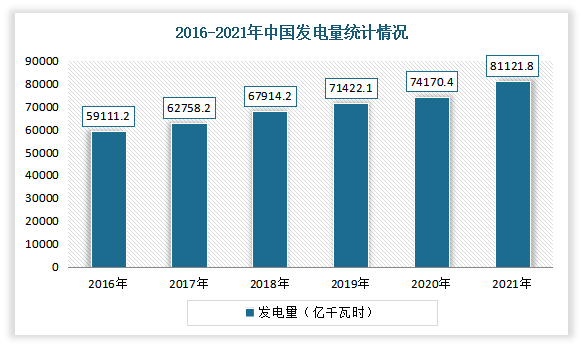
For example, in the power sector: In recent years, China's power operations have performed well, with various indicators showing steady growth. Power supply has basically met the needs of national economic development and people's livelihood. In 2020, China's electricity generation was 7,417.04 billion kWh, a Year-on-year (YoY) increase of 2.7%. In 2021, electricity generation reached 8,112.18 billion kWh, a Year-on-year (YoY) increase of 8.1%.
Data source: National Energy Administration, compiled by Guanyan Tianxia
According to the "Ubiquitous Power Internet of Things White Paper 2019" released by State Grid Corporation of China, the construction of the Ubiquitous Power Internet of Things is proposed in two phases: initially built by early 2021 and fully completed by 2024. The goal of the Ubiquitous Power Internet of Things is to empower the traditional power grid with digital technology, enhancing its perception capabilities, interaction levels, and operational efficiency. The Ubiquitous Power Internet of Things will comprise a four-layer structure consisting of the perception layer, network layer, platform layer, and application layer, where lighting equipment and integrated sensors are important components of the perception layer. State Grid Corporation of China is expected to significantly increase its capital expenditure, and the lighting equipment market is poised to benefit substantially.
In addition, according to the "14th Five-Year Plan for Modern Energy System", accelerate the renovation and upgrading of distribution networks, promote the construction of smart distribution networks and active distribution networks, enhance the capacity and flexibility of distribution networks to accommodate new energy sources and diversified loads, and prioritize the local and nearby development and utilization of new energy. Actively develop smart microgrids primarily for integrating new energy, achieving compatibility and complementarity with the main grid. Improve the structure of regional grid backbone networks, promote flexible and controllable interconnection between grids, build a power system with reasonable scale, hierarchical zoning, and safe reliability, and enhance the dynamic stability level of the grid in adapting to new energy.
During the 14th Five-Year Plan period, complete construction and commence operation of hydropower stations including Wudongde on the Jinsha River (already completed and in operation), Baihetan (some units already completed and in operation), and Lianghekou on the Yalong River (some units already completed and in operation). Advance the construction of hydropower stations such as Lawa on the Jinsha River and Shuangjiangkou on the Dadu River. Strive to commence construction of hydropower stations including Gangtuo and Xulong on the Jinsha River, Yagen Level II and Mengdigou on the Yalong River (approved and construction commenced), Danba on the Dadu River, and Yangqu on the Yellow River (approved and construction commenced). Conduct in-depth preliminary studies for hydropower stations such as Benzilan, Longpan, and Guxue. Implement major projects including hydropower development in the lower reaches of the Yarlung Zangbo River.
Completed and commissioned: Units 5 and 6 of Liaoning Hongyanhe (Unit 5 already completed and commissioned); Shandong Shidaowan High-Temperature Gas-Cooled Reactor and "Guohe One" demonstration project; Unit 6 of Jiangsu Tianwan (already completed and commissioned); Units 5 and 6 of Fujian Fuqing (Unit 5 already completed and commissioned), Units 1 and 2 of Zhangzhou Phase I; Units 1 and 2 of Guangdong Taipingling Phase I; Units 3 and 4 of Guangxi Fangchenggang, and other nuclear power units.
Actively promote the construction of decentralized wind power and distributed photovoltaic projects in eastern and central regions, optimize the base-scale development of onshore wind and solar power in Xinjiang, Qinghai, Gansu, Inner Mongolia, Ningxia, northern Shaanxi, northern Shanxi, northern Hebei, Liaoning, Jilin, and Heilongjiang, and prioritize the construction of offshore wind power bases in Guangdong, Fujian, Zhejiang, Jiangsu, and Shandong.
Steadily develop municipal solid waste incineration for power generation, orderly develop agricultural and forestry biomass power generation and biogas power generation, and construct biomethane projects at the scale of tens of millions of cubic meters. Vigorously promote medium-to-deep geothermal heating and cooling in regions such as Beijing-Tianjin-Hebei, Shanxi, Shaanxi, Henan, and Hubei, and build a batch of geothermal power generation demonstration projects in areas with abundant high-temperature geothermal resources such as Tibet, Western Sichuan, and Qinghai.
Advance the construction of pumped-storage hydropower stations in Tongcheng, Pan'an, Tai'an Phase II, Hunyuan, and other locations. Commence construction of pumped-storage hydropower stations at Daya River, Shangzhi, Luanping, Xushui, Lingshou, Meidai, Wuhai, Taishun (approved and under construction), Tiantai (approved and under construction), Jiande, Tonglu, Ningguo, Yuexi, Shitai, Huoshan, Lianyungang, Hongping Phase II, Damushan, Pingtanyuan (approved and under construction), Ziyun Mountain, Anhua, Lizowan (approved and under construction), Warang, Niushou Mountain (approved and under construction), Guiyang (Shichangba), Nanning (approved and under construction), Qiannan (Huangsi), and Yanglin. Conduct research on large-scale energy storage projects for cascade hydropower stations in the upper reaches of the Yellow River. Promote the coordinated development of concentrated solar power with wind power and photovoltaic power generation in regions such as Qinghai, Xinjiang, Gansu, and Inner Mongolia. Prioritize flexibility retrofits for coal-fired power units of 300 MW and below; for areas with difficult peak-shaving conditions, study and promote flexibility retrofits for 600 MW subcritical coal-fired power units.
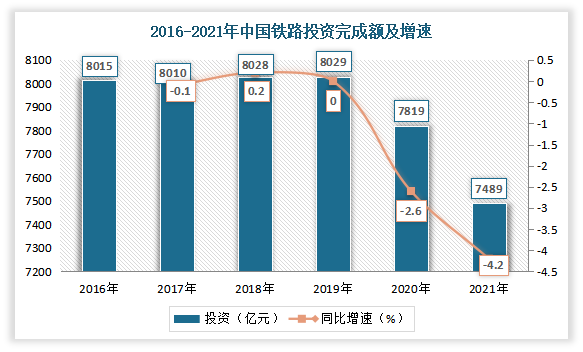
Railway sector: China's railway investment completion amounted to around RMB 800 billion from 2016 to 2019. Affected by the pandemic, China's railway investment completion showed a downward trend in 2020–2021. In 2021, China's railway investment completion reached RMB 748.9 billion, a Year-on-year (YoY) decrease of 4.2%.
Data source: National Railway Administration, compiled by Guanyan Tianxia
With the continuous development of China's railway industry, the operational mileage of railways continues to grow. Data shows that by 2021, China's railway operating mileage reached 150,000 kilometers, including 40,000 kilometers of high-speed rail; the national railway network density was 156.7 km per 10,000 square kilometers; the double-track rate was 59.5%; and the electrification rate was 73.3%.
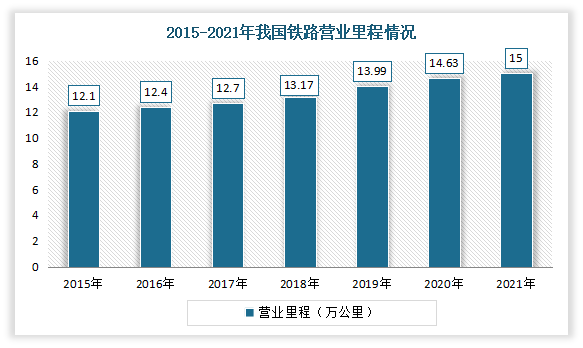
Data source: National Railway Administration, compiled by Guanyan Tianxia
During the 14th Five-Year Plan period, China's railway construction mileage is expected to continue increasing. According to the "Development Plan for a Modern Comprehensive Transportation System during the 14th Five-Year Plan," China will add 19,000 kilometers of operational railway mileage, with urban rail transit operating mileage reaching approximately 10,000 kilometers. The high-speed railway network will cover over 95% of cities with populations exceeding 500,000, and bottlenecks on conventional railway lines will be largely eliminated. By the end of 2025, the national operational railway mileage is projected to reach approximately 165,000 kilometers, including about 50,000 kilometers of high-speed railways (including some intercity railways), covering more than 95% of cities with populations over 500,000, basically forming a "national 1-2-3 high-speed rail travel circle." Therefore, in the next five years, China's railway investment scale is expected to continue growing, and accordingly, the demand for railway lighting equipment is likely to further increase.
Coal: Coal is the most abundant and widely distributed fossil fuel on Earth. It is mainly divided into four categories: bituminous coal, anthracite, sub-bituminous coal, and lignite. 60% of the world's recoverable coal reserves are concentrated in the United States (25%), the former Soviet republics (23%), and China (12%).
Since 2016, China's raw coal production has remained relatively stable. Data shows that in 2020, affected by the pandemic and other factors, raw coal production slightly decreased by only 0.16%. In 2021, China's raw coal production exceeded 4 billion tons, reaching 4.07 billion tons, a Year-on-year (YoY) increase of 5.99% compared to 2020.
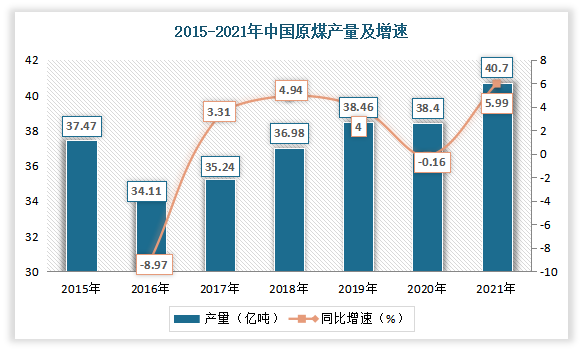
Data source: National Bureau of Statistics, compiled by Guanyan Tianxia
However, as coal remains the primary energy source in our country, it must follow a green and low-carbon development path, align with the goals of peaking carbon emissions and achieving carbon neutrality, take national conditions into account, control total consumption, hold the bottom line, implement orderly reduction and substitution, and promote the transformation and upgrading of coal consumption.
During the "13th Five-Year Plan" period, although China's annual coal production remained basically stable, the coal industry was actually in a state of "parallel exit of outdated production capacity and release of high-quality production capacity." Old and inefficient mines were shut down, while large-scale modern coal mines were built and put into operation, improving the quality of the supply system. During the "14th Five-Year Plan" period, China's coal industry will continue the trend of the "13th Five-Year Plan," with limited growth in annual production (it is expected that by the end of the 14th Five-Year Plan, domestic annual coal production will be controlled at 4.1 billion tons). However, the quality of supply will reach a higher level. To achieve this goal, the coal production capacity replacement policy will be further improved, high-quality production capacity is expected to be released faster, and the construction of new high-quality production capacity will effectively boost the demand for related lighting equipment.
According to the "14th Five-Year Plan for Modern Energy System", efforts will be intensified to plan and build a new energy supply and consumption system based on large-scale wind and solar power bases, supported by surrounding clean, efficient, advanced, and energy-saving coal-fired power, and carried by stable, safe, and reliable ultra-high voltage transmission lines; priority will be given to utilizing existing conventional power sources to actively promote the construction of multi-energy complementary clean energy bases, implementing projects such as "wind-solar-hydro (storage)" and "wind-solar-thermal (storage)".
Strengthen intelligent and green coal mining, and promote clean and efficient coal production and washing. By 2025, coal mine methane utilization will reach 6 billion cubic meters, and the raw coal preparation rate will reach 80%. Carry out R&D and demonstration applications of technologies such as coal-to-liquids, coal-to-gas, and advanced coal chemical Industry, advance breakthroughs and industrialization of advanced coal chemical technologies, fully leverage coal's role as a feedstock, further broaden the directions, pathways, and scope of coal utilization, and conduct research on modern coal chemical technologies and ecological environmental protection.
Military Industry Sector:In recent years, with the growth of China's economic strength, national defense spending has steadily increased to enhance national defense capabilities. Data shows that in 2021, China's national fiscal budget for defense expenditure was RMB 1,379.544 billion (of which RMB 1,355.343 billion was allocated at the central level), representing a 6.8% increase over the previous year's executed budget. In 2022, the national fiscal budget for defense expenditure was RMB 1,476.081 billion (of which RMB 1,450.450 billion was allocated at the central level), representing a 7.1% increase over the previous year's executed budget.
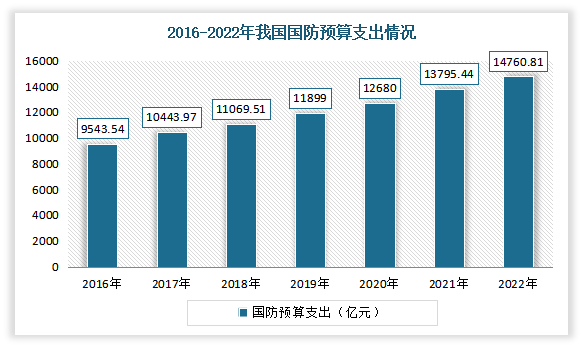
Data source: Network Department of the Chinese People's Liberation Army News and Communication Center, compiled by Guanyan Tianxia
Even so, China's military expenditure as a share of GDP remains lower than that of military powers such as the United States and Russia. According to World Bank statistics, since 2010, China's defense budget has accounted for a relatively stable 1.8–1.9% of GDP, while the United States has maintained a share above 3.3%, Russia above 3.6%, and even India around 2.5%. Therefore, in comparative terms, China's military spending still has considerable room for growth, which will also drive certain development in the special lighting market.
Source: Guan Yan Report Network