
These three fields under the "Dual Carbon" goals face the most severe talent shortage! Ministry of Education: Strengthen photovoltaic talent development and integrate green, low-carbon concepts into the education and teaching system.
The Ministry of Education recently issued the "Work Plan for Strengthening the Construction of Higher Education Talent Training System for Carbon Peaking and Carbon Neutrality," requiring the integration of green and low-carbon concepts into the education and teaching system, and the extensive development of green and low-carbon education and science popularization activities. Fully leverage the positive role of student organizations and volunteer teams to carry out a series of practical activities, enhance public awareness of green and low-carbon practices, and actively guide society toward a green and low-carbon lifestyle. The notice also calls for accelerating the construction of disciplines and majors related to energy storage and hydrogen energy, further strengthening talent training in wind power, photovoltaics, hydropower, and nuclear power, and increasing efforts to develop teaching resources such as courses and textbooks in the field of carbon peaking and carbon neutrality.
The Plan proposes integrating green and low-carbon concepts into the education and teaching system. It promotes university participation in or establishment of national laboratories, national key laboratories, and national technology innovation centers related to carbon peaking and carbon neutrality, and builds a major platform for integrated breakthroughs in key core technologies in the field of carbon neutrality. Focus on tackling key technologies for carbon reduction, such as green development of fossil energy, low-carbon utilization, and pollution and carbon reduction; key technologies for zero carbon emissions, such as new solar, wind, geothermal, ocean, biomass, nuclear energy, and energy storage technologies; and key technologies for negative carbon emissions, such as carbon dioxide capture, utilization, and storage. Accelerate the research, development, and promotion of advanced and applicable technologies.
The plan introduces that currently faces a shortage of talent in the "dual carbon" sector, mainly involving three areas: energy storage and hydrogen energy, carbon capture, utilization and storage, and carbon finance and carbon trading.
The Plan proposes accelerating the development of disciplines and majors related to energy storage and hydrogen energy. Aiming at large-scale renewable energy integration, it promotes universities to accelerate talent cultivation in the fields of energy storage and hydrogen energy, serving the demand for large-capacity and long-duration energy storage to achieve full-chain coverage; and accelerates talent cultivation related to carbon capture, utilization, and storage (CCUS). In response to the future industrial development needs of CCUS technologies, it promotes universities to promptly establish relevant disciplines and majors, fostering the development, application, and promotion of low-carbon, zero-carbon, and negative-carbon technologies; and accelerates the construction of teaching resources for carbon finance and carbon trading. It encourages relevant institutions to accelerate the development of scarce teaching resources such as carbon finance, carbon management, and carbon markets. On the basis of co-construction, co-management, and sharing of high-quality resources, it fully leverages the existing professional talent cultivation system, improves the curriculum system, strengthens professional practice, deepens industry-academia collaboration, and accelerates the cultivation of specialized talents.
In promoting the transformation and upgrading of traditional professions, the Plan proposes to further strengthen talent development in wind power, photovoltaics, hydropower, and nuclear power. Appropriately expand the scale of professional talent training to meet the growing demand for talent in hydropower, pumped storage, and nuclear power; accelerate the transformation and upgrading of talent development in key fields such as traditional energy and power, electrical engineering, transportation, and construction.
Focus on the clean and efficient development and utilization of primary energy, strengthening the training of professionals in coal, oil, and natural gas. Focus on the efficient conversion of secondary energy, strengthening the training of new energy professionals in heavy-duty gas turbines, flexible peak shaving for thermal power, smart power generation, distributed energy, and multi-energy complementarity. Focus on serving the construction of new power systems, strengthening the training of electrical professionals with features such as intelligence and integration. Focus on promoting electrification and energy saving and consumption reduction in industries such as construction and industry, strengthening the training of professionals in transportation and construction.
Relevant officials from the Ministry of Education introduced the in-depth implementation of reform pilots. A number of future technology colleges, modern industry colleges, and demonstration energy colleges in the field of green and low-carbon will be established. Focusing on key areas such as energy, transportation, and construction, we will accelerate the development of online courses and virtual simulation experiment projects in qualified comprehensive universities and industry-specific universities across the country, and launch a batch of comprehensive reform pilot projects covering majors, courses, textbooks, and teaching methods.
The original text is as follows:
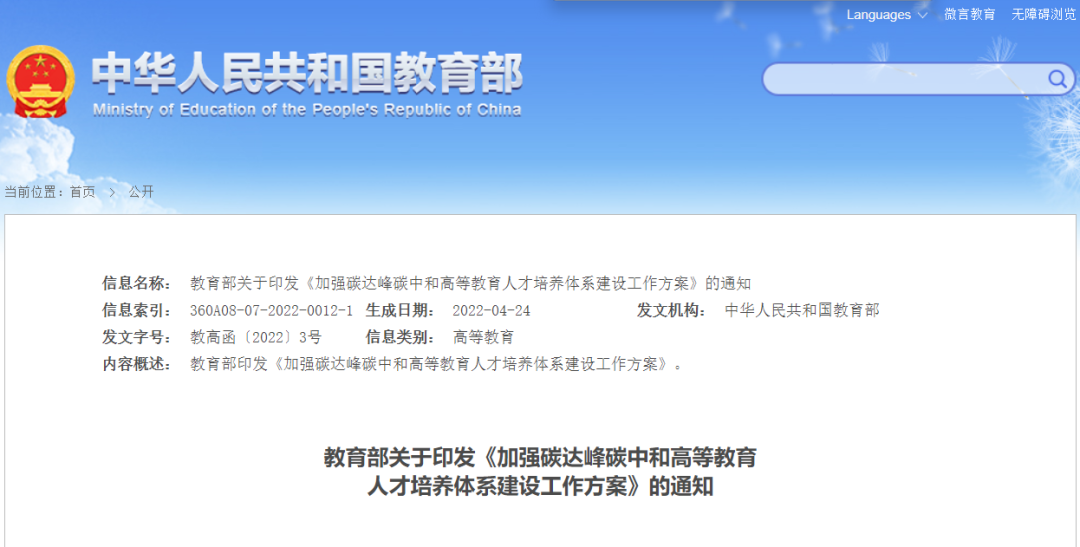
Ministry of Education issues "Strengthening Carbon Peaking and Carbon Neutrality in Higher Education
Notice on the Work Plan for Building a Talent Development System
Jiao Gao Han [2022] No. 3
Education Departments (Commissions) of all provinces, autonomous regions, and municipalities directly under the Central Government; Education Bureau of the Xinjiang Production and Construction Corps; Education Divisions (Bureaus) of relevant departments (units); all universities directly under the Ministry of Education; and all universities jointly established by the Ministry and provincial governments:
To implement the spirit of the "Opinions of the CPC Central Committee and the State Council on Fully, Accurately and Comprehensively Implementing the New Development Philosophy to Do a Good Job in Carbon Peaking and Carbon Neutrality" and the "Notice of the State Council on Printing and Distributing the Action Plan for Carbon Peaking Before 2030" (Guo Fa [2021] No. 23), and to serve the national demand for professional talent cultivation in carbon peaking and carbon neutrality through high-quality development of higher education, the "Work Plan for Strengthening the Construction of Higher Education Talent Cultivation System for Carbon Peaking and Carbon Neutrality" is hereby issued to you. Please implement it conscientiously in light of actual conditions.
Ministry of Education
April 19, 2022
Strengthen the higher education talent cultivation system for carbon peaking and carbon neutrality
Construction Work Plan
Achieving carbon peak and carbon neutrality is a broad and profound systemic transformation of the economy and society, which puts forward new requirements for strengthening the cultivation of various talents in the new era. To implement the spirit of the "Opinions of the CPC Central Committee and the State Council on Fully, Accurately and Comprehensively Implementing the New Development Concept and Doing a Good Job in Carbon Peak and Carbon Neutrality" and the "Notice of the State Council on Printing and Distributing the Action Plan for Carbon Peaking Before 2030" (Guo Fa [2021] No. 23), promote the construction of a high-quality higher education system, and improve the quality of talent cultivation in majors related to carbon peak and carbon neutrality, this plan is formulated.
1. General Requirements
1) Guiding Ideology. Guided by Xi Jinping Thought on Socialism with Chinese Characteristics for a New Era, we will thoroughly implement the strategic deployment of strengthening the country through talent in the new era. Facing the goals of carbon peaking and carbon neutrality, we will integrate Xi Jinping’s thought on ecological civilization throughout the entire process and all aspects of higher education talent cultivation. We will strengthen green and low-carbon education, promote the transformation and upgrading of academic disciplines, accelerate the cultivation of urgently needed and scarce talents, deepen the integration of industry and education for collaborative talent development, enhance capabilities in talent cultivation and scientific and technological breakthroughs, strengthen faculty development, and advance international exchange and cooperation, thereby providing strong talent guarantees and intellectual support for achieving the goals of carbon peaking and carbon neutrality.
2) Working Principles
—Comprehensive planning, combining general and specialized approaches. Based on the broad coverage and long战线 characteristics of the talent cultivation system for carbon peak and carbon neutrality, conduct systematic and overall planning. Enhance overall awareness of ecological civilization, implement education on new development concepts and ecological civilization responsibilities for all employees, and accelerate the cultivation of specialized talents in various industries and fields such as engineering technology and financial management.
—Scientific assessment and prioritized implementation. Strengthen the forecasting of talent demand in key industries, and based on the laws of talent development in the new era, education and teaching, and technological innovation, accelerate the cultivation of scarce talents in new energy, energy storage, hydrogen energy, and carbon capture, while actively planning the upgrading and transformation of related majors such as traditional energy, transportation, materials, and management.
—Pilot first, progress steadily. Support comprehensive universities and industry-specific universities with strong foundations and distinct characteristics to take the lead in establishing new colleges, disciplines, and majors in the field of carbon peaking and carbon neutrality. Based on exploration and accumulated experience, guide and drive the comprehensive strengthening of talent cultivation for carbon peaking and carbon neutrality.
Deep integration and cross-disciplinary innovation. Strengthen the synergy between science and education, accelerate the transformation of research achievements into teaching content, and cultivate high-level professional talents through major projects, platforms, and engineering initiatives. Deepen the integration of industry and education, promote faculty exchange and resource sharing, establish industry-education alliances, and advance deep collaborative talent development.
—Based on national conditions, facilitating domestic and international exchange. Drawing on the experience of developed countries, and in light of our own foundational conditions, characteristics, and national development context, we will build a talent cultivation system for carbon peaking and carbon neutrality with Chinese characteristics and world-class standards. We will strengthen opening-up and cooperation, expand pathways and models for talent cultivation collaboration, and nurture young scientific and technological talents with a global vision who are adept at articulating the "Chinese solution."
II. Key Tasks
1) Strengthen green and low-carbon education
1. Integrate the concept of green and low-carbon development into the education and teaching system. Strengthen publicity and widely carry out green and low-carbon education and popular science activities. Fully leverage the positive role of university student organizations and volunteer teams to conduct a series of practical activities, enhance public awareness of green and low-carbon practices, and actively guide the whole society toward a green and low-carbon lifestyle.
2. Strengthen training for leading cadres. Leverage the disciplinary and professional strengths of universities to support phased, multi-level training for leading cadres, clarify key policy points, deepen their understanding of the importance, urgency, scientific nature, and systematic approach of carbon peaking and carbon neutrality work, and enhance their professional competence and operational capabilities.
3. Strengthen continuing education and lifelong learning. Support relevant universities, open universities, and other institutions in enhancing cooperation with government departments, enterprises, and social organizations to jointly develop non-degree continuing education and training programs. Expand lifelong learning resources through multiple (Sales) channels to meet the lifelong learning needs of learners and support economic and social development in the field of carbon peak and carbon neutrality.
2) Build a high-level platform for scientific and technological breakthroughs
4. Promote the participation of universities in, or the establishment of, national laboratories, national key laboratories, and national technology innovation centers related to carbon peaking and carbon neutrality; guide higher education institutions to build a batch of high-level national research platforms; and strengthen basic theoretical and methodological research on the causes and impacts of climate change, ecosystem carbon sinks, etc.
5. Promote the establishment of major integrated platforms at universities for tackling key core technologies in the field of carbon neutrality. Form a number of key research teams to focus on breakthroughs in key carbon reduction technologies such as green development of fossil energy, low-carbon utilization, and pollution and carbon reduction; key zero-carbon emission technologies such as new solar, wind, geothermal, ocean, biomass, nuclear energy, and energy storage technologies; and key negative-carbon emission technologies such as carbon dioxide capture, utilization, and storage, so as to accelerate the R&D and promotion of advanced and applicable technologies.
6. Strengthen research-based education. Encourage universities to implement special programs for cultivating interdisciplinary talent in carbon neutrality, and strongly support the formation of cross-college and interdisciplinary research and talent development teams. Leverage large teams, major platforms, and key projects to support high-quality, multi-level training of undergraduate and graduate students.
3) Accelerate the training of scarce talent
7. Accelerate the development of disciplines and majors related to energy storage and hydrogen energy. With the goal of large-scale renewable energy integration, promote universities to accelerate talent cultivation in the fields of energy storage and hydrogen energy, serving the demand for large-capacity, long-duration energy storage, and achieving full-chain coverage.
8. Accelerate the training of talent in carbon capture, utilization, and storage (CCUS). In response to the future development needs of the CCUS industry, promote the rapid establishment of relevant academic disciplines and majors in universities, facilitate the development, application, and promotion of low-carbon, zero-carbon, and negative-carbon technologies, and reserve talent for future technological breakthroughs and industrial quality improvement and capacity expansion.
9. Accelerate the development of teaching resources for carbon finance and carbon trading. Encourage relevant institutions to accelerate the construction of scarce teaching resources in carbon finance, carbon management, and carbon markets. Based on the co-construction, co-management, and sharing of high-quality resources, fully leverage the existing professional talent training system, improve the curriculum system, strengthen professional practice, deepen industry-academia collaboration, and accelerate the cultivation of specialized talents.
4) Promote the transformation and upgrading of traditional specialties
10. Further strengthen talent development in wind power, photovoltaics, hydropower, and nuclear power. Moderately expand the scale of professional talent training to meet the growing demand for talents in hydropower, pumped storage, and nuclear power, and enhance the international soft power of "going global". Broaden the depth and breadth of expertise to promote technological progress and industrial upgrading in areas such as new energy materials, equipment manufacturing, operation and maintenance, and frontier technologies.
11. Accelerate the transformation and upgrading of professional talent cultivation in key sectors such as traditional energy power, electrical, transportation, and construction. Focusing on the clean and efficient development and utilization of primary energy, strengthen the cultivation of professionals in coal, oil, and natural gas. Focusing on the efficient conversion of secondary energy, enhance the cultivation of new energy professionals in areas such as heavy-duty gas turbines, flexible peak shaving for thermal power, smart power generation, distributed energy, and multi-energy complementarity. Focusing on serving the construction of new power systems, strengthen the cultivation of electrical professionals with features such as intelligence and integration. Focusing on promoting electrification and energy saving and consumption reduction in industries such as construction and industry, strengthen the cultivation of professionals in transportation and construction.
12. Accelerate the improvement of talent development programs in key areas. Organize relevant teaching steering committees and industry steering committees to adjust training objectives, revise development plans, optimize curriculum systems and teaching content around the goals of carbon peak and carbon neutrality, and strengthen the close integration of enabling technologies such as the Internet, big data analytics, artificial intelligence, and the digital economy with professional teaching.
5) Deepen the integration of industry and education for collaborative talent cultivation
13. Encourage joint training through university-enterprise cooperation. Support relevant universities in deepening industry-academia collaboration with large and medium-sized enterprises, as well as specialized, refined, distinctive, and innovative enterprises in domestic sectors such as energy, transportation, and construction. Jointly develop training programs tailored to enterprise talent needs, and explore diverse talent development models for undergraduate, graduate, and non-degree education at various levels.
14. Build a national innovation platform for the integration of industry and education. Improve the operational mechanisms for building such platforms, increase investment in key major areas, actively explore cooperation mechanisms, enhance the quality of talent cultivation, and promote the rapid transformation of scientific and technological achievements.
15. Support the establishment of an Industry-Education Integration Alliance for Carbon Peaking and Carbon Neutrality. Encourage universities to collaborate with enterprises, strengthen division of labor and complementary advantages based on industry characteristics, form regional or industry-specific university-enterprise alliances, and establish transnational alliances with relevant countries when appropriate to promote shared standards, technology sharing, and personnel exchange.
6) Deepen the implementation of reform pilots
16. Establish a number of future technology colleges, modern industry colleges, and demonstration energy colleges in the field of green and low-carbon development. Aiming at the development needs of carbon peaking and carbon neutrality, innovate talent cultivation models for different types and characteristics of universities, and create entities capable of leading future low-carbon technology development with industry characteristics and regional applied talent cultivation, playing a demonstrative and leading role.
17. Launch pilot projects for teaching reform and talent development in the fields of carbon peaking and carbon neutrality. Focusing on key sectors such as energy, transportation, and construction, accelerate the development of online courses and virtual simulation experimental courses at qualified comprehensive and industry-specific universities in China, and initiate a batch of comprehensive reform pilot projects covering majors, courses, textbooks, and teaching methods.
7) Strengthen the construction of a high-level teaching staff
18. Encourage universities to strengthen the development of high-quality faculty in the field of carbon peak and carbon neutrality. Organize faculty training in this field, leverage the demonstrative and leading role of national-level teaching teams, renowned teachers, and first-class courses, promote mature and effective talent cultivation models and curriculum implementation plans, and enhance the teaching capabilities of frontline teachers. Encourage universities to strengthen support for faculty development in the field of carbon peak and carbon neutrality, implement flexible mechanisms for carbon neutrality talent policies, increase efforts in precise recruitment, improve internal income distribution and incentive mechanisms, and form a faculty system with reasonable scale and tiered configuration.
8) Strengthen the development of teaching resources
19. Strengthen the development of teaching resources such as courses and textbooks in the field of carbon peaking and carbon neutrality. Based on the analysis of general and professional competencies of talents in carbon peaking and carbon neutrality, collaboratively build knowledge graphs, instructional videos, electronic courseware, exercises and test questions, teaching cases, laboratory and practical training projects, etc., by sector, to form a high-quality shared teaching resource library.
9) Strengthen international exchange and cooperation
20. Accelerate the cultivation of international talent in the fields of carbon peaking and carbon neutrality. Based on professional expertise, focus on enhancing global perspectives, strengthen international communication capabilities, and encourage students in related majors to actively participate in internships with relevant international organizations.
21. Intensify efforts to attract high-level overseas talent. Encourage universities to actively recruit outstanding professionals in carbon capture, utilization and storage (CCUS), clean fossil energy utilization, frontier renewable energy technologies, energy storage and hydrogen, and carbon economy and policy research, gathering high-level overseas talent to participate in the development of carbon neutrality disciplines and scientific research.
22. Launch international joint training programs for carbon peaking and carbon neutrality talent. Encourage universities to collaborate with world-class universities and academic institutions on joint undergraduate, master's, and doctoral training, technological innovation, and think tank consulting in the field of carbon neutrality. Deepen bilateral and multilateral innovative cooperation in clean energy and climate change, and cultivate specialized professionals who actively contribute to global climate governance and the operation of global carbon markets.
III. Organization and Implementation
1) Strengthen the implementation of responsibilities. Relevant departments and universities must deeply recognize the importance, challenges, and urgency of cultivating talent for carbon peaking and carbon neutrality. They must resolutely implement the decisions and deployments of the CPC Central Committee and the State Council, earnestly assume their responsibilities, formulate specific tasks and work plans based on the key tasks of this plan and their own realities, and focus on ensuring the effective implementation of all tasks.
2) Increase support. Encourage universities to support the training of professionals in carbon peaking and carbon neutrality, discipline construction, and scientific and technological breakthroughs through diversified (Sales) channels such as actively securing fiscal funds at all levels, corporate investment, the National Low-Carbon Transition Fund, market-oriented green and low-carbon Industry investment funds, and self-raised funds. Give priority support in terms of majors, faculty, courses, and teaching materials to ensure that policies, measures, and results are effectively implemented.
三)做好监测评估。在学科评估、专业审核评估和工程教育专业认证等过程中适当增加碳达峰碳中和高等教育人才培养评价内容。加强监督考核结果应用,对工作成效突出的单位和个人按规定给予表彰奖励。定期开展典型案例推荐遴选工作,加强宣传推广。