
Hunan Province: Strengthen the construction of "multi-pole integration" and coordinate the needs of various industries!
To further strengthen the construction and management of "multi-pole integration" for urban roads, effectively standardize the installation of "poles, electricity, networks, pipelines, and boxes", and accelerate the application and promotion of new technologies such as 5G, Internet of Things, big data, and artificial intelligence, the official website of the Hunan Provincial Department of Housing and Urban-Rural Development recently released the "Opinions on Strengthening the Construction and Management of 'Multi-Pole Integration' for Urban Roads".
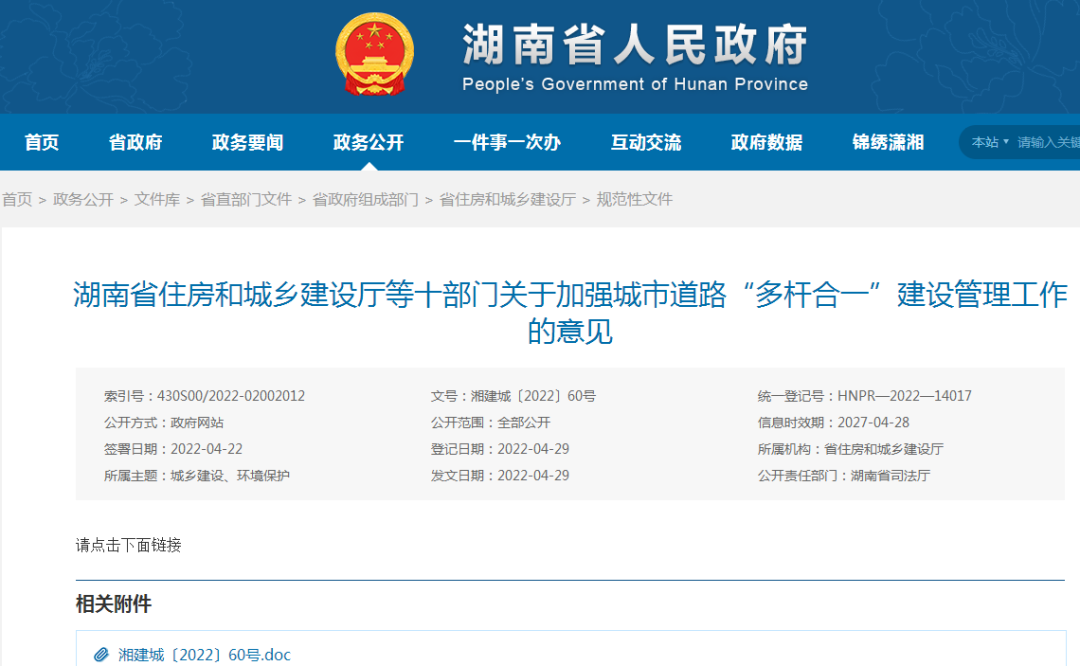
The opinion requires that, starting from May 2022, prefecture-level and county-level cities across the province take the lead in promoting "multi-pole integration" construction on newly built urban roads, and step-by-step promote the retrofitting of existing roads for "multi-pole integration" in conjunction with urban renewal initiatives. 2 By the end of 2025, prefecture-level and county-level cities shall establish a batch of high-quality, high-standard multi-functional smart pole demonstration projects . Explore innovative models for investment, financing, construction, operation, and maintenance management, and leverage the demonstrative and driving role of "multi-pole integration" construction in combination with the digital economy and new-type urban infrastructure development.
The opinion points out that should select technically mature and highly operable projects from the "multi-pole integration" construction and renovation project database to carry out pilot programs first. Pilot projects should focus on adopting intensive construction methods such as "combined poles, combined conduits, combined cabinets, shared power supply, and shared network" . Pilot areas should prioritize roads with a demand for 5G base station deployment and where numerous poles significantly affect the cityscape. Pilot application scenarios should emphasize various smart convenience services for residents.
In addition, the opinion states that "multi-pole integration" projects should be constructed in accordance with the requirements of the Hunan Province Technical Standard for Multi-functional Light Poles (DBJ43/T013-2020), while taking into account the needs of various industry sectors.
The full text of the "Opinions" is as follows:
I. General Requirements
Guided by Xi Jinping Thought on Socialism with Chinese Characteristics for a New Era, fully implement the spirit of the 19th National Congress of the Communist Party of China and all its plenary sessions, adhere to the new development philosophy, meet the requirements for high-quality development, strengthen the construction and management of "multi-pole integration" for urban roads, enhance the level of informatization, digitalization, and intelligence, accelerate the construction and renewal of new-type urban infrastructure, and satisfy the people's growing needs for a better life. Adhere to government leadership with multi-party participation. Relevant departments shall play a leading role, strengthen policy support, and relevant ownership units shall cooperate with government departments to promote implementation, gradually forming a favorable situation led by the government with participation from enterprises and various social sectors. Adhere to coordinated planning and steady implementation. Assess the current status of road poles, systematically plan the "multi-pole integration" construction for new roads, and implement the "multi-pole integration" renovation for existing roads in stages. Adhere to demonstration-led guidance and reform innovation. Explore innovative models for investment, financing, construction, operation, and maintenance management, and combine with the digital economy and new-type urban infrastructure construction to promote the demonstrative and driving role of "multi-pole integration" construction.
Starting from May 2022, prefecture-level and county-level cities across the province will take the lead in promoting "multi-pole integration" construction on newly built urban roads, and step-by-step promote the retrofitting of existing roads for "multi-pole integration" in conjunction with urban renewal initiatives. By the end of 2022, prefecture-level and county-level cities must complete the planning for "multi-pole integration" construction on urban roads. By the end of 2025, prefecture-level and county-level cities shall establish a batch of high-quality, high-specification multi-functional smart pole demonstration projects, possess a number of derivative smart industry bases with outstanding innovation capabilities and clustered development, and achieve significant results in exploring innovative investment, financing, construction, and operation management models.
Encourage county-level cities with the necessary conditions to implement the construction and management of "multi-pole integration" for roads.
II. Main Tasks
(1) Strengthen planning preparation. Localities shall organize and carry out baseline surveys of the current status of various facilities on existing urban roads, clarifying the distribution, operation, ownership, and other details of facilities such as poles, power supply, gateways, pipelines, cabinets, and mounted equipment. A comprehensive ledger of various facilities on urban roads within the jurisdiction shall be established and dynamically updated. Scientifically prepare construction plans for "multi-pole integration" on urban roads, coordinating construction needs for urban lighting, video surveillance, traffic management, environmental monitoring, information release, emergency broadcasting, 5G base stations, and the Internet of Things . The plan shall be implemented after approval by the local people's government. The construction plan for "multi-pole integration" on urban roads shall comply with the relevant provisions of the "Catalogue List for the Preparation of Special Territorial Space Plans" (Xiang Zi Zi Fa [2021] No. 38) and be coordinated with special plans for electricity, communications, lighting, etc.
(II) Promote classified implementation. Localities shall standardize the planning, construction, and management of urban roads. For newly built or renovated urban roads, emphasis should be placed on promoting the "integration of multiple poles," ensuring compliance with the construction plan for such integration, and fully soliciting opinions from relevant competent authorities. Construction and management procedures shall be standardized in accordance with the "Regulations on the Administration of Urban Roads," the requirements of the "delegation, regulation, and service" reform, and the reform of the approval system for engineering construction projects. For newly built urban roads, multifunctional light poles shall be designed, constructed, and accepted simultaneously with the roads. For existing urban roads, considering actual conditions and taking into account various existing poles, the locations for multifunctional light poles shall be determined in a coordinated manner, prioritizing intersection areas followed by road section areas . A project library for "integration of multiple poles" construction and renovation projects shall be established based on the construction plan, and the project construction sequence shall be scientifically determined. Projects for "integration of multiple poles" shall be constructed in accordance with the requirements of the "Hunan Province Technical Standard for Multifunctional Light Poles" (DBJ43/T013-2020), while taking into account the needs of various industry sectors.
(3) Strengthen demonstration and guidance. Select projects with mature technology and strong operability from the "multi-pole integration" construction and renovation project database to carry out pilot programs first, exploring replicable and promotable experiences . Pilot projects should focus on adopting intensive construction methods such as "combined poles, combined conduits, combined cabinets, shared power supply, and shared network." Pilot areas should prioritize roads with a clear demand for 5G base station deployment and where numerous poles significantly affect the cityscape. Pilot application scenarios should emphasize various smart convenience services for residents . Housing and urban-rural development, natural resources, development and reform, and other relevant industry authorities must strengthen guidance and supervision of pilot projects. Using pilot projects as an entry point, enhance coordination and collaboration among departments involved in "multi-pole integration" projects, break down "information silos" and "data chimneys," establish a working mechanism with high integration of business, technical, and regulatory processes, and achieve co-construction and sharing of infrastructure and data.
(4) Innovative Construction Models . Adopt various forms such as clarifying operational revenue rights, government purchase of services, government-guided pricing, and market bidding to encourage and attract social capital to participate in the investment, construction, operation, and management of "multi-pole integration" projects. For projects with operational attributes, fully leverage market mechanisms and establish charging mechanisms for various mounted devices and multiple application scenarios based on the principles of "investors benefit, users pay, and cost allocation proportional to resource occupancy," thereby forming a sustainable source of operating Revenue. Encourage capable research institutions, construction enterprises, manufacturing enterprises, and professional operating entities to combine with social capital to form enterprise groups or consortia with comprehensive business capabilities, adopting methods such as general contracting to uniformly construct "multi-pole integration" projects and maximize overall benefits.
(5) Strengthen operation and maintenance management. Localities shall designate specialized management entities, formulate operational management regulations, clarify property right boundaries and O&M responsibility points; for assets classified as administrative and institutional state-owned assets, they shall be included in the entity's financial accounting management. Strengthen the operation and maintenance management of various functional devices mounted on multi-functional light poles and their data information, to achieve integrated linkage applications such as smart lighting, smart urban management, smart security, smart transportation, and smart environmental protection , orderly promote the establishment of data sharing mechanisms and public data disclosure mechanisms across departments and industries, ensure data security, and promote the integration of the multi-functional light pole O&M management platform into smart urban management to achieve unified network management. Localities shall regulate the installation of poles and other facilities on urban roads, establish rules and regulations, and strengthen supervision . For areas where multi-functional light poles have already been constructed using the "multi-pole integration" approach, under conditions that meet safety requirements, newly added equipment shall be mounted on multi-functional light poles, and equipment mounted on existing poles shall be gradually integrated and migrated to multi-functional light poles based on equipment renewal cycles and the designed service life of existing poles, to avoid redundant construction.
(6) Cultivate the industry chain. Actively attract leading enterprises and high-tech companies in multifunctional lighting pole equipment manufacturing, system development, and related derivative fields from both domestic and international markets to establish operations in Hunan. Build the industry chain through cooperation with provincial enterprises, supply chain integration, and asset restructuring. Encourage industry leaders, renowned universities and research institutes, and industry research organizations to establish innovation platforms in Hunan, such as industrial innovation centers, technological innovation centers, engineering research centers, key laboratories, and enterprise technology centers. Conduct joint research on key common technologies, build a multi-level independent innovation system, and enhance technological R&D and innovation capabilities.
III. Safeguard Measures
(1) Strengthen organizational leadership. Relevant provincial departments shall strengthen supervision and guidance on the construction and management of "multi-pole integration" in accordance with their respective responsibilities. Localities shall clarify departmental responsibilities, and establish a working mechanism led by the lead department with coordinated cooperation from relevant departments. As the lead unit, the competent authority for urban roads (bridges) shall work with relevant departments to formulate an implementation plan for the construction and management of "multi-pole integration", specifying objectives, tasks, implementation schedules, and supporting policy requirements, and submit it to the Provincial Department of Housing and Urban-Rural Development for record by the end of August 2022. Efforts shall be made to incorporate the construction and management of "multi-pole integration" into the urban construction management system, and establish a regular supervision and scheduling mechanism. The industry competent authorities and ownership units for various pole facilities on urban roads shall cooperate in promoting related work in accordance with their respective responsibilities and authorities.
(2) Strengthen policy support. Relevant provincial departments shall study and formulate policy measures to support the development of the multi-functional lighting pole industry. Localities shall prioritize "multi-pole integration" construction projects in their medium-term plans and annual construction schedules, and include them in the scope of local government procurement. Special-purpose bonds are encouraged to support eligible "multi-pole integration" construction projects. Financial institutions are encouraged to increase credit support and, under the premise of controllable risks and commercial sustainability, provide medium- to long-term credit support for eligible "multi-pole integration" construction and renovation projects, while actively developing innovative secured lending products based on expected revenues from toll rights and purchase service agreements.
(3) Strengthen industry coordination. Fully leverage the advantages of "multi-pole integration" in intensive construction, cost savings, and environmental protection, and guide participation from relevant industries. For tasks such as equipment mounting on "multi-pole integration" structures, relocation of existing facilities, formulation of operational fee standards, construction of supporting facilities, and daily maintenance, fully consider the reasonable needs of relevant industry units, strengthen coordination, and ensure the orderly advancement of "multi-pole integration" construction and management.
(4) Strengthen publicity and guidance. Relevant departments at all levels should intensify publicity efforts to raise public awareness of the construction and management of "multi-pole integration," fostering a positive atmosphere of consultation, joint construction, and shared benefits. Promote the application of new technologies, new standards, and new products.