
Vegetables Grown in an Abandoned Mine 245 Meters Underground! Breakthroughs Achieved in Key Research on Plant Factories
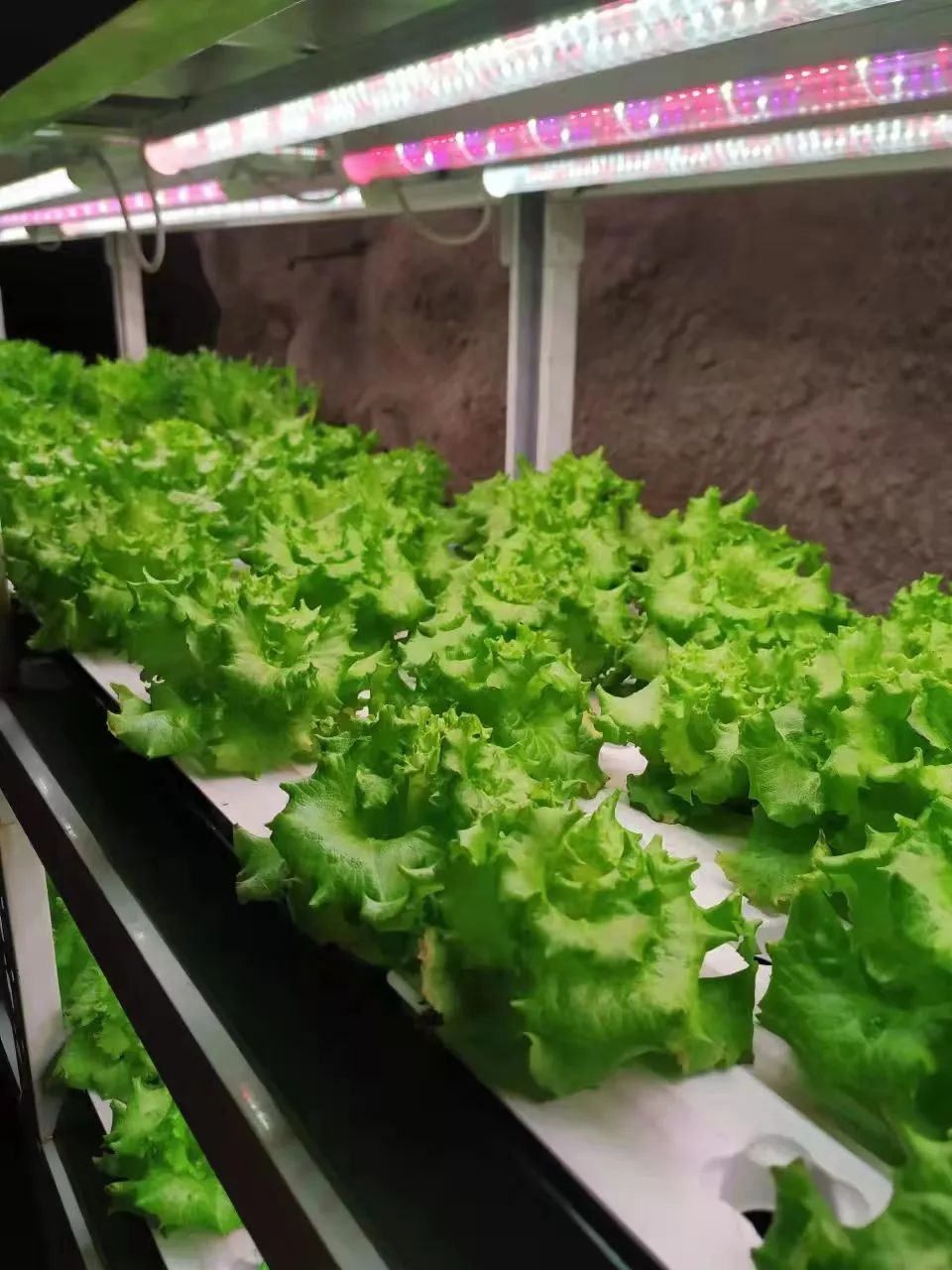
Can vegetables be grown more than 200 meters underground? In early April, lush green butterhead lettuce was thriving in rows within the abandoned mine tunnel at a depth of 245 meters in Daye City, Hubei Province.
This is a preliminary result of the research project "Key Technology Research for Plant Factories in Abandoned Mines" , undertaken jointly by Hubei University of Technology and Wuhan Hugong Furi Energy Technology Co., Ltd. under the Science and Technology Department of Hubei Province . The experimental field is located at Daye Nonferrous Group Tongluoshan Mine , adjacent to the ancient Tongluoshan Copper Mine Site in Daye City, which has a mining history of over three thousand years .
"Not only lettuce can be grown underground in mines; theoretically, any plant you wish to grow can be cultivated there!" said Professor Zeng Wei, project R&D lead and Director of the Low-Carbon Economy and Technology Research Center at Hubei University of Technology.
Technical means to create a growth environment
Heavy metal content is far below safety standards
Plant growth requires natural conditions such as temperature, light, water, fertilizer, and carbon dioxide gas. How can these be met underground? From an agricultural perspective, the mine shaft offers constant year-round temperature and humidity conditions. Taking the underground level at 245 meters in the Tonglushan Copper Mine in Daye as an example, the temperature remains consistently between 25°C and 28°C, with humidity maintained at 70% to 80%, creating an excellent environment for plant growth. Moreover, carbon dioxide concentration stays between 700 and 800 ppm, which is double that of the surface. Carbon dioxide is known as 'plant air fertilizer'.
The most pressing issue to address in abandoned mines is lighting. "Our team's research direction is solar energy, photovoltaics, and low carbon. Within the general visible photovoltaic range, only 10% of the spectrum is the effective required by plants. By providing the necessary lighting tailored to the growth characteristics of different plants, cultivating various plants underground can become a reality. " said Zeng Wei.
"Currently, our lettuce is growing very well, and its growth cycle is shortened by 20%~40% compared to field cultivation." Zeng Wei introduced: " Underground lettuce" is cultivated using hydroponics, with nutrient supply provided by an integrated water and fertilizer machine . "Since the main source of pests and diseases in field cultivation comes from the soil, while the hydroponic nutrient solution in underground plant factories can be treated and replaced, underground vegetables can be produced without pesticide use."
Since no temperature control energy is required, production energy costs can be reduced by more than 60% compared to ground-based plant factories.
"Our mine covers hundreds of thousands of square meters. If we implement three-layer vertical farming, it is equivalent to adding over a thousand mu of arable land," said Zeng Haipeng, the mine manager of Tonglushan Mine.
Initially, the team was concerned that the mining area's strata might be contaminated with heavy metals. "However, the water source used for growing vegetables is not groundwater but treated tap water." After testing by the Food Quality Supervision and Inspection Testing Center of the Ministry of Agriculture and Rural Affairs (Wuhan), it was found that lettuce contained no pesticide residues, and toxic heavy metals such as mercury and arsenic were not detected. Moreover, the content of heavy metals unique to local water bodies, such as lead, cadmium, and chromium, was even an order of magnitude lower than international food safety standards. "Tap water is easy to treat; the hydroponic method avoids heavy metal pollutants in the soil, making it safer than open-field cultivation," said Zeng Wei.
Reusing abandoned mines can solve the employment problem of miners
Building underground plant factories in abandoned mines is promising
The idea of cultivating 'underground vegetables' originated from a survey. Hubei Province has many abandoned phosphate mine shafts, as well as copper, iron, and salt mines that have exhausted their reserves or are nearing the end of extraction. "While investigating whether tailings ponds in Daye City could be used for photovoltaic power generation, we discovered that the local area also commonly faces the dilemma of reusing mining sites," said Zeng Wei.
Huangshi City, where Daye is located, is a national resource-depleted city. Since the 1960s and 1970s, mineral resources have become extremely scarce, leading to increased mining costs. "Old mines are hollowed out underground within depths of 700 to 800 meters, facing a high risk of geological disasters. To prevent collapses and landslides, the investment required for closing each mine shaft reaches hundreds of millions of yuan."
"Closing a mine not only incurs high costs but also leads to massive miner unemployment," said Zeng Wei. Taking Tonglushan Mine as an example, once closed, three to four thousand miners would face job losses. However, if the choice is made to transform and upgrade the Industry, it can not only solve the re-employment issue for a large number of miners but also continue to utilize existing power supply, ventilation, water-electricity tracks, and communication resources.
A mine plant factory is a systematic engineering project involving various disciplines such as agriculture, energy, machinery, optics, and electronics . Underground work requires strict safety regulations , making automation and intelligent cultivation an important option for mining agriculture . To this end, the Hubei University of Technology project team includes professors from multiple colleges, including the School of Electrical and Electronic Engineering, the School of Mechanical Engineering, the School of Science, and the School of Economics and Management. The project also received strong support from the Hubei Academy of Agricultural Sciences, Wuhan Hugong Furi Energy Technology Company, Guangdong Babylon Manor, and the Daye Nonferrous Copper Lushan Mine where the project is located, fully demonstrating the integrated effects of industry-academia collaboration and interdisciplinary integration.
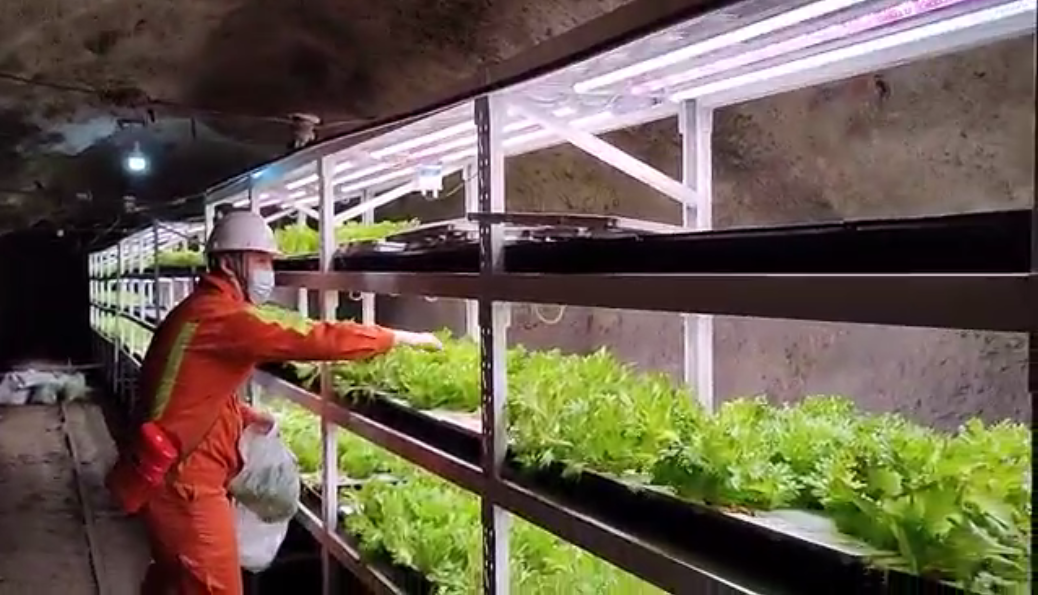
"Vegetables are planted on both sides of the existing mine rails, all automation equipment is installed, which just solves the problem of needing fixed rails to assist intelligent robots in mechanical operations." Zeng Wei said that currently, automated harvesting equipment has basically completed its research and relevant tests have been conducted in the laboratory.
During the 2022 National Two Sessions, Academician Yuan Liang of the Chinese Academy of Engineering proposed: In 2020, China closed 12,000 coal mines. By 2030, over 15,000 abandoned mines will require closure, with an estimated 7.2 billion cubic meters of underground space available for utilization. "If the underground planting model of plant factories can be developed, it will provide significant support and assistance to the country's 1.8 billion mu red line for arable land," said Zeng Wei.
"Lettuce is merely the starting variety for trials. Next, we will conduct planting trials for high-end vegetables, medicinal herbs, and flowers, while simultaneously implementing a multi-spectrum combination and vertical farming model in abandoned mines, featuring interactive assistance between low-light, high-respiration edible fungi and high-light, high-CO2-absorption plants," said Zeng Wei.