
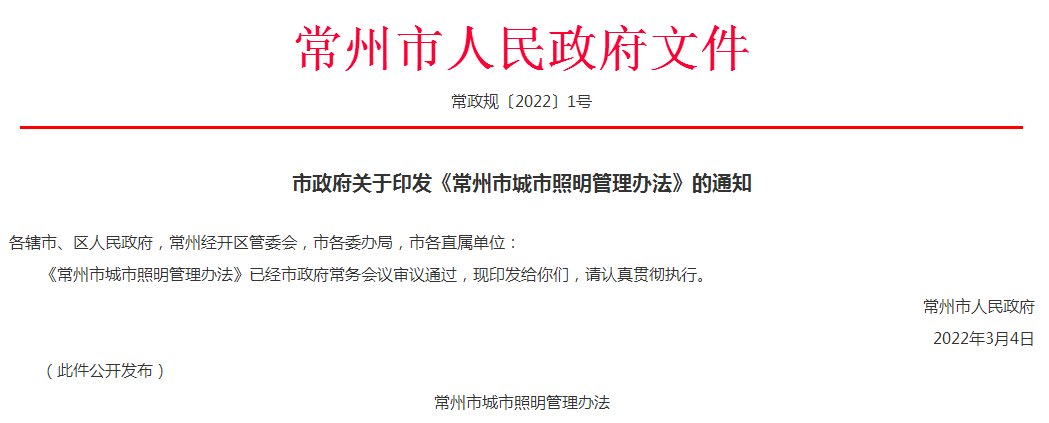
The "Changzhou City Urban Lighting Management Measures" have been issued
To further standardize the management of urban lighting in Changzhou, improve the urban lighting environment, promote energy conservation, and drive high-quality sustainable development of urban lighting in Changzhou, combined with local realities, the Municipal Housing and Urban-Rural Development Bureau has revised and improved the existing "Changzhou City Urban Lighting Management Measures" (Chang Zheng Gui [2012] No. 10) (hereinafter referred to as the original "Measures") and issued the new "Changzhou City Urban Lighting Management Measures" (hereinafter referred to as the new "Measures"). The new "Measures" will take effect on May 1st.
The new "Measures" consist of six chapters and forty articles, mainly covering the definition and scope of application of urban lighting, management responsibilities, planning and construction, management and maintenance, and energy saving.
Compared to the original "Measures", the new "Measures":
First, it better meets the requirements of Changzhou's administrative district adjustments, institutional reforms, and the optimization of functions by administrative departments, facilitating a unified effort among urban lighting authorities at all levels to effectively coordinate urban lighting management.
Secondly, to ensure the coordinated development of urban lighting with urban construction, fully leverage the safety guarantee function of functional lighting facilities and the role of landscape lighting in highlighting local characteristics and promoting night-time economy development, specific clauses regarding the scope of setting up functional and landscape lighting facilities have been further clarified.
Third, implement the concept of innovative lighting, clarify the evaluation and inspection requirements for urban lighting energy consumption, strengthen energy consumption management, further achieve energy saving and emission reduction, and promote high-quality development of Changzhou urban lighting.
Fourth, Changzhou is the first city in the province to incorporate multi-functional lamp posts into the new "Regulations". It also leads the province in the application of multi-functional lamp posts. This move will further promote the quality improvement of Changzhou's "urban furniture" and contribute to the construction of a beautiful and livable city.
The full text of the new "Measures" is as follows:
"Changzhou City Urban Lighting Management Measures"
Chapter 1 General Provisions
Article 1: To strengthen urban lighting management, improve the urban lighting environment, and promote energy conservation, in accordance with relevant regulations such as the "Urban Lighting Management Regulations" (Ministry of Housing and Urban-Rural Development Order No. 4) and combined with the actual conditions of this city, these Measures are formulated.
Article 2: The planning, construction, maintenance, and supervision and management of urban lighting in this municipality shall be governed by these Measures.
The term urban lighting referred to in these Measures includes functional lighting and landscape lighting.
Article 3: Urban lighting management shall follow the principles of people-oriented, economical and practical, energy saving and environmental protection, and beautifying the environment, strictly controlling the energy consumption of decorative landscape lighting for public facilities and large buildings.
Article 4: The Municipal Housing and Urban-Rural Development Bureau is the competent administrative department for urban lighting work citywide, responsible for managing urban lighting across the city. Urban lighting authorities in subordinate cities (districts) shall perform relevant urban lighting management duties according to their respective responsibilities.
Urban lighting institutions undertake auxiliary and technical work for urban lighting industry management in accordance with regulations, and are responsible for the daily management of construction, maintenance, and operation of urban lighting facilities.
Departments such as Development and Reform, Industry and Information Technology, Public Security, Finance, Natural Resources and Planning, Urban Management, Transportation, Water Conservancy, Culture, Radio, Television and Tourism shall, in accordance with their respective responsibilities, carry out relevant work on urban lighting management.
Article 5: The urban lighting competent department shall commend or reward units and individuals who have made significant achievements in urban lighting energy saving.
Chapter 2: Planning and Construction
Article 6: The urban lighting competent department shall, in conjunction with relevant departments, organize the preparation of a special plan for urban lighting based on the territorial spatial plan and implement it after approval by the people's government at the same level according to statutory procedures.
Article 7: The urban lighting competent department shall entrust units with corresponding qualifications to undertake the preparation of special plans for urban lighting.
When formulating a special plan for urban lighting, requirements for the lighting effects in different areas shall be established based on the region's level of economic and social development, combined with the city's natural geographical environment and cultural conditions, and in accordance with the functional zoning of the city determined by the territorial spatial planning.
Article 8: Functional lighting facilities shall be installed in areas such as urban roads, roads within residential communities, transportation hubs, bridges, tunnels, pedestrian overpasses, squares, public parking lots, open parks, public green spaces, and scenic or historical sites, as well as highways within the built-up areas of towns.
The following areas shall be equipped with landscape lighting facilities in accordance with the requirements of the urban lighting special plan:
(1) Major urban roads, urban viaducts, key tourist routes, landscape greenways, landscape waterways, and important buildings (structures) on both sides;
(II) Major landmark, historical, transportation-related, and large-scale public buildings (structures);
(III) Important parks, green spaces, scenic areas, commercial streets, and surrounding important buildings (structures);
(4) City gateways and entrances, as well as surrounding important buildings and structures;
(5) Other areas determined by the special plan for urban lighting.
Article 9: Units engaged in the survey, design, construction, and supervision of urban lighting projects shall possess corresponding qualifications, and relevant professional technical personnel shall obtain corresponding practicing qualifications in accordance with the law.
Article 10: New construction, reconstruction, and expansion of urban lighting facilities shall comply with requirements such as illuminance, luminance, and energy consumption standards determined by the urban lighting special plan, and shall also meet relevant national standards and specifications.
Existing urban lighting facilities that do not comply with the special plan for urban lighting shall be gradually renovated in accordance with the plan.
Article 11: The construction funds for urban lighting facilities invested by the government shall be included in the budget for government investment project construction funds.
Encourage social capital to participate in the construction and maintenance of urban lighting facilities.
Article 12: For construction projects covered by Article 8 of these Measures, urban lighting facilities required to be provided in accordance with planning requirements shall be designed, constructed, accepted, and put into use simultaneously with the main project.
Article 13: The lighting installation rate for functional lighting in new, reconstructed, or expanded urban road projects shall reach 100%.
Construction units shall actively promote the application of multi-functional lamp posts, carry out intensive construction and standardized setting of road poles and related facilities, and build a harmonious and orderly road space.
Article 14: For buildings and structures that meet the conditions for installing urban lighting facilities, lighting facilities may be installed without affecting their function or surrounding environment; relevant units and individuals shall provide support and cooperation.
Chapter 3: Management and Maintenance
Article 15: The urban lighting competent department shall establish and improve rules and regulations to strengthen the management of urban lighting facilities.
The municipal urban lighting competent department organizes the construction of a centralized control system for urban lighting in this city. The district (or county) urban lighting competent departments rely on the municipal urban lighting centralized control system to organize and construct urban lighting control platforms.
Urban lighting statistical data and materials are regularly reported by the urban lighting competent authorities of the city (district) to the municipal urban lighting competent authority.
Article 16: The urban lighting competent authority may, in accordance with the law, determine the maintenance unit for urban lighting facilities through bidding processes, specifically responsible for the maintenance of government-invested urban lighting facilities.
Article 17: Urban lighting facilities funded by non-governmental investments shall be maintained by the property owner, who shall establish a corresponding maintenance guarantee mechanism; those meeting the following conditions may be transferred to the management of the urban lighting competent authority after asset transfer procedures are completed through mutual agreement:
(1) Comply with the special urban lighting plan and relevant standards;
(II) Comply with urban lighting facility quality and safety standards;
(3) Comply with the technical and safety standards for integration into the urban lighting network;
(4) Provide necessary maintenance and operating conditions;
(5) Provide complete acceptance inspection documentation;
(6) Other conditions that shall be met in accordance with the law.
Landscape lighting facilities with non-government investment that comply with the urban lighting special plan shall be included in the centralized urban lighting control system according to regulations.
In the event of major events or special circumstances requiring the opening or closing of urban lighting facilities, execution shall follow the time designated by the municipal people's government.
Article 18: The operating and maintenance funds for urban lighting facilities allocated in the government budget shall be used exclusively for this purpose to ensure the normal operation of urban lighting facilities.
Article 19: The management and maintenance of urban lighting facilities shall comply with relevant standards and specifications. Urban lighting facility maintenance units shall strengthen daily inspections and maintenance of urban lighting facilities to ensure maintenance quality. If urban lighting facilities do not meet technical specification requirements, the urban lighting competent department shall urge rectification.
Article 20: All units and individuals shall protect urban lighting facilities and shall not engage in the following acts:
(1) Carving or defacing urban lighting facilities;
(II) Unauthorized planting of trees, digging pits to extract soil, or placing other objects within the safety distance of urban lighting facilities, or dumping corrosive waste such as acid, alkali, salt, or other corrosive waste residue and liquid;
(III) Unauthorized posting, hanging, or installation of promotional materials or advertisements on urban lighting facilities;
(4) Unauthorized installation of cables, placement of other facilities, or connection to power sources on urban lighting facilities;
(5) Unauthorized relocation, dismantling, or utilization of urban lighting facilities;
(VI) Other acts that may affect the normal operation of urban lighting facilities.
No unit or individual may steal urban lighting facilities.
Article 21: The safe distance between trees near urban lighting facilities and live electrical objects shall not be less than 1 meter. If trees, due to natural growth, fail to meet the required safe distance or affect lighting performance, relevant units shall carry out pruning in accordance with laws and regulations together with the greenery management responsible persons.
If trees pose a serious threat to the safe operation of urban lighting facilities due to force majeure, the maintenance unit of urban lighting facilities may take measures in accordance with the law and promptly report to the urban greening competent department.
Article 22: Where it is necessary to attach, lay cables or pipelines on urban lighting facilities, consultation and agreement must be reached with the owner of the urban lighting facilities to ensure sufficient safety distance between them and the urban lighting facilities, guaranteeing the normal operation of the urban lighting facilities.
Article 23: Where it is necessary to connect power supply to urban lighting facilities, the user must reach an agreement with the owner of the urban lighting facilities and make the connection in accordance with relevant technical standards and safety regulations. The electricity user shall strictly implement relevant safety regulations for electricity use, be responsible for electrical safety, and bear related costs.
Article 24: Where it is necessary to hang or install non-lighting facilities such as public welfare publicity materials, equipment, or signs on urban lighting facilities, consultation and agreement with the owner of the urban lighting facilities must be reached. Such installations shall be carried out at agreed locations and times in accordance with relevant technical standards and safety regulations, ensuring no safety hazards exist, and shall not affect the appearance or operation of the urban lighting facilities.
Article 25: Where it is necessary to demolish, relocate, or modify urban lighting facilities, or where construction activities may affect the integrity and safe operation of such facilities, consultation and agreement with the owner of the urban lighting facilities shall be reached. If relevant procedures are required by law, they shall be followed.
In emergency situations such as disaster relief and rescue, measures such as demolition, relocation, or modification of urban lighting facilities shall be implemented in accordance with relevant emergency management regulations.
Article 26: Where urban lighting facilities are damaged, the scene shall be properly protected to prevent further damage, and the owner of the urban lighting facilities shall be notified immediately.
If the traffic management department of the public security organ discovers that urban lighting facilities have been damaged due to a traffic accident, it shall promptly notify the owner of the urban lighting facilities.
If urban lighting facilities within the property management area are damaged, the property service enterprise or other manager shall promptly take emergency measures, notify the owner of the urban lighting facilities, and assist in maintenance work.
Chapter 4: Energy Saving
Article 27: Implement the concepts of green lighting, smart lighting, and humanistic lighting; support scientific research on urban lighting technology; promote the use of energy-saving, environmentally friendly new lighting technologies, materials, equipment, and processes; and improve the scientific and technological level of urban lighting.
Article 28: Encourage the scientific and localized application of renewable energy utilization systems, such as solar energy, in the construction and renovation of urban lighting facilities.
Article 29: The urban lighting competent department shall, based on the urban lighting special plan, formulate an urban lighting energy-saving plan and energy-saving technical measures, prioritize the development and construction of functional lighting, strictly control the scope, luminance, and energy consumption density of nightscape lighting, and phase out inefficient lighting products within a time limit in accordance with relevant national regulations.
Article 30: The urban lighting competent department shall regularly carry out energy-saving education, publicity, and on-the-job energy-saving training to promote energy conservation.
Article 31: The urban lighting competent department shall establish an urban lighting energy consumption evaluation system and regularly inspect the energy consumption of urban landscape lighting, excessive lighting beyond standards, etc.
Article 32: The urban lighting authority shall establish and improve the energy-saving mechanism for zoning, time-sharing, and grading of lighting.
In urban lighting, high-efficiency energy-saving products and advanced light control methods should be actively adopted; the use of high-energy-consuming luminaires is strictly prohibited.
Excessive lighting and other behaviors exceeding energy consumption standards are prohibited in urban landscape lighting.
Chapter 5 Legal Liability
Article 33: Units without corresponding qualifications and personnel without corresponding professional qualifications engaged in urban lighting engineering survey, design, construction, or supervision shall be punished in accordance with relevant laws, regulations, and rules.
Article 34: Whoever commits any of the acts specified in Paragraph 1, Article 20 of these Measures shall be ordered by the urban lighting authority to correct within a time limit; individuals shall be fined between 200 and 1,000 yuan, and units between 1,000 and 30,000 yuan. If losses are caused, compensation shall be made in accordance with the law.
Article 35: In urban landscape lighting, if there are behaviors such as excessive lighting that exceed energy consumption standards, the urban lighting competent department shall order correction within a time limit; if not corrected within the time limit, a fine of not less than 1,000 yuan but not more than 30,000 yuan shall be imposed.
Article 36: If the urban lighting competent department and its staff are negligent, abuse their power, or engage in favoritism and fraud in urban lighting management work, they shall be given disciplinary sanctions in accordance with the law; if a crime is suspected, criminal responsibility shall be investigated in accordance with the law.
Chapter 6 Supplementary Provisions
Article 37: The meanings of the following terms in these Measures are:
(1) Functional lighting refers to lighting that uses artificial light to ensure the safety of people's travel and outdoor activities;
(II) Landscape lighting refers to lighting in outdoor areas using artificial light for the purpose of decoration and scenery creation;
(3) Urban lighting facilities refer to lighting fixtures used for urban lighting, as well as equipment and ancillary facilities for power distribution, monitoring, energy saving, and other systems.
Article 38: Administrative penalties prescribed by these Measures shall be implemented in accordance with relevant regulations if the power to impose administrative penalties is relatively centralized according to law.
Article 39: The people's governments of cities (districts) may, in accordance with these Measures and based on local conditions, formulate implementation rules.
Article 40: These Measures shall come into force on May 1, 2022. The "Changzhou City Urban Lighting Management Measures" (Chang Zheng Gui [2012] No. 10) issued by the Municipal People's Government on August 31, 2012, are hereby repealed simultaneously.