
Global Horticultural Lighting Market Report
According to available data, the main factors affecting plant growth include temperature, light, water (rainfall), soil, length of the frost-free period, and wind speed. Among these, light influences plant growth and development in terms of spectrum, luminous intensity, and photoperiod. For example, photoperiod is an important signal source that regulates plant growth and development; flowering time is closely related to the season—winter jasmine blooms in early spring, while chrysanthemums bloom only in autumn. This is because plants regulate their own growth cycles by sensing periodic changes in light duration. Photoperiod has a profound impact on seed germination, flowering time, and dormancy.
Analysis of the Impact of Light on Plants | |
Indicator | Impact on Plant Growth and Development |
Illuminance | Light intensity mainly affects the rate of photosynthesis in plants, thereby altering their morphology. Plants have a specific range of light intensity requirements; when the light intensity <光补偿点时,呼吸速率大于光合速率;当光补偿点<光照强度<光饱和点时,植物进行正常的光合作用;当光照强度> reaches the light saturation point, transpiration accelerates, and plants close their stomata to prevent excessive water loss, resulting in "midday depression of photosynthesis." |
Light Quality | In the visible light Spectrum (380nm–760nm), the light energy required to promote plant growth is mainly distributed in two bands: 610nm–700nm (red light) and 400nm–510nm (blue light). The absorbable wavelengths are mainly concentrated in the blue-violet band (peak at 450nm) and the red-orange band (peak at 660nm), but the suitable light quality varies among different plants and at different growth stages of the same plant. In addition, ultraviolet light with wavelengths less than 400nm and far-red light with wavelengths between 700nm and 800nm, although they do not promote photosynthesis, can serve as environmental signals to regulate the process of plant growth and development and metabolism. |
Light Cycle | Photoperiod is an important signal source that regulates plant growth and development. For example, flowering time is closely related to the season: winter jasmine blooms in early spring, while chrysanthemums do not bloom until autumn. This is because plants regulate their own growth cycles by sensing periodic changes in light duration. Photoperiod has a profound impact on seed germination, flowering time, and dormancy. For instance, begonia seeds require a photoperiod of 8–12 hours for maximum germination. Photoperiod can also affect stem elongation and internal hormone levels, inducing and promoting the expression of genes related to vegetative growth. By appropriately extending the photoperiod, the duration of photosynthesis can be increased, thereby promoting plant growth. |
Source: Compiled by Guanyan Tianxia
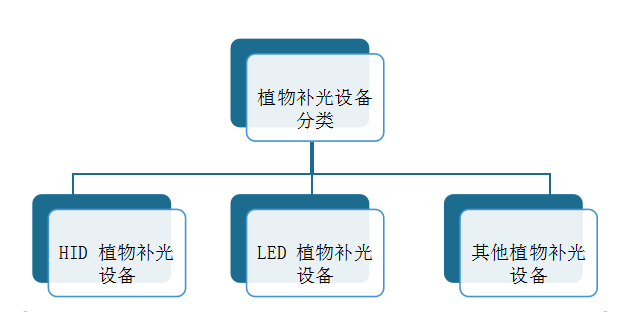
Plant growth lighting equipment is an artificial light source that primarily stimulates plant growth by emitting electromagnetic spectra suitable for photosynthesis, including HID plant growth lighting equipment, LED plant growth lighting equipment, and other types such as fluorescent lamps. Among these, HID plant growth lighting equipment is suitable for lighting in large-scale plant cultivation and planting, with mature and reliable technology, making it one of the most widely used light sources in the field of plant growth lighting today. Furthermore, with the development of LED technology, more and more downstream industries are beginning to use LED plant growth lighting equipment.
Source: Compiled by Guanyan Tianxia
I. Current Global Market Status
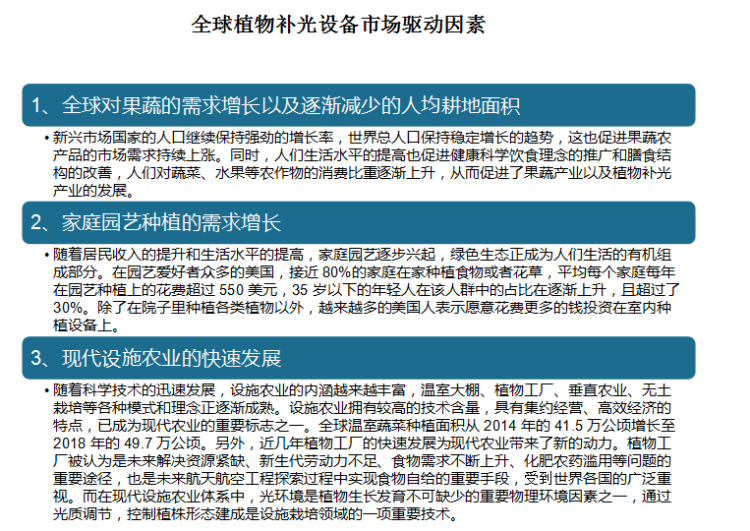
According to the "Research on Market Development Trends and Future Investment Analysis of China's Plant Supplemental Lighting Equipment (2022-2029)" released by Guanyan Report Network, in recent years, driven by the growing global demand for fruits and vegetables, decreasing per capita arable land, rising demand for home gardening, and the rapid development of modern facility agriculture accelerating the popularization of new agricultural forms such as greenhouses and plant factories, the demand for plant supplemental lighting equipment has continued to grow. It has now become one of the fastest-growing segments in the horticultural lighting sector.
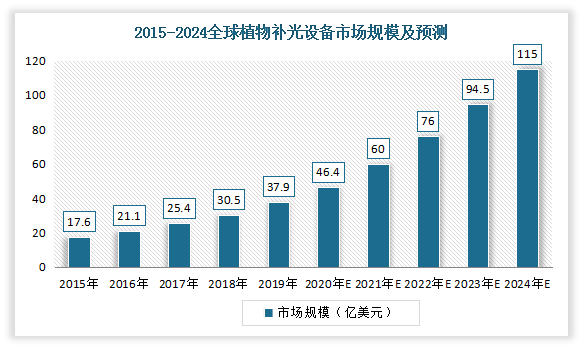
Data shows that the global market size for plant supplemental lighting equipment grew from USD 1.76 billion in 2015 to USD 3.79 billion in 2019, with a compound annual growth rate (CAGR) of 21.1%. The global market size for plant supplemental lighting equipment is projected to reach USD 11.50 billion by 2024.
Data source: Frost & Sullivan, compiled by Guanyan Tianxia
Source: Compiled by Guanyan Tianxia
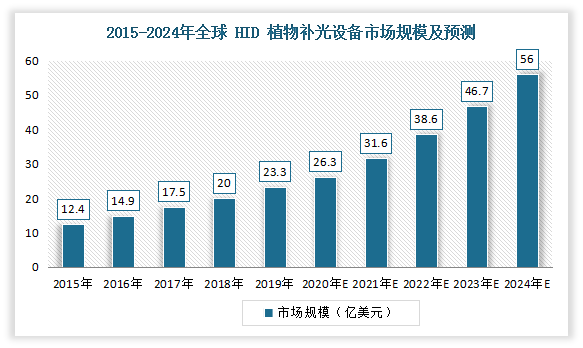
From the perspective of细分 segments, due to characteristics such as high luminous efficacy, wide irradiation range, high stability, low unit price, and strong environmental adaptability, the market demand for HID plant supplemental lighting equipment has grown rapidly. To date, it is the most widely used type of equipment in the field of plant growth. Data shows that in 2019, the global market size for HID plant supplemental lighting equipment was USD 2.33 billion, accounting for 61.5% of the global plant supplemental lighting equipment market. It is expected that by 2024, the global market size for HID plant supplemental lighting equipment will reach USD 5.60 billion.
Data source: Frost & Sullivan, compiled by Guan Yan Tianxia
LED plant growth lights play a key role in modern agricultural construction. In recent years, with the maturation and development of LED technology, the global penetration rate of LED products has increased year by year. Data shows that the global market size for LED plant lighting equipment grew from USD 310 million in 2015 to USD 1.22 billion in 2019, with a compound annual growth rate (CAGR) of 40.8%. It is expected that LED plant growth light equipment will be further applied in modern agricultural production, reaching a market size of USD 5.7 billion by 2024.
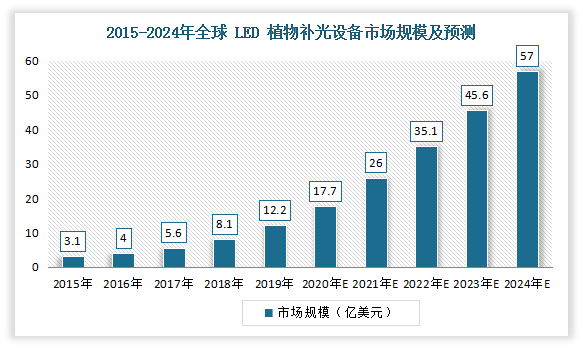
Data source: Frost & Sullivan, compiled by Guan Yan Tianxia
From the perspective of application fields, plant supplemental lighting equipment is currently mainly used in greenhouses, vertical farming, plant factories, and home gardening.
Among these, plant supplemental lighting equipment is most widely used in the commercial greenhouse sector. Data shows that in 2019, the global market size for plant supplemental lighting equipment applied to the commercial greenhouse segment reached USD 2.51 billion, and it is projected to grow to USD 6.06 billion by 2024, with a compound annual growth rate (CAGR) of 21.4%.
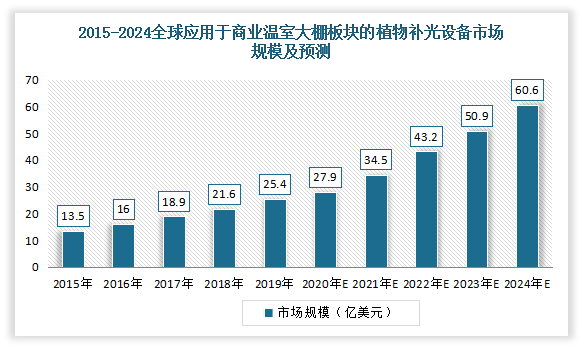
Data source: Frost & Sullivan, compiled by Guanyan Tianxia
In the home gardening sector, driven by the global rise in horticultural cultivation and increased consumer awareness, many households are using plant grow lights to cultivate flowers and other plants, resulting in rapid market growth. Data shows that the global market size for plant grow lights in the home gardening segment grew from USD 300 million in 2015 to USD 890 million in 2019, and is projected to reach USD 3.59 billion by 2024.
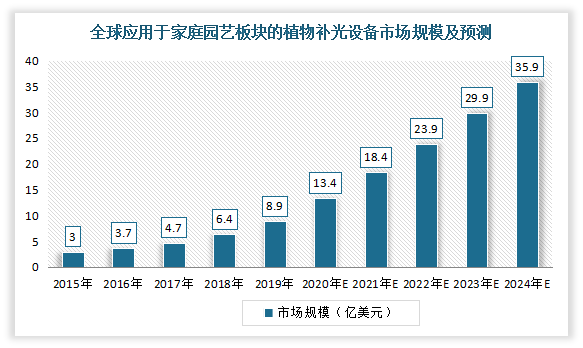
Data source: Frost & Sullivan, compiled by Guan Yan Tianxia
There is huge growth potential in the plant factory sector. It is understood that LED, due to its designable spectrum characteristics, can be combined and adjusted as needed to create "light recipes" suitable for plant growth. This feature aligns perfectly with the development needs of fully artificial light-utilizing plant factories. It is expected that with future food shortages and a lack of new-generation labor, plant factories will be widely applied, thereby continuously driving the growth of the global market for plant supplemental lighting equipment. Data shows that in 2019, the market size of global plant supplemental lighting equipment applied to the plant factory segment was $240 million, and it is expected to grow to $1.47 billion by 2024.
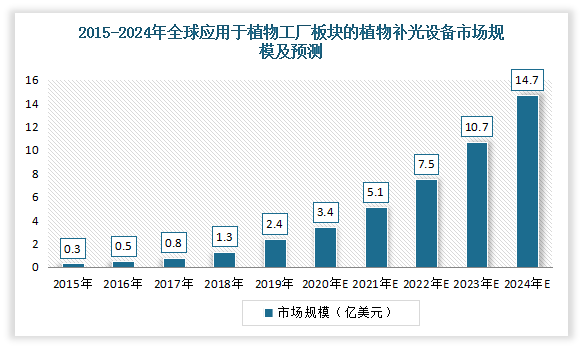
Data source: Frost & Sullivan, compiled by Guanyan Tianxia
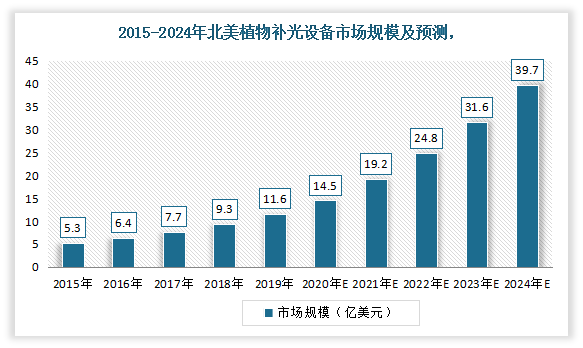
From a global perspective, driven by the growth in home gardening demand, the North American plant supplemental lighting market has developed rapidly in recent years and has become the largest market segment worldwide. Data shows that the market size of plant supplemental lighting equipment in North America grew from USD 530 million in 2015 to approximately USD 1.16 billion in 2019. It is projected that the market size will reach approximately USD 3.97 billion by 2024.
Data source: Frost & Sullivan, compiled by Guanyan Tianxia
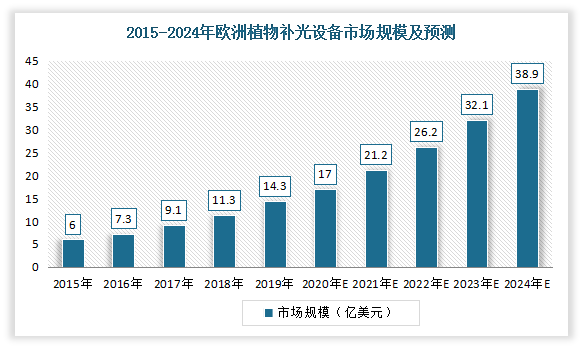
Europe follows next. Since 2015, the market size for plant supplemental lighting equipment in Europe has been growing continuously. Data shows that the market size grew from USD 600 million in 2015 to approximately USD 1.43 billion in 2019. The European plant supplemental lighting equipment market is expected to reach USD 3.89 billion by 2024.
Data source: Frost & Sullivan, compiled by Guan Yan Tianxia
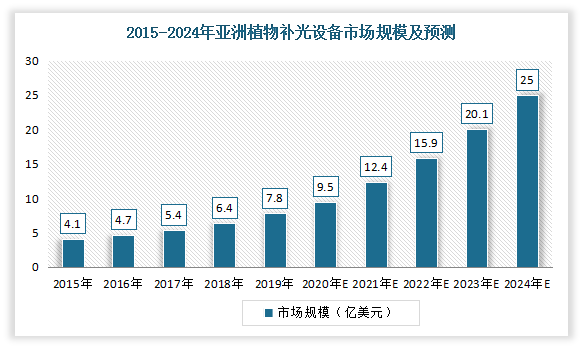
In Asia, the market size of plant supplemental lighting equipment has grown rapidly, driven by the fast development of commercial greenhouses and plant factories. Data shows that the Asian market for plant supplemental lighting equipment grew from USD 410 million in 2015 to approximately USD 780 million in 2019. The market size in Asia is projected to reach USD 2.5 billion by 2024.
Data source: Frost & Sullivan, compiled by Guanyan Tianxia
II. Development of the Chinese Market
Plant supplemental lighting equipment belongs to the lighting fixtures industry. In recent years, with the state's increased emphasis on energy conservation, emission reduction, and high-efficiency lighting, the Chinese government and industry authorities have provided strong support and encouragement to the lighting and lighting fixtures industries, formulating many corresponding industrial policies and measures. Against this backdrop, China's plant supplemental lighting equipment industry has achieved sound development.
Policies Related to the Plant Supplemental Lighting Equipment Industry | ||
Issuing Organization | Policy Name | Main Content |
State Council | Decision on Accelerating the Cultivation and Development of Strategic Emerging Industries | Strategic emerging industries will be based on national conditions, focusing on the development and promotion of high-efficiency energy saving technologies, equipment, and products, achieving breakthroughs in key technologies in key areas, and driving an overall improvement in energy efficiency. Accelerate the R&D and industrialization demonstration of key common technologies for resource recycling and utilization, improving the level of comprehensive resource utilization and remanufacturing industrialization. Demonstrate and promote advanced environmental protection technologies, equipment, and products to enhance pollution prevention and control levels. Promote the construction of a market-oriented energy conservation and environmental protection service system. Accelerate the establishment of a waste product recycling and utilization system supported by advanced technologies, and actively promote clean coal utilization and comprehensive seawater utilization. |
Comprehensive Work Plan for Energy Conservation and Emission Reduction during the "12th Five-Year Plan" | sets the promotion of high-efficiency lighting energy-saving products as a development goal: the application rate of high luminous efficacy and long-life light sources in urban lighting shall be no less than 90%. Under the premise of meeting light distribution requirements, the efficiency of road lighting luminaires using high-pressure sodium lamps and metal halide lamps shall be no less than 75%. The energy efficiency indicators of light sources such as high-pressure sodium lamps and metal halide lamps, as well as their matching ballasts, shall meet the minimum energy performance standards specified in relevant regulations; energy-saving inductive ballasts and electronic ballasts shall be prioritized. The power factor of lighting circuits shall not be less than 0.85. The use of high-consumption, low-efficiency lighting facilities and products is strictly prohibited in new projects, and inefficient, high-consumption products in urban lighting shall be completely phased out within two years. | |
NDRC | Guidance Catalog of Key Products and Services for Strategic Emerging Industries | Based on the seven industries and 24 development directions determined by the "Decision on Accelerating the Cultivation and Development of Strategic Emerging Industries", it is further refined into nearly 3,100 specific products and services (including approximately 740 items in the energy saving and environmental protection industry, about 950 items in the new generation information technology industry, around 500 items in the biological industry, approximately 270 items in the high-end equipment manufacturing industry, about 300 items in the new energy industry, around 280 items in the new materials industry, and approximately 60 items in the new energy vehicle industry). It explicitly states that the new technology of high-power electronic ballasts for HID lamps belongs to the field of high-efficiency lighting products and systems within the high-efficiency energy saving sector of the energy saving and environmental protection industry, aligning with China's strategic emerging industry policies. |
State Council | "13th Five-Year Plan for the Development of Strategic Emerging Industries" | Vigorously enhance the technology and application level of high-efficiency energy-saving equipment. Encourage R&D of high-efficiency energy-saving equipment (products) and key components, increase demonstration and promotion efforts, and accelerate the reduction of comprehensive costs. Formulate and revise mandatory energy efficiency and energy consumption limit standards, and accelerate the transformation and application of energy-saving technological achievements. Publish catalogs for the promotion of energy-saving products and technologies, improve government procurement policies for energy-saving products, and promote an increase in the market share of energy-saving products. Improve the energy efficiency labeling system and the certification system for energy-saving products, implement the Energy Efficiency Leader system in fields such as industry, construction, transportation, and consumer goods, and drive energy-using enterprises and product manufacturers to achieve leapfrog improvements in energy efficiency. |
NDRC | Guidance Catalog of Key Products and Services for Strategic Emerging Industries (2016 Edition) | Based on the "13th Five-Year Plan for the Development of Strategic Emerging Industries," which outlines 5 major fields and 8 industries, further refined into 40 key directions with 174 sub-directions and nearly 4,000 specific products and services. It explicitly states that high-power electronic ballasts for HID lamps belong to the field of high-efficiency lighting products and systems within the energy-saving and environmental protection industry, aligning with China's strategic emerging industry policies. |
State Council | "Comprehensive Work Plan for Energy Conservation and Emission Reduction during the 13th Five-Year Plan" | Organize and implement key energy-saving projects such as Green lighting and the industrialization demonstration of energy-saving technical equipment; accelerate the adoption of mature and applicable technologies like Semiconductor / Solid-state lighting (SSL); comprehensively adopt energy-saving and emission-reduction system integration technologies to promote the optimization and upgrading of lighting systems; advance energy saving in agriculture and rural areas, accelerate the elimination of outdated agricultural machinery, promote energy-saving agricultural machinery and equipment, and develop energy-saving agricultural greenhouses. |
NDRC | "13th Five-Year Development Plan for the Semiconductor Lighting Industry" | By 2020, China achieved continuous breakthroughs in key semiconductor lighting technologies, steadily improved product quality, continuously optimized product structure, steadily expanded industry scale, and gradually increased industry concentration, forming more than one LED lighting enterprise with sales exceeding RMB 10 billion, cultivating 1–2 internationally renowned brands and about 10 domestically well-known brands. |
National People's Congress | Energy Conservation Law of the People's Republic of China | states that "energy saving is a basic national policy of China." The state encourages and supports the research, development, demonstration, and promotion of energy-saving science and technology, promoting innovation and progress in energy-saving technologies. |
NDRC | "Monitoring Report on the Development Trends of National Fixed Asset Investment in 2018 and Outlook for the Investment Situation in 2019" | In 2019, investment in key technologies, high-end equipment, core components and electronic components will be increased to accelerate the construction of new infrastructure and the commercialization of 5G. This means that 5G smart streetlight projects will be rapidly advanced. |
Green Industry Guidance Catalog (2019) | The "Catalog" includes six major sections, such as the energy-saving and environmental protection industry and the cleaner production industry. In the energy-saving and environmental protection industry section, several products and technologies from the lighting industry are listed. | |
Ministry of Science and Technology | Special Plan for Innovation-Driven Rural Revitalization Development (2018–2022) | Accelerate the cultivation of agricultural high-tech industries and enterprises. Led by the construction of National Agricultural High-Tech Industry Demonstration Zones, use high-tech to transform and upgrade the agricultural industry, strengthen high-tech industries such as biological breeding, intelligent agricultural machinery, modern food manufacturing, and smart agriculture, and cultivate more than 15,000 agricultural high-tech enterprises. |
General Office of the CPC Central Committee | Several Measures on Promoting the Organic Integration of Smallholder Farmers and Modern Agricultural Development | Improve the material and technical equipment conditions for smallholder farmers. Select and promote practical, lightweight, and simplified equipment and technologies suitable for smallholders, innovate shared-use models, and enhance their production technology and equipment levels. Promote the integration of agriculture, science, and education, as well as industry-academia-research collaboration; improve the system of scientific and technological commissioners; organize experts to reside in villages and specific sites; and provide training and technical guidance to smallholders on new agricultural varieties, technologies, models, and equipment. |
State Council | 2019 Government Work Report of the State Council | Improve land-use guarantee policies for rural industry development. Strengthen the economic strength of collective economies. Increase special bond investments to support modern agricultural facilities, drinking water safety projects, and living environment improvement, continuously enhancing farmers' production and living conditions. |
Opinions on Comprehensively Promoting Rural Revitalization and Accelerating the Modernization of Agriculture and Rural Areas | Strengthen support for modern agricultural science and technology and material equipment, accelerate the improvement of the standard system for the entire modern agricultural industry chain, promote standardized production by new types of agricultural business entities, and cultivate leading agricultural enterprises as standard "front-runners". | |
Source: Compiled by Guanyan Tianxia (WW)
Benefiting from government policies and rapid technological advancements, China's plant supplemental lighting equipment sector has developed rapidly. However, compared to foreign markets, the domestic industry is still in its early stages with low market maturity, holding immense potential for the future.
Taking the plant factory sector as an example, plant factories are considered a crucial pathway for addressing future challenges such as resource scarcity, shortage of new-generation labor, rising food demand, and the overuse of chemical fertilizers and pesticides. They are also a key means of achieving food self-sufficiency in future aerospace engineering exploration, garnering widespread attention from countries around the world.
Although China's plant factories started relatively late, their research has received national-level support, exemplified by the 2013 National "Twelfth Five-Year" 863 Program project—"Research on Intelligent Plant Factory Production Technology." Furthermore, as various types of capital accelerate their entry into this emerging field, the scale of domestic plant factories continues to expand. To date, China has become one of the most active countries globally in the R&D and industrialization of plant factories. Data shows that by the end of 2020, the number of plant factories in China exceeded 220.
LED lighting is widely used in plant cultivation, including plant tissue culture, leafy vegetable cultivation, plant factories, seedling factories, edible mushroom factories, algae cultivation, plant protection, and flower cultivation. Horticultural lighting is a specialized niche market; currently, many end applications are still professional plant factories and greenhouse growers who are gradually replacing HID. Moreover, this represents only one segment of plant factories and does not include demand from other segments such as greenhouses, vertical agriculture, and home gardening. Thus, it is evident that there will be significant demand for plant supplemental lighting equipment in China's future market.