
The university has made new progress in deep ultraviolet luminescent carbon dot materials and their horticultural lighting applications
Recently, Professor Hong Bi's team from the School of Materials Science and Engineering at Anhui University, in collaboration with Professor Vladimir Yu. Osipov from the Ioffe Institute of the Russian Academy of Sciences, Professor Binghui Ge from the School of Physical Science and Technology at Anhui University, and Professor Junfa Zhu from the National Synchrotron Radiation Laboratory at the University of Science and Technology of China, innovatively synthesized a carbon dot with efficient solid-state deep ultraviolet luminescence and fabricated it into a light-emitting device for promoting plant growth and nutrient enrichment.
Relevant research findings were published online in the top international journal of materials science, "Advanced Materials", under the title "Rational Synthesis of Solid-State Ultraviolet B Emitting Carbon Dots via Acetic Acid-Promoted Fractions of sp3 Bonding Strategy".
Anhui University is the first corresponding institution. Professor Bi Hong from the School of Materials Science and Engineering at Anhui University is the corresponding author. Master's students Xu Jiahui and Liang Qingjing from the School of Chemistry and Chemical Engineering are co-first authors. Teacher Li Zijian from the School of Materials Science and Engineering and Teacher Ge Binghui from the Electron Microscopy Center are co-authors of this paper.
Inspired by the highly compartmentalized structure within biological cells, this work proposes a novel sp3-compartmentalization strategy (sp3-compartmentalization strategy) to prepare deep ultraviolet-emitting carbon dots featuring narrow emission (FWHM of 24 nm), high solid-state quantum yield (20.2%), and excellent environmental adaptability (maximum emission wavelength of 308 nm) (Fig. 1).
Based on the excellent optical properties of these carbon dots, the research group fabricated deep ultraviolet light-emitting devices and further applied them to horticultural lighting, significantly increasing the content of nutrients such as ascorbic acid and anthocyanins in plants (Fig. 1). This work provides new ideas for the rational design of carbon dot structures and performance, while also expanding the application of carbon dots in UV light-emitting devices and horticultural lighting.
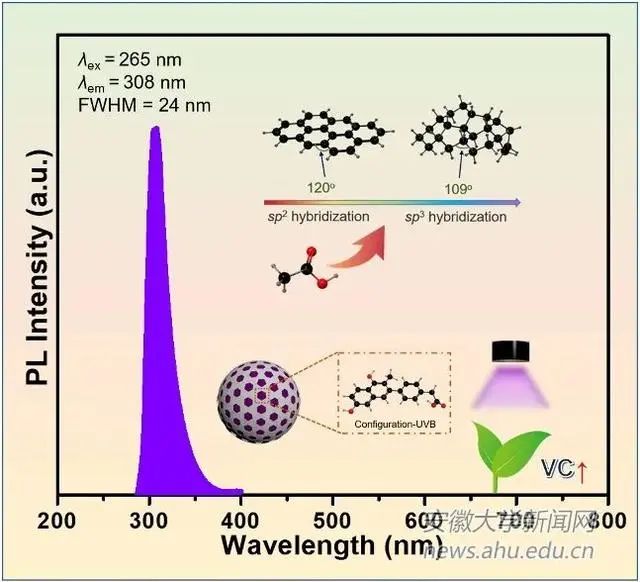
Figure 1. Emission spectrum, emission mechanism of deep-UV luminescent carbon dots, and schematic for horticultural lighting
This research work was supported by the National Natural Science Foundation of China and the International Science and Technology Cooperation Special Project of the Key R&D Program of Anhui Province. It also received support from the Key Laboratory of Hybrid Material Structure and Function Regulation, Ministry of Education; the Key Laboratory of Green Polymer Materials of Anhui Province; the Key Laboratory of Functional Inorganic Material Chemistry of Anhui Province; and the Supercomputing Center of Anhui University.
Article Link:
https://onlinelibrary.wiley.com/doi/10.1002/adma.202200011