
The Ministry of Housing and Urban-Rural Development released the '14th Five-Year Plan': By 2025, green buildings will be fully built, accelerating the popularization of LED lighting [[0]]
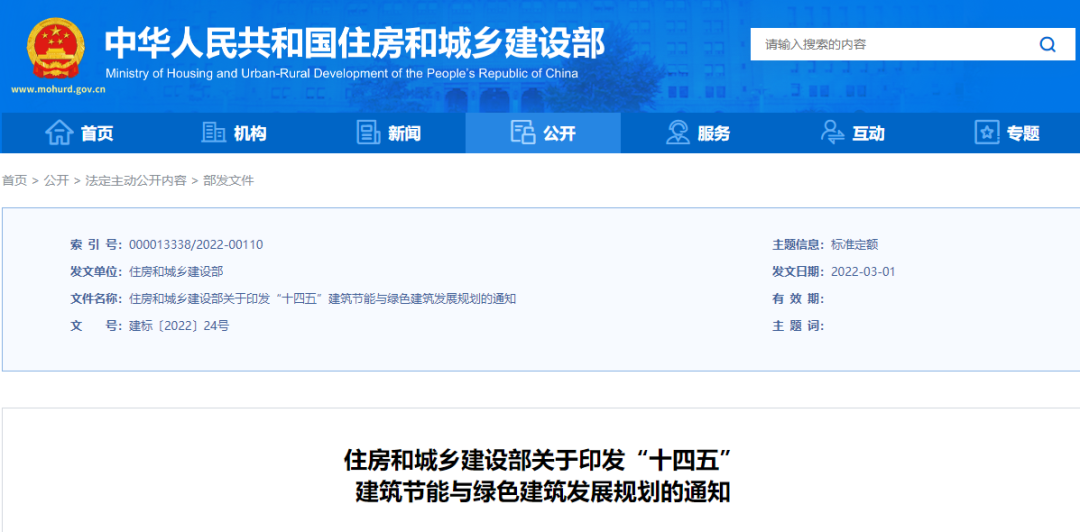
近日,住建部发布《“十四五”建筑节能与绿色建筑发展规划》(简称《节能规划》)。规划中对建筑节能绿色改造、发展数字化、智能化技术、低碳技术等目标,为照明行业带来新的机遇。
The "Energy Saving Plan" proposes that by 2025, all newly built urban buildings shall be fully completed as green buildings, building energy utilization efficiency will steadily improve, the building energy structure will be gradually optimized, the growth trend of building energy consumption and carbon emissions will be effectively controlled, a green, low-carbon, and circular construction development model will basically take shape, laying a solid foundation for achieving peak carbon emissions in the field of urban and rural construction before 2030.
The overall goal is to complete energy-saving retrofitting of existing buildings with an area of more than 350 million square meters by 2025, and to build ultra-low energy and near-zero energy buildings with an area of more than 50 million square meters.
The document requires that future efforts focus on improving the quality of green building development, raising the energy-saving level of new buildings, strengthening the green renovation of existing buildings, and promoting the application of renewable energy.
I. Key Projects for High-Quality Green Building Development: Taking urban civil buildings as the creation target, guide new construction, reconstruction and expansion projects, and existing buildings to be designed, constructed, operated, and renovated according to green building standards. By 2025, all newly built urban buildings will fully implement green building standards, a batch of high-quality green building projects will be completed, and people's sense of experience and gain will be significantly enhanced.
II. Promotion Project for Ultra-Low Energy Buildings. Comprehensively promote ultra-low energy buildings in the Beijing-Tianjin-Hebei region and surrounding areas, Yangtze River Delta, and other regions with conditions; encourage government-invested public welfare buildings, large public buildings, and new buildings in key functional zones to implement ultra-low energy building and near-zero energy building standards. By 2025, build demonstration projects for ultra-low energy and near-zero energy buildings covering more than 50 million square meters.
III. Key City Construction for Public Building Energy Efficiency Improvement. Carry out performance evaluation and experience summary for the first batch of key cities for public building energy efficiency improvement, launch the implementation of the second batch of key cities for public building energy efficiency improvement, establish an energy-saving low-carbon technology system, explore diversified financing support policies and financing models, and promote market mechanisms such as energy performance contracting (EPC / EMC) and electricity demand-side management. During the '14th Five-Year Plan' period, complete energy retrofitting of existing public buildings totaling more than 250 million square meters.
IV. Strengthen green retrofitting of existing buildings. Promote the application of optimization control strategies for building facilities and equipment to improve the efficiency of heating, air conditioning, and electrical systems. Accelerate the popularization of LED luminaires. Adopt technologies such as intelligent elevator group control to improve elevator energy efficiency. Establish a commissioning system for public building operations, promote regular commissioning of energy-using equipment in public buildings, and improve energy efficiency levels.
V. Improve the operation and management system for green buildings. Strengthen the operation and management of green buildings, improve the operating efficiency of green building facilities and equipment, and incorporate daily operation requirements of green buildings into property management content. Continuously optimize and improve the operational level of green buildings. Encourage the construction of intelligent operation and management platforms for green buildings. Fully utilize modern information technology to achieve real-time monitoring and statistical analysis of indicators such as building energy consumption, resource consumption, and indoor air quality.