
Notice on the 2021 National Supervision and Spot Check Results for Lighting Sources and Luminaire Product Quality
Recently, the State Administration for Market Regulation officially released the "Notice on the National Supervision and Spot Check Results of Lighting Sources and Luminaire Product Quality in 2021". The qualified rate for lighting sources and luminaires in this national spot check was 92%, a decrease of 4 percentage points compared to 2020. This spot check covered 430 batches of products produced by 424 enterprises, involving three types of lighting source and luminaire products: fixed general-purpose luminaires, self-ballasted LED lamps, and LED control devices.
Spot checks revealed that 34 batches of products were non-compliant, with a non-compliance rate of 7.9%. It should also be noted that small and medium-sized enterprises (SMEs) still dominate the list of non-compliant companies. Therefore, improving product quality among SMEs remains a key priority for the industry.
One of the main reasons for the rise in non-compliance rates is the intense price competition in the general lighting market, coupled with continuous raw material price increases over the past two years, which has increased cost pressure on enterprises. Some companies have substituted inferior components during procurement, ultimately leading to a decline in product quality. Additionally, due to intensified spot checks on fixed general luminaires and self-ballasted LED lamps in 2021, more problematic products were identified in this year's national sampling.
I. Pass rate of fixed general-purpose luminaires: 93.2%
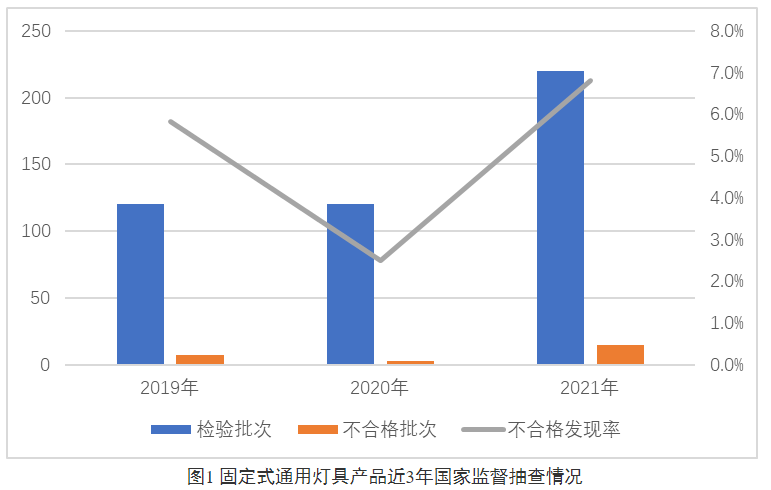
This spot check inspected 220 batches of fixed general-purpose luminaires produced by 220 enterprises across 12 provinces (municipalities), finding 15 batches non-compliant, with a non-compliance rate of 6.8%, an increase of 4.3 percentage points compared to the previous inspection. The non-compliance rates for this product over the past three years were 5.8%, 2.5%, and 6.8%, respectively. This inspection focused on 129 batches produced by 129 enterprises in Guangdong, a key industrial cluster region, accounting for 58.6% of the total batches inspected; 9 batches were found non-compliant, with a non-compliance rate of 7.0%.
This spot check focused on inspecting 8 items: structure, external and internal wiring, protection against electric shock, durability test, resistance to heat, fire and tracking, disturbance voltage (mains terminals), radiated electromagnetic disturbance, and harmonic current limits. Except for external and internal wiring and the durability test, non-conformities were found in all other items. According to analysis by technical institutions, the main causes of non-conformity are: first, insufficient understanding of the requirements of GB7000.1—2015 "Luminaires Part 1: General requirements and tests", leading to unreasonable product structural design; second, inadequate quality control of insulating component materials and control gear components during production.
2. The pass rate for self-ballasted LED lamps is 84.9%
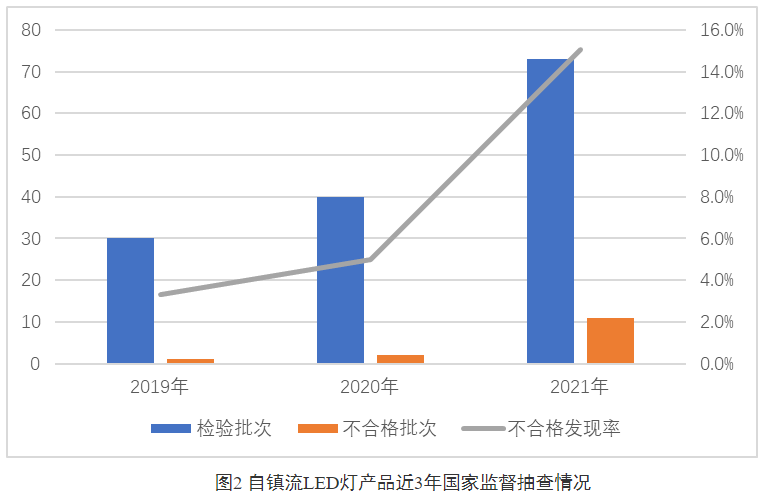
This spot check inspected 73 batches of self-ballasted LED lamp products produced by 73 enterprises in 7 provinces (municipalities), finding 11 batches non-compliant, with a non-compliance rate of 15.1%, an increase of 10.1 percentage points compared to the previous spot check. The non-compliance rates for this product over the past three years were 3.3%, 5.0%, and 15.1%, respectively. This inspection focused on manufacturers in two industrial clusters, Guangdong Province and Zhejiang Province, inspecting 49 batches and 12 batches respectively, with non-compliance rates of 16.3% and 25.0%.
This spot check focused on testing seven items: interchangeability, protection against accidental contact with live parts, insulation resistance and dielectric strength after humidity treatment, mechanical strength, heat resistance, fire and flame resistance, and harmonic current limits. The non-compliant items involved interchangeability, protection against accidental contact with live parts, insulation resistance and dielectric strength after humidity treatment, mechanical strength, and harmonic current limits. Among them, 7 batches of products were tested for harmonic current limits according to standard requirements, and 6 batches were found non-compliant. According to the analysis by technical institutions, the main reasons for non-compliance are: first, defects in product circuit design and insufficient electromagnetic compatibility protection measures; second, insufficient insulation between the accessible metal housing and live parts inside the lamp body; third, insecure fixation between the lamp cap and the lamp body, or the lamp cap dimensions do not meet standard requirements.
3. The qualification rate of LED control devices is 94.2%
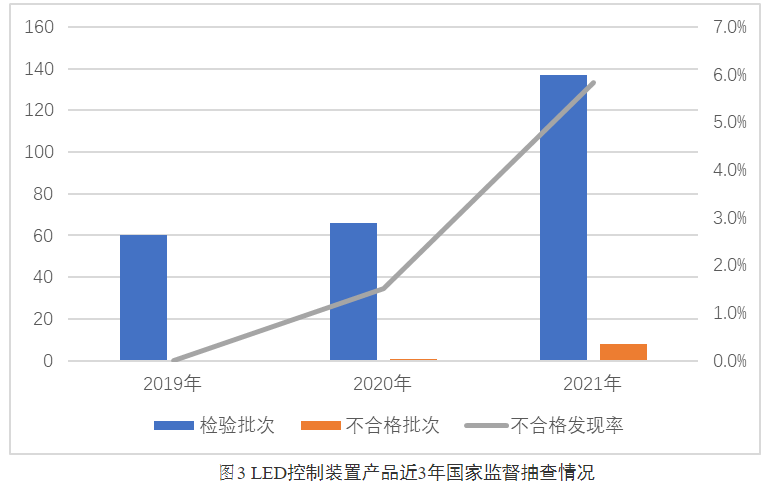
This spot check inspected 137 batches of LED control device products manufactured by 131 enterprises across 10 provinces (municipalities). Eight batches were found non-compliant, resulting in a non-compliance rate of 5.8%, an increase of 4.3 percentage points compared to the previous spot check. The non-compliance rates for this product over the past three years were 0%, 1.5%, and 5.8%, respectively. This inspection focused on 90 batches from 88 manufacturers in Guangdong, a key industrial cluster region, accounting for 65.7% of the total batches inspected. Six batches were found non-compliant, with a non-compliance rate of 6.7%.
This spot check focused on inspecting 10 items, including measures to prevent accidental contact with live parts, protective earthing arrangements, moisture resistance and insulation, dielectric strength, abnormal operation, and structure. The non-compliant items involved measures to prevent accidental contact with live parts, dielectric strength, abnormal operation, resistance to heat, fire and tracking, and special supplementary requirements for separate safety extra-low voltage DC or AC electronic control gear for LED modules. According to the analysis by technical institutions, the main reasons for non-compliance are: first, enterprises' inadequate understanding of product standard requirements and unreasonable circuit wiring design; second, lax quality control by enterprises, failing to strictly conduct factory inspections in accordance with standard requirements.
Relevant Requirements
In response to the issues identified during this national product quality supervision spot check, the market regulation bureaus (departments, commissions) of all provinces, autonomous regions, municipalities directly under the Central Government, and the Xinjiang Production and Construction Corps shall carry out the following work:
(1) Strengthen the handling of spot check results. In accordance with the "Product Quality Law of the People's Republic of China", the "Interim Measures for the Administration of Product Quality Supervision and Spot Checks" and other regulations, properly handle the results of supervision and spot checks. Seal up and detain non-compliant products in accordance with the law, order enterprises selling non-compliant products to stop selling the same products, comprehensively clean up and legally dispose of inventory of non-compliant products; order manufacturing enterprises producing non-compliant products to stop producing and selling the same products, clarify rectification requirements, urge the implementation of rectification measures, and organize re-examinations in a timely manner. For cases suspected of constituting crimes, transfer them to judicial authorities in a timely manner. In accordance with the law, include enterprises with serious illegal and dishonest behaviors in the list of seriously illegal and dishonest enterprises for management. The result handling situation must be entered into the e-CQS system in a timely manner and reported to the State Administration. The State Administration will strengthen tracking and supervision, and notify the result handling situations of various regions as appropriate.
(2) Carry out special quality governance. The market supervision departments of Guangdong and Zhejiang provinces shall carry out special rectification of the product quality of self-ballasted LED lamps, strengthen supervision and inspection of key enterprises within their jurisdictions, comprehensively use various measures to maintain a high-pressure stance on quality supervision, seriously deal with quality-related illegal acts, and strive to improve quality levels.
(3) Urge the implementation of main responsibilities. Notify local governments and relevant departments about the non-compliant products identified in this spot check, take effective measures to urge enterprises to fulfill their main responsibilities for product quality and safety in accordance with the law, guide enterprises to organize production strictly in accordance with standards, and safeguard product quality and safety.
(4) Strengthen quality and technical assistance. Organize relevant industry organizations and technical institutions to help enterprises thoroughly identify causes, propose improvement measures and solutions, and promote the improvement of industry quality levels.
Attachment: "List of Non-compliant Products and Enterprises from the 2021 National Supervision Spot Check on the Quality of Lighting Sources and Luminaires".
