
Research Progress! LED Lighting Network Can Significantly Reduce Bycatch and Improve Fishing Efficiency
In the win-win scenario of commercial fisheries and marine wildlife, researchers found that using light nets significantly reduces bycatch of sharks, rays, sea turtles, and unwanted finfish.
Researchers published their findings in Current Biology, discovering that lighted gillnets reduced total bycatch by 63%--including a 95% reduction in sharks, rays, and skates; an 81% reduction in Humboldt squid; a 48% reduction in unwanted finfish; while maintaining target catch rates and market value.
The authors of this study include Jesse Senko, Assistant Research Professor at Arizona State University; Hoyt Peckham, Director of Small-Scale Fisheries at the Wildlife Conservation Society; Daniel Aguilar-Ramirez, Fishery Biologist at Mexico's National Institute of Fisheries and Aquaculture (INAPESCA); and John Wang, Fisheries Ecologist at NOAA Fisheries.
Gillnets are one of the most widely used fishing gear in coastal areas of the world's oceans, but they often catch other animals that fishermen do not target. These animals include endangered, threatened, and protected species such as sharks, sea turtles, marine mammals, and seabirds, as well as other fish species and non-market juvenile target fish. These animals are often dead or injured and discarded at sea. Bycatch of non-target species in coastal gillnet fisheries--known as 'bycatch'--has led to a decline in endangered species worldwide and has also impacted coastal ecosystems.
Over the past decade, using LED lights to illuminate gillnets has become an effective tool for reducing incidental catch of endangered sea turtles in coastal gillnet fisheries. However, the impact of net illumination on other vulnerable species, total fishery bycatch, and fishing operational efficiency has never been studied.
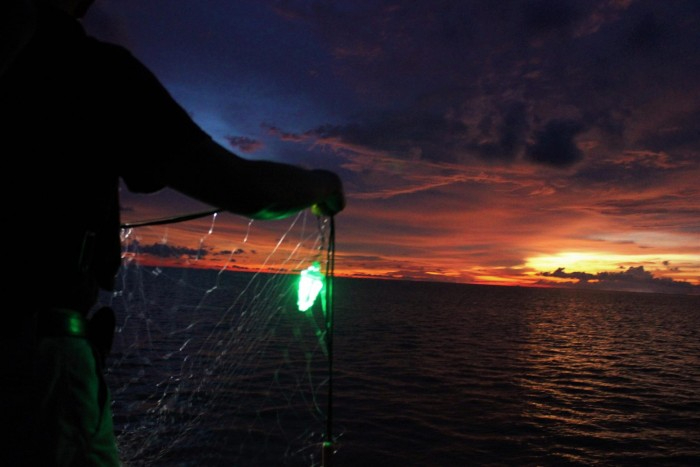
Researchers installed green LED lights every 10 meters on the fishing nets along the Pacific coast of Baja California Sur, Mexico. They were also surprised to find that, due to declines in bycatch and illegal fishing globally, the illuminated nets almost eliminated bycatch of sharks, rays, and skates—a group of ancient animals.
Furthermore, the lighting net reduces the time fishermen spend retrieving and untangling nets by 57%, making this technology attractive to fishermen seeking efficiency without worrying about bycatch. This is because fewer entangled animals need to be removed from the lighting nets, including very few sea turtles, sharks, rays, squid, and small fish; removing these from the nets is time-consuming, difficult, and even dangerous. In practice, this means fishermen can save over an hour per trip when using lighting nets, which also helps improve catch quality.
Jesse Senko, the first lead author of the study's paper from Arizona State University, stated: "These results indicate that the potential benefits of lighting nets extend far beyond sea turtles, while also suggesting that in similar coastal gillnet fisheries worldwide, lighting nets hold great promise for reducing discarded bycatch."
Hoyt Peckham, co-author of the study and Director of Small-Scale Fisheries at the Wildlife Conservation Society, stated: 'Gillnets are ubiquitous because they are inexpensive and catch everything that passes through them. This work is exciting because it provides a practical Solution that improves gillnet selectivity and avoids bycatch. Emerging technologies should help us incorporate this lighting into gillnet materials, thereby making adoption of this Solution effortless for fishermen.'
John Wang, a fisheries ecologist at the Pacific Islands Fisheries Science Center of NOAA Fisheries in Honolulu and co-author of the study, pointed out: 'Reducing the time required to untangle bycatch makes life easier for fishermen, which is just as important as reducing the biomass of bycatch in fishing nets. Crucially, it is vital that fishermen are made aware of the tangible benefits this brings. This is essential for the adoption of such technologies in the fishing industry.'
The World Wide Fund for Nature (WCS) is working in many coastal countries to reduce the bycatch of iconic megafauna, such as dolphins, sharks, and rays, in gillnet fisheries. However, to date, technical solutions capable of reducing bycatch have been very limited; additionally, allowing continued fishing for the target species often has significant impacts on livelihoods and food security. This work provides a possible means to protect the last strongholds of threatened megafauna worldwide and will be further explored as part of WCS's global marine conservation efforts.