
Multi-pole integration! Anhui Province's "Technical Standard for Comprehensive Setting of Urban Road Poles" officially implemented!
Recently, the Anhui Provincial Local Standard "Technical Standard for Comprehensive Setting of Urban Road Poles" (DB34/T 3956-2021), compiled by the Hefei Municipal Bureau of Urban and Rural Construction and approved by the Anhui Provincial Administration for Market Regulation, was officially implemented on December 8, 2021. In the near future, newly built or renovated roads in Anhui Province are expected to bid farewell to the phenomenon of "a forest of poles" on the streets.
In accordance with standards, when Anhui Province sets up integrated poles for newly built roads or existing roads undergoing major repairs, reconstruction, expansion, or special rectification, it shall follow the principle of "integration wherever possible." This involves comprehensively integrating various types of poles along the road, centrally deploying associated equipment cabinets, and providing appropriate reservations for the future installation of various facilities. The overall layout of integrated poles should prioritize traffic safety and needs. Integrated poles should preferably be installed within green belts, ensuring they do not obstruct the mounted facilities. Integrated poles should avoid light interference between street lights and traffic facilities, which could affect the functionality of intelligent traffic systems. Additionally, pole design should reserve some interfaces for future facility access, achieving "one-time construction, long-term benefits."
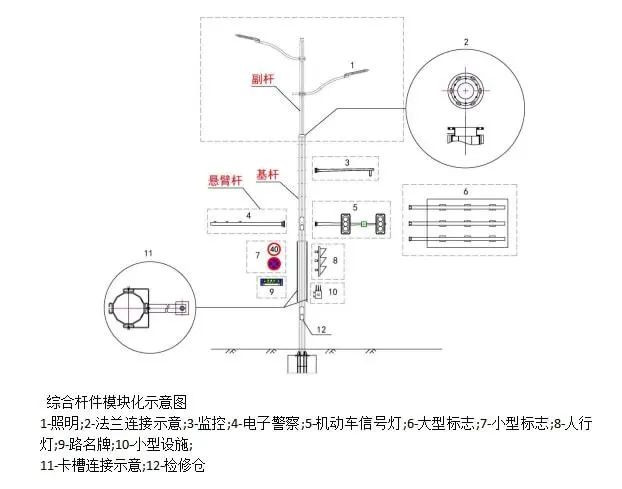
Modular Integrated Pole Example
Flange connections are used between the main pole and secondary pole, as well as between the main pole and cantilever arm. The bodies of the main pole, secondary pole, and cantilever arm all have pre-drilled holes to provide cable routing for mounted facilities as needed.
Integrated Pole Style
The typical styles of integrated poles can be divided into five categories:
1. Street light integrated pole: Reserved functions, capable of mounting other small facilities and equipment.
2. Class A integrated traffic pole: Primarily equipped with traffic signal lights, can be equipped with street lights; the main pole and cantilever arm have reserved interfaces, and other facilities can be mounted as needed.
3. Class B integrated traffic pole: Primarily equipped with traffic monitoring, can be equipped with street lights; the base pole and cantilever pole have reserved interfaces, and other facilities can be installed as needed.
Class C integrated traffic pole: Primarily mounts medium and large traffic signs, can accommodate street lights; the main pole and cantilever arm have reserved interfaces, allowing other facilities to be mounted as needed.
Class D integrated traffic pole: Primarily mounts small traffic signs, can mount street lights, and other facilities can be mounted as needed.
The main pole can be divided into multiple compartments as needed. In principle, power supply cables for various facilities should be laid in separate compartments, while low-voltage circuits can be bundled and laid in the same compartment. Interfaces and conduit holes should be compatible with the compartmentalized cabling, and the cable channels should not obstruct the interfaces and conduit holes. The top flange of the auxiliary pole may also be designed without cable exit holes to form a waterproof sealed end.
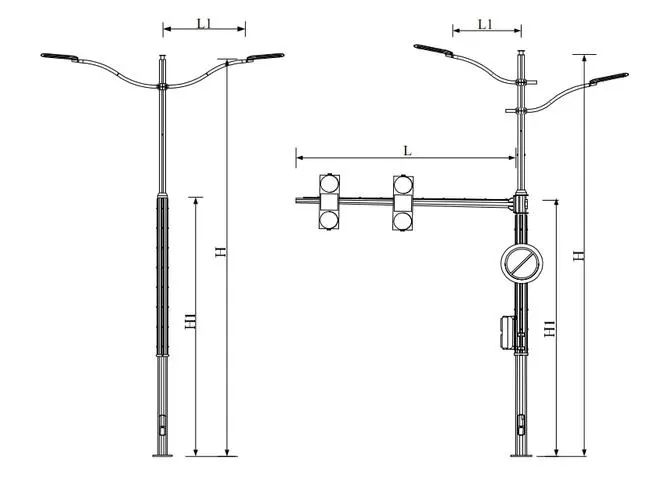
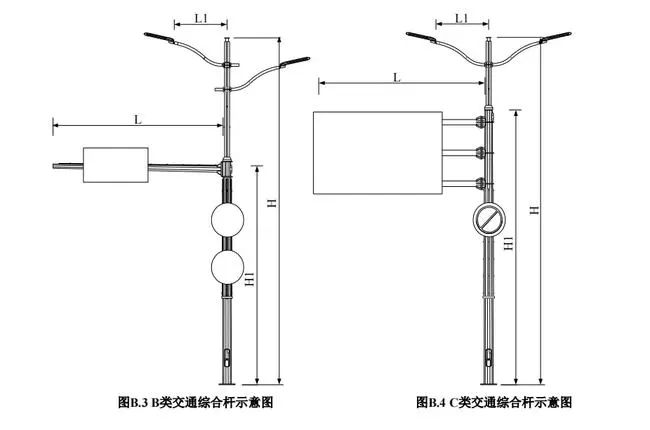
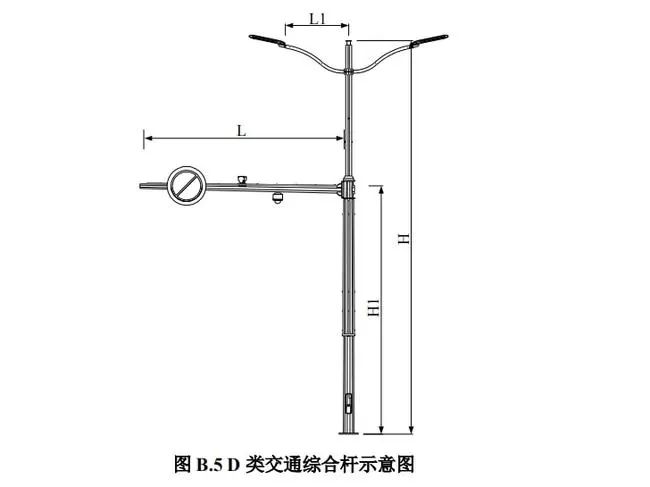
Overall Design
The overall design should be integrated throughout the entire road design process, completing the main tasks at each stage. During the feasibility study phase, thorough investigation, research, evaluation, and forecasting should be conducted to comprehensively study and demonstrate the necessity, economic rationality, technical feasibility, and implementability of the integrated pole configuration; determine the main technical standards and construction scale; compare different construction schemes and propose a recommended construction scheme. During the preliminary design phase, design principles and technical standards should be clarified, the design scheme should be refined based on collected relevant data, and issues, precautions, and related recommendations in the design should be identified. The depth of design should be sufficient to control project investment and meet the requirements for preparing construction drawing design, ordering major equipment, tendering, and construction preparation. During the construction drawing design phase, the design should meet the requirements for construction drawing budgeting, construction tendering, construction installation and fabrication, and ordering of materials and equipment, and serve as the basis for project acceptance.
The overall design emphasizes the systematic and comprehensive integration of pole installations. Designers shall coordinate with disciplines including roads, bridges, tunnels, pipelines, traffic, lighting, landscaping, landscape architecture, and ancillary structures in accordance with the requirements of design proposals at each stage, to reasonably determine the project scope, technical standards, construction scale, main technical indicators, longitudinal and lateral layout points, and the overall design scheme.
To achieve the overall goals of safety, environmental protection, and sustainable development, three aspects should be included: first, traffic functions should ensure comfort, safety, and high efficiency; second, in terms of environmental protection, the construction of poles and cabinets should minimize negative impacts on air, acoustic, and light environments, as well as on the lives of residents along the route; third, in terms of resource conservation, the construction of poles and cabinets should be fully integrated to reduce material and energy waste and minimize encroachment on road surfaces.
The overall layout of integrated poles should prioritize traffic safety and requirements. Generally, intersections have higher traffic safety requirements, resulting in more poles being installed with specific placement requirements. The placement of integrated poles should first meet the traffic safety requirements within the intersection area, and then adjust the spacing of integrated poles upstream and downstream along the road section from point to line.
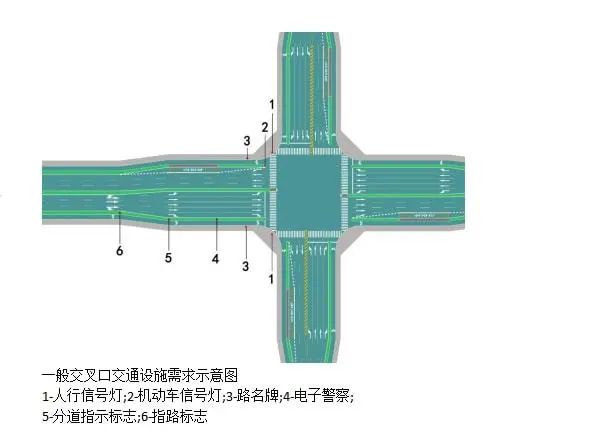
Intersections are generally equipped with traffic facilities on the approach lanes, such as electronic police systems, lane guidance signs, directional signs, and street name signs; the exit lanes mainly feature traffic signals and street name signs; pedestrian signals are installed along the curb radius. The comprehensive layout of an intersection should first meet traffic design requirements, then integrate other facilities.
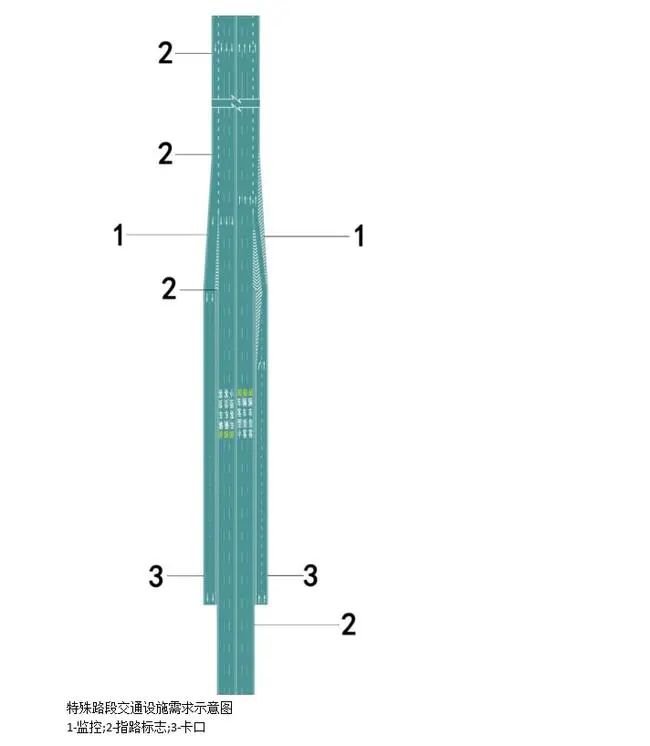
Special road sections such as merging and diverging areas, weaving zones, and the start/end points of ramps require appropriate traffic facilities based on their specific locations. Street lights and other poles should be designed in coordination with traffic design requirements, using combined pole designs.
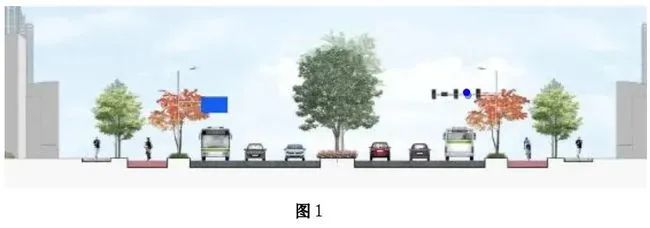
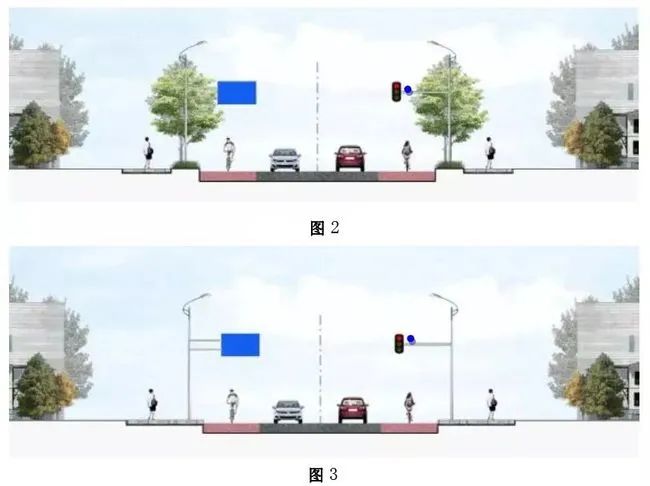
Integrated poles should preferably be installed within green belts, as shown in Figures 1 and 2. Landscape design must ensure that mounted facilities are not obstructed. Where no green belt is available, install as shown in Figure 3.
Integrated poles should adopt an assembly-based, modular design. The main pole, secondary pole, and cantilever arm serve as the primary structural components, while slots and facilities act as modular mounting elements that can be freely combined to meet usage requirements in various scenarios. Additionally, the pole design should reserve interfaces for future facility integration, achieving "one-time construction, long-term benefits."
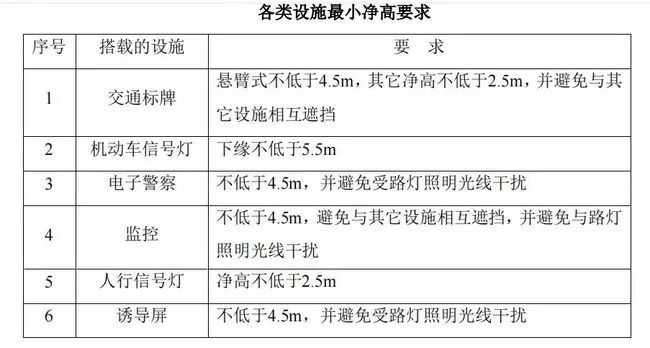
The mounted facilities and cantilever arms of the pole must not encroach on the road building clearance, meeting the requirements for vertical clearance and lateral clear width. For industrial zones or road sections with heavy large-vehicle traffic, the vertical clearance requirement should be appropriately increased. The integrated pole should avoid light interference between street lights and traffic facilities, which could affect the functionality of intelligent traffic systems.
Implementing the "integration of multiple poles and consolidation of multiple cabinets" not only significantly reduces the number of poles and cabinets on both sides of roads, saving urban land resources, purifying and beautifying the urban environment, and enhancing the city's image, but also provides an infrastructure carrier for next-generation information and communication technologies, improving the precision and intelligence level of urban management.
The introduction of this standard provides important guidance for regulating the integrated installation of urban road poles in Anhui Province, promoting high-quality and smart municipal infrastructure development, and creating harmonious and orderly road spaces.