
Chinese Plant Factories vs. Foreign Plant Factories
Construction Begins on China's Carbon Neutrality Demonstration "Plant Factory"
On November 6, the Shuimu Mengdian Carbon Neutrality Demonstration Factory project broke ground in Huixian City, Xinxiang, Henan Province. This project is the first demonstration project in China to integrate industry and agriculture to advance the dual carbon strategy, rural revitalization, and high-efficiency agriculture.
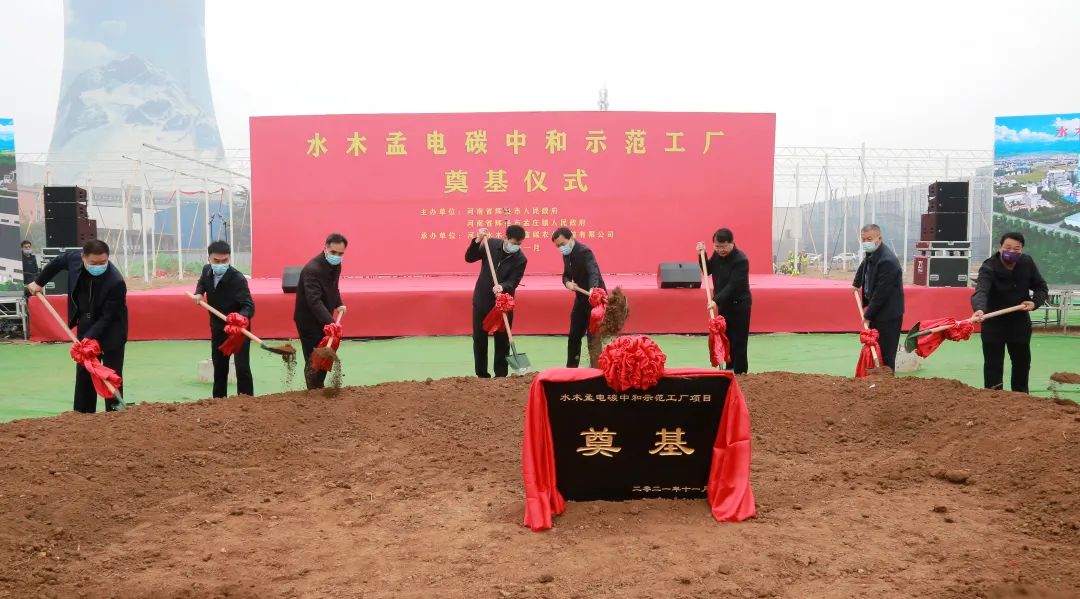
It is understood that Phase I of the project involves an investment of 210 million yuan, covering an area of 55 mu. It includes four components: a carbon-enriched technology innovation center of over 4,000 square meters, a carbon-enriched vegetable factory, an energy island, and a microalgae factory. Phase II will expand to 500 mu, with the total projected investment for the project reaching 550 million yuan.
Fan Haitao, Party Secretary and Chairman of Henan Mengdian Group, introduced that the project will utilize resources such as carbon dioxide, waste heat, and off-peak electricity generated by Mengdian Group. Through intelligent computers and electronic sensor systems, environmental conditions for plant growth—including temperature, humidity, lighting, and nutrient solutions—are automatically controlled. This eliminates plants' dependence on sunlight and soil, as well as constraints imposed by climatic conditions, thereby enabling vegetable production.
This project is the only industrial-agricultural integration project in the country located within a power plant. It combines heat and carbon dioxide generated by the power plant with agriculture, creating a model of sustainable, factory-style agriculture and exploring a "carbon neutrality" path that integrates thermal power generation with agricultural production. (Source: Huixian Release)
China Unmanned Plant Factory Rice Breeding Accelerator
Recently, at the National "13th Five-Year Plan" Scientific and Technological Innovation Achievements Exhibition, co-hosted by the Ministry of Science and Technology, the National Development and Reform Commission, the Ministry of Finance, and other units, the "Unmanned Plant Factory Rice Breeding Accelerator" developed by the Innovative Team of the Institute of Urban Agriculture, Chinese Academy of Agricultural Sciences, was showcased as a "landmark scientific and technological achievement demonstrating technological support for high-quality national development," receiving high attention from Party and state leaders as well as all sectors of society.
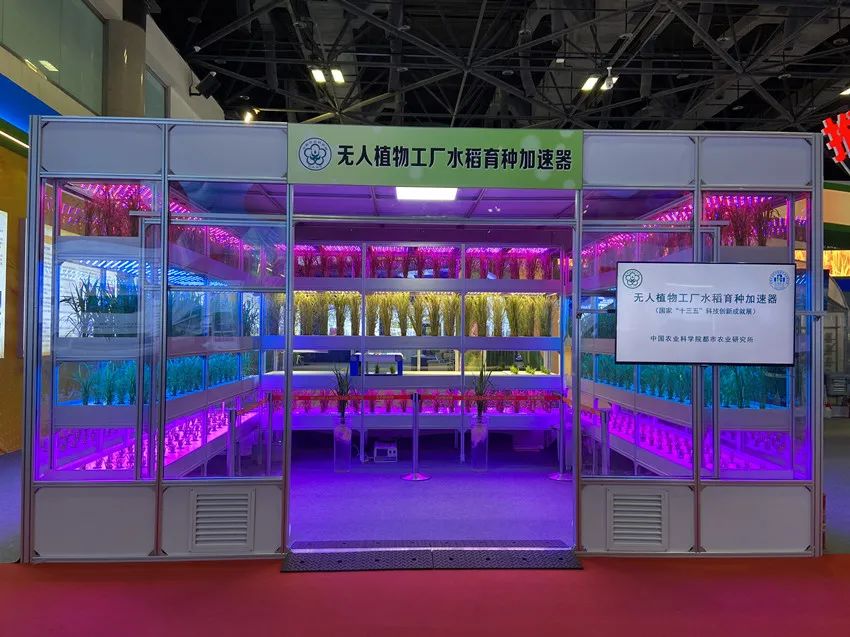
As visitors enter the agriculture and rural development exhibition area, they can see a colorful transparent glass house from afar. Inside, rice plants of varying heights are grown, appearing particularly vibrant under lights of different colors. This glass house showcases the "Unmanned Plant Factory Rice Breeding Accelerator".
The achievements of the "Unmanned Plant Factory Rice Breeding Accelerator" were supported by key national R&D programs and the Chinese Academy of Agricultural Sciences Innovation Engineering project. Through close collaboration between this team and Academician Qian Qian's team at the China National Rice Research Institute, the technical advantages of controllable environments in plant factories were leveraged to study the mechanisms of environment-nutrition coupled regulation on the rice growth cycle. This research identified regulatory methods to stimulate photosynthetic potential, promote biomass accumulation, induce early flowering, and facilitate rapid growth and fruiting, achieving a significant breakthrough by halving the rice growth cycle to approximately 60 days for harvest.
This achievement is a bold attempt to address breeding challenges and food security through industrialized methods, providing a novel technical pathway for shortening crop breeding cycles and enabling efficient factory-based production. Yang Qichang, a researcher at the Institute of Urban Agriculture, Chinese Academy of Agricultural Sciences, stated that unlike traditional field production, this technology operates in a fully controlled artificial environment, allowing complete control over lighting, temperature, humidity, and certain nutrients.
He stated that by precisely matching light, nutrients, temperature, and other factors, this "accelerator" shortened the rice growth cycle from 120 days to 60 days, while increasing yield and ensuring quality, providing valuable technical reserves for future grain production in plant factories. "We use multi-wavelength LED light sources to provide different spectrum formulas at different stages of rice growth, enabling them to grow faster and better."
He stated that this technology is currently at the international forefront and represents a key direction for global breakthroughs. It can provide an important tool for future breeding scientists, with rice breeding expected to increase from 2 generations per year to 6 generations.