
Recent clinical trials indicate that LED lighting with a sun-like spectrum helps improve learning efficiency and memory.
Seoul Semiconductor Co., Ltd. (KOSDAQ 046890) announced that, following Seoul National University in South Korea and the University of Basel in Europe, another research team has discovered that exposure to light with a sun-like spectrum can improve key learning abilities, such as working memory, cognitive processing speed, and test accuracy.
This clinical trial began in 2019 and was conducted by the Division of Sleep and Circadian Disorders at Brigham and Women's Hospital, a teaching affiliate of Harvard Medical School. The participants were university-level adults, and the results clearly demonstrated the effectiveness of procedural learning.
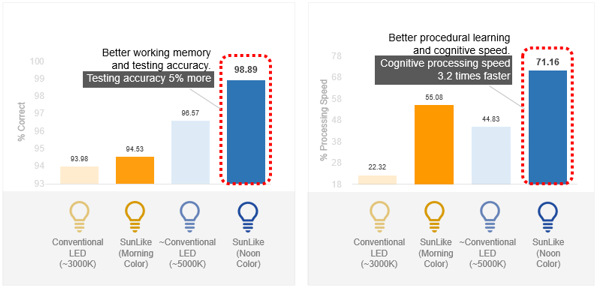
Compare cognitive performance under traditional LED lighting versus SunLike LED lighting
Dr. Shadab Rahman, Assistant Professor of Medicine at Harvard Medical School and MPH, a researcher in the Sleep and Circadian Rhythm Disorders Division at Brigham and Women’s Hospital, led this study together with Dr. Leilah Grant, Dr. Melissa St. Hilaire, Dr. Steven Lockley, and other researchers at Brigham and Women’s Hospital.
Dr. Rahman said: "Even when the Color temperature and Luminance are the same, light with different Spectrum may affect non-visual responses to lighting in different ways, including Circadian rhythm and cognition." "In this experiment, we found that under lighting with a daylight-like Spectrum, young people's working memory, cognitive processing speed, procedural learning, and test accuracy were all improved compared to traditional LED Spectrum lighting. This is an important result that can inform Indoor lighting choices to enhance students' learning and memory functions."
The daylight-like spectrum lamps used in the study are SunLike products manufactured and provided by Seoul Semiconductor. SunLike is an optical semiconductor technology capable of reproducing the natural light spectrum curve across wavelengths such as red, orange, yellow, green, cyan, blue, and violet. This new concept of LED light source embodies characteristics nearly identical to natural light and accordingly optimizes the human 24-hour circadian rhythm.
Nowadays, research on the relationship between light and human biological functions is increasing. A recent study by Professor Christian Cajochen and his team on the impact of spectrum on sleep quality, visual comfort, health, and daytime alertness found that daylight LED benefits visual comfort, melatonin, mood, waking performance, and sleep. The study was published in the Journal of Lighting and Research Technology on March 24, 2019. Additionally, an experiment conducted at Seoul National University College of Medicine in July 2018 showed that using SunLike LED lights can improve vitality and alertness.
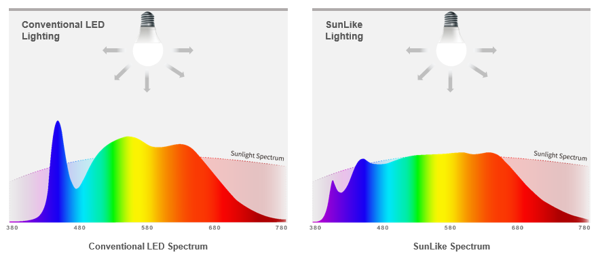
Spectrum comparison under identical shape and color lighting conditions
Seoul Semiconductor CEO Lee Jung-hoon said, "Nature is magnificent. The human body has a 24-hour biological clock that has evolved to set time by tracking the daily cycle of sunlight. SunLike is a technology that replicates all visible light wavelengths, coming as close as possible to natural sunlight. For 30 years, we have been dedicated to R&D to provide light closest to sunlight for plants, animals, and humans. This helps maintain circadian rhythm and sleep, enables children and students to learn effectively, and supports good health."
Seoul Semiconductor and Toshiba Materials jointly participated in the development and IPO of SunLike in 2017. Over the past two years, the two companies held continuous negotiations to improve decision-making speed and operational efficiency for the SunLike business. Seoul Semiconductor acquired all technologies, patents, trademarks, etc., related to SunLike, the light closest to the sun. Core staff from Toshiba Materials also joined Seoul Semiconductor and began expanding sales starting in September.