
New Opportunities! A Must-Read for Lighting Export Companies
New opportunities for lighting exports,
RCEP officially takes effect on January 1 next year
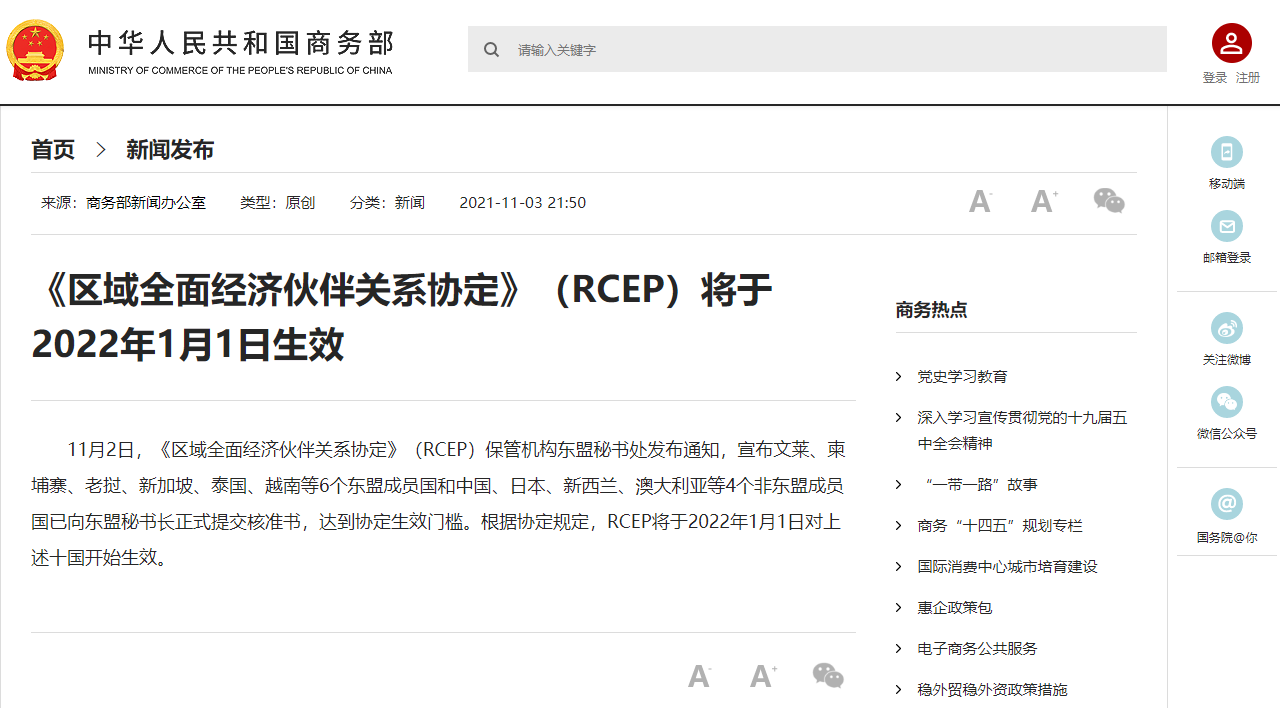
Image source: Ministry of Commerce
On November 2, the ASEAN Secretariat, the depository of the Regional Comprehensive Economic Partnership (RCEP), issued a notice announcing that six ASEAN member states—Brunei, Cambodia, Laos, Singapore, Thailand, and Vietnam—and four non-ASEAN member states—China, Japan, New Zealand, and Australia—have formally submitted their instruments of ratification to the ASEAN Secretary-General, reaching the threshold for the agreement to enter into force. According to the provisions of the agreement, RCEP will take effect for these ten countries on January 1, 2022.
The core content of the RCEP agreement is to reduce import and export tariffs on products and parts among contracting states, eliminate tariff and non-tariff barriers between member countries, and promote higher-level trade liberalization and investment facilitation among member countries. For lighting companies, the implementation of RCEP helps reduce the prices of some Export products, improve product quality, and thus gain better competitiveness in the markets of contracting states.
The signing of RCEP will bring new opportunities to the development of China's lighting industry.
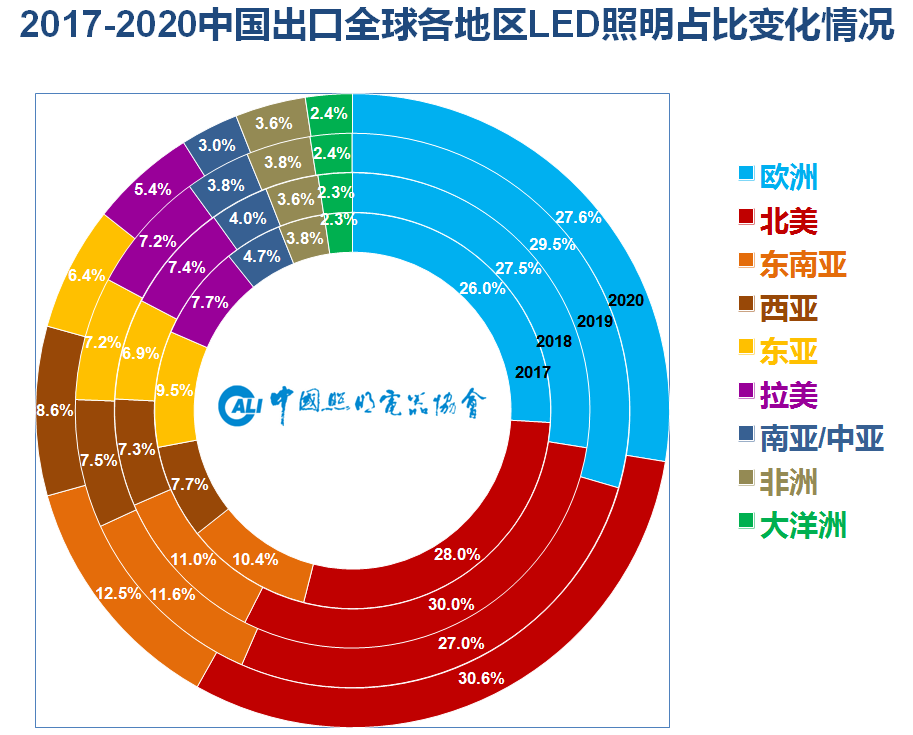
From a global regional perspective on LED lighting exports in 2020, the Asia-Pacific market, dominated by emerging economies, performed significantly better than the European and American markets, dominated by developed economies. Within the Asia-Pacific market, regions including East Asia, Southeast Asia, and Oceania—home to RCEP signatory countries—all showed strong performance. In 2020, the export value of LED lighting products from major RCEP signatory regions was approximately USD 7.5 billion, accounting for 21.3% of total exports.
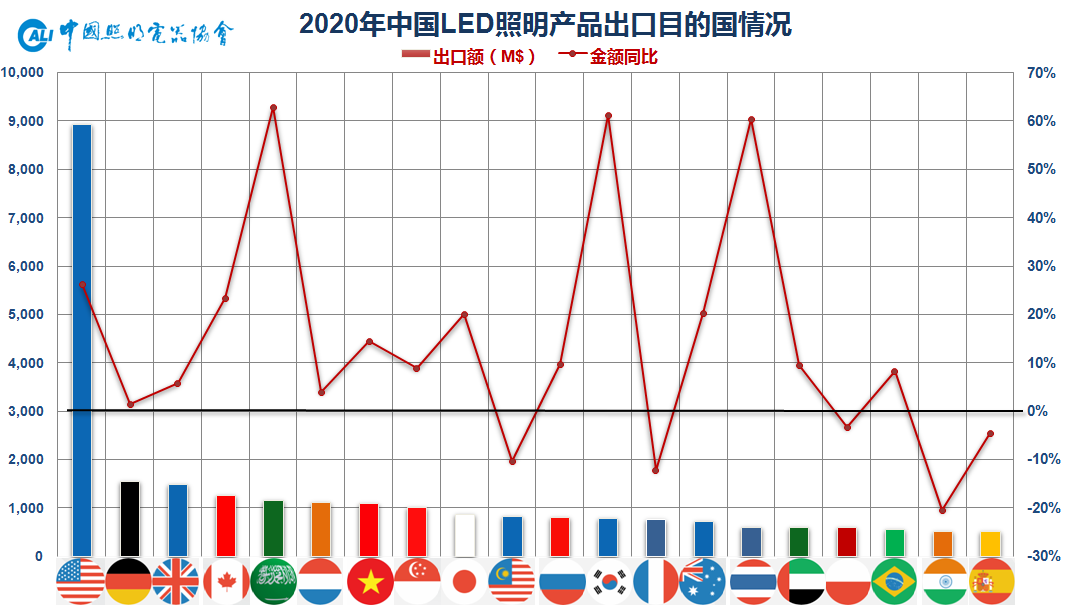
In 2020, among the destination countries for China's LED lighting product exports, RCEP signatory countries South Korea and Thailand achieved ultra-high growth of over 60%, Australia grew by more than 20%, and Vietnam grew by more than 10%.
The signing of RCEP can promote the deep integration of production and supply chains in the regional lighting industry, facilitate Chinese lighting enterprises' participation in international division of labor, leverage the export advantages of Chinese lighting products in contracting states, drive China's lighting industry toward the mid-to-high end, build a high-quality development system for the lighting industry, and form a new development pattern within the lighting industry where domestic and international dual circulation mutually reinforce each other.
The China Lighting Industry Association hopes that lighting enterprises will adapt to institutional opening-up dominated by rules, regulations, management, and standards, enhance the sense of urgency for transformation and upgrading, improve management levels, and actively participate in international cooperation among RCEP member states.
About the Regional Comprehensive Economic Partnership (RCEP)
RCEP由东盟于2012年发起,历时8年谈判,2020年11月15日,RCEP签署。签署该协定的成员国包括东盟10国和中国、日本、韩国、澳大利亚、新西兰,总人口达22.7亿,GDP达26万亿美元,出口总额达5.2万亿美元,均占全球总量约30%。
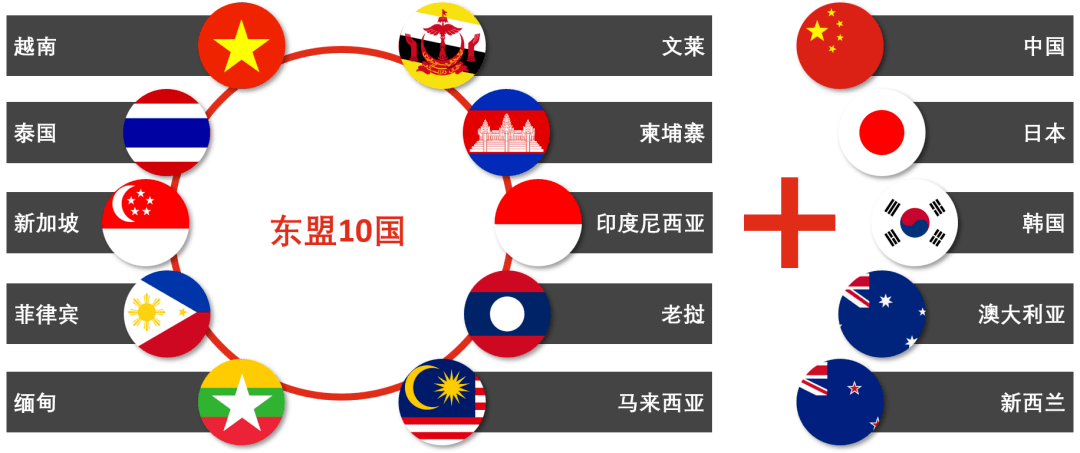
Wang Shouwen, Vice Minister of Commerce and Deputy Chief International Trade Negotiator, stated that the signing of the agreement means that an integrated large market representing about one-third of the global economy has been formed. Overall, RCEP is not only the world's largest free trade agreement to date, but also a comprehensive, modern, high-quality, and mutually beneficial one. Wang Shouwen recently clarified that China is fully prepared to comprehensively fulfill the obligations stipulated by RCEP upon its entry into force.
UK Lighting Product Energy Efficiency Regulations
No. 1095 of 2021 officially implemented
Recently, the UK Energy Efficiency Regulations 2021 No. 1095 were officially released. The regulations include two parts: the ErP Regulations and the Energy Labelling Regulations. The UK energy labelling scheme came into effect on October 1, 2021.
For light sources placed on the UK market from 1 October 2021, suppliers must print the new label on product packaging.
For light sources already on the UK market, at the request of the Dealer / Distributor, suppliers must provide new energy labels to replace the old ones, which can be applied as stickers over the old labels.
For light sources placed on the UK market before 1 October 2021 with old energy efficiency labels, dealers must replace the old labels with new ones by 1 April 2023 to cover the old labels, which can be affixed to the packaging in printed or adhesive form.
The ErP Regulation (EU 2019/2020) and the Energy Labelling Regulation (EU 2019/2015), along with the timeline milestones and differences in each stage of Regulation 2021 No. 1095, are as follows:
ErP Regulation EU 2019/2020 2021 No.1095
Target Markets: EU, NI; UKCA
(Northern Ireland) (UK, Wales, Scotland)
Implementation Date: September 1, 2021; October 1, 2021
Energy efficiency labeling regulations EU 2019/2015 2021 No.1095
Target Markets: EU, NI; UKCA
(Northern Ireland) (UK, Wales, Scotland)
Implementation Date: September 1, 2021 October 1, 2021
Label Replacement Deadline: March 1, 2023 – April 1, 2023
Product Data Upload Date: May 1, 2021 - October 1, 2021
Label Style
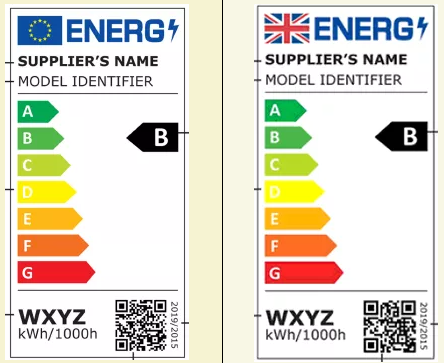
ErP, Energy Efficiency Labeling Regulations Technical Documentation
1. Supplier name and address;
2. Model name;
3. Model names of all equivalent models;
4. Identity and signature of the authorized person;
5. Calculation process, including the calculation to determine the energy efficiency class;
6. Referenced harmonized standards or other standards used;
7. Test conditions not fully described in the previous item;
8. Reference control settings and instructions on how to implement the control;
9. Explain how to remove lighting control components and/or non-lighting components, or
How to turn off the light source or minimize power consumption during light source testing;
10. Special warnings regarding product portfolio, installation, maintenance, or testing;
11. Declared values of the following technical parameters:
1) Useful luminous flux (Φuse), unit: lm;
2) Color rendering index (CRI);
3) Operating power (Pon), in W;
4) Beam angle of directional light sources (DLS);
5) Correlated color temperature (CCT) of fluorescent lamps and HID light sources, in K;
6) Standby power (Psb), in W, including when the value is zero;
7) Network standby power (Pnet) of the connected light source (CLS), in W;
8) Displacement factor (cos φ1) of mains-powered LED and OLED light sources;
9) Color consistency of LED and OLED light sources, measured in MacAdam ellipse steps;
10) Luminance of HLLS, in cd/mm²;
11) Flicker (Pst LM) of LED and OLED light sources;
12) Stroboscopic effect of LED and OLED light sources;
13) Color purity of CTLS, within the following specified range:
Blue, dominant wavelength range: 440nm-480nm;
Green, dominant wavelength range: 520nm-570nm;
Red, dominant wavelength range: 610nm-670nm.
2021 No.1095 Technical Document
Based on EU 2019/2015, the following items have been added:
1. Peak luminous intensity value of directional light sources (DLS);
2. R9 color rendering index of LED and OLED light sources;
3. Survival rate of LED and OLED light sources;
4. Lumen maintenance factor of LED and OLED light sources;
5. L70B50 lifetime of LED and OLED;
Note: The above changes are equivalent to the amendments added in EU 2021/340.