
Yangguang Lighting appoints Qi Xiaoming as Executive Deputy General Manager | Half-year performance reports from Leyard, Debang, Huati, Shikong Technology, and others are released
01
Yangguang Lighting appoints Qi Xiaoming as Executive Deputy General Manager
Yangguang Lighting announced in the evening of August 19 that, upon nomination by General Manager Mr. Guan Yong and approval by the Board Nomination Committee, the Board of Directors has agreed to appoint Mr. QI XIAOMING as Executive Deputy General Manager of the company. His term shall commence from the date of approval at this Board meeting and expire upon the conclusion of the ninth Board of Directors.
In addition, Yangguang Lighting announced that, in accordance with the operational provisions of the Investment Agreement, the Company has recently transferred 100% of the equity of its wholly-owned subsidiary, Zhejiang Yangguang Urban Lighting Engineering Co., Ltd. (hereinafter referred to as "Chengzhao Company"), to Zhiyi IoT. The transfer price was determined based on the net asset amount stated in the audited report of Chengzhao Company as of June 30, 2021, after deducting undistributed profits, and the Equity Transfer Agreement was formally signed with Zhiyi IoT.
Audited by Zhonghui Certified Public Accountants (Special General Partnership), the net assets of Chengzhao Company as of June 30, 2021 amounted to RMB 87,658,796.51. After deducting undistributed profits of RMB 9,324,929.30, the amount was RMB 78,333,867.21. Zhiyi IoT finally determined the transaction price to purchase this equity at RMB 78,333,867.21.
According to the introduction, Chengzhao Company's main business scope includes the development, manufacturing, sales, and installation of lighting appliances and accessories (excluding lamp tubes), emergency lighting luminaires, LED lighting products and other luminaires, electrical equipment, air switches, distribution boxes, ventilation fans, bathroom heaters, small home appliances, kitchen and bathroom equipment, and instruments; design and installation of lighting system engineering; production and sales of steel pipe poles; energy performance contracting (EPC / EMC) and information consulting; undertaking, design, construction, and comprehensive technical services for energy-saving and environmental protection projects; development, sales, and services for solar photovoltaic lighting systems, as well as design and installation of lighting systems; construction labor services.
Yangguang Lighting stated that this equity transfer agreement will not result in a change of control of Chengzhao Company, nor does it involve any circumstances that would harm the interests of the company and other shareholders.
Many in the lighting industry will recall that in June this year, Yangming Lighting announced that, to restructure, innovate, and enhance its presence in the Chinese market, the company signed an Investment Agreement on June 24, 2021 with QI XIAOMING, a former shareholder of Zhejiang Zhiyi IoT Technology Co., Ltd. (“Zhiyi IoT”), regarding capital increase cooperation for Zhiyi IoT. The company subscribed to a capital contribution of RMB 85 million, holding an 85% equity stake in Zhiyi IoT; QI XIAOMING subscribed to a capital contribution of RMB 15 million, holding a 15% equity stake in Zhiyi IoT. It was also decided to use Zhiyi IoT as the platform company to operate Yangming Lighting’s domestic market business.
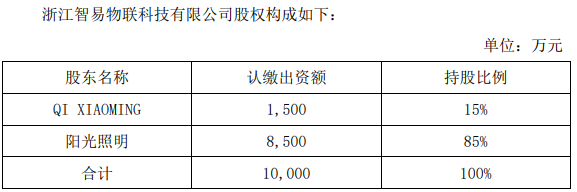
Yangguang Lighting stated that the company has introduced the Zhiyi IoT management team, primarily to restructure its business organizational management framework, rapidly increase its domestic market share, and strengthen and expand its presence in the domestic market. The company will increase investment and joint venture efforts to expand the domestic sales market, promote innovation-driven products, and enhance design capabilities and comprehensive service capabilities, which will facilitate complementary advantages and mutual benefits.
02
Shikong Technology
Shikong Technology: Executive Personnel Changes
On August 20, Shikong Technology announced that there have been personnel changes among the company's senior management. The specific details are as follows:
The Board of Directors recently received a written resignation letter from Mr. Xiangfeng Xing, the Company's Deputy General Manager and Secretary to the Board. Due to personal reasons, Mr. Xiangfeng Xing has requested to resign from his positions as Secretary to the Board and Deputy General Manager. After his resignation, he will continue to hold other positions within the Company.
In addition, upon nomination by the Chairman of the Company and review by the Nomination Committee of the Board of Directors, the Board of Directors has agreed to appoint Mr. Wang Xincai as the Secretary of the Board of Directors of the Company, with his term of office commencing from the date of approval by the Board of Directors and ending upon the expiration of the term of the second Board of Directors.
Meanwhile, the Board of Directors agreed to appoint Ms. Wang Xue as the Company's securities affairs representative to assist the Board Secretary in fulfilling duties and carrying out work, with the term of office starting from the date of approval by the Board of Directors until the expiration of the second Board of Directors.
According to the records, Wang Xincai, male, born in 1977, is a Chinese national with no permanent right of residence abroad. He holds a bachelor's degree and professional titles of Certified Public Accountant, Certified Valuer, and Senior Accountant. He has obtained the qualification certificate for serving as Secretary of the Board of Directors of the Shanghai Stock Exchange. He previously served as Deputy General Manager of the Finance Department of MCC Jingcheng Engineering Technology Co., Ltd. Since June 2017, he has served as the Company's Chief Financial Officer, and currently holds the positions of Chief Financial Officer and Secretary of the Board of Directors.
Shikong Technology: Plans to Establish a Controlled Subsidiary for Overseas Investment to Expand Smart Parking Business
On the evening of August 19, Shikong Technology announced that it plans to jointly establish Beijing New Shikong Transportation Technology Co., Ltd. (tentative name, hereinafter referred to as "Shikong Transportation") with related parties Shikong Chuang No. 1 and Shikong Chuang No. 2 to carry out city-level smart parking business. The proposed registered capital of Shikong Transportation is RMB 50 million, of which Shikong Technology will subscribe RMB 30 million in cash, holding a 60% stake.
It is understood that Shikong Chuang No. 1 and Shikong Chuang No. 2 are shareholding platforms established for core personnel of Shikong Transportation's smart parking business. In the future, core management and technical personnel will continue to be introduced according to business development needs. This external investment is not only a practical implementation of the company's "Business Partner" model, but also an important attempt to seize the development opportunities of smart cities and deepen its industrial layout.
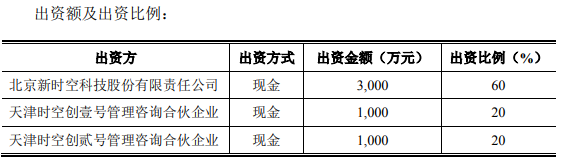
The announcement shows that the business scope of Shikong Transportation covers city-level smart parking-related businesses, including planning and design, feasibility study reports, traffic review and optimization, parking planning and design, solution evaluation and calculation, etc.; financial investment includes investing in smart parking projects through models such as operating right leasing, operating right acquisition, property rights acquisition, and BOT model; software and hardware platform construction includes the construction of smart parking system platforms and smart parking infrastructure; operation management includes on-street parking operation services, off-street parking operation services, post-parking market data operation services, and empowering comprehensive urban management services.
Shikong Technology stated that this investment represents the company's exploration of the smart parking business, helping to deepen its layout in the smart city industry. With city-level parking projects as the core, it plans to integrate urban parking resources and big data through its independently developed smart parking management platform, aiming to generate revenue in the field of city (regional) smart parking services and promote the company's sustainable and healthy development.
In smart city construction, transportation is a key focus area. Smart parking serves as the breakthrough point for intelligent transportation systems, addressing the "toughest challenge," which will further accelerate the pace of smart city development.
Shikong Technology's revenue slightly increased in the first half of the year
On the evening of August 19, Shikong Technology released its 2021 semi-annual report. In the first half of the year, the company achieved revenue of RMB 415 million, a Year-on-year (YoY) increase of 0.36%; net profit attributable to shareholders of the listed company was RMB 31.8423 million, a Year-on-year (YoY) decrease of 56.64%.
Shikong Technology's core business includes lighting engineering system integration services and the development and productized application of smart city IoT systems, mainly applied in urban landscape lighting and smart city sectors. The company focuses on projects for major national events, landmark projects, and premium nighttime economy projects in cultural tourism cities. During the reporting period, it successfully implemented projects such as Jinan West Railway Station, the main venue of the Universiade, and Chongqing's "Two Rivers and Four Banks," receiving consistent recognition from the public, clients, and the government.
The company's net profit decreased compared to the same period last year, mainly due to:
1. Nightscape / Landscape lighting projects for the night-time economy are customized services, with significant differences between individual projects. Due to variations in implementation location, project duration, technical complexity, market competition, and other factors, gross profit margins differ substantially across projects. During the reporting period, the company's average gross profit margin for construction projects was lower than that of the same period last year;
2. During the reporting period, the prices of bulk commodities such as copper, aluminum, and stainless steel rose rapidly, leading to an increase in the procurement costs of various raw materials required for the company's construction projects;
3. During the reporting period, the Company increased its investments in technology R&D, marketing, and business expansion, and expanded its reserve of high-caliber talent, which led to an increase in selling expenses, administrative expenses, and R&D expenses during the reporting period.
03
Leyard's net profit increased by 26.69% year-on-year (YoY) in the first half of the year
On the evening of August 19, Leyard released its semi-annual performance report, stating that revenue for the first half of 2021 was approximately RMB 3.601 billion, a year-on-year (YoY) increase of 24.16%; net profit attributable to shareholders of the listed company was approximately RMB 285 million, a year-on-year (YoY) increase of 26.69%.
With LED display as its core, Leyard leverages globally leading technology, a rich product portfolio, and high-quality services to highlight the strong brand value of "Leyard".
During the reporting period, the revenue of all four business segments increased compared to the same period last year.

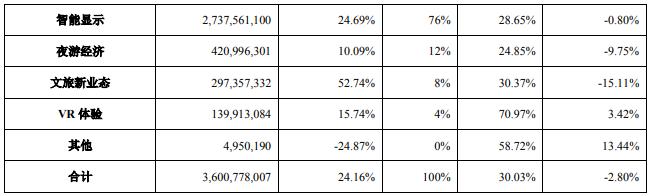
The revenue share of the smart display segment remained stable at 76%, representing a 24.69% year-on-year increase and basically flat compared to the same period in 2019; the gross profit margin slightly decreased, mainly due to a significant rise in the proportion of domestic (Sales) channel products, leading to a gross profit margin adjustment driven by product mix.
The gross profit margin of the night tourism economy segment declined significantly, mainly due to policy adjustments, the impact of the pandemic, and intensified competition, leading to a general decline in industry gross profit margins.
Revenue from new cultural tourism business formats grew rapidly, while gross margin declined significantly, mainly due to project settlement reasons.
As the pandemic situation in the United States gradually stabilized in May, the VR experience segment saw its performance stabilize, achieving a year-on-year growth of 15.74%.
During the reporting period, the gross profit margin decreased by 3.22%, mainly due to a significant year-on-year decline in the night tourism economy and new cultural tourism business segments; overseas Revenue declined by 10.77%, primarily due to the pandemic.
In addition, in 2021, driven by a significant increase in domestic LED industry demand and supply chain shortages, industry concentration increased. The company had full order books, even experiencing situations where insufficient production capacity affected deliveries. As of August 15, new orders in 2021 increased by 36% year-on-year and by 13% compared to 2019; among them, domestic smart display orders increased by 70% year-on-year, international smart display orders increased by 33% year-on-year, and NP Company's orders increased by 66% year-on-year.
During the reporting period, the company's intelligent display business faced widespread raw material shortages and rising costs within the LED industry. The company swiftly decided to expand production capacity in Changsha and raised product prices by 5%-15% to offset the increased costs, ensuring a full order book without significantly impacting gross profit margins.
04
Tospo Lighting's net profit increased by 5.56% YoY in the first half of the year
Tospo Lighting released its 2021 semi-annual performance report. According to the announcement, the company achieved revenue of RMB 2.462 billion, a Year-on-year (YoY) increase of 18.13%; Net profit attributable to shareholders of the Listed company was RMB 182 million, a Year-on-year (YoY) increase of 5.56%. Since the second quarter, the company divested Tospo Plastics and consolidated Shanghai Liangqin and Wuhan Liangxinpeng into its financial statements. Excluding these factors, sales on a comparable basis grew by 28.8%, and Net profit excluding non-recurring items increased by 1.38% Year-on-year (YoY).
Tospo Lighting focuses on the general lighting industry and continues to expand into the automotive sector.
In the general lighting business, the international market, particularly in the Americas and Eurasia regions, achieved significant growth. The "Global Village Expansion Plan" and "Precision Service for Strategic Customers" strategies have proven effective. The company has deepened its cooperation with existing core customers, while continuously making progress and achieving results in developing new customers, new sales channels, and new markets.
In the domestic market, the company emphasizes team building in the lighting engineering sector, striving to create high-quality lighting projects. The company focuses on landscape lighting projects represented by cultural tourism night tours, while also undertaking urban illumination projects in key areas. It is cultivating and expanding education lighting and industrial lighting, and continuously increasing investment in road lighting. In the first half of the year, the company won bids for new projects in smart streetlights, education lighting, and industrial lighting.
The supermarket and commercial lighting business continues to maintain its growth momentum. Teyes is steadily advancing the corporate upgrading of dealers nationwide, and regional key account development has achieved significant results.
In terms of automotive business, during the reporting period, the company completed the acquisition of Shanghai Liangqin and Wuhan Liangxin Peng, strengthening the company's product line layout in the automotive sector. The LDM business for automotive headlight controllers continued to maintain rapid growth, while significant breakthroughs were also achieved in the development of Battery Management System (BMS) controller projects.
05
Huati Technology's operating profit and net profit both declined in the first half of the year
On August 19, Huati Technology released its 2021 semi-annual report. The company's revenue during the reporting period was RMB 347 million, a year-on-year decrease of 5.3%; net profit attributable to shareholders of the listed company was RMB 30.7042 million, a year-on-year decrease of 9.8%.
Huati Technology is a system solution provider focusing on new smart city scenarios and cultural lighting, integrating R&D and manufacturing, operation management, solution design, and engineering installation in the urban lighting sector. In recent years, the company has continuously deepened its efforts in R&D, product manufacturing, solution design, and operation management for smart streetlights and related fields, striving to become a builder and service provider for new-type smart cities.
During the reporting period, while maintaining its market share in the western region, the company further expanded its business outside the province, becoming one of the largest comprehensive urban lighting service providers in China.
The company enters the smart city sector by leveraging smart streetlights, exploring the deep integration of smart streetlight and smart city businesses, and innovating business models. Smart streetlight operation services involve obtaining operational rights for streetlights and surrounding equipment for a certain period after project construction is completed, mainly including: charging pile operations, information advertising, hosting 4G/5G base stations on licensed poles to provide services, WIFI value-added operation services, and smart parking value-added services. Through a model combining construction with subsequent operations, the company has gradually evolved from single product sales to a full industry chain model integrating product sales with smart city operation services.
The company pioneered the concept of "Urban Cultural Lighting" by introducing "Cultural Customization" into urban lighting design. By combining lighting design technology with the art of light, it has developed a series of culturally customized lighting products, further enhancing the city's cultural sophistication.
Huati Technology stated that in recent years it has focused on R&D and product design in the fields of smart lighting, cultural lighting, and green lighting. While enhancing its capabilities in urban smart lighting planning and solution design, sales of smart streetlights and culturally customized lighting products have continued to grow, and corresponding utility model patents or design patents have been obtained.
At the same time, the company continues to increase R&D investment in new urban lighting technologies and has independently developed smart streetlight products based on IoT technology. These provide novel technical means for the construction of smart cities and the development of the big data industry, resulting in a series of software copyrights represented by the Smart City Asset Management and Operation Platform V3.0.
Huati Technology also released the 2021 private placement plan for A-shares. The total funds to be raised in this private placement shall not exceed RMB 300 million (inclusive). After deducting issuance expenses, the net proceeds are intended to be invested in the smart streetlight intelligent manufacturing project and to supplement working capital. The issuance is targeted at no more than 35 specific investors.
Huati Technology stated that the implementation of the smart streetlight intelligent manufacturing project will introduce automated production lines and build a digital factory to achieve intelligence and digitization of the manufacturing process. This will promote the overall improvement of the company's manufacturing capabilities and standards, and further enhance product customization capabilities. In the future, the company will establish a dual-base manufacturing pattern with Chengdu and Deyang. Driven by the dual engines of R&D and manufacturing, it will quickly respond to market demands and meet customers' personalized and differentiated product customization needs. With smart streetlights as the entry point and relying on products plus operations, the company aims to become a comprehensive solution provider for new-type smart cities, thereby fully achieving its strategic development goals.