
Integration of components and lamp poles is the development direction of solar street lights.
Structural innovation in the integration of components and lamp poles, and the resulting single-system high-power solar street light, are breakthrough research achievements made by the new energy lighting industry in recent years. This is an important development direction for solar street lights, which is significant for the system technology progress of solar street lights and for achieving carbon emission reduction in the field of street lighting.
Under the global trend of carbon emission reduction, single-system high-power solar street lights with integrated lamp pole structures have emerged. By the end of August 2021, the installation of 141 thin-film component and lamp pole integrated solar street lights on the main road of the West Fifth Road overpass in Zibo City (two-way six-lane) and auxiliary roads had been in operation for one full year. These integrated thin-film solar street lights replaced the original 310W CSM light sources, adopting high-luminous efficacy LED light sources with a power of 150W; the lamp pole height is 13 meters. For auxiliary roads and ramps, the power is 120W, and the lamp pole height is 12 meters. The pole spacing is 37 meters for all. The average illuminance on the road surface reaches 32 lx, with a color temperature of 4000K. They use lithium battery energy storage and an IoT control system, designed based on local sunshine conditions for 5 rainy/foggy days. These parameters are gratifying and represent the latest technological progress results in solar street lights.
Having undergone the baptism of severe cold and heat, wind and rain, this batch of thin-film solar street lights lived up to expectations, remained on duty, illuminated the overpass above and below, and their good lighting effects were recognized by street lighting professionals and received praise from local street lighting management departments. Worth praising, worth congratulating!
This achievement, which has national even international demonstration significance, was made possible through the efforts of enterprises, professional organizations, and strong support from local governments. It is a milestone in the development of the photovoltaic street light industry, marking a new stage where photovoltaic street lights enter the phase of integration with lamp posts, single-system high-power operation, and application on standard roads, becoming a new force for energy conservation and emission reduction in the lighting field. Especially, the breakthrough achievement of single-system high power brought by the new structure integrating thin-film modules with lamp posts has attracted high attention from the industry. Professionals in photovoltaic street lights from many provinces and cities such as Guangdong have flown to Zibo, Shandong, to witness the charm of thin-film photovoltaic street lights.
Developed in 2019 by a company in Shandong, this thin-film photovoltaic street light concentrates the latest achievements in new materials, new technologies, and new designs in the field of photovoltaic lighting, featuring three distinct characteristics:
一、在国内率先将国产铜铟镓硒薄膜光伏组件大规模应用于光伏路灯;二、采用光伏组
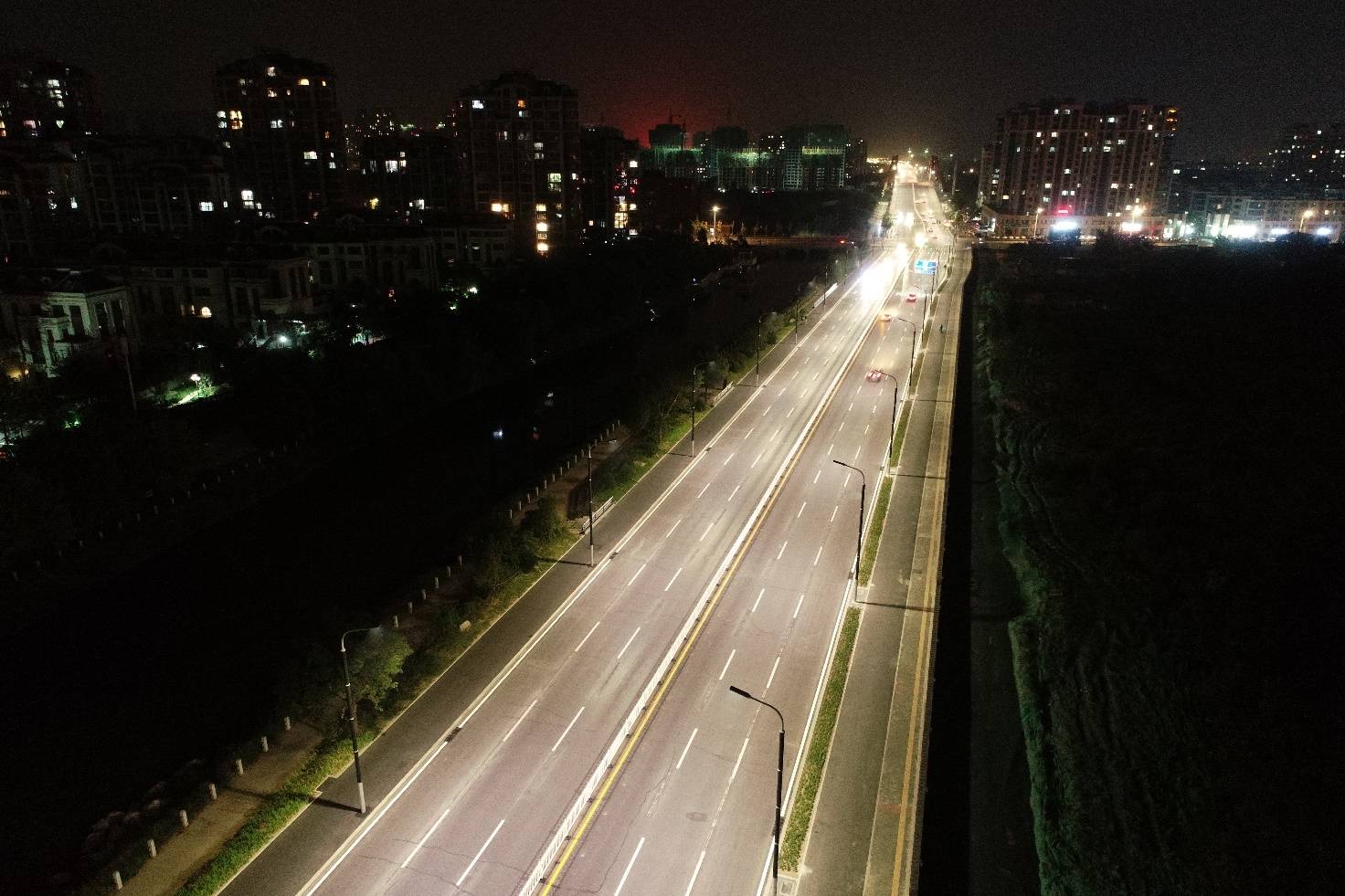
Night view of the application of Shandong company's thin-film component and lamp post integrated photovoltaic street light on West Fifth Road, Zibo. Photo by Sun Hongkai
Integrated structural design of components and lamp posts, adopting single-system high-power 150-watt, 120-watt LED light sources; third, in Zibo High-tech Zone
With the enthusiastic support of leadership, installed on the main and auxiliary roads of the six-lane bidirectional overpass on West 5th Road in Zibo, demonstrating strong confidence in new energy high-tech photovoltaic street lights.
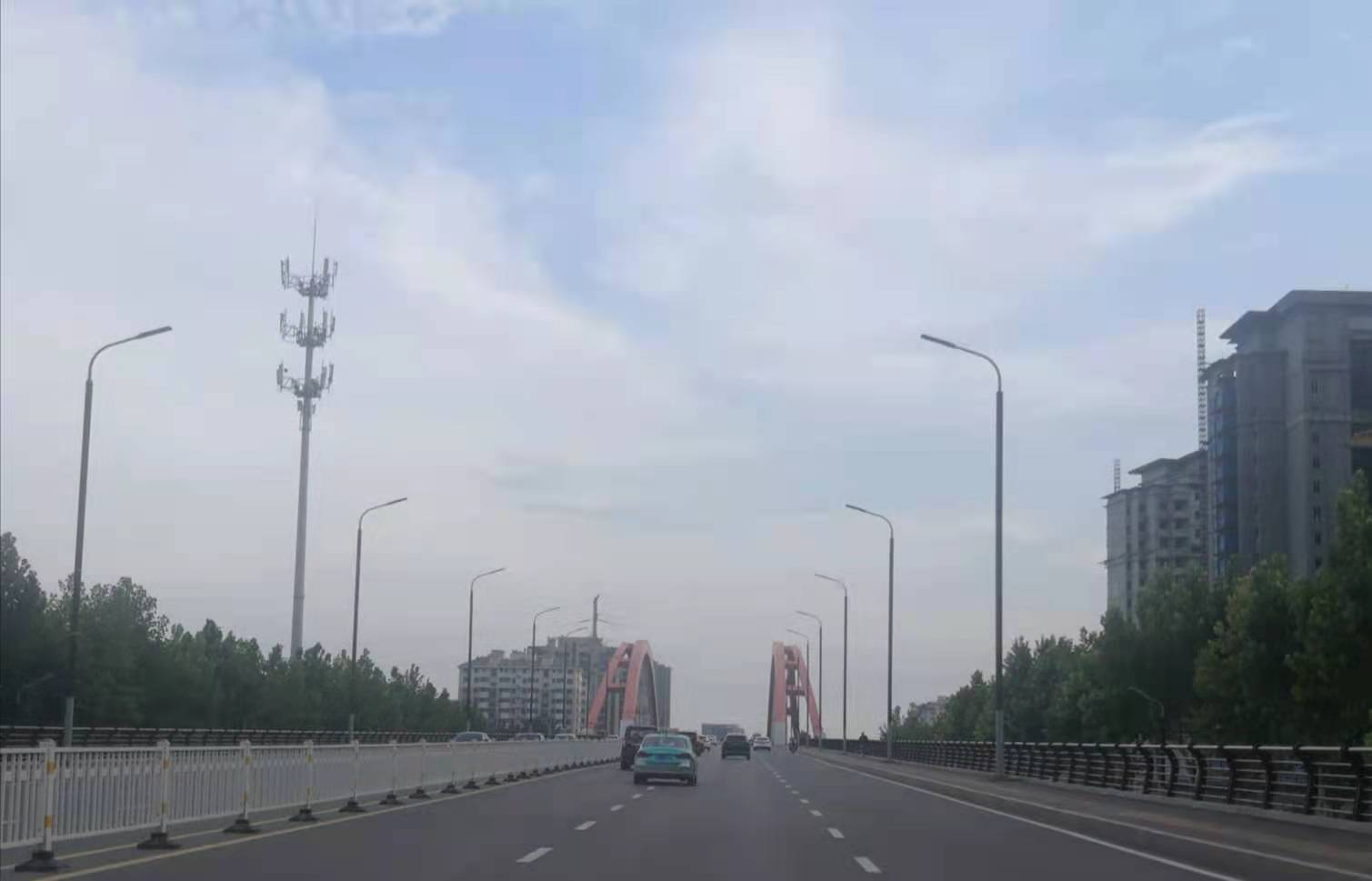
Day view of a photovoltaic street light integrating thin-film modules and pole from a Shandong company applied on West 5th Road, Zibo. Photo by An Lanpo, July 2021.
A single system refers to a photoelectric-electro-optical conversion and control system, as opposed to a combined system; 'high power' generally refers to LED high-luminous-efficacy light sources for photovoltaic street lights ranging from above 100 to 200 watts. The combination of single systems and high-power light sources is a technological achievement resulting from advances in new photovoltaic materials and structures, representing high-end products for photovoltaic street lights; the structural advantages generated by the integration of photovoltaic modules and poles determine their important market value and application prospects. This type of photovoltaic street light, which integrates the latest technologies in photoelectric conversion, control with IoT, energy storage, light sources, and light distribution, and applies module-pole integration to standard roads with four, six, or even eight lanes in both directions, can be called the second generation of photovoltaic street lights.
Currently, most photovoltaic street lights belong to small and medium power ranges of 10 to 100 watts, used extensively in rural areas, mountainous regions, pastoral zones, forested areas, and islands, forming the main force of the market, but facing the phased task of quality improvement, upgrading, and replacement. According to surveys, photovoltaic street lights with a "PhD cap" structure generally have a maximum power of 120 watts and are mostly applied to standard roads with four lanes in both directions. Some enterprises have developed 240-watt and 250-watt high-power "PhD cap" type photovoltaic street lights, available in both single-system high-power and combined high-power versions, with a certain scale of application, offering excellent lighting effects and meeting all design requirements, suitable for standard roads with more than four lanes in both directions.
A lighting engineering project completed by a Hunan company at the end of 2017 on the Changsha Dongzhu Expressway, featuring a six-lane bidirectional road spanning 13 kilometers, adopted a combined system of 240-watt photovoltaic street lights with supercapacitor energy storage. It has been operating for three and a half years so far, especially enduring a test of 50 consecutive rainy, foggy, and low-light days in March-April 2021.
In February 2016, a company in Anhui implemented a photovoltaic street light lighting project on National Highway G104. It adopted single-system power photovoltaic street lights of 150W and 300W for a two-way eight-lane section, with an installation mileage of 24 kilometers. The system has been operating for over 5 years. There are many similar projects; their lighting effects have been recognized by local street light management departments, becoming classic cases of high-power photovoltaic street light lighting.
Manufacturing high-power "PhD cap" type photovoltaic street lights is not a problem, but issues such as increased weight and wind resistance, restricted application environments, increased costs, and decreased economic efficiency may arise.
New photovoltaic materials bring innovation to the structure of photovoltaic street lights, creating clear advantages for single-system high-power photovoltaic street lights integrated with the pole: they can maximize the use of pole space to generate more electricity; although the total wind resistance area is reduced only slightly, the form of the contact surface is changed, enhancing wind resistance strength; more electricity creates conditions for designing and manufacturing smart poles with photovoltaics, opening up more market space, and even enabling the development of medium-height photovoltaic street lights. From the lighting effect of the dual-direction six-lane overpass on West Fifth Road in Zibo, it is evident that integrated photovoltaic-pole street lights can fully compete with grid-powered street lights.
It is understood that nearly 10 photovoltaic lighting enterprises are researching street lights and courtyard lights with integrated structures of photovoltaic modules and poles, adopting polygonal structures and using monocrystalline silicon, polycrystalline silicon, and shingled monocrystalline silicon materials. It is believed that in the near future, a large number of clean, renewable solar energy integrated photovoltaic street lights and courtyard lights will appear on various standard roads and urban residential areas, becoming a beautiful scenery.
Due to the increasing number of large cities in China, to meet traffic demands between cities, there are more and more standard roads. Because first-tier cities have high and sustained car traffic volume during evening and night hours, some ring expressways, inter-city expressways, and highways have begun installing street lights. For example, Guangshen Expressway is one of the earliest highways in China to install street lights; Foshan Ring Road; Wenong Expressway lit up in 2020; Chifeng City Outer Ring installed over 5,000 photovoltaic street lights in 2017. Installing photovoltaic street lights on highways and expressways near cities aligns with the trend of carbon emission reduction. Installing photovoltaic street lights eliminates the need for trenching and cable laying, removes concerns about power outages, and requires no transformers; its comprehensive advantages will stand out in highway and expressway lighting. This is also a rigid demand for photovoltaic street lights. To meet the demand for applying photovoltaic street lights on standard roads such as highways and expressways, single-system high-power and pole-integrated IoT photovoltaic street lights will become an important development direction for street light lighting.
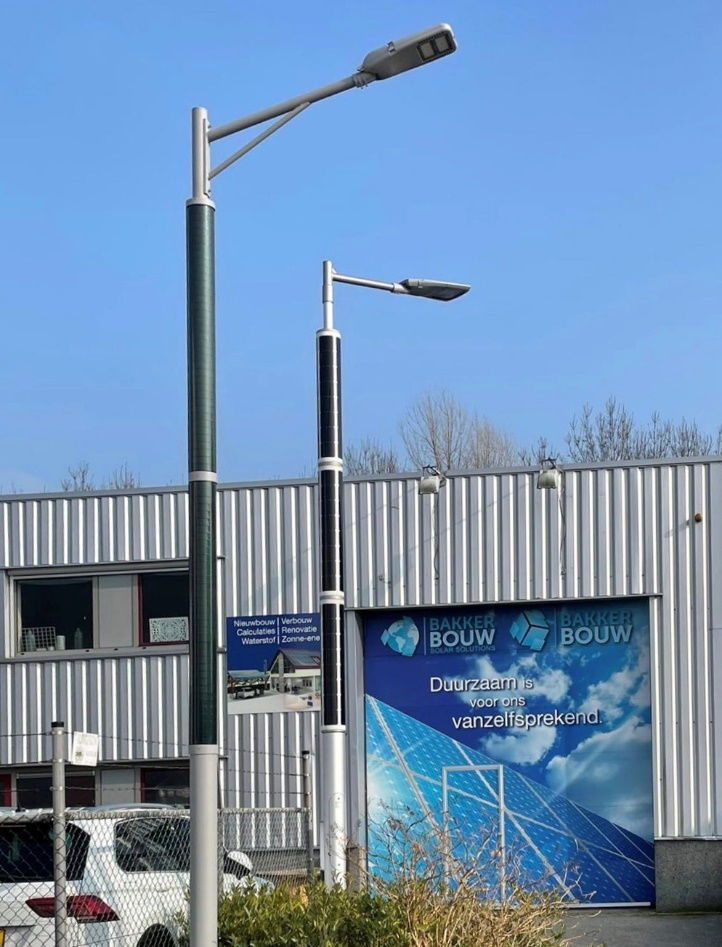
It is understood that Germany is also developing integrated photovoltaic modules and lamp poles, as well as single-system high-power PV street lights. The left image shows two PV street lights with integrated photovoltaic modules and lamp poles that have been competing since 2020; both are 60 watts. The one on the left features a dark green thin-film module from a Shandong company, while the one on the right has a black crystalline silicon module from a German company. These two PV street lights are of the same height; they appear taller on the left and shorter on the right due to different camera angles. This competition has attracted high attention from industry experts, and everyone awaits the results.
Single-system high-power PV street lights and grid-connected street lights complement each other in terms of application scenarios, but their carbon emission reduction effects are exactly opposite: using one grid-connected street light adds to carbon emissions, while installing one PV street light reduces carbon emissions by one unit and increases carbon reduction by one unit. To facilitate the standardized promotion and application of various types of PV street lights, the New Energy Committee of the China Illuminating Engineering Society launched the formulation of group standards such as "Design Specification for PV Street Light Applications" and "Construction and Acceptance Specification for PV Street Light Engineering Projects" in September 2019. After nearly two years of effort, the formulation work has entered the final review stage. Once these two group standards are released, they will not only standardize the application of single-system high-power PV street lights but also become an important basis for road traffic planning and design departments in applying PV street lights on standard roads.
It is recommended that more high-tech integrated PV street lights be installed on standard roads with suitable lighting conditions in various regions, contributing to carbon emission reduction, carbon neutrality, peak carbon emissions, carbon trading, and the development of the circular economy in China's lighting field.
An Lanpo, Executive Deputy Director of the New Energy Lighting Committee of the China Illuminating Engineering Society