
Healthy lighting illuminates the Chinese Space Station
Science and technology are the primary productive forces. With the development of intelligent control and Healthy lighting technologies in China, the interior construction of China's space station is continuously advancing, with widespread application of Healthy lighting and smart home systems to provide astronauts with a more comfortable spatial environment.
According to the China Manned Space Agency, at Beijing time on June 17, 2021, the Shenzhou-12 manned spacecraft was successfully launched from the Jiuquan Satellite Launch Center, smoothly sending three astronauts—Nie Haisheng, Liu Boming, and Tang Hongbo—into space. The astronauts will stay in the space station for three months. To improve the "comfort level" of their life in space, the cabin activity space has been increased from 15 cubic meters in Tiangong-1 to 110 cubic meters for the entire station, essentially moving from a "single-room apartment" to a "spacious flat".
In the Chinese Space Station, designers have provided each astronaut with a handheld terminal. Astronauts can adjust the cabin lighting environment via an app according to their personal needs, selecting sleep mode, work mode, exercise mode, and more. The lighting environment of the Tiangong space station simulates various natural states such as sunrise, noon, dusk, and night, creating an earthly living atmosphere for astronauts in space to the greatest extent possible. Different cabin lights can regulate astronauts' emotions and avoid discomfort caused by prolonged exposure to monotonous environments. This is precisely the combined application of healthy lighting and smart home technology.
It is reported that, in order to achieve the ideal healthy lighting effect, designers conducted multiple trials, repeatedly verifying and adjusting the lighting. By employing the most advanced intelligent control methods, they aimed to provide astronauts staying in space for extended periods with the most comfortable living experience possible.
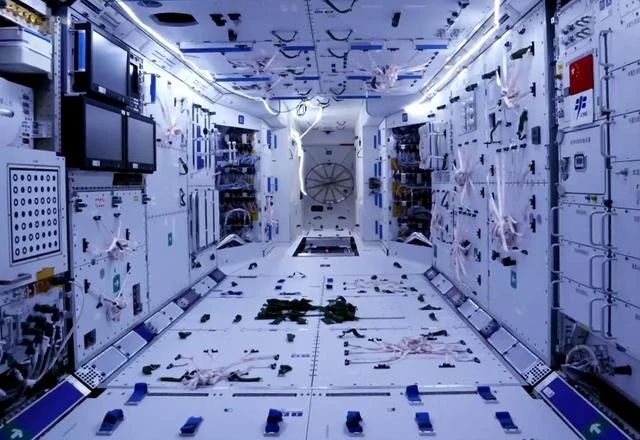
As the cabin space continues to expand, the technological sophistication of "interior decoration" is also constantly improving. In line with a "human-centered" design philosophy, the Chinese Space Station features separate living and working areas. The living area includes independent sleeping, hygiene, and exercise zones, as well as a space kitchen and dining area. The design maximizes privacy and convenience, significantly enhancing the quality of life for astronauts in space.
Healthy lighting is always smart, but smart lighting is not necessarily healthy! The extensive application of Healthy lighting and smart home systems in the Chinese Space Station serves as a significant encouragement and model for the development of these two industries. Healthy lighting encompasses multiple layers, including circadian lighting, biological lighting, educational lighting, and germicidal lighting. Its future application space is vast, making it one of the inevitable directions for the future development of the lighting industry.