
Momentum remains strong, hitting new record highs at the start of the year—Quick Report on China's Lighting Appliance Industry Export in Q1 2021
Author/Wen Qidong
China Association of Lighting Industry(中国照明电器协会)
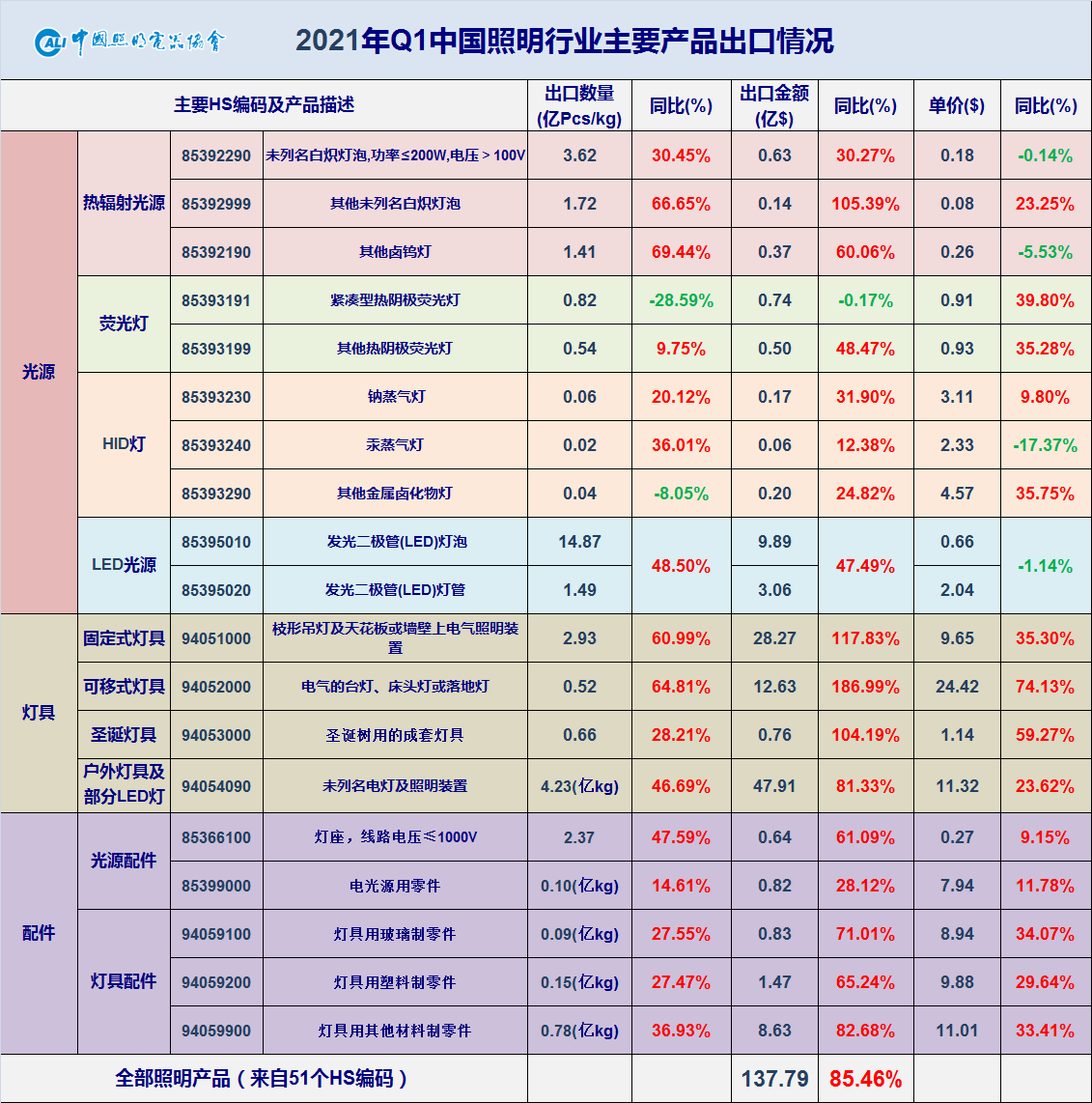
Note: On December 31, 2020, the Tariff Commission of the State Council issued the "Import and Export Tariff of the People's Republic of China (2021)". The original 8-digit HS code 85395000 for "Light-emitting diode (LED) light bulbs (tubes)" was deleted, and two new 8-digit HS codes were added: 85395010 for "Light-emitting diode (LED) light bulbs" and 85395020 for "Light-emitting diode (LED) tubes". This adjustment originated from suggestions submitted by the China Association of Lighting Industry(中国照明电器协会) to relevant departments regarding adjustments to import and export tariff items in the lighting industry, among which the suggestion to separately list the above-mentioned LED light source products under HS codes was adopted.
In Q1 2021, China's total lighting product exports reached USD 13.779 billion, a Year-on-year (YoY) increase of 85.46%, and 43.29% higher than in Q1 2019. Among them, LED lighting product exports amounted to USD 9.825 billion, a Year-on-year (YoY) increase of 102.66%, and 51.15% higher than in Q1 2019. Both the total lighting product exports and LED lighting product exports set historical highs for Q1 exports in the lighting industry.
另据海关总署数据,2021年一季度,我国货物贸易出口总值达到4.61万亿元人民币,同比增长38.7%,以美元计则达到7100亿美元,同比增长达49.0%;其中机电产品2.78万亿元,占出口总值的60.3%,同比增长达43.0%,以美元计为4286亿美元,同比增长达53.5%。照明行业继续领先大盘,为提振整体出口做出贡献。
Almost all product categories, including light sources, luminaires, and accessories, saw comprehensive growth. In particular, both the export volume and export value of luminaires and accessories rose significantly. Meanwhile, the substantial increase in average export unit prices also reflects, to some extent, the impact of rising raw material costs on end products.
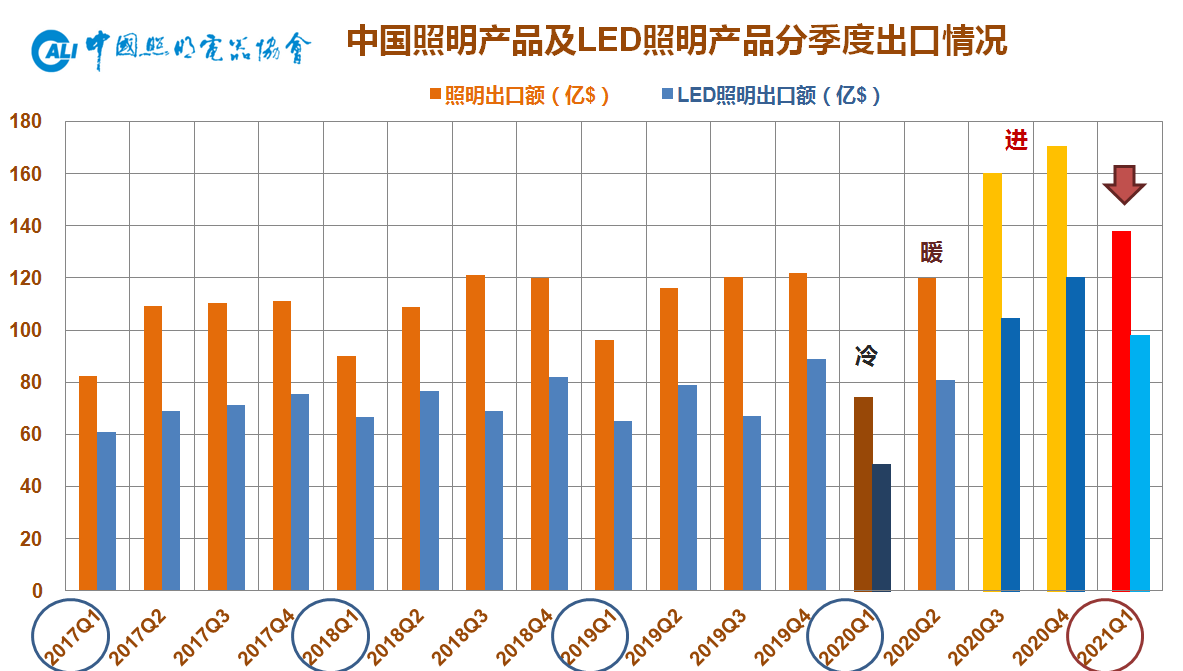
中国照明出口经历了2020年的“V”字型反转后,在2021年开年继续高歌猛进。同比高增不单单是因为2020年的同期数据跌至谷底,从图中可见,2021年一季度出口额不仅远超往年一季度,甚至显著高于往年作为旺季的三、四季度数据。
This continues to demonstrate the resilient, essential demand for lighting products in basic national economic life. Meanwhile, overseas pandemic waves persist and intensify, with full resumption of industrial production and work in relevant industrial countries remaining intermittent and indefinitely delayed. Consequently, against the backdrop of significant global monetary easing, orders for lighting products from various countries have concentrated in China, the global manufacturing center and supply chain hub for lighting—a trend that continues to this day.
On the other hand, against the backdrop of soaring global raw material prices, many overseas customers, anticipating temporary shortages of chips and materials in the upstream supply chain, have commonly placed advance and oversized orders to secure production capacity and materials from domestic suppliers. Therefore, considering the current order backlog of relevant export enterprises, lighting product exports are highly likely to remain at a high level in the second quarter of 2021.
While the overall export situation is encouraging, we should view it rationally and remain cautiously optimistic. If in Q4 2020 the practical difficulties faced by export enterprises were mainly sharp exchange rate fluctuations, rising shipping costs and container shortages, significant price hikes for raw materials and components accompanied by supply shortages, as well as power outages and restrictions in some regions, then the most prominent issue in Q1 this year remains the dilemma of "soaring raw material prices and manufacturing sector distress" that has persisted since last year.
Fluctuations in raw material prices are inherently cyclical events; their impact was merely amplified by the sudden intervening factor of the pandemic.
First, the impact of inflation: driven by global loose monetary policies, whether through raw material cost pass-through or investment demand, the surge in international commodity prices does not fully reflect changes in market supply and demand, but rather reflects excess liquidity worldwide;
Second, supply chain disruptions occurred. The globalized supply chain was hindered by factors such as the sudden outbreak of the pandemic and Sino-US trade friction. The supply of certain bulk commodities, such as copper and iron, became tight or even scarce. In addition, environmental protection policies and production restrictions in relevant manufacturing countries further exacerbated this impact.
Third, hoarding and reluctance to sell: the surge in raw material prices naturally triggered active and passive hoarding in the market, which also exacerbated price increases and shortages to some extent.
Fourth, demand is growing. The pandemic has accelerated digital transformation in demand. Data shows that global demand for consumer electronics related to the stay-at-home economy, such as mobile phones, computers, and small home appliances, remains high. Digital demands like remote video conferencing/teaching systems are also booming, and the new energy vehicle manufacturing boom is in full swing. In addition, the global pandemic has led to the concentration of manufacturing in China, causing significant price increases and shortages of electronic industrial raw materials and components such as aluminum substrates, PCBs, IC chips, passive components, and plastics. This is particularly true for general-purpose, non-exclusive components used in the automotive and consumer electronics industries, forcing the lighting industry to compete with high-margin industries for production capacity.
Entering 2021, especially in the past two months, a flood of notices regarding price increases for various raw materials and components has arrived, placing significant pressure on the production capacity delivery and profit margins of related export enterprises.
From another perspective, this market cycle is not only a comprehensive test of the supply chain, but also a process of identifying high-quality suppliers and customers, and even an industry reshuffle that separates the genuine from the fake. It can be said that truly high-quality finished product enterprises are currently less constrained by chip and material shortages; high-quality supporting enterprises will take this opportunity to optimize customer resources and product structure; and high-quality end customers will accept price increases from upstream, following the objective law that such increases will inevitably be passed down to downstream.
Summary
总之,未来行业中优秀企业间的竞争更多是优质供应链间的竞争,后疫情时代,高效与安全并重,有限需求将更趋于向优质产能转移,在这一轮严苛考验中存活下去并将进一步发展壮大的仍将是专注专业、诚实信用并遵循基本商业逻辑的企业们。