
Ministry of Housing and Urban-Rural Development and 15 other departments: Encourage the construction of public supporting facilities such as smart light poles
Recently, the Ministry of Housing and Urban-Rural Development, the Office of the Central Cyberspace Affairs Commission, the Ministry of Public Security, and other departments jointly issued the "Guiding Opinions on Accelerating the Development of Digital Homes and Improving Living Quality" (hereinafter referred to as the "Opinions"), putting forward 15 opinions in 4 aspects on accelerating the development of digital homes, improving living quality, and enhancing the human settlement environment.
The proposal explicitly requires that newly built community supporting facilities be equipped with basic smart products such as intrusion alarms and video surveillance, ensuring unobstructed fire lanes and enhancing community security. Elderly care facilities should be configured with smart products for health management and emergency calls to improve the age-friendly level of the community.
The proposal encourages the construction of public supporting facilities such as smart parking, smart express lockers, smart charging piles, intelligent parking systems, smart fitness equipment, smart light poles, and smart trash bins, to enhance the level of intelligent services.
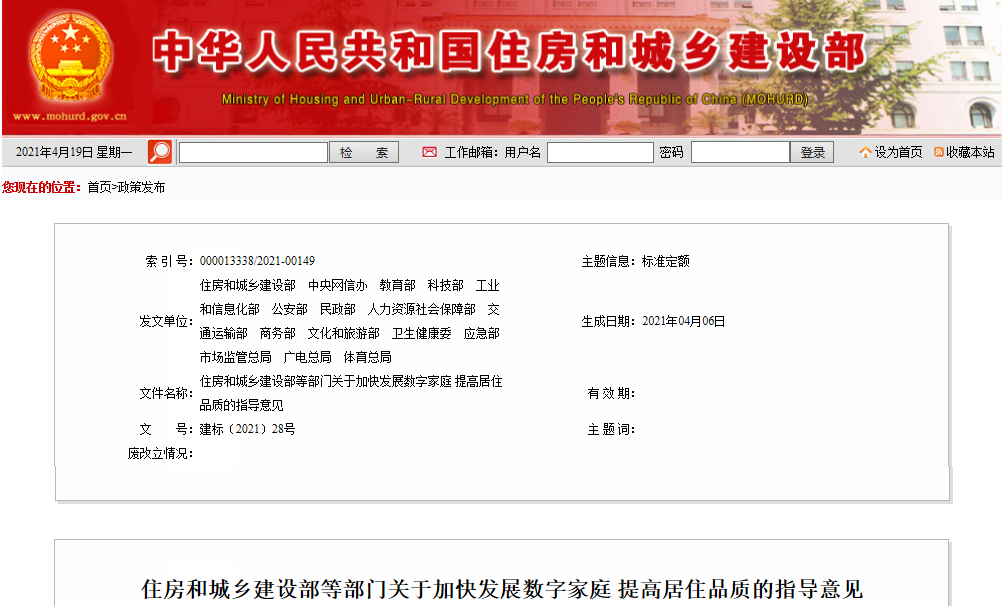
Full text of the attached document:
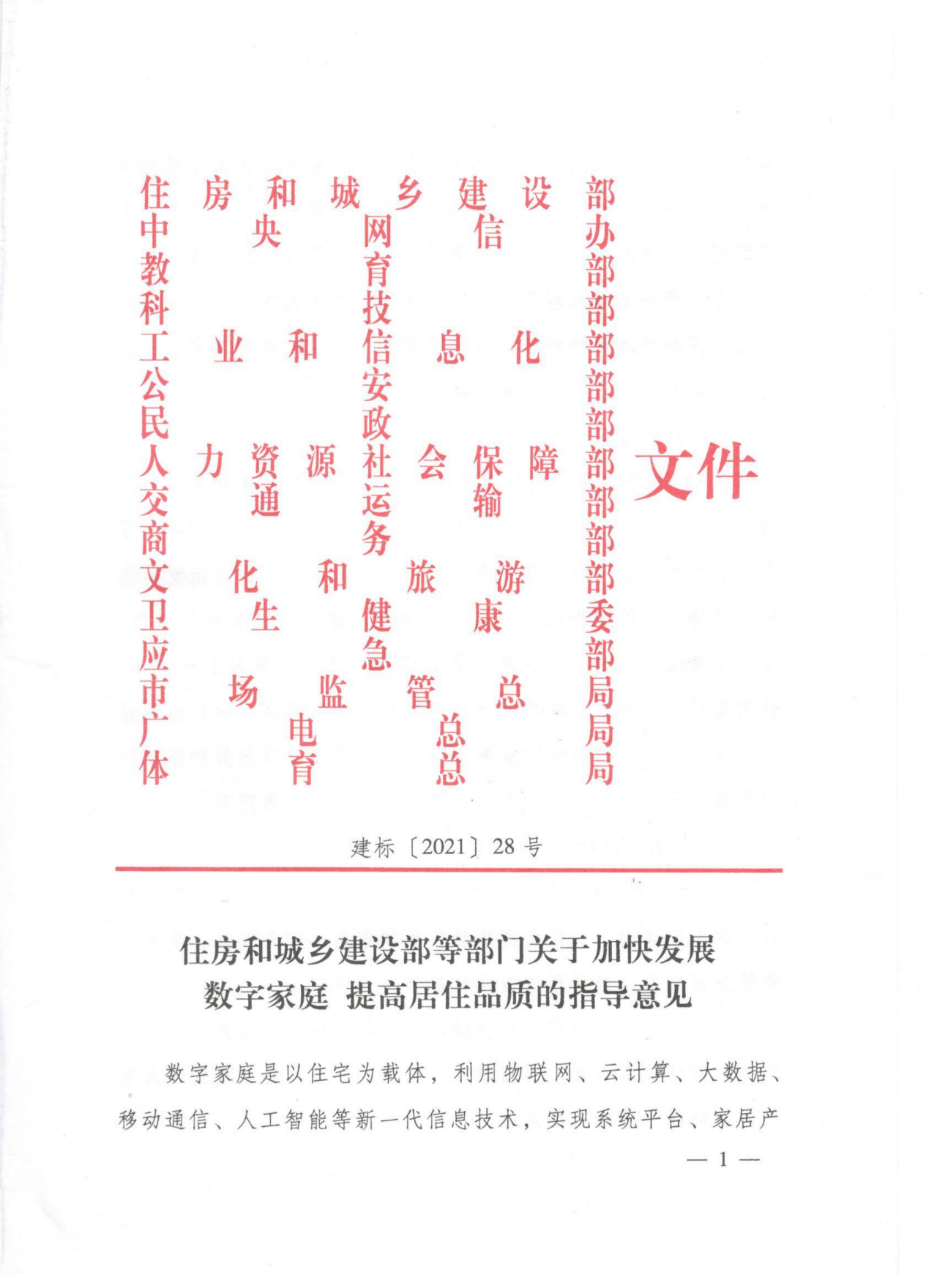
Guiding Opinions of the Ministry of Housing and Urban-Rural Development and Other Departments on Accelerating the Development of Digital Homes and Improving Living Quality
Housing and Urban-Rural Development Departments (Commissions, Management Committees), Cyberspace Administration Offices of Party Committees, Education Departments (Commissions), Science and Technology Departments (Commissions), Industry and Information Technology Competent Authorities, Public Security Departments (Bureaus), Civil Affairs Departments (Bureaus), Human Resources and Social Security Departments (Bureaus), Transport Departments (Commissions), Commerce Competent Authorities, Culture and Tourism Departments (Bureaus), Health Commissions, Emergency Management Departments (Bureaus), Market Supervision and Administration Bureaus (Departments, Commissions), Radio and Television Bureaus, and Sports Bureaus of all provinces, autonomous regions, and municipalities directly under the Central Government; Housing and Urban-Rural Development Bureau, Cyberspace Administration Office of the Party Committee, Education Bureau, Science and Technology Bureau, Industry and Information Technology Bureau, Public Security Bureau, Civil Affairs Bureau, Human Resources and Social Security Bureau, Transport Bureau, Commerce Bureau, Culture, Sports, Radio, Television and Tourism Bureau, Health Commission, Emergency Management Bureau, and Market Supervision and Administration Bureau of the Xinjiang Production and Construction Corps:
A digital home is a residential-based service system that leverages next-generation information technologies such as the Internet of Things (IoT), cloud computing, big data, mobile communications, and artificial intelligence to achieve interconnectivity between system platforms and home products, thereby meeting users' needs for accessing and utilizing information. In recent years, information technology has developed rapidly, continuously expanding the functions and services of digital homes. However, issues remain, including unbalanced development, low levels of intelligence in residential and community supporting facilities, and insufficient interconnectivity among product systems. To implement the strategic decisions and deployments of the CPC Central Committee and the State Council on expanding domestic demand and developing the digital economy, accelerate the development of digital homes, enhance living quality, and improve the living environment, the following opinions are proposed:
I. General Requirements
(I) Guiding Ideology. Guided by Xi Jinping Thought on Socialism with Chinese Characteristics for a New Era, we will fully implement the spirit of the 19th National Congress of the Communist Party of China and its Second, Third, Fourth, and Fifth Plenary Sessions. Based on the new stage of development, we will apply the new development philosophy, foster a new development pattern, adhere to a people-centered approach, uphold systematic thinking, and coordinate the promotion of high-quality development. We will deepen supply-side reforms in the housing sector, deeply integrate the application of digital home products with engineering design, strengthen the construction of livable housing and new-type urban infrastructure, enhance the supply capacity of consumption services for digital home products, improve the level of convenience services, adapt to the trend of consumption upgrading and the normalized requirements of epidemic prevention and control, and continuously meet the people's growing needs for a better life.
(2) Basic Principles.
—Adhere to market-led development with government guidance. Fully leverage the leading role of the market in the development of digital homes, and better utilize the government’s role in planning and layout, security assurance, and policy formulation, to promote the formation of a diversified participation and coordination mechanism.
—Adhere to adapting measures to local conditions and promote systematically. Based on urban infrastructure and current consumption patterns, ensure coordinated planning, highlight key priorities, develop by category according to demand, encourage pilot programs first, and drive the implementation of digital home applications.
—Adhere to integration and sharing, and pursue innovation-driven development. Strengthen interconnectivity of products and platforms across fields and industries, promote the coordinated application of next-generation information technology, Internet Protocol version 6 (IPv6), and smart home solutions, drive the integrated development of related industries, and foster an industrial ecosystem for cross-boundary applications.
— Uphold safety and reliability, and pursue green development. Strengthen network and information security as well as cultural and publicity management, effectively protect residents' privacy, ensure the cybersecurity of digital home products and systems, strictly adhere to the basic requirements of green, low-carbon, and circular development, and improve energy and resource utilization efficiency.
(3) Development goals. By the end of 2022, policies, regulations, and standards for digital homes will be largely in place; provinces (autonomous regions, municipalities) with relatively good foundational conditions will have at least one city or district carrying out digital home construction, basically forming replicable and scalable experiences and lifestyle service models. By the end of 2025, a relatively complete digital home standard system will be established; newly built fully furnished residential units and community supporting facilities will fully possess communication connectivity capabilities and be equipped with necessary smart products; existing residential units and community supporting facilities will be equipped with a certain number of smart products, with initial results seen in digital transformation; an orderly developing digital home industry ecosystem covering real estate development, product R&D and manufacturing, and operation services will take shape; health, education, entertainment, medical care, fitness, smart broadcasting and television, and other digital home life service systems will be relatively well-developed.
2. Clarify Digital Home Service Functions
(1) Meet residents' needs for intelligent services for home products. This includes more convenient management and control of smart home products, sensing and interaction between smart home products and the home environment, prevention of illegal intrusion and visits by unknown persons, safety in electricity, fire, gas, and water usage, as well as energy saving control, environmental and health monitoring, etc.
(2) Meet residents' needs for obtaining social services online. This includes more convenient access to in-home services such as building facility maintenance, housekeeping, and medical care, as well as services like natural disaster early warnings, education, food delivery, elderly and disability assistance, medical consultations, appointment-based diagnosis and treatment, remote work, express mail pickup and delivery, e-commerce platforms, housing rentals, transportation, travel and accommodation, audio-visual entertainment, and fitness guidance.
(3) Meet residents' needs for online application of government services. This includes bringing government service items such as public education, labor and employment, social security, civil affairs, medical health, housing assurance, radio and television, and culture and sports into households, fully leveraging smart home products, integrating with local government service platforms, and enabling online "one-screen processing," "fingertip processing," and "TV-based processing."
3. Strengthen the construction of digital home engineering facilities
(1) Strengthen integrated intelligent information cabling. Increase investment in the planning and construction of information infrastructure for residential buildings and communities to achieve coverage of high-speed wireless networks such as fiber-optic broadband and Fifth Generation Mobile Communication (5G), and bring broadcast television fiber-optic and coaxial cables into homes. Encourage the development of Fiber-to-the-Room (FTTR) and Fiber-to-the-Desk solutions, focusing on improving indoor network quality in residences. Promote the convergence of triple-play networks, popularize the application of integrated information boxes in residential units, enhance power and information network connectivity capabilities to meet the needs of digital home systems, and reserve sufficient interfaces and cabling for digital homes.
(2) Strengthen the installation of smart products in residential buildings. For newly built fully decorated residences, clearly specify requirements for basic smart products such as in-home video intercoms, intrusion alarms, and automatic fire alarms; encourage the installation of health-oriented, comfort-enhancing, and energy-saving smart home products; encourage reserving conditions for age-friendly smart products such as home abnormal behavior monitoring, emergency call systems, and health management. Encourage existing residences to install smart products by referring to new residential standards, and carry out electrification, digitalization, and networking upgrades for traditional home building materials such as doors, windows, shading, and lighting.
(3) Strengthen the deployment of smart products in community supporting facilities. For newly built community supporting facilities, clearly require the installation of basic smart products such as intrusion alarms and video surveillance to ensure unobstructed fire lanes and enhance community security levels; elderly care facilities should be equipped with smart products for health management and emergency calls to improve age-friendly standards in communities; encourage the construction of public supporting facilities such as smart parking, smart express lockers, smart charging piles, intelligent parking systems, smart fitness equipment, smart light poles, and smart waste bins to enhance the level of intelligent services. Encourage existing communities to install basic smart products by referring to new community standards, and carry out digital transformation of elderly care facilities and public supporting facilities.
4. Improve the Digital Home System
(1) Strengthen the construction of the basic platform for digital home systems. Enhance guidelines for platform development, refine digital home functional configurations, and support the establishment of an open digital home infrastructure platform. Leverage technologies such as data integration and application integration to improve the platform's capabilities in receiving, analyzing, and processing data, promote refined services, and enhance the intelligence and convenience of residents' lives.
(2) Strengthen integration with relevant platforms. Promote the interconnection of the digital home system's basic platform with platforms such as the "One-Net Universal Service" and "One-Net Unified Management" of new smart cities, smart property management, smart community information systems, and specialized social services. Open information interfaces and, while adhering to information security and privacy protection requirements, promote the sharing of information resources to ensure that residents can access government, social, and product intelligence services more safely and conveniently.
(3) Promote cross-enterprise interoperability and quality assurance for smart home products. Standardize the architecture, network interfaces, networking requirements, and application scenarios of smart home system platforms, and drive cross-enterprise and cross-terminal interoperability among smart home devices, users, and data to break down connectivity barriers between different enterprises' smart home products. Enhance the support capabilities of smart home system platforms, device products, and applications for IPv6, and improve device compatibility. Encourage qualified testing and certification bodies to carry out product testing and Certification to ensure product quality.
(4) Strengthen network and digital security guarantees. Digital home systems should plan, build, and use cybersecurity technologies synchronously. In accordance with laws, regulations, and national mandatory standards, necessary technical measures shall be taken to ensure the safe and stable operation of digital home systems, prevent information leakage, damage, or loss, and ensure the security of collected and generated data as well as personal information. Comply with cryptographic application regulations to form a secure, controllable, and complete industry ecosystem.
5. Strengthen Organization and Implementation
(1) Strengthen organizational leadership. All localities must attach great importance to digital home initiatives. Relevant departments, under the leadership of party committees and governments at the same level, shall establish coordination mechanisms to form a joint work force. Taking cities or municipal districts as units, they shall comprehensively utilize information technology resources to promote the construction of basic platforms for digital home systems, strengthen engineering planning and construction management, and guide relevant market entities to address new consumer demands, thereby promoting the coordinated development of the digital home industry.
(2) Strengthen technological support. Fully leverage the role of leading enterprises and research institutions in the industry, increase R&D efforts on key technologies for digital home systems, and encourage collaborative R&D among industry, academia, research, and application sectors for basic software and application platforms. Accelerate the development of new sensing technologies such as environmental quality monitoring and human position and behavior state acquisition, with a focus on advancing core innovations in chips, components, and security, thereby building an independent innovation technology industrial system.
(3) Improve the standard system. Conduct research on the digital home standard system, improve standards for smart home planning and design, installation and construction, and operation services, and formulate configuration standards for facilities such as integrated information boxes. Improve standards for smart products, digital home scenarios, smart homes, as well as technical requirements for broadcasting, television, communications and data, and system functional requirements; prioritize the formulation of key standards for security and privacy protection, device interconnectivity and data sharing. Fully leverage the role of social organizations, encourage the development of group standards that rapidly adapt to technological advancements and market demands, and increase the supply of standards.
(4) Strengthen talent development. Attach importance to building the talent pool for the digital home industry, regarding talent as the primary resource supporting the development of digital homes. Establish a multi-level talent training system to reserve relevant professional talents. Support the joint construction and sharing of collaborative innovation platforms for industry, academia, research, and application with universities and research institutes, carry out integration of industry and education with vocational colleges, and cooperate in cultivating technical and skilled talents.
(5) Strengthen publicity and guidance. Adhere to Party-building leadership, fully leverage the roles of governments at all levels and community organizations, and carry out activities for the dissemination and implementation of policies on accelerating the development of digital homes, technical guidance, exchange and cooperation, and promotion of achievements. Guide broad public participation, strengthen international exchanges and cooperation, and create a favorable environment for the healthy development of digital homes.


China Light
The official website of the China Association of Lighting Industry and a full-media platform for the lighting sector. We provide authoritative and timely lighting information while striving to be a growth partner for businesses. From brand promotion and channel expansion to consulting, talent training and participation in standards development, we provide comprehensive professional services to help businesses improve quality and efficiency and jointly advance the high-quality development of the lighting industry.
Business Contacts
仇纯 (Ms.): 158 6155 3579
顾君 (Mr.): 137 7157 5253