
What changes has Lin Liangqi brought to NVC Lighting since becoming its CEO?
NVC Lighting was founded in 1998. Its journey has been both brilliant and turbulent, with corporate development impacted by repeated shareholder disputes. In 2020, Lin Liangqi assumed the role of CEO of NVC Lighting China and introduced a new sixteen-character management philosophy: Quality First, Adapt to Trends, Integrate Top and Bottom, Align Internal and External Hearts.
In the past year of 2020, NVC Lighting faced changes in corporate management and business models, as well as the impact of the pandemic. In 2021, looking back at the past year, how was NVC Lighting's operational development? Under the leadership of the new CEO, what transformations did NVC Lighting undergo? Recently, Hong Bing, General Manager of China Light Network, and Liu Chang, Director of the South China Region, interviewed Lin Liangqi, CEO of NVC Lighting.
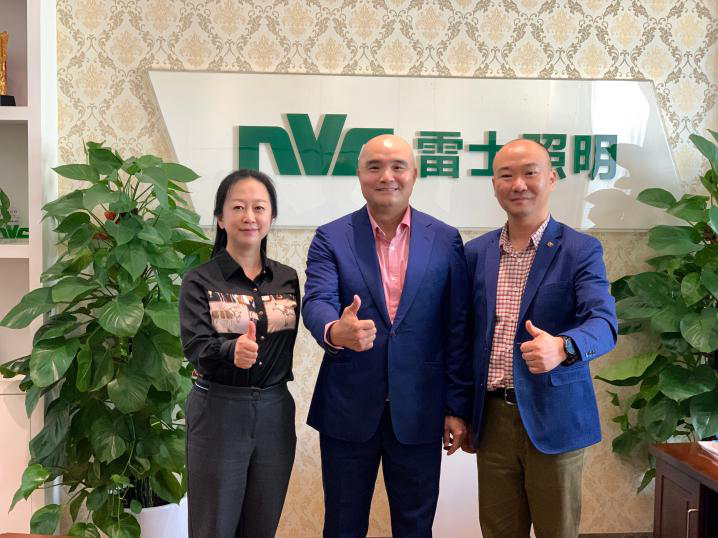
Image: NVC Lighting CEO Lin Liangqi (center)
China Light Network: After taking over as CEO of NVC Lighting, you proposed two sets of "sixteen characters" for the management of NVC Lighting, including top-down integration, which refers to the coordination between online and offline channels in the lighting industry. Could you elaborate on your specific plans?
Lin Liangqi: The most critical aspect of online-offline integration is resolving the conflicts between online and offline channels. NVC Lighting has seen rapid e-commerce growth over the past five years, which is a very positive development. However, against the backdrop of such swift e-commerce expansion, it inevitably encroaches upon or conflicts with some existing offline products, leading directly to either price competition or uncontrolled product cannibalization. Sometimes online prices are lower than offline ones, prompting consumers to buy online; yet online sales and operational performance do not truly reflect incremental market growth, but rather represent a redistribution within the existing market.
NVC Lighting's current online-offline integration focuses on two key aspects. The first is product differentiation: products available offline are not available online, ensuring strict segmentation at the product level. If the same product is offered both channels, its price control must be strict and consistent. This is a straightforward approach in theory, but challenging to execute, as major online promotions like the 618 Shopping Festival and Double 11 inevitably impact offline sales.
This brings us back to my original intention: how do we do it?
I established a group-level middle platform.
Previously, each of our business divisions was small but fully self-sufficient. For example, in e-commerce, we handled everything from product development and procurement to production, ordering, licensing, after-sales service, and even overall market operations.
The second most important point for integrating online and offline operations is to break down business units. The front office of business units is channel-oriented, focusing specifically on front-office activities and sales.
The purpose of establishing the middle platform is to span across business units. The cross-business-unit middle platform includes several aspects: marketing, supply chain, R&D, and quality control. The most important part of marketing is product management.
What does product management do? The first issue it addresses is our product matrix. Products no longer belong to business units; business units do not have ownership of products. The middle platform determines product categories and pricing. For example, ceiling lights: previously, ceiling lights might have belonged to the home category, meaning the home division held sales responsibility for ceiling light products. After vertical and horizontal integration, ceiling lights can be sold through all .
China Light Network: Last year during the Double 11 shopping festival, NVC also tried live streaming online, collaborating with streamer Viya to sell desk lamps. Will there be any changes in NVC's online sales channels in the future?
Lin Liangqi: Last year's Double 11 was a very successful attempt, and the live streaming results were also excellent. This year, we will continue our online operations, but we will further clarify the characteristics of online sales. Online sales are more focused on individual mobile products, such as DIY items or those requiring no service. First, we will further segment product categories. Second, our target audience is clearer; on the B2C side, the majority of consumers are young people, so our brand promotion will be more youthful. Women are also a very important demographic.
Another point is that our future e-commerce strategy will focus less on capturing offline market share and more on supporting and mutually driving traffic with offline channels. Online platforms can drive customers to physical stores, while physical stores can also direct traffic online, allowing the final transaction to occur either online or offline based on customer preferences.
In fact, the majority of lighting solutions require services, including last-mile delivery, installation, and offline support. Therefore, online and offline services must be integrated within the lighting industry. I believe that for any lighting company to achieve significant growth, it must pursue both simultaneously.
China Lighting Network: Due to the pandemic, lighting companies faced significant crises in 2020, but opportunities also emerged. How did NVC Lighting perform in 2020? What changes will be made to its product planning in 2021?
Lin Liangqi: It can be said that our performance last year followed a complete V-shape, declining from January to June, then rebounding starting in June and July. The full-year performance returned to pre-pandemic levels, basically the same as in 2019.
Last year, due to the pandemic and our transformation, we achieved relatively good results through a dual approach, which satisfied our shareholders. The key issue is that because we performed well in the second half of last year, our shareholders have higher expectations for us.
In product planning, the priority is improving product quality, gradually evolving into differentiated products to reduce low-end competition caused by cost pressures. Product quality comes first, followed by price or profit.
We have now set a very ambitious goal: RMB 10 billion in three years, and number one in five years. This means that NVC Lighting's total sales will double, becoming the leader in China's lighting industry within five years. To achieve this, commercial lighting must maintain its leading position, while home lighting and e-commerce must at least rank among the top one or two, thereby increasing our chances of success. Therefore, from a strategic perspective, our product R&D innovation and R&D teams are also evolving. We are moving towards healthier and smarter products, even pursuing integrated product R&D in the future, collaborating with building material companies to provide whole-house solutions or overall lighting solutions.
Secondly, regarding the sales team, we will further integrate front-office functions into the middle and back offices, clarify responsibilities more distinctly, and break down the regionalized structure of the operations centers.
Finally, one last point: address weaknesses, such as our smart products, power drivers, and O2O in channels (online mini-programs driving offline traffic), as well as engineering empowerment (from design to application). Additionally, there are two important channels: hardware channels and outdoor lighting.
NVC's frontline consists of indoor commercial lighting products, while outdoor lighting such as landscape lighting, smart poles, and garden lights are areas we aim to expand into.
China Light Network: With the popularization of fully furnished real estate, the smart home market is growing. What cross-industry collaborations does NVC have in this field?
Lin Liangqi: Smart home solutions are relatively straightforward. We have been consistently working in this area, including on e-commerce platforms. Intelligence encompasses control systems and data processing. Control systems are fairly mature; however, control systems for commercial lighting in the market still lag slightly behind.
We recently signed a strategic cooperation agreement with Tuya. Tuya's products are gradually being integrated into our commercial lighting system, and several product series will be launched soon.
The lighting industry has now reached a stage where cooperation, rather than competition, is needed. Since LED prices have dropped to rock-bottom levels, no one is willing to invest further. In addition, previous incentives from local governments to invest in LED have led to three major outcomes: first, severe overcapacity; second, product homogenization; and third, deterioration in product quality. To stay competitive, manufacturers increasingly use cheaper materials, resulting in some LED products being even cheaper and of worse quality than traditional products.
Therefore, I believe that the development of the industry requires cooperation. Excess production capacity must be fully utilized. Leading brands and large enterprises should play a pioneering role in attracting high-quality industry elements and talent to form an integrated ecosystem.
Returning to the topic of smart solutions: while many companies are developing smart software, what matters more is truly understanding how to integrate information. The NVC brand is well-positioned to do this on the lighting platform.
China Lighting Network: NVC has been deeply engaged in the commercial lighting sector for many years. How do you maintain such a leading position, given the numerous competitors catching up? What should future scenarios in commercial lighting look like?
Lin Liangqi: I think there are several aspects:
First, in terms of products, we continuously innovate by integrating smart and health-related features, as well as the all-in-one approach we just mentioned.
Secondly, in terms of market channels, the market may be segmented more finely, such as educational lighting, hospital lighting, rail transit lighting, factory lighting, restaurant lighting, venue lighting, hotel lighting, etc., becoming increasingly segmented, professional, and offering integrated solutions. Further segmentation, for example in hospitals, may include operating room lighting, ward lighting, corridor public lighting, and outpatient clinic lighting, taking all these into full consideration, leading to even finer segmentation.
Third is our team's service capability. From product design to the training, education, and onboarding of our designers, followed by involvement in the design and construction processes, and even after-sales service operations, we continuously enhance our engineering capabilities.
China Light Network: In the past three years, which niche market do you see as having the most promising prospects? Why?
Lin Liangqi: Now everyone is crowding into street lights and schools.
The new infrastructure strategy of the country will inevitably lead to many infrastructure projects. Street lights, being related, will certainly have good growth points, and there will also be significant investment in schools and healthcare facilities. In my personal opinion, three specific sectors will see excellent development: schools, hospitals, and hotels.
Currently, hotels have a relatively high level of intelligence and specialization; landscape lighting is part of local government fiscal expenditure, and its operational efficiency is not very good. This year, NVC has resumed focusing on Key Account (KA) developers, signing contracts with approximately 40 to 50 of the top 100 developers. Developers are a very important entry point for smart home solutions, and they are now gradually expanding beyond just residential interiors to include outdoor communities, shopping malls, and hotels. Therefore, KA developers are also a crucial aspect of our development strategy.