Mini LED Industry / Supply Chain and Corporate Layout Analysis (with Charts)
Source: 中国之光网|| Views: 13640
Mini LED Industry / Supply chain and Enterprise Layout Analysis
Recently, Samsung Electronics launched the new Neo QLED TV. In addition, it is reported that TCL will introduce a new Mini LED display technology during CES 2021 and apply it to new consumer electronics products. With continuous technological development, the application of Mini LED is becoming increasingly widespread. According to incomplete statistics, more than ten Micro LED/Mini LED products have been unveiled since the third quarter of 2020 alone. Mini LED offers better display performance and is thinner and lighter. Currently, there are two main applications: large-size LED displays and LCD backlighting. Backlighting application scenarios include TVs, mobile phones, tablets, e-sports, automotive, etc. Mini LED backlighting and display technologies have industrialization advantages and are an important track for future corporate layout.
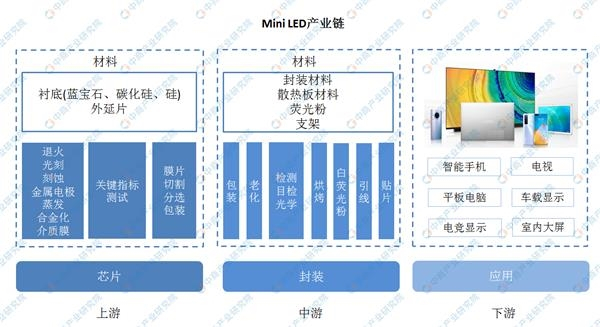
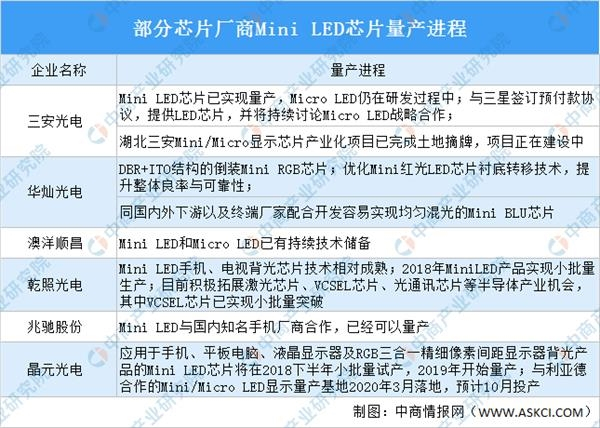
Source: Compiled by Zhongshang Industry Research Institute From the perspective of the industry chain, the Mini LED industry chain is divided into upstream chips, midstream packaging, and downstream applications. Midstream packaging refers to the process of connecting external leads to chip electrodes to form Mini LED devices. The main functions of packaging are to protect the chip and improve light extraction efficiency. Downstream applications mainly include mobile phones, televisions, tablets, automotive displays, etc. (1) Major LED chip manufacturers are actively expanding LED chip production capacity LED chip manufacturers are actively expanding production of mid-to-high-end products such as Mini LED. As the core of the fifth major display technology, Mini LED offers display quality close to OLED, but at a lower price than OLED, with low power consumption and long lifespan; the technology is already mature. Currently, manufacturers such as Sanan Optoelectronics and HC Semitek have entered the mass production stage for Mini LED chips.
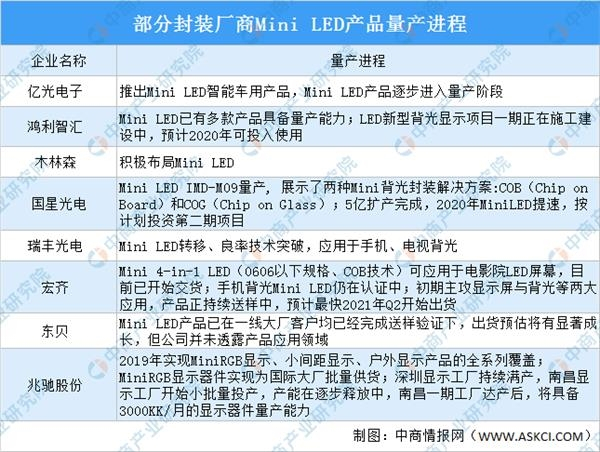
Source: Compiled by China Business Industry Research Institute (2) Packaging plants are actively expanding Mini LED production capacity Packaging refers to the process of connecting external leads to chip electrodes to form LED devices. The main functions of packaging are to protect the chip and improve light extraction efficiency. Currently, Mini LED products from manufacturers such as Nationstar Optoelectronics P0.9 Mini LED display products, Refond Optoelectronics, Hongli Zhihui, and MTC have begun small-batch production.
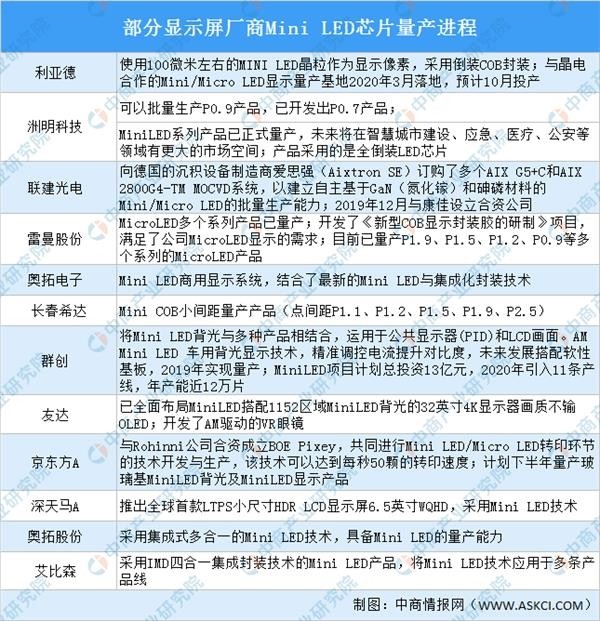
Source: Compiled by Zhongshang Industry Research Institute (3) Display manufacturers deploy Mini LED Mini LED has successfully met the technical, production capacity, and yield requirements, and is about to enter a fast lane of development, becoming a new blue ocean market for LED displays. Many manufacturers are vigorously laying out Mini LED, hoping to achieve overtaking on a bend. Currently, display manufacturers such as Leyard and Unilumin have already shipped P0.9 products.
Source: Compiled by China Business Industry Research Institute ( Source: China Business Industry Research Institute)
New breakthrough! Rohinni announces doubled Mini LED transfer speed
On January 11, US-based Rohinni announced a breakthrough in Mini LED transfer technology. Based on its new bonding head technology, the Mini LED transfer speed reaches 100Hz (100 times per second). It is claimed to be the fastest transfer speed currently available. Compared with Rohinni's first-generation transfer technology, the new technology effectively doubles the transfer speed and halves the cost.
Rohinni possesses a proprietary process that can efficiently and with high precision transfer Mini/Micro LED to the substrate. Between 2016 and 2019, Rohinni established joint ventures with three companies in succession to jointly promote the commercial application of Mini/Micro LED.
In December 2016, Rohinni and keyboard membrane switch manufacturer Key Tronic jointly established the Luumii joint venture, aiming to promote the application of Micro LED technology in keyboard and logo backlight products.
Around September 2018, Rohinni and Magna Electronics established the joint venture Magna Rohinni Automotive, aiming to produce ultra-thin Micro LED lighting solutions.
In December 2019, Rohinni and BOE established a joint venture Micro LED company, BOE Pixey, to jointly produce Micro LED solutions for display backlights.
Currently, BOE Pixey mainly focuses on the technology development and production of the Mini/Micro LED transfer process. This technology can achieve a transfer speed of 50 chips per second while ensuring high efficiency and high precision.
Rohinni admits that the company's new technology helps joint ventures in various fields increase production speed and reduce production costs.
In terms of applications, Rohinni states that OEM manufacturers in markets such as consumer electronics, automotive, and outdoor signage can adopt its transfer technology to produce products superior to existing market offerings, achieving higher luminance, thinner and lighter profiles, and lower power consumption.
Rohinni stated that Mini LED is expected to be widely used in high-end applications such as TVs, video walls, and consumer electronics (tablets and laptops) in 2021.
Rohinni's new technology enables true mass production at a lower cost, which means lower product prices for consumers. Overall, it helps drive the rapid adoption of Mini LED, encouraging manufacturers to start new designs to meet the upcoming wave of Mini LED products.