
OSRAM's Xie Wenfeng: Embrace Change, Improve People's Lives with Optoelectronic Technology
On October 10, at the GILE (Guangzhou International Lighting Exhibition), Xie Wenfeng, Vice President of Sales for Greater China and Japan at OSRAM Opto Semiconductors, was interviewed by Hong Bing, Editor-in-Chief of Light of China Network & Agricultural Lighting Network, and Liu Chang, Head of South China Region at Light of China Network, under the program "Times Hong Liu". Mr. Xie addressed questions regarding OSRAM's market situation and development strategies.
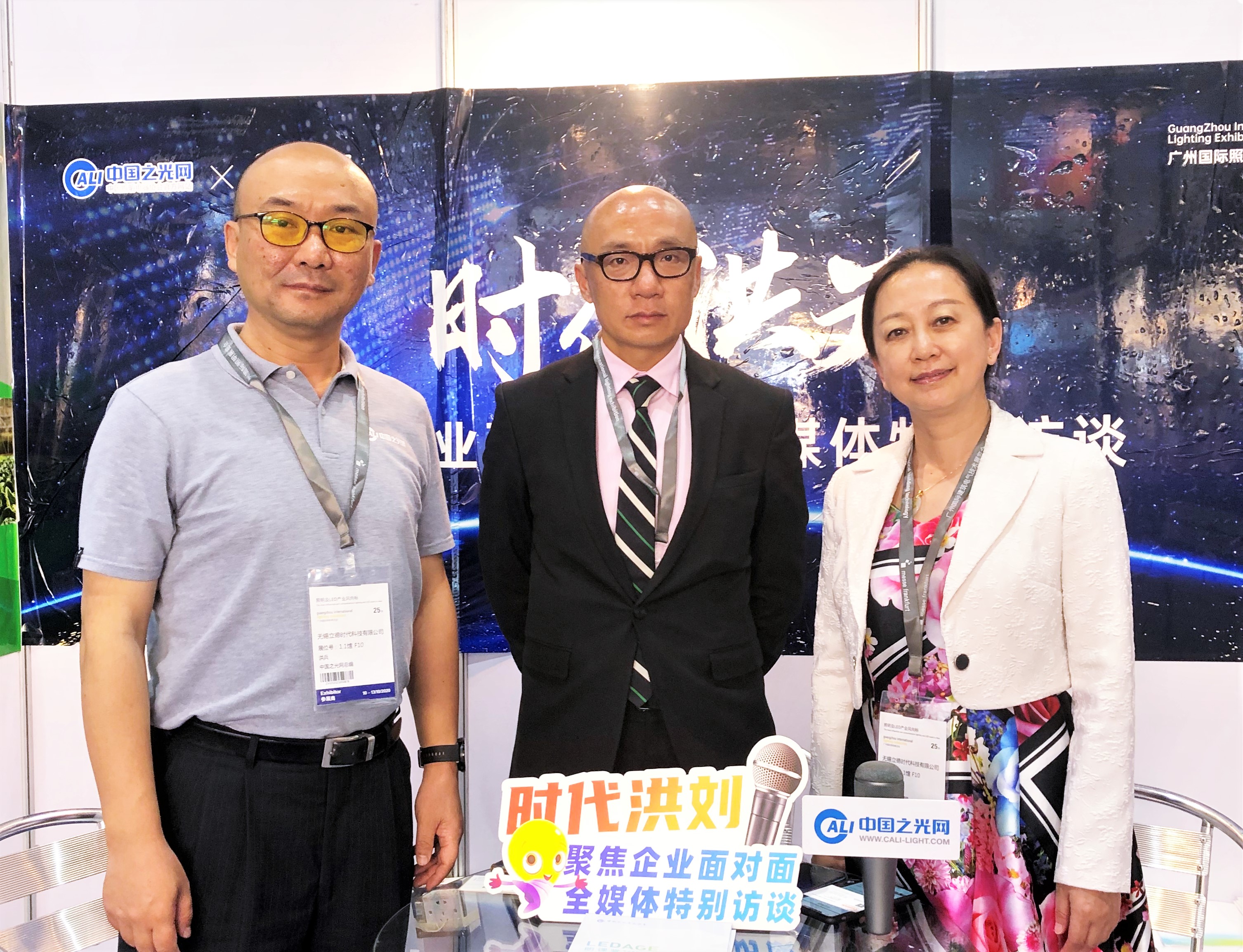
(from left to right: Hong Bing, Xie Wenfeng, and Liu Chang)
Below is the full interview:
How was the market situation faced by OSRAM globally in the first few quarters of this year? What was the situation domestically? How did OSRAM respond?
Xie Wenfeng: This year, the global economy has been impacted by the pandemic. OSRAM has also been affected to some extent. According to the company's previously released third-quarter financial report, OSRAM's revenue for the third fiscal quarter was €606 million, a 29.4% decrease on a comparable basis year-over-year.
On the other hand, since the onset of the pandemic, the company has implemented crisis management measures globally, such as effective liquidity management and cost reduction with efficiency improvement, effectively mitigating the impact of the pandemic. The group's free cash flow was controlled at negative €7 million. Compared to major sales markets in the industry, performance exceeded expectations. EBITDA before special items was negative €27 million, significantly better than expected. In the Optoelectronic Semiconductors (OS) business, revenue amounted to €297 million, adjusted EBITDA reached €36 million with a margin of 12.2%, and positive free cash flow of €24 million was achieved again.
Previously, due to various uncertainties caused by the global pandemic, OSRAM revised its fiscal 2020 performance guidance in the first half of the year, lowering related financial forecasts. However, in September, the company announced an upward revision to its fiscal 2020 performance guidance. Currently, the Board expects Revenue to decrease by approximately 14% on a comparable basis, whereas the previous estimate was a decline of 15%-19%. The adjusted EBITDA margin is expected to be around 8%, compared to the previously estimated range of 3%-6%. Free cash flow is projected to remain flat, whereas it was previously expected to be negative.
Although the global pandemic has not yet ended, fortunately, OSRAM is showing clear signs of recovery, especially in the domestic market, where factory production capacity has returned to pre-pandemic levels. The improvement in the core market situation in China has benefited the Opto Semiconductors division, resulting in solid performance. OSRAM's fiscal year 2020 has ended; although the annual financial report has not yet been released, I believe the overall performance will be more optimistic than expected.
In response to the pandemic "black swan" event, OSRAM implemented effective liquidity management measures on one hand, while market demand shifted on the other. We continue to focus on technological innovation and product development, providing solutions that meet people's needs.
During the pandemic, the UV disinfection lighting market surged. Has OSRAM made corresponding adjustments and new plans?
Xie Wenfeng: After the pandemic, the UV sterilization market has regained significant attention, with rapid overall growth. OSRAM has also increased its investment in the UV sterilization field. In March, we donated UV sterilization lamps to hospitals in Wuhan. OSRAM's series of UV sterilization products and solutions are favored by the market in various application scenarios such as hospitals, campuses, and industrial settings. We have even developed and launched an in-vehicle UV sterilization system.
The effectiveness of UV disinfection against the novel coronavirus has been verified by numerous authoritative third-party reports. For OSRAM, "UV disinfection + sensing" is a promising direction. We have deep technical expertise in the sensing field and aim to effectively combine UV disinfection technology with sensing technology to meet the needs of various application scenarios. Currently, one of the biggest concerns about UV disinfection in the market is the potential damage to human eyes and skin. By integrating sensing technology to achieve intelligent detection, we ensure that lights turn off when people are present. If someone is detected within the UV radiation range, the power is immediately cut off, effectively preventing injury risks caused by accidental activation, forgetting to turn off the lights, or unauthorized entry.
Which market do you see having the most promising development in automotive, residential, office, commercial, UV, and horticultural lighting sectors? Why?
Xie Wenfeng: It can be said that each field has its own market characteristics, making comparisons difficult. Currently, many technologies are already quite mature; however, market demands are constantly changing. The key lies in how to combine different technologies and apply them to various scenarios to meet these evolving market needs. For instance, UV sterilization can be applied in white goods such as refrigerators and air conditioners, as well as in wastewater treatment and even within vehicle interiors.
For OSRAM Opto Semiconductors, UV and horticultural lighting are currently key focus areas. Taking horticultural lighting as an example, it is developing rapidly in China. Although the scale is not yet large, the growth potential is considerable. Many people perceive that due to persistently high costs, horticultural lighting has remained in a situation of "high praise but low adoption." However, market demand is gradually undergoing new changes. In addition to fields such as the cultivation of precious medicinal herbs, many customers with high-quality requirements for plant freshness have already deployed vertical farming solutions. For instance, salad vegetables like lettuce and herbs like basil require immediate harvest and use, while transportation costs are relatively high. With advancements in horticultural lighting technology, I believe that costs will see a significant decrease in the foreseeable future.
OSRAM has conducted significant research in the field of autonomous driving technology, such as LiDAR technology. When do you think autonomous driving technology will be widely implemented?
Xie Wenfeng: On March 9, the official website of China's Ministry of Industry and Information Technology published the draft for approval of the recommended National standard (mandatory / recommended) "Classification of Driving Automation for Vehicles", which is scheduled to take effect on January 1, 2021. This classification standard divides driving automation into levels 0–5 based on the extent to which the driving automation system can perform dynamic driving tasks, according to role allocation in performing dynamic driving tasks and whether there are limitations on operational design domains. The industry believes that the introduction of national standards is a key prerequisite for the development and large-scale application of autonomous driving technology, and clear classification standards will help promote the mass production and implementation of various autonomous vehicles.
Autonomous driving technology is the integration of a series of core technologies, including recognition and monitoring technology, positioning technology, communication security technology, human-machine interaction technology, and more. When autonomous driving technology can be implemented on a large scale depends on the maturity of the development of each technology itself, as well as the maturity of the integration of these technologies. A specific timeline cannot be predicted, but I believe that this day will not be far off. Globally, many cities have already opened up road testing, and even road testing for driverless taxi services has emerged.
LiDAR is just one component of these technologies. As the "eyes" of autonomous vehicles, it is one of the most important sensors and plays a significant role in ensuring driving safety. Achieving L4 autonomy requires the integration of LiDAR, high-precision maps, environmental perception, and other technologies, making it significantly more complex than L3. With its high-precision and high-reliability detection capabilities, LiDAR is generally considered an essential core sensor for L3–L5 autonomous vehicles. According to MarketsandMarkets, the market size for LiDAR used in autonomous driving and other applications is expected to grow from USD 844 million in 2019 to USD 2.273 billion in 2024, with a compound annual growth rate (CAGR) of 18.5% from 2019 to 2024.
As a technology leader in the LiDAR field, OSRAM Opto Semiconductors has been committed to innovation in applications within this domain. OSRAM has developed LiDAR systems for high-resolution near-field detection, which generate real-time high-resolution 3D information by mapping the vehicle's surrounding environment in 3D using infrared pulsed lasers. This ensures comprehensive visibility of driving conditions on highways and urban traffic situations, contributing technological innovations to the realization of autonomous driving and intelligent transportation.
Compared to radar sensors, LiDAR systems offer significant advantages by generating high-resolution 3D view information in real time over long distances. Modern systems produce tens of thousands of data points. Compared to high-resolution camera systems, the 3D "view" and the ability to directly measure distance to objects provide decisive advantages. Therefore, security systems leverage LiDAR technology to detect differences between shadows and spatial objects. LiDAR also offers outstanding performance in dark environments, providing useful data even under backlight conditions.
Alvin Tse
Vice President of Sales, Greater China and Japan, OSRAM Opto Semiconductors
Mr. Xie Wenfeng joined OSRAM in July 2020 as Vice President of Sales for Greater China and Japan in the OSRAM Opto Semiconductors division, responsible for formulating and executing sales strategies and plans for mainland China, Hong Kong, Taiwan, and Japan, and managing major regional sales projects, marketing activities, business development, and channel management.
Mr. Xie Wenfeng is a veteran in the LED industry, with over 25 years of experience in product development, sales, and marketing in the Asia-Pacific region, covering traditional lighting, SSL, and LED components. Additionally, he provides LED solutions and serves as an executive manager in fields such as SSL, mobile flash memory, TV and display backlighting, and automotive.