
Certification Rules for High-Quality Lighting Environment in Classrooms
At the first session of the "Discussion on High-Quality Classroom Lighting Environment" cloud forum series jointly organized by the China Association of Lighting Industry (CALI) and the China Quality Certification Center (CQC), Chen Song, Deputy Manager of the New Energy Product Certification Department at CQC, shared insightful content on the "CQC Certification Requirements for High-Quality Classroom Lighting Environment." This helped attendees gain a clearer understanding of the certification rules, quality testing, and relevant standards for classroom lighting (especially the classroom lighting environment). Key points are summarized below:

Chen Song
Deputy Manager, New Energy Product Certification Department, China Quality Certification Center (CQC)
Secretary of the CNCA TC05 Lighting Appliances Technical Expert Group
Member of the Luminaire Subcommittee of SAC/TC 224
I. A Premise/Perspective
1. A good classroom lighting environment is defined as a high-quality lighting optical environment for classrooms, rather than a [[12. 健康照明与非视觉效应]] environment. Lighting effects can be evaluated for quality, but there is currently no unified standard, definition, or terminology for healthy lighting.
A high-quality classroom lighting environment refers to a classroom lighting environment that uses safe and energy-saving luminaires, and through reasonable design, installation, and maintenance, continuously complies with the requirements of CQC certification rules. In summary, classroom lighting should achieve:
"Good Luminaire + Good Design + Good Construction + Good Maintenance"
II. Certification Requirements for Classroom Lighting
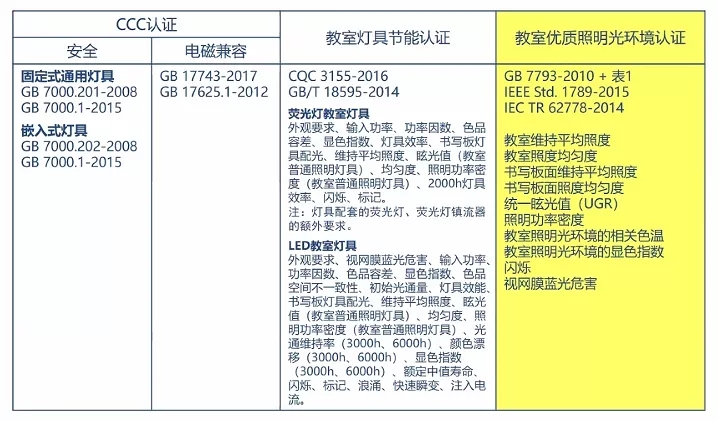
(Not only focus on product certification for classroom lighting, but also on the certification of the classroom lighting optical environment.)
1. Certification Rules for Classroom Lighting Products
Luminaires used in classroom lighting shall pass China Compulsory Certification and CQC Energy saving certification for classroom lighting products.
(1) CCC (Compulsory Safety Certification): CQC-C1001-2014 "Implementation Rules for Compulsory Product Certification - Lighting Appliances"
(2) CQC (Voluntary Energy Saving Certification): CQC31-465318-2016 "Energy Saving Certification Rules for Lighting Products in Primary and Secondary Schools and Kindergarten Classrooms"
2. Certification Rules for High-Quality Classroom Lighting Environment
CQC (Voluntary Lighting Environment Certification): CQC16-465199-2020 "Certification Rules for High-Quality Classroom Lighting Environment", implemented since January 21, 2020.
Technical requirements: The lighting environment in classrooms shall comply with GB 7793-2010 "Hygienic standard for daylighting and lighting in primary and secondary school classrooms" and the requirements in Table 1:
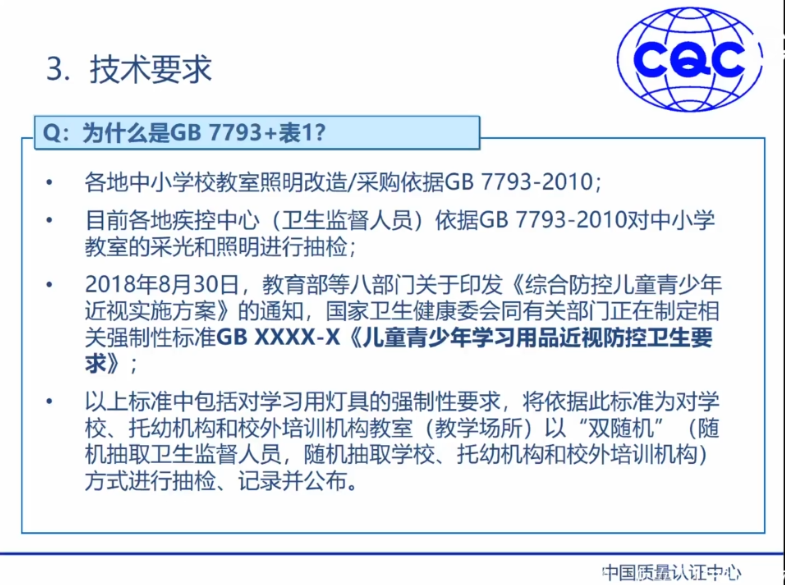
▼Table 1:

(9 test items, 10 indicators)
3. Features of Certification for High-Quality Classroom Lighting Environments
1. Standard compatibility:
Based on GB 7793-2010 "Hygienic Standard for Daylighting and Lighting in Primary and Secondary School Classrooms": National standard of the Ministry of Health
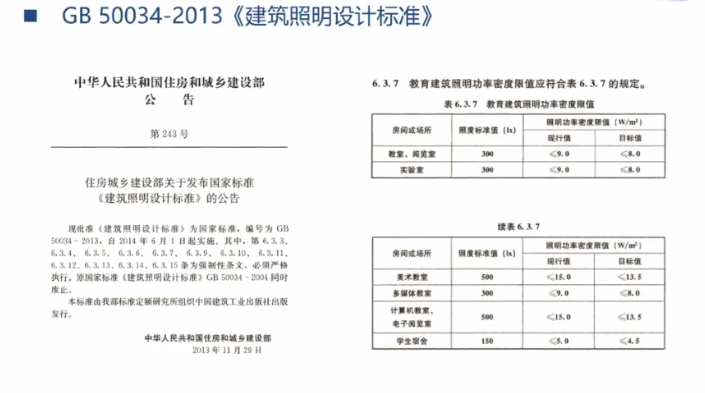
Complies with the mandatory provisions of GB50034-2013 "Standard for lighting design of buildings": a standard of the Ministry of Construction
Compatible with CQC3155-2016 "Technical Specification for Energy Saving Certification of Lighting Products in Primary and Secondary Schools and Kindergarten Classrooms"
Closely follow GBXXX-XXX "Hygiene Requirements for Myopia Prevention and Control in Learning Supplies for Children and Adolescents": a standard currently being developed by the National Health Commission (not yet released, mandatory standard)
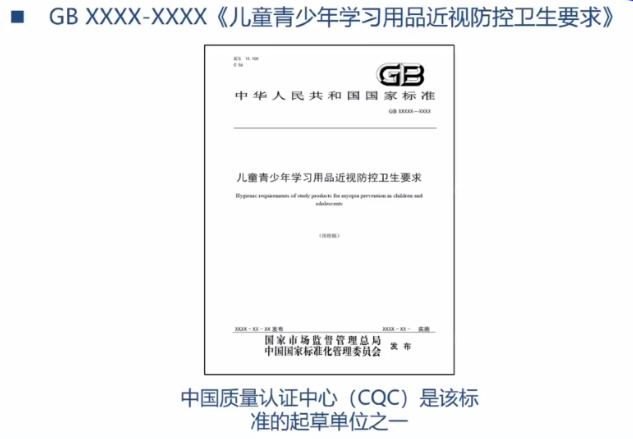
It is reported that the release of this standard will play an important role in protecting children's vision health and promoting the standardized development of China's learning supplies printing industry, luminaire industry, and other industries related to learning supplies for children and adolescents.
Scope and main technical content:
(1) Scope of this standard. This standard is a mandatory national standard in its entirety. It specifies the hygiene requirements and test methods related to vision protection for children's and adolescents' learning supplies, including textbooks, supplementary teaching materials, examination papers, exercise books, study magazines, newspapers and other printed matter and publications, as well as classroom lighting, desk lamps for reading and writing, and multimedia teaching projection equipment. It applies to enterprises that produce, manufacture, or use children's and adolescents' learning supplies, as well as primary and secondary schools and secondary vocational and technical schools.
(II) Main Technical Content: The main technical indicators involved include: (1) Paper quality requirements for textbooks, supplementary materials, exam papers, exercise books, newspapers, periodicals, and other printed matter and publications, including indicators such as paper basis weight, D65 Luminance, Chromaticity values, smoothness, fluorescent whiteness, opacity, print solid density, and registration error; (2) Requirements for font type, font size, and line spacing; (3) Specifications and dimensional requirements for grid lines; (4) Lighting requirements for classroom lighting and luminaires for study, including indicators such as Illuminance levels, Luminance, Maintenance factor, Uniformity of illuminance, Unified glare rating (UGR), source Color temperature, Color rendering index (CRI), and Retinal blue light hazard; (5) Indicators for teaching projection multimedia screens, such as screen Luminance, resolution, color gamut, refresh rate, and Maintenance factor. (Content sourced from the public draft for reference only; please refer to the final official version after publication.)
2. Simplify the process as much as possible while ensuring effectiveness
Classroom Quality Lighting Environment Certification adopts a service model of "initial on-site testing + initial on-site inspection + post-certification supervision".
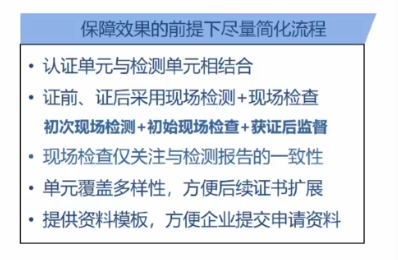
Among them, the certification rules are:
In principle, the user entity serves as the certification unit, with each user entity constituting one certification unit.
Different certification applicants, different classroom lighting environment construction units, and different user units shall be treated as separate certification units.
For detailed certification rules, full video explanations, and Q&A, scan the QR code below to watch the replay on Mingketang.

The full version of the standard is available on the China Quality Certification (CQC) website,
Or leave a message in the background of China Light Network.
Business Inquiry:
Qiu Chun 15861553579
qiuchun@cali-light.com
China Light
The official website of the China Association of Lighting Industry and a full-media platform for the lighting sector. We provide authoritative and timely lighting information while striving to be a growth partner for businesses. From brand promotion and channel expansion to consulting, talent training and participation in standards development, we provide comprehensive professional services to help businesses improve quality and efficiency and jointly advance the high-quality development of the lighting industry.
Business Contacts
仇纯 (Ms.): 158 6155 3579
顾君 (Mr.): 137 7157 5253