
The Ecological and Environmental Code officially comes into effect on August 15! Are your streetlights still compliant?
Foreword
On August 15, National Ecological Day, the Civil Code of the People’s Republic of China on Ecological Environment officially came into force. Adopted by the Fourth Session of the 14th National People’s Congress on March 12, 2026, this code is China’s second law to bear the title “Code,” following the Civil Code, and also the world’s first code named after “ecological environment.” It comprises five parts and 1,242 articles, covering general provisions, pollution prevention and control, ecological protection, green and low‑carbon development, legal liabilities, and supplementary provisions.
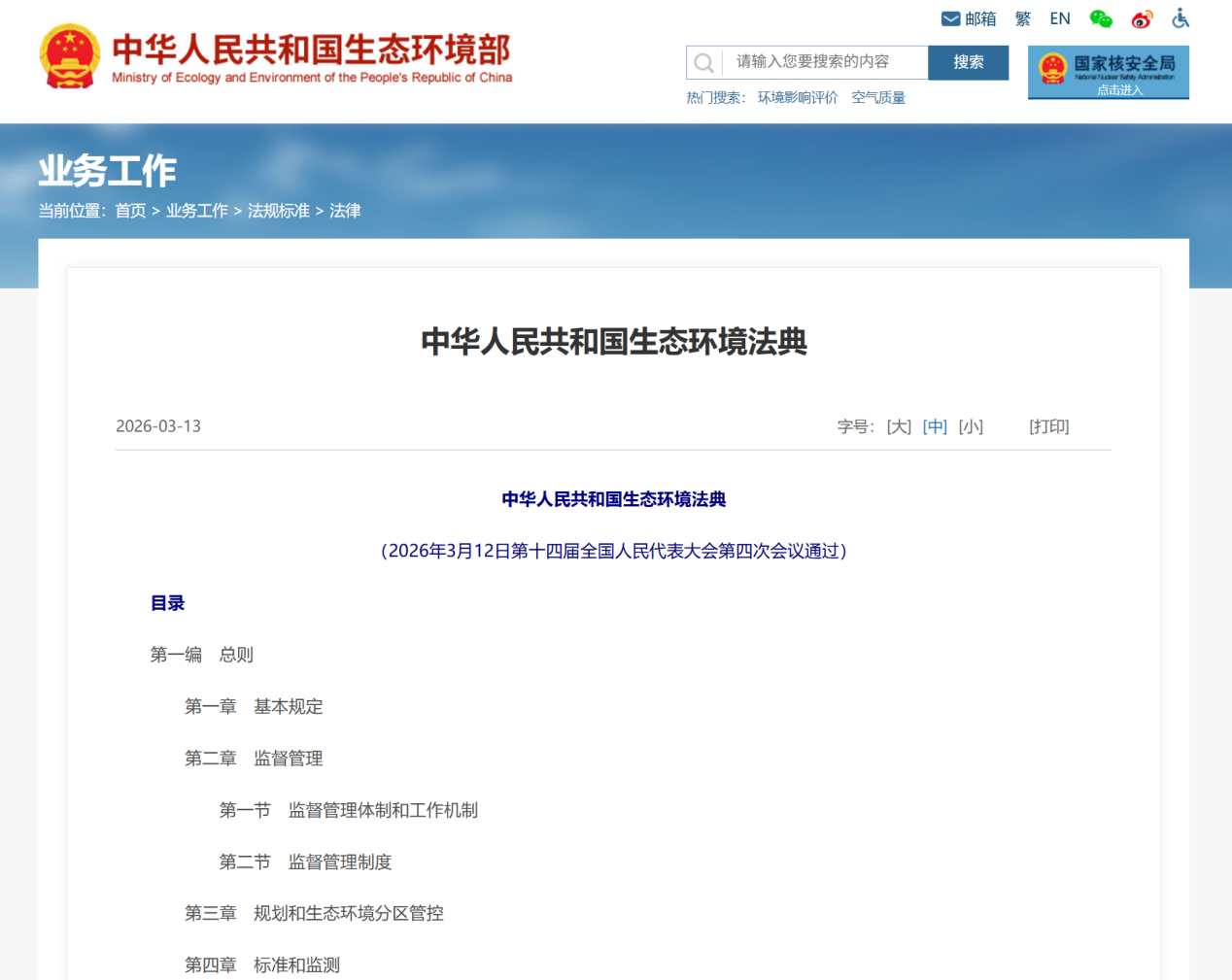
The Code systematically integrates pollution prevention and control, ecological protection, and green, low‑carbon development into a legal framework. In particular, Part Four, “Green and Low‑Carbon Development,” includes dedicated chapters on energy conservation and the transition to green, low‑carbon practices, while Part Two introduces, for the first time, a specific chapter on “Light Pollution Prevention and Control.” For municipal lighting—characterized by broad coverage, substantial energy consumption, and close ties to public life—this not only represents a mandatory compliance requirement but also presents a new policy opportunity for urban green upgrades.
From “Lighting Up” to “Going Green”
Has your street lighting kept pace with the Code?
Municipal lighting, as a core component of urban public infrastructure, has long prioritized ensuring adequate illumination. With the implementation of the Code, however, municipal lighting has been formally brought under a standardized, refined ecological regulatory system: light pollution now has a clear legal definition, energy conservation is backed by statutory provisions, and the transition to green, low‑carbon solutions is supported by institutional safeguards.
This means that municipal lighting is no longer merely an infrastructure issue of “is it lit or not?” but rather a governance challenge concerning “compliance, greenness, and smartness.” Article 667 of the Code defines light pollution for the first time at the legal level as “the phenomenon where excessive or inappropriate use of artificial lighting, or improper alteration of natural daylight conditions, disrupts human vision in the surrounding living environment”; Article 1004 explicitly calls for “actively promoting market‑based energy‑saving services such as contract energy management.” From excessive illumination to light pollution, from high energy consumption to inefficient management, every shortcoming will become a strict criterion in compliance assessments.
Proactive Upgrading Is Better Than Reactive Remediation
Under the Code, those who act first will reap the benefits!
The enactment of the Code does not impose a straitjacket on municipal lighting; instead, it opens a policy window for urban green upgrades.
Currently, many cities across China face the following common challenges:
Low‑efficiency luminaires and persistently high overall energy consumption
Excessive or ineffective lighting on certain road segments, leading to significant light pollution
A single‑source energy mix, with long‑term reliance on traditional grid power
Loose management practices, lacking digital monitoring tools for energy use and emission reduction data
These issues not only fail to meet the Code’s requirements for ecological protection, pollution prevention, and green, low‑carbon development, but also point to vast potential for upgrading.
In this context, leveraging market‑driven, professional approaches to implement energy‑efficient retrofits, optimize lighting environments, transition to renewable energy, and adopt digital management has become essential for local governments seeking to fulfill the Code’s mandates and seize opportunities for green transformation. Compliance is not the end goal—it marks a new starting point for municipal lighting as it evolves from “traditional illumination” toward “smart, zero‑carbon” solutions.
How to Pass the Compliance Test?
Guanan’s Four Core Competencies
Help You Achieve One‑Stop Compliance and Systematic Upgrades!
With over two decades of expertise in municipal lighting energy efficiency, Guanan Energy adheres to the principles of “safety, zero carbon, and intelligence,” aligning its core business closely with the spirit of the Code.
Even before the Code took effect, Guanan had already completed more than 30 EMC projects and retrofitted 600,000 luminaires, demonstrating the value of market‑based energy‑saving models. Now, with the Code in force, Guanan is not passively adapting—it is proactively leading the way, leveraging four core capabilities to help municipal lighting achieve one‑stop compliance and systematic upgrades.
1/EMC Energy Management: Zero‑Cost Compliance Upgrades
Article 1004 of the Code explicitly states that the state “actively promotes market‑based energy‑saving services such as contract energy management.” Guided by its EMC energy‑management model, Guanan offers a “zero‑investment, zero‑risk, fully managed” retrofit solution: Guanan funds the upgrade, customers entrust their electricity bills to Guanan, and upon contract expiration, the equipment reverts to the customer. Having implemented over 30 large‑scale EMC projects and retrofitted more than 600,000 luminaires, Guanan has enabled public institutions to complete upgrades without any upfront investment, easily clearing the threshold for Code compliance.
2/Precise Light Distribution and Pollution Control: Tackling Light Pollution at Its Source
Article 667 of the Code legally defines light pollution, marking a shift from soft recommendations to binding regulations. Guanan has developed a dual‑layer lighting system featuring “one strategy per route plus on‑demand dimming,” customizing light distribution plans for main roads, secondary streets, residential areas, commercial districts, and other settings. Paired with high‑quality cutoff luminaires, this approach precisely controls light spillage, minimizing glare at the source. Simultaneously, dynamic dimming adjusts lighting based on ambient light levels, traffic flow, and weather conditions, significantly reducing unnecessary illumination and energy waste while balancing traffic safety with urban ecological quality—ensuring every beam of light is lawful, reasonable, and appropriately calibrated.
3/Light‑Storage Integration for Transformation: Building an Autonomous Green Power Supply System
Article 1021 of the Code encourages energy users to prioritize clean, low‑carbon sources such as renewables. Guanan’s integrated light‑storage module incorporates photovoltaic panels, energy storage batteries, light‑storage inverters, and an advanced energy‑management system, creating an independent green power supply: during the day, solar energy is converted into electricity, with surplus stored in batteries for on‑demand use, breaking away from the traditional reliance on grid power. This effectively cuts municipal electricity costs and carbon emissions, while providing emergency backup during grid outages, delivering multiple benefits—energy savings, carbon reduction, and enhanced safety—and supporting the city’s broader green energy transition.
4/Smart Digital Operations: Making Compliance Data Traceable, Auditable, and Accessible
Article 25 of the Code calls for “enhancing the informationization, digitization, and intelligentization of ecological environmental protection supervision and management.” Guanan has independently developed a digital energy‑management platform that meets the Code’s requirements for digital, precise, and traceable oversight. The platform establishes a multi‑tiered energy‑consumption analysis system, automatically generates operational reports, conducts energy‑consumption comparisons, calculates energy savings, and traces electricity usage—eliminating traditional manual accounting methods. At the same time, it archives comprehensive equipment and energy‑consumption data, building a digital asset ledger that ensures full traceability, auditability, and accessibility of all relevant information, fully satisfying the compliance assessment needs of municipal lighting and ensuring that every kilowatt‑hour saved is verifiable and accountable.
The Code Has Taken Effect—Compliance Waits for No One.
Guanan Joins Forces with You
To Make Every Streetlight in Your City Green and Compliant!
With the Code in force, municipal lighting has entered a new phase of ecological, low‑carbon, and compliant development. This is both a crucial legal test and a historic opportunity for urban green upgrades. Guanan Energy will remain firmly anchored in the Code’s standards, continuously refining its technologies and services, drawing on more than two decades of expertise to help municipalities worldwide reduce carbon emissions, curb pollution, and enhance ecological quality.
Source: Zhejiang Guanan Energy Technology Co., Ltd.