
Opposing the notion that “higher luminous efficacy always means greater energy efficiency”: Energy‑efficiency assessments in lighting must shift from “device efficiency” to “system‑level effective illuminance”—luminous efficacy is merely a sufficient condition, while equivalent power density (NPD) is the necessary one.
I. Introduction: A Mythologized Metric
In the lighting industry, “the higher the luminous efficacy, the more energy‑efficient” has almost become an unquestionable “axiom.” Tender documents list it as a mandatory criterion, companies tout it as their core selling point, and designers adopt it as their primary selection guideline. High luminous efficacy is virtually synonymous with lighting energy efficiency, sparking a veritable race to achieve ever‑higher values.
However, this seemingly self‑evident proposition is, in fact, the biggest misconception in the field of lighting energy efficiency.
Luminous efficacy (lm/W) is merely a measure of how efficiently a light source converts electrical energy into light; it is neither equivalent to system efficiency nor to actual energy savings. Treating high luminous efficacy as a panacea for energy conservation represents a fundamental misunderstanding of lighting systems. In 2017, Shanghai Yiyong Optoelectronics Technology Co., Ltd. introduced the “Adaptive Luminous Efficacy” theory (published in Electrical Lighting, Issue 4, 2017), which challenges this conventional thinking: luminous efficacy is a dynamic variable that depends on the specific application scenario.
This article systematically demonstrates, from six perspectives, that “the higher the luminous efficacy, the more energy‑efficient” is a false premise. Assessments of lighting energy efficiency must shift from “device efficiency” to “system‑level effective illuminance,” while evaluations of lighting quality should move away from “parameter‑driven competition” toward “scene‑specific adaptation.”
II. Logical Misalignment: Sufficiency Does Not Equal Necessity
The first fallacy of the claim “higher luminous efficacy equals greater energy efficiency” lies in a fundamental misplacement of logical relationships.
High luminous efficacy refers to the amount of luminous flux (lm/W) produced per watt of power consumed by the light source—it measures capability: how much light can be generated per unit of power. By contrast, energy efficiency seeks outcomes—minimizing electricity consumption while meeting visual requirements.
The relationship between these two concepts is clear: high luminous efficacy is a sufficient condition for energy efficiency (high efficacy → potential energy savings), but not a necessary one (energy efficiency does not require high efficacy). More critically, under certain usage conditions, high luminous efficacy may even lead to reduced energy savings: when a light source emits far more light than the scene actually needs, excess luminous flux must be curtailed through methods such as reducing power or adding shading accessories—processes that inherently incur efficiency losses. The theoretical gains associated with high efficacy are thus largely offset by these suppression measures, resulting not in energy savings but in additional wasted light output.
Deriving lamp energy efficiency directly from high luminous efficacy constitutes a classic causal error. The proper logic chain for lighting energy efficiency should be: “scene requirements → target illuminance → effective luminous flux → calculated power,” rather than “high efficacy → low power → energy savings.” The essence of energy efficiency lies in “lighting on demand,” not “unlimited supply.”
III. Attribution Error: The True Source of LED Energy Efficiency Is “Directional Emission,” Not “Efficacy Numbers”
The second fallacy of the “higher efficacy, greater energy efficiency” argument stems from an incorrect attribution of LED energy‑saving advantages.
It is undisputed that LEDs consume less energy than traditional light sources at comparable levels of luminous efficacy. However, interpretations of this phenomenon often contain significant biases. The fundamental reason LEDs outperform traditional lamps (such as metal halide or fluorescent lights) lies in their directional emission characteristics: LED beams typically have a half‑power angle of ≤180°, whereas traditional lamps emit light in all directions (360°). Because LEDs are directional, their luminous utilization factor can reach 0.8–0.9, while other light sources usually achieve only 0.4–0.5.
Traditional lamps’ 360° emission means that at least 30%–40% of the emitted light must be redirected back toward the intended area via optical components, leading to substantial losses due to absorption and scattering during repeated reflections. In contrast, LEDs’ directional emission allows for much higher luminous utilization. Consequently, even when light sources exhibit identical luminous efficacies, using LEDs can save considerable energy compared to traditional alternatives.
The conclusion is self‑evident: the real driver of LED energy efficiency is the “luminous utilization factor (CU),” not the laboratory‑reported efficacy value. With equal efficacy, LEDs are more energy‑efficient; however, high efficacy alone does not guarantee LED energy savings. Attributing LED’s energy‑saving benefits solely to “high efficacy” represents a classic case of reversed causality. In practical applications, the luminaire’s photometric design, installation method, and characteristics of the illuminated surface collectively determine the required power level, with luminous efficacy serving merely as one of many secondary parameters.
IV. Variable Misalignment: Efficacy Is a Dependent Variable, Not a Constant
The third fallacy of the “higher efficacy, greater energy efficiency” claim arises from treating static laboratory parameters as universal constants.
The “nominal efficacy” measured in the lab reflects a static peak under specific conditions—25°C and rated current. In real‑world use, however, efficacy fluctuates dramatically depending on the application scenario: elevated junction temperature (Tj) causes a sharp drop in efficacy; PWM dimming or analog dimming results in non‑linear changes in efficacy relative to output power; installing diffusers, lenses, anti‑glare grids, or other optical accessories can reduce efficacy by 15%–40%; color temperature and color rendering index also significantly affect performance; and system factors such as power supply efficiency and thermal management further influence actual efficacy.
Whether through physical light control (lenses, reflectors, baffles) or intelligent dimming (light sensors, timers, human‑presence detectors), efficacy varies dynamically with each specific scene. Efficacy is a dependent variable tied to the illuminated environment, with the scene serving as the independent variable. Applying a single laboratory figure across all scenarios is akin to marking a boat’s position on the riverbank after it has already passed.
At the heart of the “adaptive efficacy” theory is the recognition that the benchmark for evaluating lighting energy efficiency should be “scene‑specific efficacy”—measured as the product of system efficacy and effective luminous flux utilization, reflecting the true energy‑saving value of a light source within its actual operating context, rather than relying on isolated device‑level efficacy figures obtained in the lab.
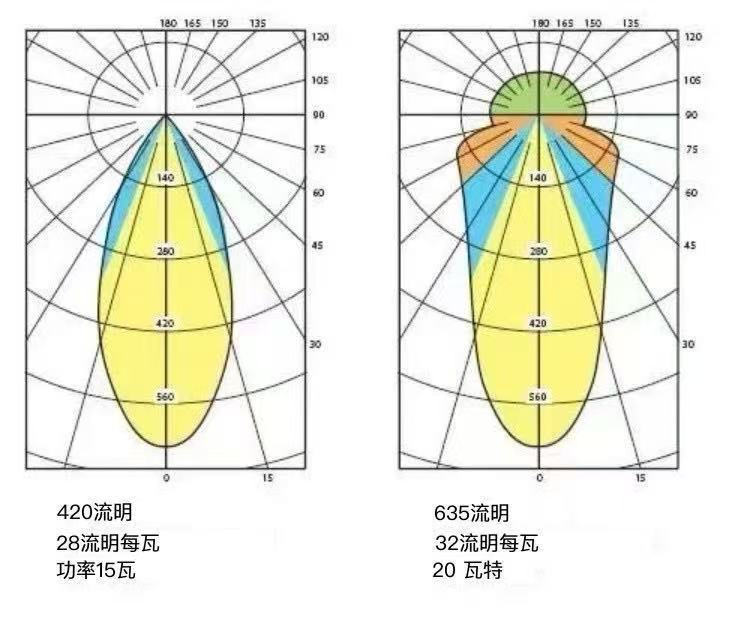
Figure 1: Meeting lighting scene requirements (yellow area): Left image shows slightly lower efficacy, with power set at only 15 W. Right image exhibits higher efficacy, but requires 20 W.
V. Standard Misfocus: Power Density Should Be the Sole Criterion for Evaluating Lighting Energy Efficiency
The fourth fallacy of the “higher efficacy, greater energy efficiency” argument lies in a fundamental misalignment of what is being assessed.
Efficacy evaluates the light source (device), whereas energy efficiency assesses the entire system. Treating light‑source parameters as indicators of system‑level energy savings is like using an engine’s “thermal efficiency” to judge a car’s fuel economy instead of measuring the vehicle’s overall “fuel consumption per 100 km”—a nonsensical and unscientific approach.
The ultimate standard for determining lighting energy efficiency should be: under the prerequisite of meeting scene‑specific requirements for target illuminance, uniformity, glare limits, and other quality criteria, achieving the minimum power density needed for that particular setting. The sole criterion for selecting a light source—whether its efficacy meets the threshold—is whether it satisfies the scene’s illumination needs at the lowest possible system power. Only the minimum power density that ensures compliance serves as the definitive measure of energy efficiency.
Specifically, normalized power density (NPD) should be adopted as the core evaluation metric, calculated according to the following formula:
NPD = LPD / Eav = (ΣP / S) / Eav
where ΣP denotes total installed lighting power (W), S represents the illuminated area (m²), and Eav stands for the average maintained illuminance (lx) in that region, typically expressed in units of W/(m²·100 lx).
NPD does not measure “how much light the source produces,” but rather “how much effective illuminance is delivered per watt of electricity”—the very essence of lighting energy efficiency. By normalizing differences in illuminance, NPD enables fair comparisons across diverse scenes, making it a more scientific, equitable, and truly relevant metric than luminous efficacy.
VI. Reversed Causality: High Efficacy Is a Driver of Light Pollution, Not a Remedy
The fifth fallacy of the “higher efficacy, greater energy efficiency” claim—and perhaps the most overlooked yet profound—is its tendency to obscure the true root causes of light pollution.
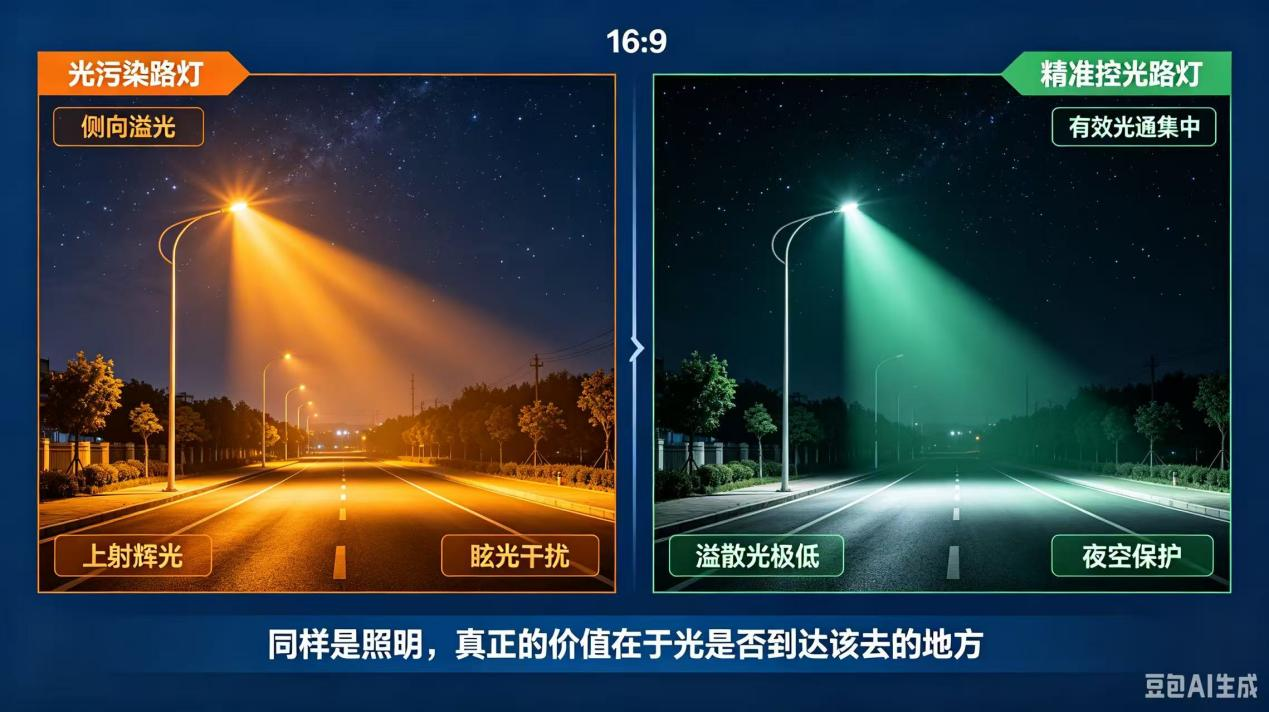
What drives light pollution? It is not low light‑source efficacy requiring more fixtures; on the contrary, it is precisely the misguided belief that high efficacy equates to energy efficiency, coupled with a failure to differentiate between actual scene requirements and an obsessive pursuit of ever‑higher efficacy and increased lumen output, resulting in widespread light spillage. For example, road lighting often prioritizes excessively high‑efficacy fixtures without matching them with precise photometric designs, causing large amounts of light to spill beyond roadway boundaries and illuminate the sky and surrounding buildings; façade lighting frequently employs high‑power floodlights in pursuit of “brightening effects,” with beams shooting straight into the sky or invading residential windows; and advertising signs featuring high‑brightness LED displays and light boxes remain lit throughout the night, creating persistent light curtains along city skylines.
The underlying logic of this “high‑efficacy worship” is: the higher the efficacy, the brighter the light at the same power level; the brighter, the better; the brighter, the more “energy‑efficient.” Within this chain of reasoning, energy efficiency becomes distorted into “stacking brightness,” quality is reduced to “parameter‑chasing,” and light pollution emerges as an inevitable consequence.
When the direction is wrong, no matter how fast you run, you’re still heading south. Celebrating high efficacy and valuing extreme brightness are, in fact, the technical roots of escalating light pollution.
VII. Root‑Cause Solutions: From “Creating Light Pollution” to “Controlling Light Limits”
Once the primary causes of light pollution are identified, viable solutions naturally follow.
Current mainstream approaches to light‑pollution prevention focus primarily on symptomatic remedies: regulating installation angles to reduce direct upward light emissions, employing timer‑controlled systems to switch off certain fixtures late at night, and adopting dimming technologies to adjust brightness based on pedestrian and vehicular traffic. While these measures are certainly effective, they amount to “mending the fence after the sheep are lost”—by the time constraints are imposed, the light has already been emitted.
The true solution lies in evaluating lighting quality through the lens of “adaptive efficacy,” establishing a closed-loop logic of “emitting more light, emitting better light, and using light wisely” right at the source.
“Emitting more light” means ensuring that light reaches its intended target area with minimal waste; “emitting better light” involves selecting appropriate spectra, color temperatures, and color rendering indices, rather than blindly chasing lumen numbers; and “using light wisely” entails dynamically adjusting output according to scene dynamics, achieving “lighting on demand” instead of “full‑scale supply.” Together, these three elements form a complete logical cycle: first clarify “how much light is needed,” then decide “how much to emit,” and finally control “how to use that light.” Efficacy levels are merely intermediate technical parameters—not starting points, let alone endpoints.
Light efficacy and light pollution are two sides of the same coin. High efficacy itself is not the problem; the issue lies in ignoring scene‑specific needs under the dogma of “efficacy above all else.” By appropriately adapting efficacy to scene requirements—allowing efficacy to serve the scene rather than dominate it—light pollution can be controlled at its source. Through scientifically informed policies that leverage strengths while mitigating weaknesses, we can ensure that light truly serves our purposes—this is the fundamental path to effectively managing light limits.
Preventing light pollution is not about “surrounding and blocking” light after it has been emitted, but rather about “precise planning” before it leaves the source. Moving from “creating light” to “using light wisely” represents a qualitative leap—from “device‑centric thinking” to “system‑centric thinking.”
VIII. Case Studies: How High Efficacy Can Backfire, Leading to Increased Energy Consumption and Light Pollution
Theoretical principles must be tested in practice. The following cases vividly illustrate how “efficacy‑only thinking” can result in higher actual energy consumption and worsening light pollution.
Case One: Improper Photometric Design in Road Lighting. A certain city’s side street opted for 200 lm/W high‑efficacy LED fixtures. Because the photometric curve was not optimized for the narrow roadway, over 50% of the luminous flux spilled beyond the road boundary, flooding the sky and illuminating nearby residents’ windows. Local residents complained that “nights felt like days.” In contrast, the same stretch of road equipped with 150 lm/W fixtures paired with precise photometric designs saw effective luminous flux utilization rise from 0.5 to 0.8, delivering superior energy‑saving results while eliminating all light‑related complaints. High efficacy failed to deliver energy savings and instead exacerbated light pollution.
Case Two: The “Brightening Race” on Building Facades. A landmark building in a major city used 200 lm/W LED floodlights for facade illumination, aiming for a “stunning effect” far exceeding standard illuminance levels. Excessive light shot straight into the sky, forming a conspicuous light column that earned the building designation as a “key source of light pollution” by the local observatory. After corrective measures—including switching to 150 lm/W fixtures tailored to the scene and optimizing projection angles and timing—the illuminance was brought down to reasonable levels, energy consumption fell by 35%, and the light column disappeared. High efficacy, applied in the wrong context, became an amplifier of light pollution.
Case Three: Early Automotive Headlamps. Regulations mandated a cutoff line to prevent glare, setting the goal as “maximizing brightness within the legally defined limit.” Despite these anti‑glare constraints, the beam pattern remained fixed—low on the left, high on the right—unable to adapt to changing scene conditions. Essentially, engineers were still competing on a “fixed track” to see who could shine brightest. Unable to precisely control each individual beam, they resorted to increasing total luminous flux to compensate for uneven distribution (e.g., dark areas at the edges). Since the introduction of adaptive efficacy theory, the new logic is: total brightness is sufficient; the key lies in directing light precisely where it’s most needed (e.g., inside bends or at pedestrians’ feet), while completely darkening areas that aren’t required (such as opposite‑side windows).
Thus, the greatness of adaptive efficacy does not lie in rejecting “brightness,” but in ending “material‑based lighting” and ushering in a new era of “algorithm‑driven lighting.”
These three cases powerfully demonstrate that high efficacy neither guarantees energy savings nor prevents light pollution; in fact, excessive illumination and improper photometric design can turn it into a catalyst for light pollution. Both energy efficiency and light‑pollution prevention are fundamentally interconnected—they both require starting from “scene‑specific adaptation,” rather than “parameter worship.”
IX. Conclusion: Shifting from “Device‑Centric Thinking” to “System‑Centric Thinking”
Based on the foregoing analysis and supporting case studies, we can draw the following clear conclusions:
First, high luminous efficacy is a sufficient but not necessary condition for energy efficiency. Deriving product‑level energy savings directly from high efficacy constitutes a causal error.
Second, LED’s energy‑saving advantage stems from its high luminous utilization factor enabled by directional emission, not from the efficacy number itself. Incorrect attribution risks derailing technological pathways.
Third, luminous efficacy is a dynamic variable dependent on the scene; laboratory‑reported values cannot capture the complexity of real‑world conditions. Scene serves as the independent variable, efficacy as the dependent one.
Fourth, the ultimate benchmark for assessing lighting energy efficiency must be the minimum power density required to meet scene‑specific quality standards. Normalized power density (NPD) should replace light‑source efficacy (lm/W) as the core evaluation metric.
Fifth, the true culprit behind light pollution is not low efficacy, but the blind pursuit of extreme brightness and illuminance under the “efficacy‑only” paradigm, coupled with a lack of scene‑specific adaptation. When the direction is wrong, the more “efficient” you become, the more “polluted” you end up.
Sixth, the fundamental solution to light‑pollution prevention lies in evaluating lighting quality through the lens of “adaptive efficacy,” establishing a closed‑loop logic of “emitting more light, emitting better light, and using light wisely,” ensuring that efficacy serves the scene rather than dominates it, thereby controlling light limits at the source.
The true essence of lighting energy efficiency and light‑pollution prevention resides not in endlessly “opening the tap” (piling up lumens), but in precisely “turning off the tap” (allocating resources on demand). High efficacy is a “good medicine,” not a “cure”—it marks a starting point, but falls far short of the endpoint. The real remedy lies in a systematic approach combining high‑efficacy LED light sources, precise photometric control, intelligent dimming, and scene‑specific adaptation.
Industry attention should shift from pursuing extreme parameters for individual devices to striving for comprehensive energy‑use efficiency and optimal light‑environment quality across entire lighting systems when achieving targeted outcomes in specific scenarios—a transformation from “local optimality” to “global optimality,” from “device‑centric thinking” to “system‑centric thinking,” and from “creating light” to “using light wisely.”
Efficacy determines “how much light can be produced,” power density dictates “how much electricity is consumed,” and scene‑specific adaptation decides “how well the light is used.” When assessing energy efficiency, focus on consumption rather than production; when addressing light pollution, prioritize effective light rather than sheer luminous output. The minimum power density and precise photometric design required to meet scene‑specific standards represent the only truth in both lighting energy efficiency and light‑pollution prevention.
References
[1] Yuan Qi. “The Impact of Transitioning from Product‑Level Efficacy to Scene‑Level Efficacy on the Future of Lighting” [EB/OL]. China Lighting Network, 2025.
[2] From “Product‑Level Efficacy” to “Scene‑Level Efficacy”: How Lighting Energy Efficiency Is Evolving [EB/OL]. Guangzhou International Lighting Exhibition, 2025.
[3] Scene‑Level Efficacy! The New Direction of the Lighting Industry Is Becoming Increasingly Clear [EB/OL]. Guangzhou International Lighting Exhibition, 2025.
[4] Yuan Qi of Yiyong Optoelectronics. Cognitive Biases in Road Lighting Energy Efficiency and the Practical Value of the “Adaptive Efficacy” Theory [EB/OL]. China Lighting Network, 2026.
[5] Yuan Qi. “Efficacy Is a Variable Dependent on the Scene,” Paving the Way for a New Paradigm in Lighting Development [EB/OL]. China Lighting Network, 2025.
[6] From the Proposal of the “Adaptive Efficacy Concept” to the Legislative Framework for Light‑Pollution Prevention: Lessons for the Industry [EB/OL]. China Lighting Network, 2026.
[7] National Standard of the People’s Republic of China. “Building Lighting Design Standards” GB50034‑2013 [S]. Beijing: China Architecture Publishing House, 2013.
[8] Lighting Power Density [EB/OL]. Baidu Baike.
[9] Criteria for Energy‑Efficient Lighting in Buildings [J]. ScienceDirect, 2009.
[10] The Interplay Between Parameters of Light Pollution and Energy Efficiency in Outdoor Amenity Lighting [J]. Energies, 2023, Vol. 16, No. 8: p. 3530.
[11] Research on Strategies for Balancing Light Pollution and Lighting Energy Efficiency [J]. Lighting Engineering Journal, 2024.
Author: Yuan Qi, Shanghai Yiyong Optoelectronics Technology Co., Ltd.