
Profits down 19.6%, with an 8% increase in loss-making companies: Economic Performance Analysis of the Lighting Industry for the First Half of 2026
Since the beginning of this year, the lighting industry has faced significant pressure due to external factors such as weak overseas demand and accelerated adjustments in global supply chains, compounded by domestic challenges including a continued downturn in the real estate sector and subdued consumer spending. Overall, during the first half of the year, China’s lighting industry exhibited characteristics such as production under strain, declining profitability, sluggish foreign trade, and stabilizing market scale. This article provides a brief overview of the industry’s economic performance from January to June 2026.
I. Production Under Pressure, Output Generally Stable
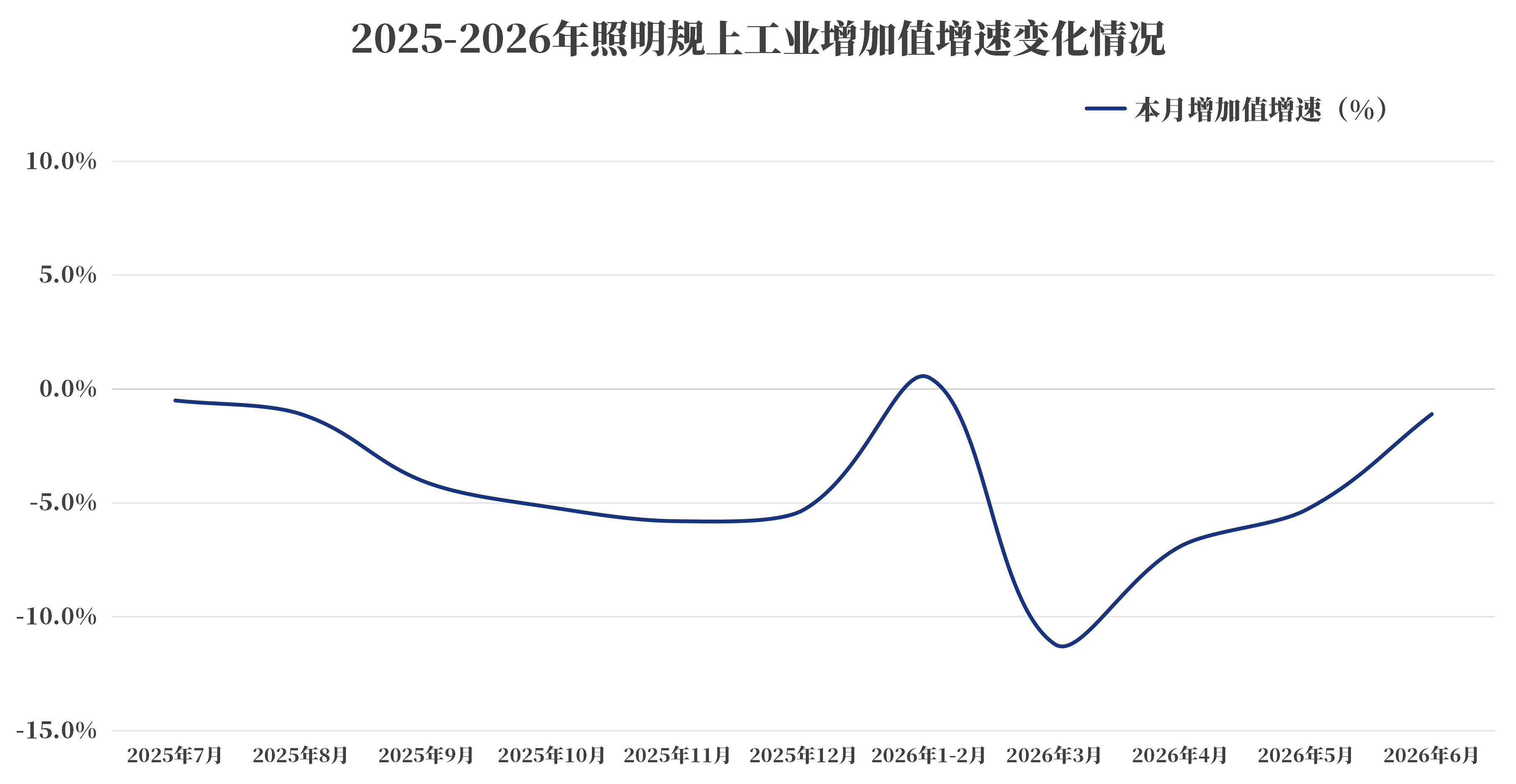
In the first half of the year, the overall pace of economic activity in China’s lighting industry slowed, contrasting sharply with the robust performance of the broader industrial sector. According to estimates, the cumulative growth rate of industrial value added for large-scale lighting enterprises in the first half of 2026 was -4.2%, down approximately 5 percentage points compared to the same period last year—9.6 percentage points lower than the national average for large-scale industrial enterprises. On a month-by-month basis, although the growth rate of industrial value added remained in negative territory, the decline has been steadily narrowing, indicating that while production activity has generally decelerated, companies’ production enthusiasm is gradually recovering.
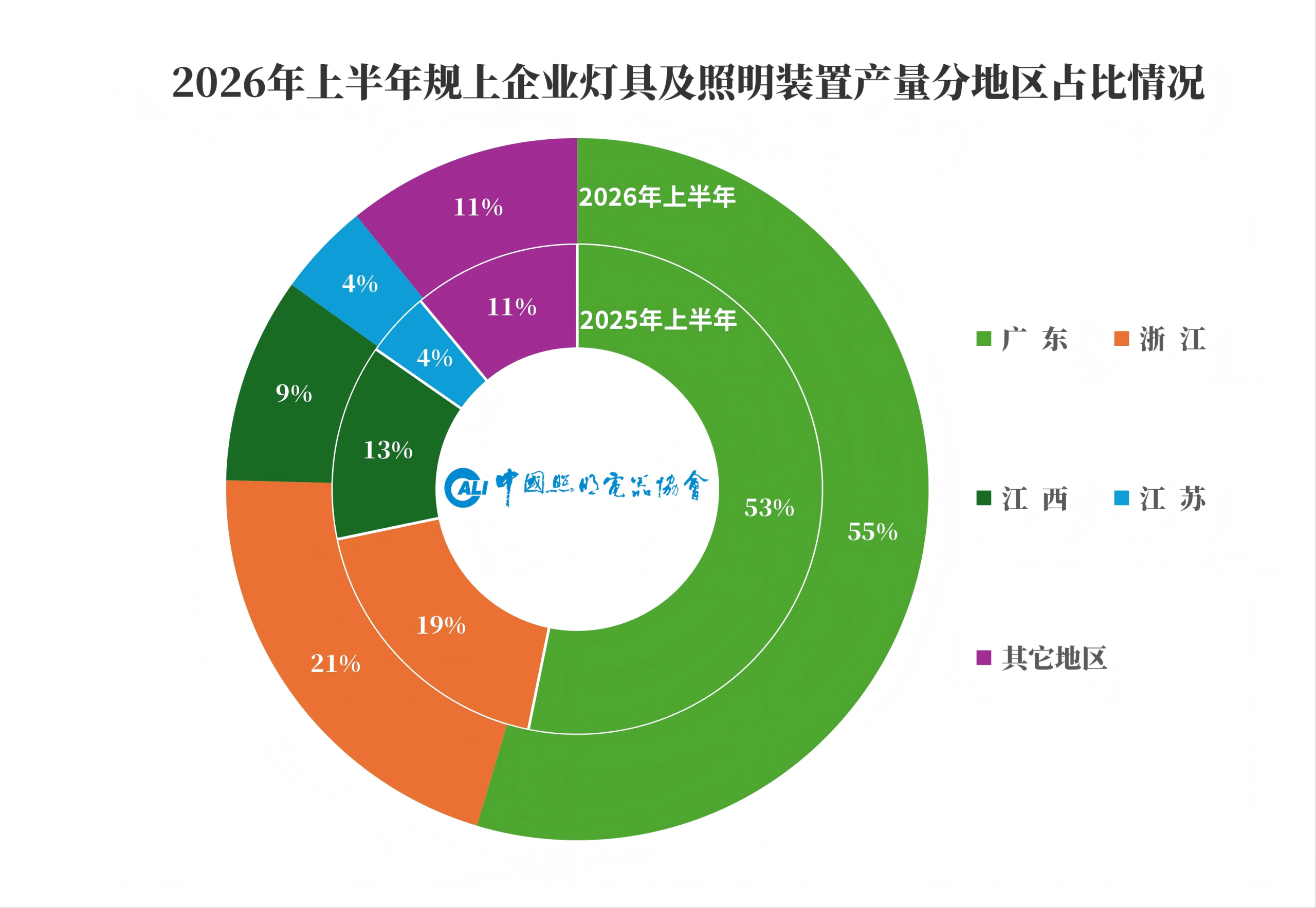
Looking at output data from large-scale enterprises, lamp and lighting fixture production showed steady growth, with cumulative year-on-year increases exceeding 4%. This growth was supported by major producing regions such as Guangdong and Zhejiang. Meanwhile, electric light source output remained roughly flat compared to last year, with a year-on-year increase of less than 2%.
II. Market Scale Stabilizing, Corporate Profits Declining
According to incomplete statistics, the number of large-scale lighting enterprises remained roughly unchanged in the first half of 2026 compared to the previous year; however, the quality of growth remains concerning. Overall, companies have maintained stable market scale primarily by sacrificing profit margins.
During the first half of the year, total operating revenue for large-scale enterprises increased by approximately 2% year-on-year, lagging behind the national industrial average by 4 percentage points. Cumulative profits for large-scale lighting enterprises declined by 19.6% year-on-year, about 30 percentage points below the national industrial average. The operating profit margin for large-scale lighting enterprises stood at around 3%, down 0.5 percentage points from the same period last year and approximately 3 percentage points lower than the national industrial average. In terms of losses, the number of loss-making enterprises rose by more than 8% year-on-year, while total losses increased by nearly 20% year-on-year.
Surveys conducted by the association among selected enterprises indicate that declining profitability stems from multiple overlapping factors:
Firstly, insufficient effective demand and a generally sluggish domestic market. Most domestic retailers reported sales declines of about 50% year-on-year in the first half, directly weighing on corporate revenues.
Secondly, mounting cost pressures. Prices for commodities such as copper and silver, along with electronic components and plastic parts, have risen, while soaring transportation costs have pushed overall manufacturing expenses up by 5%–15% across the board.
Thirdly, a mismatch between prices and costs. Intense price competition downstream has driven terminal product prices downward rather than upward, preventing manufacturers from effectively passing rising costs onto consumers. Gross margins have approached the brink of loss, severely squeezing profit margins.
Fourthly, exchange rate volatility. The sharp appreciation of the RMB against the U.S. dollar has directly impacted the current-period profits of export-oriented enterprises. These factors intertwine, leading to an overall decline in industry profitability.
III. Foreign Trade: “High Early, Low Later,” with Quarter-on-Quarter Recovery
In the first half of the year, China’s lighting industry’s foreign trade exports followed a pattern of “high early, low later, with gradual quarter-on-quarter recovery.”
First, the overall export base has bottomed out and stabilized, with month-on-month improvements in the second quarter. According to General Administration of Customs data, China’s lighting product exports totaled approximately US$24.1 billion from January to June, down about 7% year-on-year. Although still on a downward trajectory, the trend has taken on an irregular “N” shape: the first quarter saw significant fluctuations due to the timing of the Spring Festival and adjustments in overseas demand patterns, while the second quarter gradually stabilized. Thanks to initial success in expanding into emerging markets and the benefits of policies supporting stable foreign trade, second-quarter exports grew by 12% quarter-on-quarter compared to the first quarter, with monthly declines continuing to narrow. In June alone, exports reached approximately US$4.2 billion, down only 2% year-on-year, a reduction of about 7 percentage points compared to May, clearly signaling a recovery.
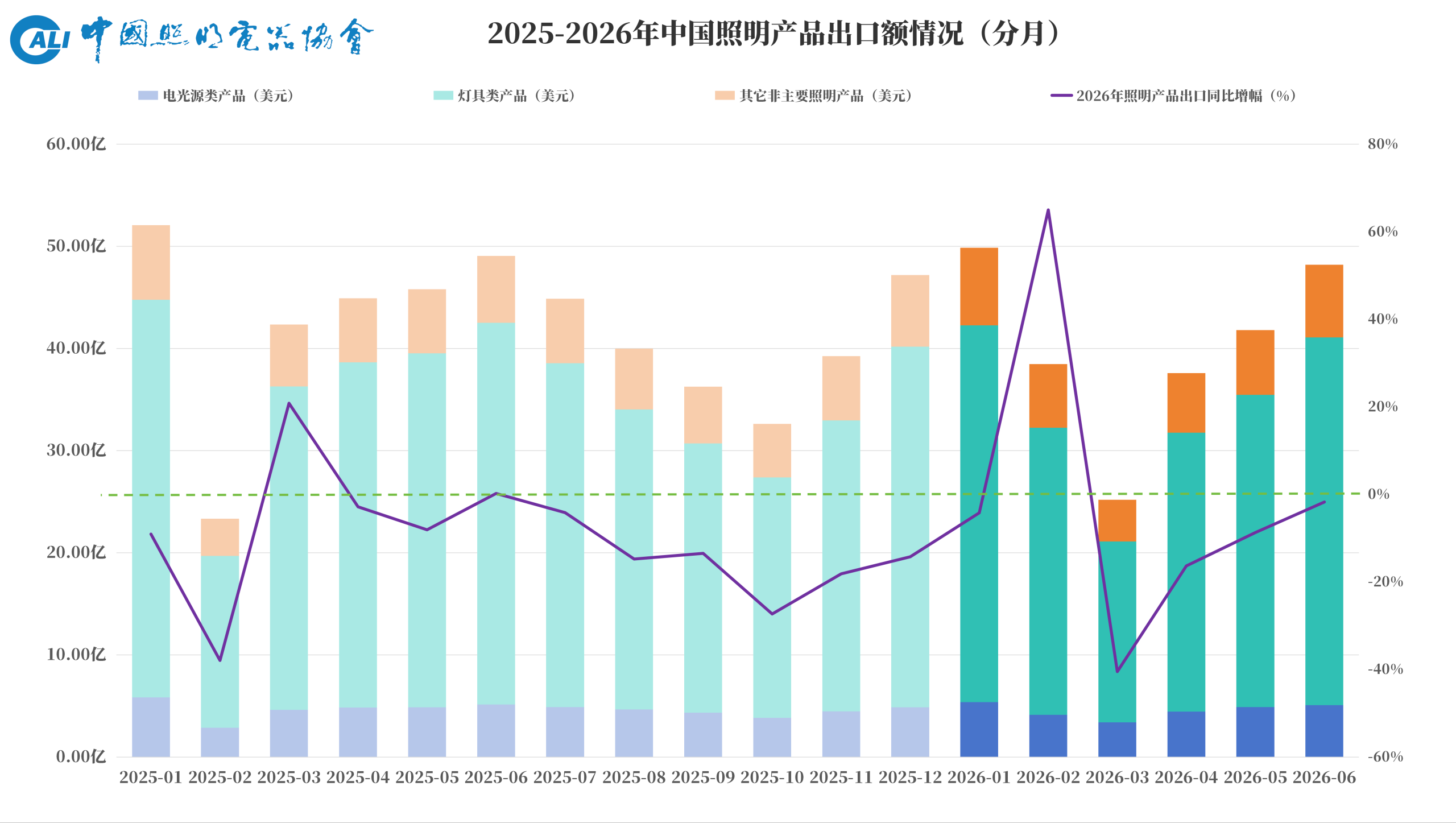
Second, product structure is accelerating differentiation, with new‑energy products bucking the trend. Lamp product exports totaled approximately US$17.7 billion, down 9% year-on-year, accounting for 74% of total exports and remaining the core export segment. Electric light source exports show a “falling volume, rising value” trend: total export volume reached about 14.2 billion units, up 13% year-on-year; export value stood at approximately US$2.7 billion, down 5% year-on-year. LED electric light source exports reached about 9.4 billion units, up roughly 27% year-on-year, representing 66% of all electric light source exports—a 7-percentage-point increase over the same period last year. Among these, LED module exports totaled about 6.1 billion units, up 46% year-on-year, but with an average export price of just US$0.03 per unit, down 52% year-on-year. Export markets are heavily concentrated in five countries—India, Pakistan, Vietnam, Egypt, and Cambodia—accounting for 64% of total exports.
Photovoltaic LED lighting products are the only category within lamps to achieve simultaneous growth in both export value and average export price, up 5% and 12% year-on-year, respectively. Markets such as the United States, Germany, and France have increased imports due to energy policies, while off-grid markets like Nigeria and the Philippines are also boosting purchases. Automotive lighting exports reached approximately US$2.4 billion, up 6% year-on-year, with average export prices rising by 8% year-on-year, achieving both volume and price growth. Traditional electric light source exports fell to about 600 million units, down 21% year-on-year, while traditional electric light source export value declined by 9% year-on-year, reflecting a rapid exit amid the global trend toward LED substitution. Overall, photovoltaic and automotive lighting—new‑energy products—are growing against the trend, while traditional light sources and general-purpose lamps remain under pressure, signaling the industry’s accelerated shift from “scale‑driven globalization” to “value‑driven globalization.”
Third, traditional markets face pressure, while emerging markets grow. Affected by insufficient overseas demand, tariff policy disruptions, global supply chain adjustments, and logistical bottlenecks, China’s lighting exports to traditional key markets are under strain.
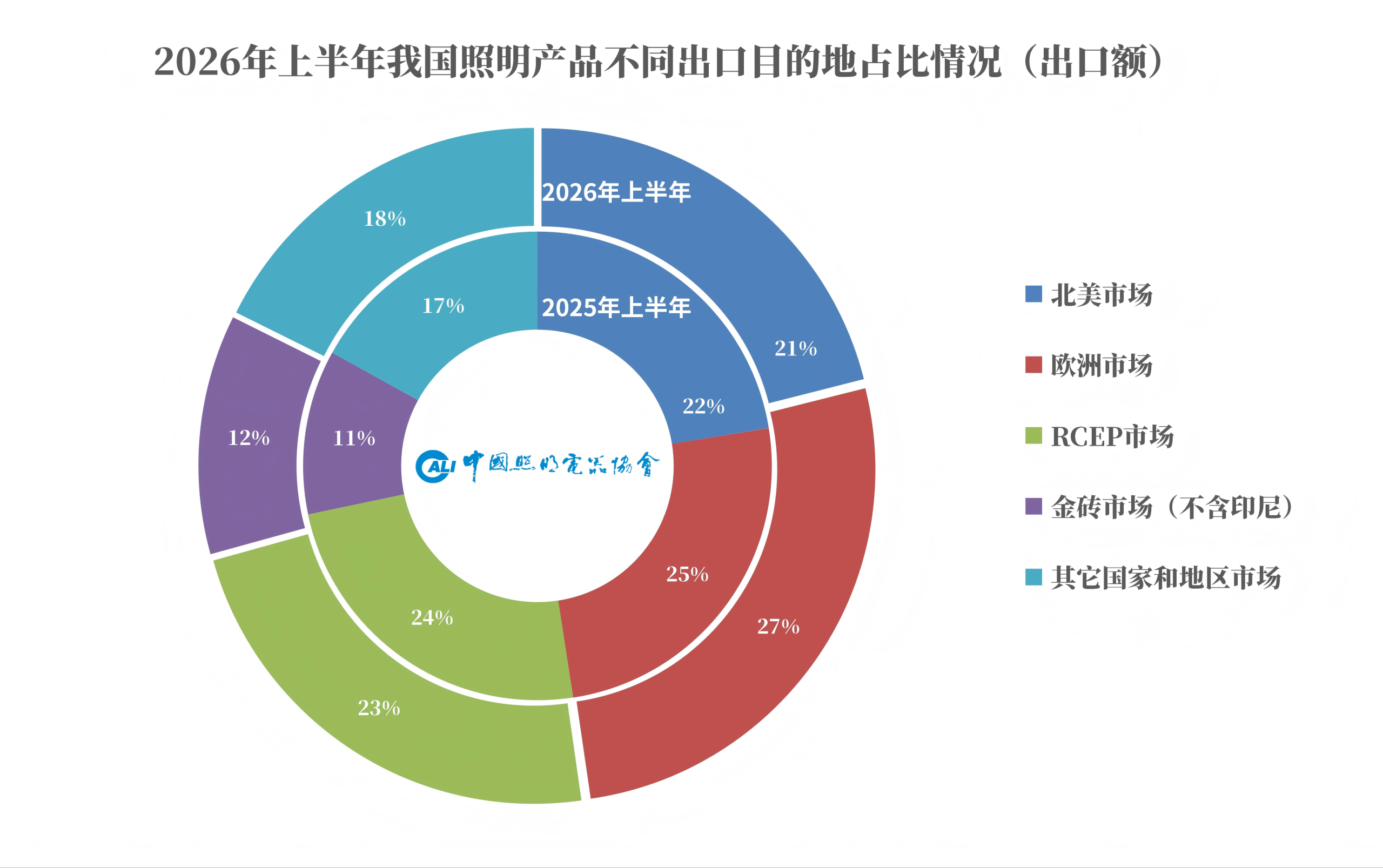
The U.S. market exported US$4.5 billion worth of lighting products, down 13% year-on-year; its share of total exports dropped from about 27% in 2021 to 19% today.
The European market exported approximately US$6.4 billion, down slightly by 2% year-on-year; its share remained at 27%, up 2 percentage points from the previous year. Within Europe, demand diverged significantly: driven by photovoltaic and energy‑efficiency retrofit needs, the Netherlands and Spain saw export growth of 23% and 17% respectively, while France grew by 4%.
Emerging markets demonstrated strong vitality. Africa exported approximately US$1.8 billion, up 6% year-on-year; major markets such as Nigeria, South Africa, and Egypt maintained growth, while Côte d’Ivoire posted a remarkable 33% increase, and Morocco grew by 9%. China’s comprehensive zero‑tariff policy toward African diplomatic partners further strengthened institutional foundations, elevating the strategic value of African markets.
Russia and India each recorded counter‑trend growth of 12% and 13% respectively, becoming the only positive‑growth markets among the top ten.
Exports to Belt and Road Initiative partner countries totaled approximately US$11.8 billion, down 7% year-on-year, yet still accounting for 49% of China’s total lighting exports, underscoring deep market roots.
With traditional European and American markets shrinking and emerging markets—especially Africa, Russia, and India—showing expansion, the strategy of diversifying foreign trade markets is beginning to bear fruit.
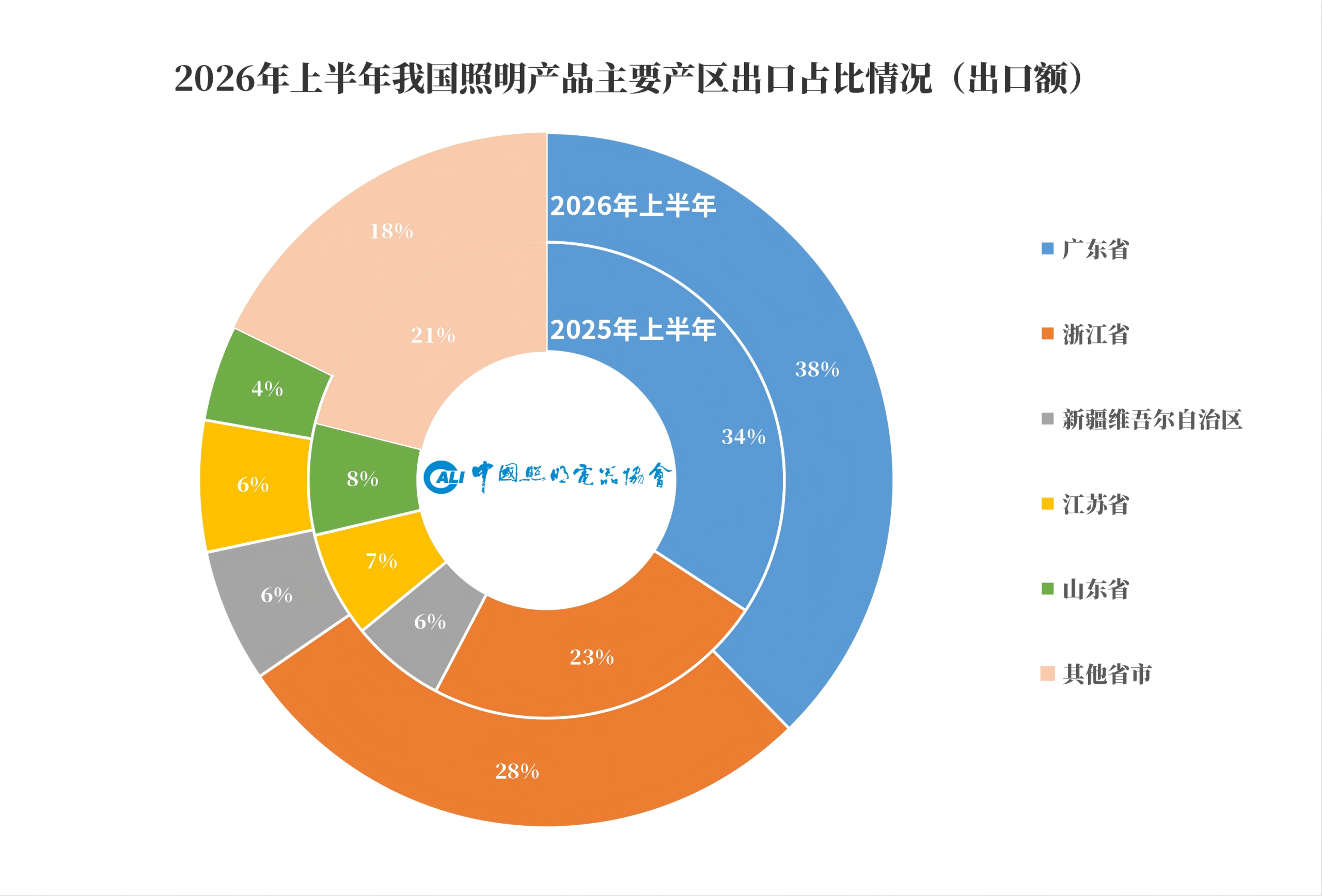
Fourth, the “two superpowers” export region configuration remains solid, with Guangdong and Zhejiang showing steady growth. Against the backdrop of declining overall lighting product exports, Guangdong and Zhejiang—the two traditional powerhouse provinces—have seen their national shares stabilize and even rise. Guangdong’s lighting product exports reached approximately US$9 billion, up 2% year-on-year; accounting for about 38% of national exports and ranking first nationwide. Zhejiang’s exports totaled approximately US$6.6 billion, up 10% year-on-year; representing 28% of national exports and ranking second. This reflects both the well‑developed industrial clusters and resilient supply chains in these regions, as well as structural adjustment pressures faced by some traditional producing areas experiencing order outflows.
Export enterprises face pressing challenges: raw material prices have risen across the board, ocean freight booking fees have surged, and carbon taxes add further burdens. Coupled with intensifying industry “involution”—where companies compete aggressively for cash flow by slashing prices—export price indices continue to fall, leading to frequent occurrences of “revenue growth without profit growth” or even “losses despite increased volume.” New EU ErP regulations and U.S. reviews of Section 301 tariffs on China have dramatically raised compliance costs, while Southeast Asian countries’ cost advantages in low‑end products have prompted order shifts. In recent years, some companies have exploited third‑country rules of origin to circumvent tariff barriers, establishing factories in Southeast Asia and Mexico, thereby diverting orders away from China.
IV. Domestic Market Demand Insufficient, Consumption Remains Sluggish
On the domestic front, the ongoing decline in real estate investment and the shift of infrastructure spending from positive to negative have left the domestic lighting market unable to recover. The real estate sector’s continued adjustments directly weigh on demand for residential lighting, commercial lighting, and related categories. According to Ministry of Commerce data, total retail sales of consumer goods and services grew by 2.7% in the first half of the year, but lighting products, being non‑essential consumer goods, exhibit high demand elasticity, resulting in a recovery pace noticeably slower than the overall consumption trend. Preliminary findings suggest that the domestic market performed poorly overall, with most retailers reporting sales declines of about 50% year-on-year, and only a handful of businesses maintaining decent business levels. Even large‑scale projects—such as municipal street lighting—face severe payment delays, leaving some street lighting firms with tight cash flow.
Beyond these macro trends, weakening consumer expectations and a shift toward more pragmatic consumption habits are reshaping the general lighting market, giving rise to the following characteristics:
First, consumers increasingly prioritize cost‑effectiveness, with reduced sensitivity to brand premiums and greater emphasis on practical utility, driving demand for affordable, high‑quality products.
Second, lighting products featuring new Chinese‑style designs are gaining popularity, with lamp designs inspired by Song‑dynasty aesthetics winning favor for their cultural depth and visual appeal.
Third, the concept of “health‑focused lighting” is gaining traction, with full‑spectrum ceiling lights emphasizing health and circadian rhythm functions attracting growing consumer interest.
Fourth, smart features have become a basic requirement, with intelligent control now standard equipment for most lighting fixtures.
In the second half of 2026, China’s lighting industry will continue its deep adjustment phase, accelerating the transition between old and new growth drivers through “compliance reshuffling” and “structural restructuring.” Overall operations will follow three core trends:
First, domestic market regulation will be comprehensively tightened, speeding up the standardization of competitive order. As efforts to build a unified national market advance, the logic of domestic market competition is rapidly evolving. This year, the State Administration for Market Regulation will reintroduce several products previously subject to self‑declaration back into mandatory third‑party 3C certification, while the State Administration for Market Regulation will strengthen oversight of online lighting sales and implement new national standards. Compliance costs have thus become a critical threshold for accelerating the elimination of low‑end production capacity. Currently, the pain point of excessively low upstream component prices—making it difficult for downstream finished products to pass EMC testing—is forcing companies to reshape their supply chains. In the second half of the year, enterprises lacking core technologies, engaging in non‑compliant production, evading taxes, or failing to comply with social security regulations will accelerate their exit, potentially impacting the market in the short term. However, from a long-term perspective, this is an inevitable growing pain on the path toward high‑quality development. The industry will move away from chaotic “price wars” toward a focus on “quality, compliance, and added value,” with market concentration expected to rise.
Second, traditional foreign trade markets will remain under pressure, while efforts to develop emerging markets will accelerate. Affected by geopolitical tensions and trade barriers, traditional European and American markets continue to weaken, while Russia, India, and Belt and Road partner countries have become the core engines of stable foreign trade. Russian infrastructure projects and Indian urbanization have unleashed additional demand, but these markets carry risks such as price sensitivity, opaque certification processes, and lengthy payment cycles—for example, India mandated implementation of the new BIS safety standard for LED lamps in August. In the second half of the year, companies venturing overseas must abandon simplistic replication of domestic low‑price competition strategies abroad, instead adopting localized operations and differentiated product positioning. By establishing local service networks and conducting customized R&D tailored to regional power grids, they can circumvent trade barriers and secure reasonable premium pricing.
Third, cost volatility will become the norm, with profit recovery relying on “structural innovation.” In the second half of the year, raw material and component prices may continue to rise, while supply chains characterized by “high costs and long lead times” will keep squeezing corporate profit margins, making the red‑sea competition in general lighting hard to reverse. The core driver of industry profit recovery will depend heavily on structural innovation: photovoltaic energy‑storage lighting offering “dual price and value growth” in weak grid areas across Asia, Africa, and Latin America; high‑value premium pricing for whole‑home smart and health‑rhythm lighting; and specialized lighting solutions for plants, explosion‑proof applications, and other niche markets—all of which will serve as key engines propelling industry profitability toward stabilization and recovery.
Facing this new landscape, the China Lighting Appliance Association will continue to play its role as a bridge and liaison. In the second half of the year, the association will organize flagship events such as the China Lighting Industry Conference, invite enterprises to participate in renowned international and domestic exhibitions—including the Ancient Town Lighting Expo and the Russian Lighting Exhibition—and formulate and release relevant national and group standards, actively guiding the industry toward healthy development.
In the future, China’s lighting industry will fully enter a stage of high‑quality, value‑based competition. Only by firmly upholding compliance, deepening technological innovation, and precisely targeting overseas markets can enterprises gain a competitive edge amidst ongoing market adjustments.
This article is sourced from the China Lighting Appliance Association, authored by the China Lighting Association.
China Light
The official website of the China Association of Lighting Industry and a full-media platform for the lighting sector. We provide authoritative and timely lighting information while striving to be a growth partner for businesses. From brand promotion and channel expansion to consulting, talent training and participation in standards development, we provide comprehensive professional services to help businesses improve quality and efficiency and jointly advance the high-quality development of the lighting industry.
Business Contacts
仇纯 (Ms.): 158 6155 3579
顾君 (Mr.): 137 7157 5253